
Your Brand Story — Now It's AI's Turn to Tell It
A learn article on how answer engines reshape brand storytelling, outlining three steps: monitor how AI describes your brand, create content AI can cite, and track AI visibility, with HubSpot's AEO tool discussed as an example.
A while back, a friend of mine who runs a brand came to me to vent.
He said he'd recently used AI to look up his own company, and on a whim asked: "What's your edge over competitors?" The AI fired back an answer in seconds. It sounded completely plausible. Except half the information was from a version of the company three years old, and the other half came from a single forum post — with a key spec that was flat-out wrong.
He said: "I've spent ten-plus years telling my brand's story, word by word. How come it's now AI's turn to tell it for me?"
I shot back: "So have you ever managed how AI tells it?"
He froze.
Today, let's get to the bottom of it once and for all.
The Microphone Has Changed Hands
What is brand marketing, anyway?
Strip it down, and it's controlling the narrative: making sure the story you want to tell becomes the story the market actually hears. You write the product docs, you run the launch events, you sign off on every line of ad copy. The microphone is in your hands.
But that's changed now.
More and more buyers don't browse web pages before they buy — they just ask AI. And so a new thing has appeared, called an "answer engine." It doesn't hand you a page of links. It hands you an answer.
So where does that answer come from?
The engine combs the entire web, gathers up everything other people have written about your brand — reviews, comparison pages, forum threads, third-party coverage — and stitches it all together into a portrait of "you."
Notice: most of that material wasn't written by you.
So the story the market hears is often not the story you wanted to tell.
The brand story you've spent decades telling — AI can rewrite it into a different version in a single sentence.
So what do you do?
Here's my read: the brand teams that have gained ground in AI these past two years didn't get there by luck. Every one of them has been seriously managing one thing: how AI describes them.
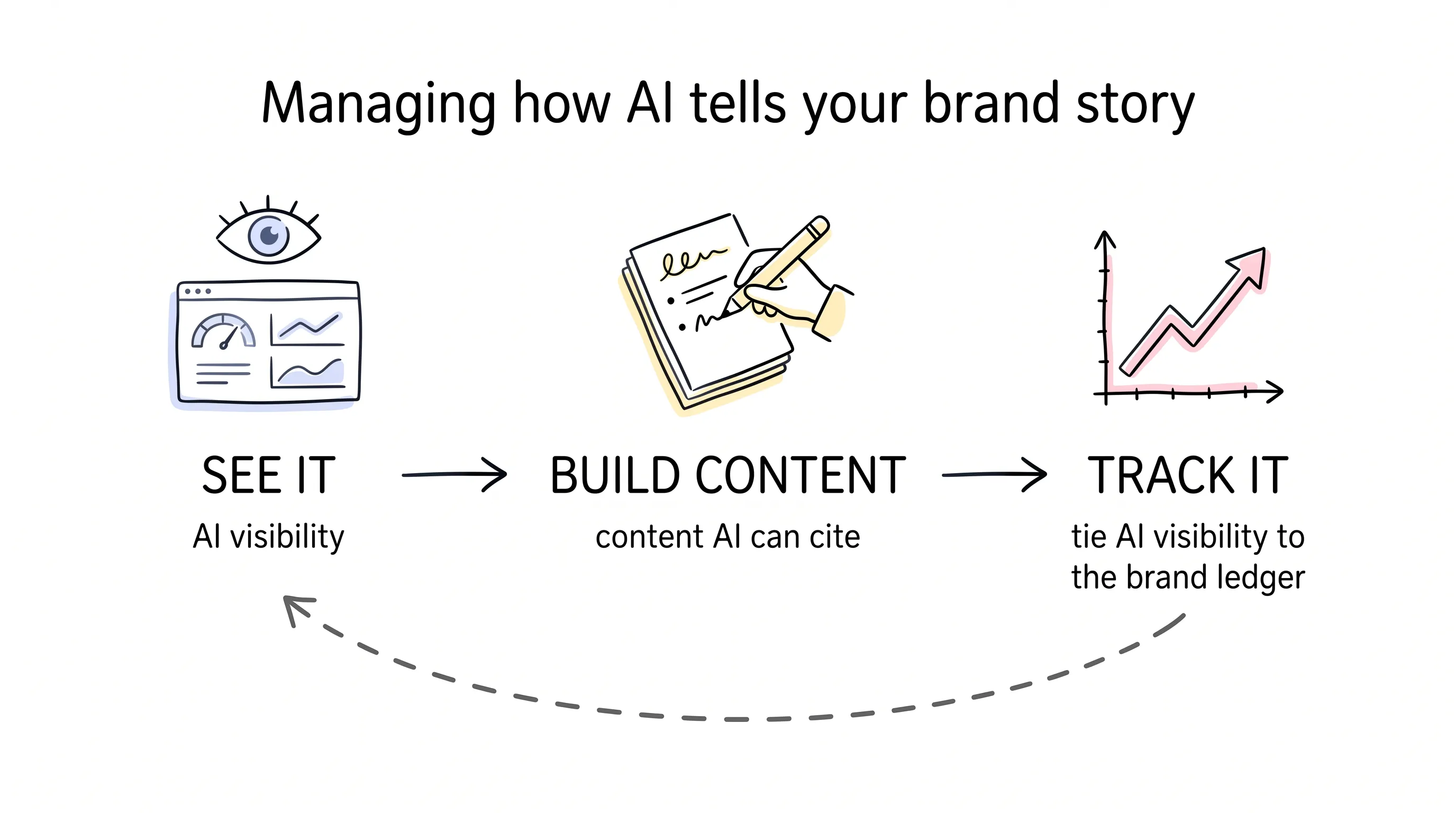
It comes down to three steps: first, see it. Then build the content. Then track the results.
Step One: See It First
Start by figuring out what AI is actually saying about you.
Sounds obvious? That's exactly where a lot of teams get stuck. They never look at how AI describes them — until a customer, a boss, or legal runs into a wrong description out in the real world, and they scramble to fix it.
The problem is, by the time you go to correct it, that wrong version has already shaped how buyers see you. You're a beat too late.
Take HubSpot, which built an AEO tool. AEO — Answer Engine Optimization — is, plainly put, making sure AI gets your brand right when it answers questions. It includes a brand visibility dashboard: how your brand appears across the major answer engines, what your AI visibility score is, how your mention volume stacks up against competitors, and which citation sources are shaping that image. Any claim that doesn't match your positioning jumps out at a glance.
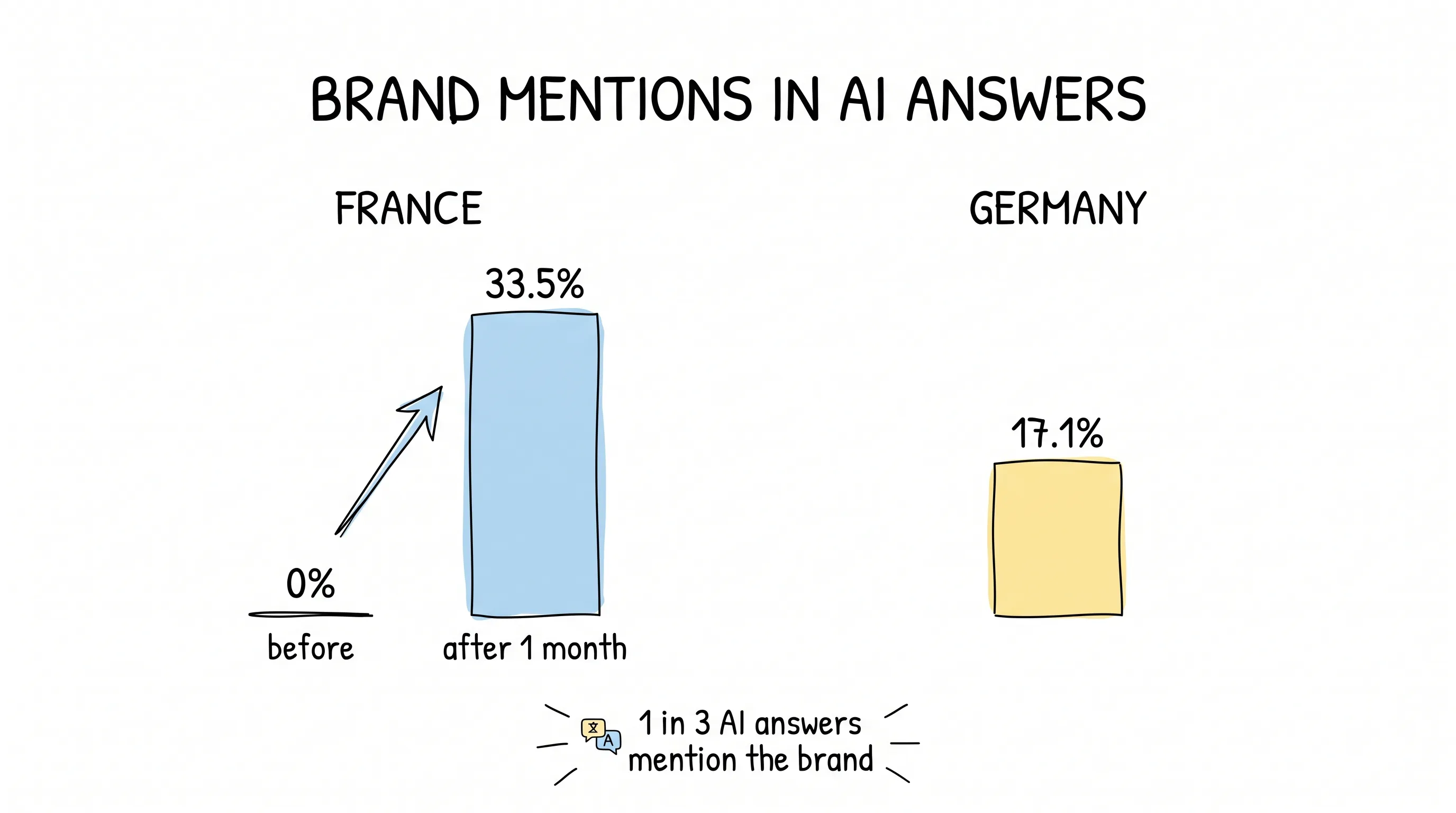
Does it work? HubSpot was its own first test case. Their marketing team measured it: brand mention rate went from 0% to 33.5% in France within a month, and hit 17.1% in Germany.
What does that mean? In France, roughly one in three AI answers mentioned them. A month earlier, it was zero.
Seeing it, though, is just the foundation. What actually determines how AI tells your story is content.
Step Two: Create Content AI Wants to Cite
Answer engines are picky: they only cite content that's authoritative and well-structured.
So what counts as "content AI wants to cite"? Your positioning pages, comparison guides, and industry explainer articles — if they're written clearly and structured properly, they can get picked up by AI and become part of the material it uses to describe your brand.
Here's the trouble: a lot of brand content was written years ago for human readers and for search engines. People read it and liked it; search engines indexed it. But the way it was written was probably never optimized for "getting cited by AI."
The result: the story, after all, is the one you're telling — yet what AI hears is someone else's version.
What's missing in between is an ongoing process of auditing and updating: regularly check your most important content, find out which pieces haven't been cited by AI yet, then rework the structure and fill in the information. HubSpot's AEO tool has a recommendations feature that directly lists which pieces of content are most likely to lift citations and visibility if you change them — you just work through them in priority order.
But even once the content is built, you're not done.
Step Three: Connect AI Visibility Back to the Brand Ledger
How did we used to measure brand investment? Awareness surveys, share of voice in media coverage, branded search volume. All indirect signals, and all slow.
AI visibility is an earlier signal.
When buyers are first building their understanding of an industry and forming their sense of a category, how many times does your brand show up in AI answers — and where does it rank? That's a signal you can capture much earlier in the buyer journey.
HubSpot's AEO tool continuously tracks changes in AI visibility score, citations, and share of voice. And because this data lives alongside Marketing Hub, you can see clearly: after a given marketing push, did your image in AI change — or not?
Brand investment can finally be reconciled with your presence in AI.
Final Thoughts
Back to my friend.
A brand story built over ten-plus years — is it worth protecting inside AI? Of course it is. But you can only protect what you can see.
Monitoring, responding, optimizing — brand teams do this work every day, and none of it is new. All that's changed is the battleground: from the media's pages to AI's answers.
The battleground moved, but the trade is the same. Whoever claims the new ground first keeps their story in their own hands.
And here's wishing you this: in AI's answers, the story told is always the one you wanted to tell.
Continue reading
Related articles

Cross-Border Business: Time to Upgrade Your AI Toolbox
A learn article explaining how AI tools help cross-border e-commerce sellers clear five hurdles: language, regulation, logistics, payments, and fraud. It outlines a five-compartment toolbox, a five-step adoption path, and metrics such as conversion rate and CLV, while cautioning against over-reliance on AI.

AI Is Taking Over the Dirty Work of Social Media Marketing, One Task at a Time
This learn article outlines four social media marketing tasks AI can handle — audience analytics, content drafting and design, ad targeting and creative testing, and spam moderation — and cautions that taste, judgment, and data security remain human responsibilities.

AI Is Already This Good — Why Is Your Social Media Marketing Still Pure Manpower?
An overview of 18 AI tools for social media marketing, organized into six categories covering audience research, content creation, scheduling, comment and DM handling, ad management, and visual production, plus notes on personalization, prediction, and emerging trends.