
Your Brand Is Disappearing from the Answers
An explainer on Answer Engine Optimization (AEO): why brands may be absent from AI-generated answers, how to manually check citations in Google AI Overviews, ChatGPT, and Perplexity, criteria for evaluating AEO tools, and metrics to track.
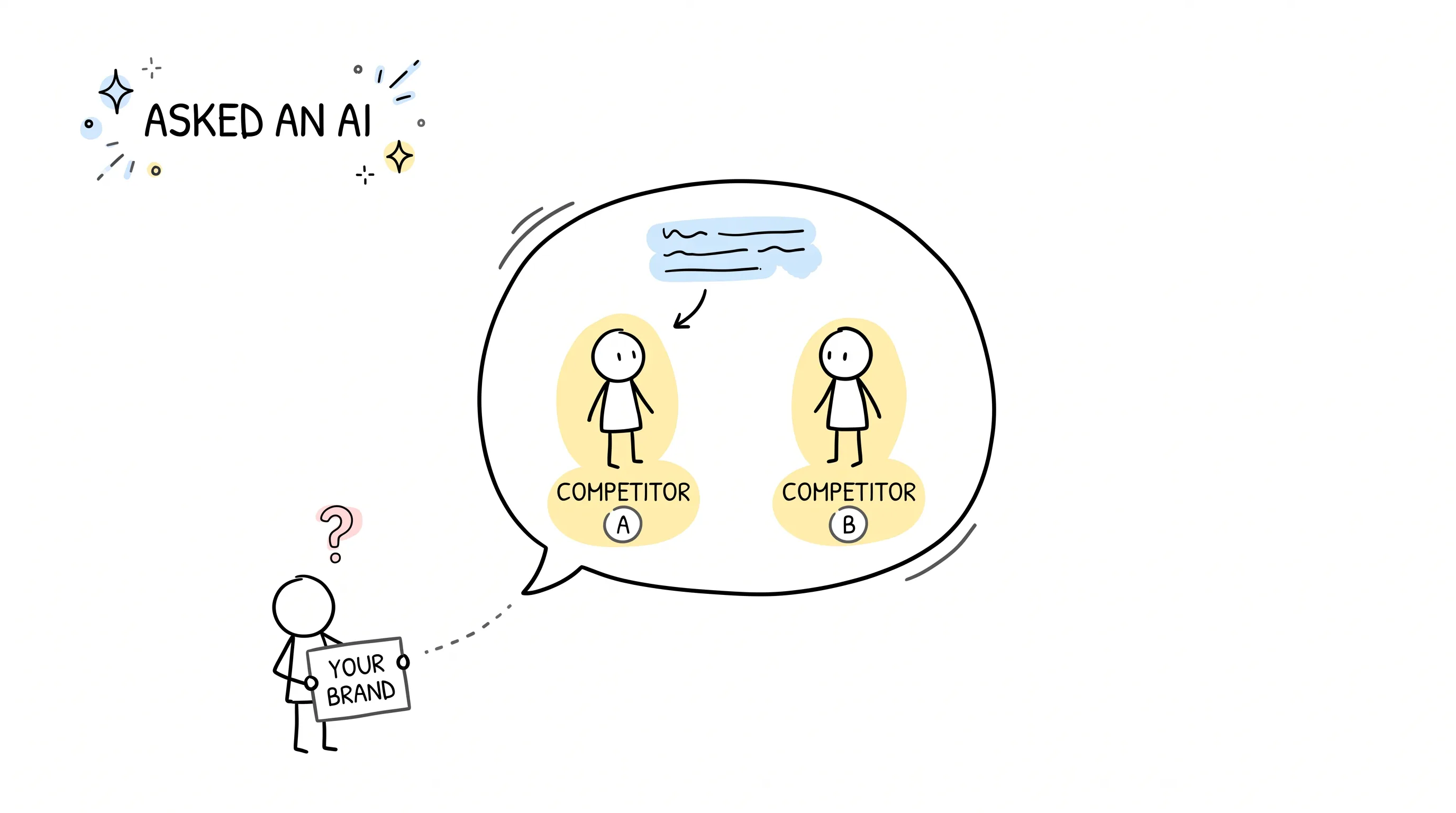
A few days ago, an old friend who runs an enterprise software company took me to dinner. The dishes had barely arrived when he pushed his phone across the table and turned the screen toward me.
He had asked ChatGPT a product-selection question from his industry. The AI delivered a polished, earnest answer recommending three vendors.
Two of the three were his competitors.
He wasn't there.
"Tell me that's not infuriating. I rank number one on Google."
I told him: ranking first doesn't buy you anything anymore.
Here's the analogy. Search used to be like strolling through a shopping mall; ranking first meant you held the prime storefront on the ground floor. Now customers don't browse the mall anymore. They grab the one all-knowing friend in their life and just ask. The friend answers, and they leave.
If the friend never mentions you, the most golden storefront in the world is worthless.
If you're not in the answer, you don't exist.
What Is AEO?
So what is AEO?
AEO stands for Answer Engine Optimization.
Put simply: getting your brand to show up more often, and more accurately, in the answers AI gives.
Tools like ChatGPT, Perplexity, and Gemini are, at their core, answer engines: instead of handing you a page of links, they read the entire web and synthesize one answer. For many questions, the user finishes reading that answer and is done — no click ever happens.
Google understood this best. In May 2024, it brought the pattern into its own results page under the name AI Overviews. Search a question, and an AI summary sits at the very top.
Just like that, the battlefield had a whole new front.
SEO governs rankings; AEO governs answers. The two don't replace each other: the crawl efficiency and authority signals SEO builds are exactly the foundation answer engines draw on when choosing citation sources. SEO done well is what arms AEO.
Lose either half, and you limp.
What Is an AEO Checker?
So how do you know whether you have a speaking part in the answers?
That's where an AEO checker comes in. It keeps answering four questions for you:
- Are ChatGPT, Perplexity, and Gemini mentioning my brand? Citing my pages?
- Am I in Google's AI Overviews?
- Can AI actually read my structured data and entity signals (the people, products, and facts AI models associate with your brand)?
- Is my content easy for AI to lift and cite?
Detection alone isn't enough. A good checker then sets priorities: what to fix first, what to fix later, and why.
Before You Do Anything, Run a Manual Check
Set aside the question of spending money on a tool. A manual pass first is how you get a feel for this.
Step one: check Google AI Overviews.
List the questions you care about most: brand terms, product terms, the informational questions buyers ask all the time. Open an incognito window, search them one by one, and record three things: Did an AI summary trigger? Was my domain among the cited sources? What exactly did it say about me?
One trap here. AI Overviews don't fire every time, and each time they do, the cited sources can change. Don't judge your fate on a single run — open several sessions and test multiple rounds.
And don't count on Search Console. It lumps AI Overview data into the "Web" search type, and you can't split it out. Google only rolled out a dedicated generative AI performance report this past June, and at launch it covered just a subset of sites, reporting impressions but not clicks. It won't save you.
Step two: check ChatGPT and Perplexity.
Every Perplexity answer ships with citations — a full column of sources down the right side. ChatGPT goes online either when a question needs fresh information or when you manually enable web search, and it lists cited sources beneath the answer.
Check two things: Is my domain in the citation list? Is my brand named in the answer text?
Those are two different scores. A citation carries a link; a mention is just the name. Both count as wins — record them separately.
Ask the same question several times, each in a fresh session. Answer engines can serve up different sources on every run, so what you're logging isn't a single snapshot — it's a pattern. Whichever question keeps citing competitors while you sit on the sidelines, that's your assignment list.
So where's the ceiling on manual checking?
With few questions, manual works fine. Once the list grows, it will grind you down. And AI Overviews shift fast — manual sampling can't keep pace with the change.
At this point, it's time for tools.
Six Gates to Clear Before You Buy
Tools on the market run from $50 to several hundred dollars a month. Before you buy, hold each one against six tests:
- Check which engines it covers. In February 2026, ChatGPT reported 900 million weekly active users; by August, Gemini had crossed one billion monthly actives. Those two plus Perplexity are the baseline, and a tool has to track all three.
- Check whether citations and mentions are measured separately. Two different kinds of winning — blended together, you've measured neither.
- Check whether it audits entities and structured data. Half of whether AI can read your pages depends on it.
- Check the refresh cadence. Answers change daily. Re-runs every day or every week catch the swings; a monthly snapshot averages them all away. And ask, while you're at it: does each refresh burn prompt credits?
- Check whether the data can be exported. CSV, API, scheduled reports — you need at least one. If your data lives locked in their dashboard, even your trend lines depend on someone else's mercy.
- Check whether it fits your workflow. Content teams want gaps routed straight into the editorial pipeline; CRM teams want this data tied to customers and deals. A tool that can't enter the workflow is, however good, just an ornament.
Want to size up where you stand without paying first? AI Search Grader will score your brand's current presence across the answer engines.
Six Ailments; Pick the Tool That Matches the Pain
I've sorted this batch of tools by the ailment each one treats. Wherever it hurts, pick the matching cure.
Ailment one: You care most about Google AI Overviews.
Look at Ahrefs Brand Radar. Its edge is that the data is real: it comes from actual search queries, not simulated prompts. AI Overviews is its single largest index, and it carries historical data reaching back. $199 a month for the single-engine plan, $699 for all engines. If you want to spend less, Ahrefs' SEO Lite plan at $129 includes it too.
Or consider Semrush's AI Visibility Toolkit. The clever move: right inside your keyword data, it marks which terms are already triggering AI Overviews, so you know which pages — one step from the answer — to fix first. Priced by domain: the Base plan is $99 a month (billed annually, 25 prompts included); Semrush One bundles start at $199, with a 7-day trial.
Ailment two: You want citation tracking — and for it to tell you what to fix.
Look at HubSpot AEO. Citations and mentions measured separately, your visibility set beside your competitors', then prioritized recommendations: what to write, what to change, and why. Standalone, it's $50 a month with a 28-day free trial. Its ace is the CRM: layer it on Marketing Hub Professional or Enterprise, and citation data connects straight to customers and deals, and you can work backward from customer segments to the questions worth watching. Content Agent turns a blog recommendation into a first draft in one click — 1,000 credits runs about $10, roughly the cost of one blog post — and the feature is still in public beta.
Ailment three: You don't just want to know whether you're cited. You want to know why.
Look at Profound. It goes deep on the context around citations: sentiment scoring, flags on prompts where you weren't cited, citation sources classified as owned, competitor, or earned, plus co-occurrence analysis showing who gets cited alongside you. Starter is $99 a month, Growth $399, and enterprise is quote-based.
Ailment four: Perplexity is your main battlefield.
Look at Peec AI. A pure analytics play, with clean Perplexity data. One detail I like: "used" and "cited" are reported separately. $95 to $495 a month, with a trial.
Or look at AthenaHQ. It watches every Perplexity tier, including the free one. A built-in chat assistant lets you ask in plain words, "How's my visibility doing this month?" 300 credits on the free tier; the paid version is $295 a month.
Ailment five: You suspect crawlers can't even get in.
Look at Scrunch AI. Plenty of teams blame the content when the real problem is AI crawlers stuck at the door — pages built entirely in JavaScript that never render. Scrunch runs a health check on your pages, flags the JS-heavy ones, and can serve crawler-friendly HTML from the server side. The Core plan is $250 a month, with a 7-day trial.
Ailment six: You're a big team that needs 24/7 coverage of the technical side, plus a gate before anything publishes.
Look at Conductor. One end scans technical errors and crawler anomalies around the clock; on the other, Creator's content scoring grades drafts before they go live. No public pricing at any tier — you have to ask.
There is no perfect tool. Whichever nerve hurts most right now — treat that one first.
Once the Tool Is Running, Watch Four Numbers
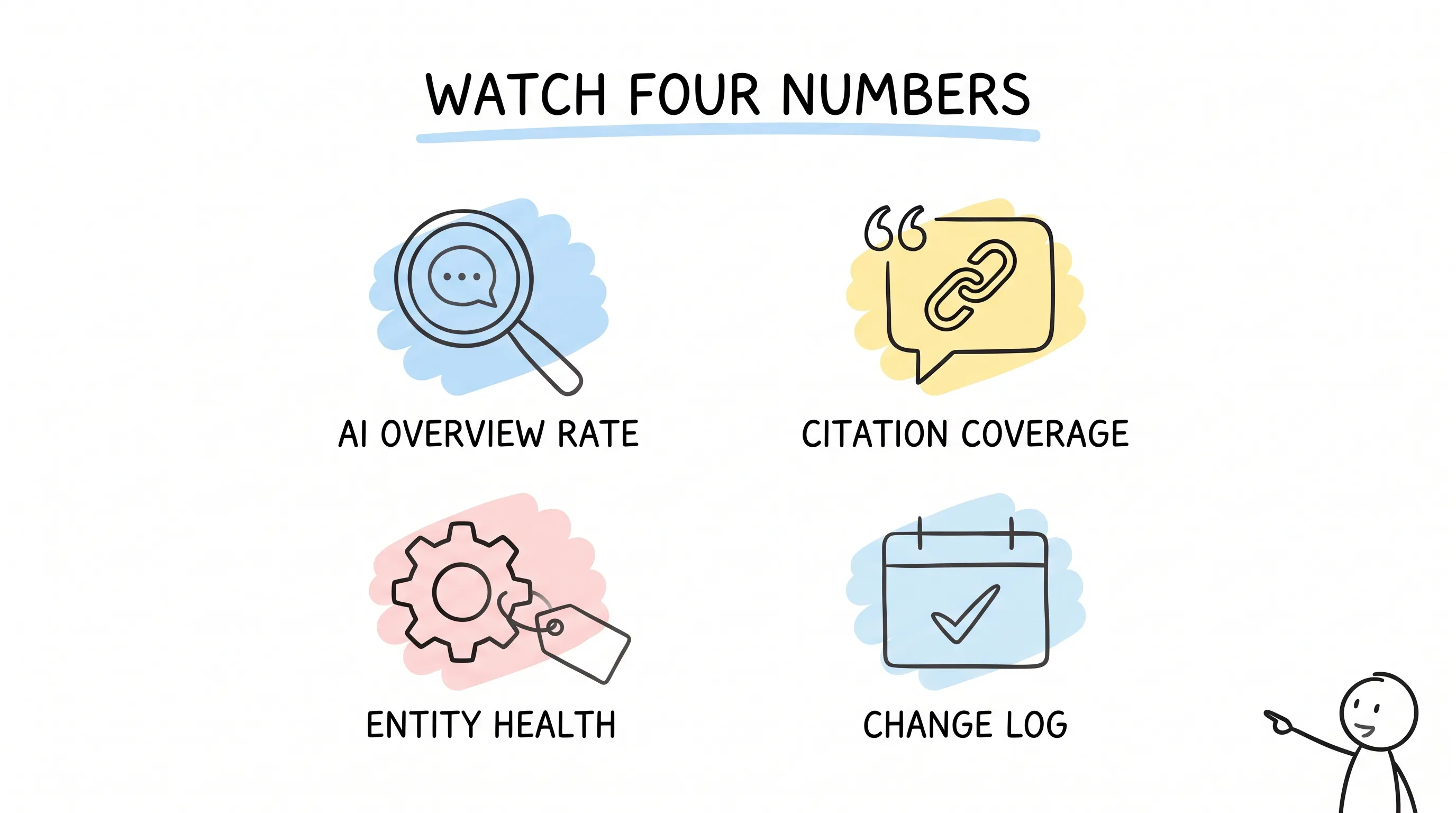
Once the tool is up, don't stare at the dashboard every day. Watch how these four numbers move:
- AI Overviews inclusion rate. Of your priority questions, what share triggered an AI summary that carried your domain? Read it as a sample rate, not a fixed value.
- Citation coverage on branded versus non-branded queries. Being cited when someone searches your brand name is table stakes. Being cited while the engine answers a buyer's question — that's the real skill. Far harder, and far more valuable.
- Entity and structured data health. Redesign a page, and these are the first signals to break.
- A change log. Date every fix. When visibility climbs next month, you'll be able to say which move bought the increase.
Any single data point means nothing. Watch the trend — the direction over a few weeks.
One Last Bucket of Cold Water
The defining trait of answer engines is that they settle the question on the spot. The user reads the answer, the problem is gone — and so is the click.
What tools can measure is the traffic that clicked through. The part where your brand was seen but never became a visit is invisible to them, and no pipeline will grow in your CRM from it.
So visibility scores and referred revenue are two numbers that correlate but must be judged separately. Never grade one by the other.
That doesn't make visibility unimportant. Quite the opposite: a brand that can't get into the answers doesn't even qualify for consideration.
Back to my friend. After that dinner, the first thing he did was list the twenty questions his industry gets asked most, then run all of them manually through ChatGPT and Perplexity.
He said the results chilled him to the bone.
Two months later, he had rewritten the content for all twenty questions. Ask now, and his name is starting to show up in the answers.
Somewhere, right now, your customer may be asking an AI about you.
When the answer comes back — will you be in it?
May your name appear in every answer that matters.
Continue reading
Related articles

Cross-Border Business: Time to Upgrade Your AI Toolbox
A learn article explaining how AI tools help cross-border e-commerce sellers clear five hurdles: language, regulation, logistics, payments, and fraud. It outlines a five-compartment toolbox, a five-step adoption path, and metrics such as conversion rate and CLV, while cautioning against over-reliance on AI.

AI Is Taking Over the Dirty Work of Social Media Marketing, One Task at a Time
This learn article outlines four social media marketing tasks AI can handle — audience analytics, content drafting and design, ad targeting and creative testing, and spam moderation — and cautions that taste, judgment, and data security remain human responsibilities.

AI Is Already This Good — Why Is Your Social Media Marketing Still Pure Manpower?
An overview of 18 AI tools for social media marketing, organized into six categories covering audience research, content creation, scheduling, comment and DM handling, ad management, and visual production, plus notes on personalization, prediction, and emerging trends.