
Your Brand Is Being Reintroduced by AI
Along the way, a quick look at a new business called GEO
Along the way, a quick look at a new business called GEO
A few days ago, I ran a little experiment.
I opened ChatGPT and asked it to recommend a few customer-management software tools. Without missing a beat, it rattled off a list of names and even added a commentary of its own, noting that one of them was "great for growing teams."
Then I went and asked Perplexity. Then Gemini. Three AIs, three lists, each ranked differently.
I stared at the screen, and a question came to mind: if I were one of the companies that didn't make the list, I would probably never know I'd been left out.
That's right — never know.
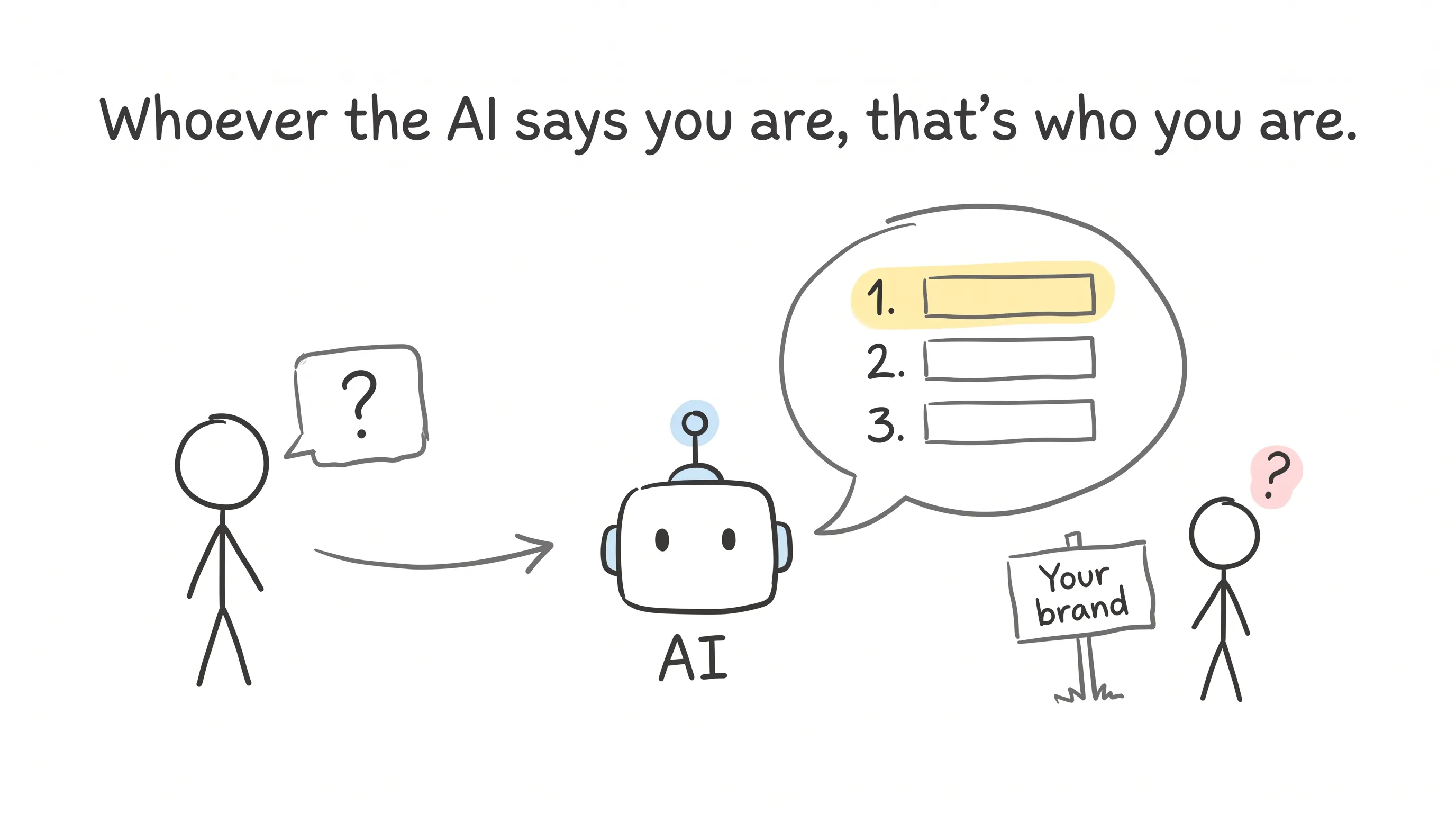
Because users have changed. People used to open a search box, type in keywords, and pick you out from ten blue links. Now they ask an AI directly. Whoever the AI says you are, that's who you are.
What Is GEO?
This business has a new name: GEO, Generative Engine Optimization.
Put simply, it's SEO's successor.
SEO studies how to get web pages ranking high in Google's search results. GEO studies how to get AIs like ChatGPT, Claude, Gemini, and Perplexity to mention you and recommend you in their answers.
What's the difference?
SEO optimizes rankings. Your dashboard shows exactly where you rank.
GEO optimizes the retelling. What words an AI uses to introduce you, whether it puts you on the shortlist at all — nobody shows you that.
You can't see it, yet it happens every single day.
So Who Watches It for You?
There's a class of tools called GEO monitoring platforms.
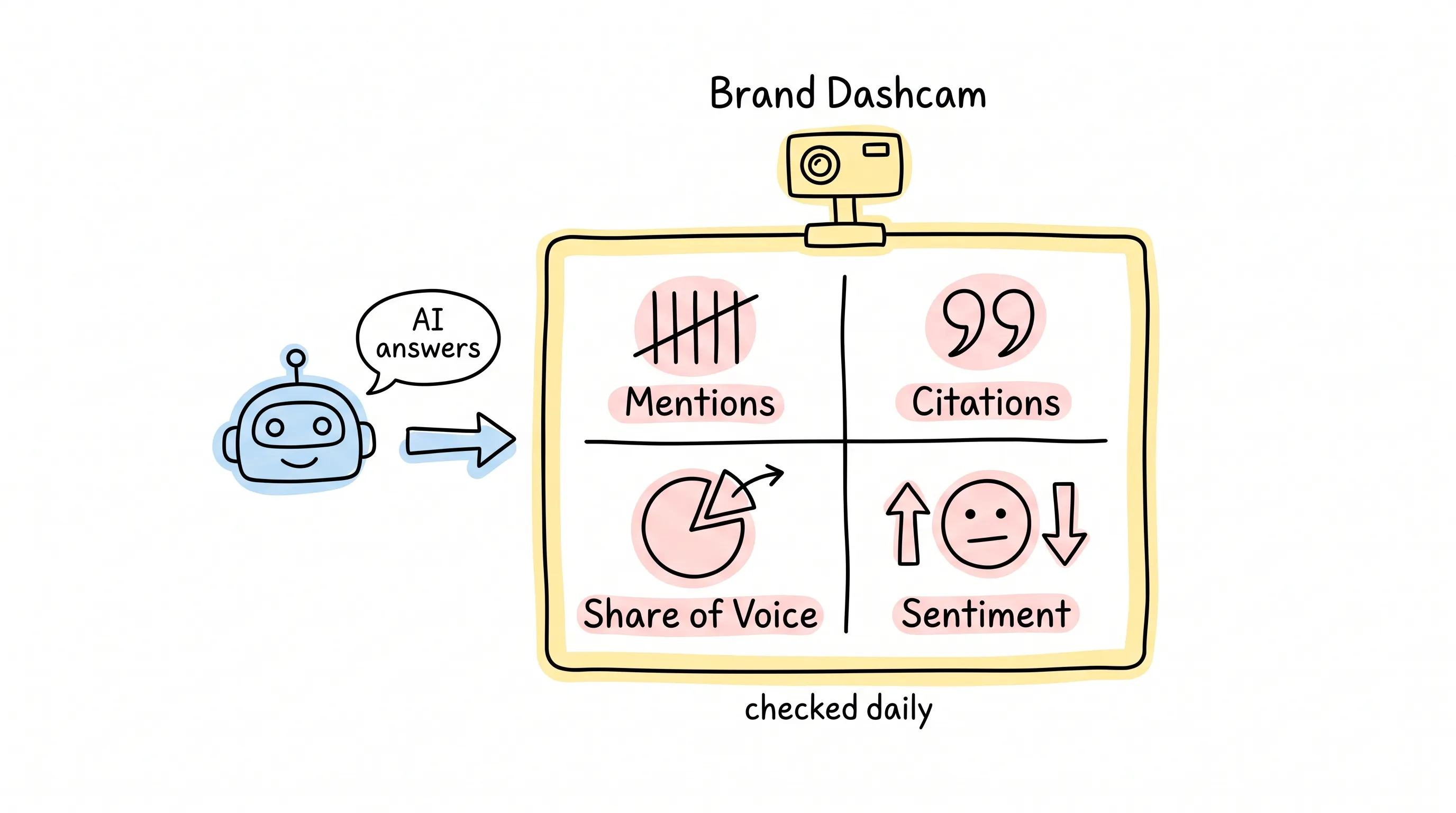
Every day they crawl into answer engines — ChatGPT, Perplexity, Google AI Overviews (those AI summaries at the top of Google search) — and keep score of four things for brands: how many times they were mentioned, how many times they were cited, how large their share of voice is, and whether what's said about them leans positive or negative.
Go a level deeper, and they can also track performance prompt by prompt (a prompt being the exact words a user asks an AI), pull competitors into the same table for benchmarking, auto-alert when something unusual happens, and finally connect your AI appearances to the real money — traffic and revenue.
Marketing teams used to watch the traffic reports in their site analytics. Now they have to watch the AI's mouth, too.
Who gets the job? These platforms. You can think of it as installing a dashcam for your brand's AI reputation.
Who needs it most? Marketing teams, SEO practitioners, brand managers. Their battlefield used to be keywords. Now, it's an entry point that talks.
Three Generations Under One Roof
A while back I came across a market map that listed 15 players in this space in total. I sorted them by founding year and noticed something interesting: three generations under one roof.
The first generation: veterans moving to a new address.
Conductor, founded in New York in 2006 and previously called LinkExperts, spent nearly twenty years in search optimization and has now turned itself into an enterprise-grade answer engine optimization platform, supplying AI content generation and website monitoring for industries like retail, technology, healthcare, travel, and finance. Similarweb, founded in 2007 as SimilarGroup, originally built digital data intelligence — market research, competitive analysis, even predicting stock performance — and has now tucked AI visibility into its toolbox as well. Semrush, founded in 2008 and headquartered in Boston, is a familiar name in the SEO world: a full suite spanning SEO, content marketing, paid media, and social media, now rounded out with AI visibility.
They aren't new players; they're old players who've moved to a new home. Their old home (traditional search) is changing address, and they moved along with it.
The second generation: the middle generation, founded in 2023 and 2024.
Scrunch, born in Salt Lake City in 2023, works on search experiences and brand monitoring for the AI era. Profound, born in New York in 2024, specializes in generative AI marketing analytics. Bluefish, founded the same year in the same city, offers an enterprise marketing suite — monitoring, optimization, and measurement in one package, plus automated workflows that run on their own. Evertune is also in New York, with customers spanning finance, retail, pharmaceuticals, technology, and consumer packaged goods. BrandLight is in Tel Aviv, handling not just brand visibility but also ad performance, e-commerce strategy, and technical website health checks. Omnia is in Madrid, tracking trending prompts and hot topics to guide where content should go.
The third generation: the new wave, born in a cluster in 2025.
AthenaHQ is in San Francisco, doing answer engine optimization and AI brand management, with an emphasis on integrating with the marketing tools you already have. Emberos is in Los Angeles, and its approach is a bit different: beyond monitoring, it also manages risk, doing forecasting and workflow orchestration, like a security guard for AI-era brands. geoSurge is in London, studying how brands are described inside large language models, then getting hands-on to adjust that. Peec AI is in Berlin, helping marketing teams look at their own and competitors' AI performance side by side. Searchable is also in London, serving e-commerce, B2B software, and local businesses, tracking brand visibility on ChatGPT, Claude, and Perplexity. GenFlux is in Delaware, focused squarely on how ChatGPT and Perplexity rank brands and make recommendations.
Count them: in 2025, London alone produced two.
Impressive — that founding pace.
Then the Giants Stepped In
Startups clustering alone isn't enough to prove a sector is real. The giants' wallets are the real ballot box.
In April 2026, Adobe bought Semrush at a valuation of $1.9 billion.
In June of the same year, Sitecore bought Scrunch at a valuation of $225 million.
Two deals, one right after the other.
Think about it: what does Adobe do? The king of creative software. At $1.9 billion, was it really buying Semrush's longtime customers? No — it was buying a ticket into the AI search era. Sitecore builds digital experience platforms, and in buying Scrunch, it bought the same ticket, at a friendlier price.
One a veteran founded in 2008, the other a rookie from 2023. Big money doesn't care how old you are — only where you stand.
Users have taken their questions somewhere new; brand budgets will move house sooner or later, too.
What It Means for You
If you're a marketer, a brand manager, or an SEO practitioner, my advice comes down to two sentences.
First sentence: don't just watch keyword rankings anymore. Take the questions your customers would actually ask, organize them into a prompt list, put them one by one to the mainstream AIs, and see whether you're in the answers and how they describe you.
Second sentence: seeing is for fixing. An AI's answers come from the content it has read. How your content is written, where it lives, and who cites it determine how the AI retells you. No time to ask every day? Perfect — those 15 companies from earlier exist to ask on your behalf.
Before, users found brands by searching. From here on, they'll know brands by a single line from an AI.
Back to That Experiment
After quizzing the three AIs, I posted the three lists in my colleagues' group chat.
One person replied with a single word: "Cutthroat."
Another asked: "Is our company on the list?"
I don't know. But I do know that the next time you ask an AI a question, behind the list it blurts out, an entire industry is already working overtime.
And here's wishing you a spot on the list, every time someone asks.
Continue reading
Related articles

Cross-Border Business: Time to Upgrade Your AI Toolbox
A learn article explaining how AI tools help cross-border e-commerce sellers clear five hurdles: language, regulation, logistics, payments, and fraud. It outlines a five-compartment toolbox, a five-step adoption path, and metrics such as conversion rate and CLV, while cautioning against over-reliance on AI.

AI Is Taking Over the Dirty Work of Social Media Marketing, One Task at a Time
This learn article outlines four social media marketing tasks AI can handle — audience analytics, content drafting and design, ad targeting and creative testing, and spam moderation — and cautions that taste, judgment, and data security remain human responsibilities.

AI Is Already This Good — Why Is Your Social Media Marketing Still Pure Manpower?
An overview of 18 AI tools for social media marketing, organized into six categories covering audience research, content creation, scheduling, comment and DM handling, ad management, and visual production, plus notes on personalization, prediction, and emerging trends.