
Your Brand Guidelines Can't Control Your Brand Anymore
An essay on why static brand guidelines struggle to govern brands across fast-moving channels. It covers separating brand constants from flexibility, training team judgment with real examples, translating brand language into instructions AI can execute, and shifting brand stewards from gatekeepers to coaches.
A couple of days ago, a friend of mine who works in consumer products invited me out for coffee. The first thing out of his mouth was a complaint:
"Building a brand these days is so hard."
"So what's hard?" I asked. Did someone botch the logo? Get a color code wrong?
Nope. It was this: every single day, someone comes to him asking, "Does this comply with our brand guidelines?" A short video has to ask. A livestream has to ask. An executive wants to post something on their personal feed — that has to ask too. The people asking aren't wrong, and the people answering aren't wrong. But somewhere in all that asking and answering, the work grinds to a halt.
Hearing all this, I had to smile.
This isn't one company's problem. It's the same wall that almost every brand has run into over the past couple of years.
The wall has a name: brand guidelines.
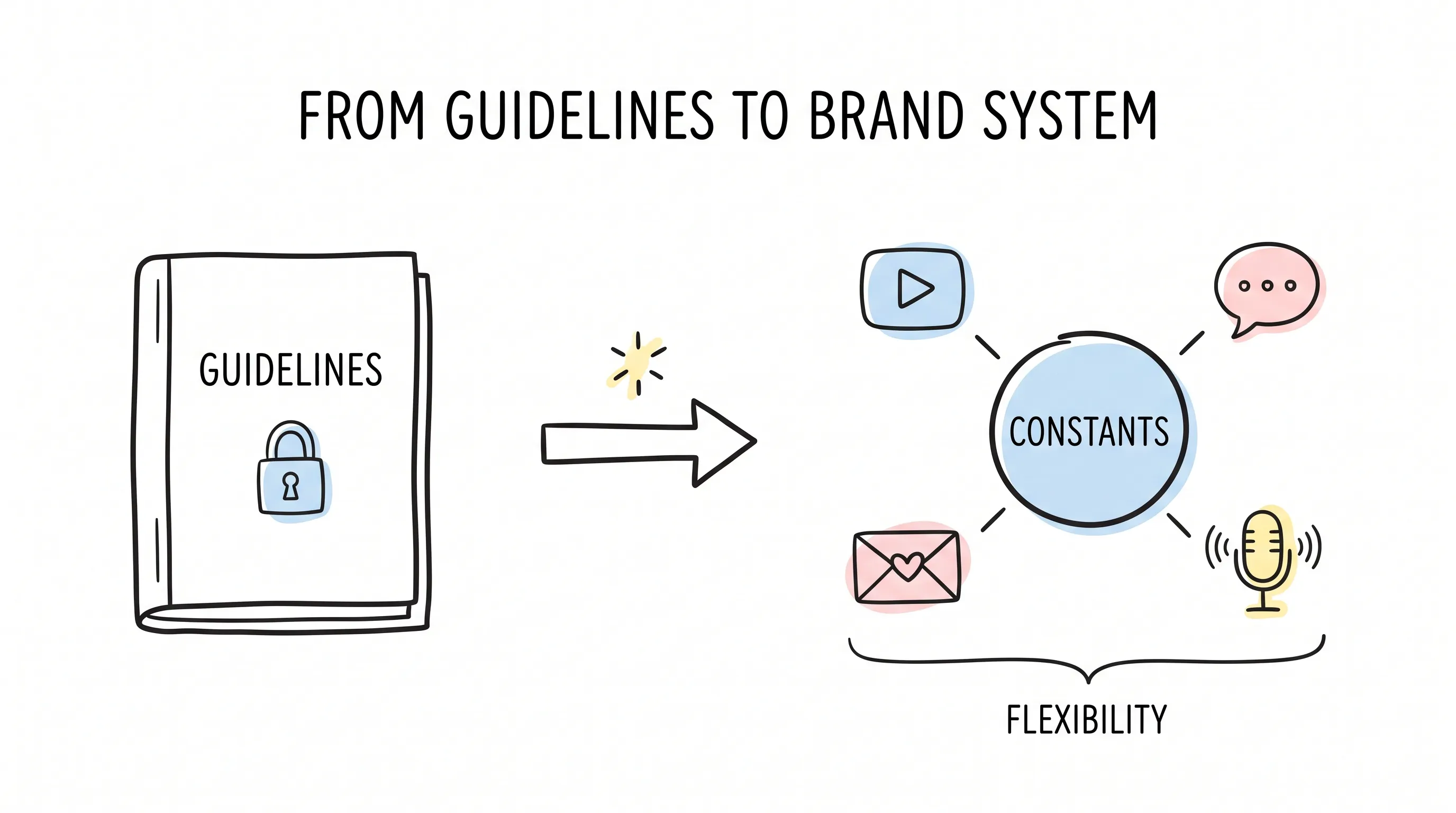
The Manual Governs "Yes or No." The Brand Needs "Why Yes."
What is a brand guideline, anyway?
It's that PDF. The one that says: the logo has 3 approved usages, these are the primary color codes, use these two typefaces, and the tone of voice should be "professional and approachable."
Is this thing still useful today? Yes. It's the starting point — the anchor the whole team steers by.
But at some point, you'll notice it has lost its grip.
Why? Because the places a brand has to show up now have outgrown the manual. A short video can't move at the pace of an annual report. What an executive says on social media can't read like website copy. And the energy of an in-person event has nothing to do with the energy of a mass email.
Every platform demands something different from the brand.
So what counts as consistent? Here it is, plainly:
Consistency isn't looking identical everywhere. It's being recognizable everywhere.
How do you get there? Split the brand into two halves.
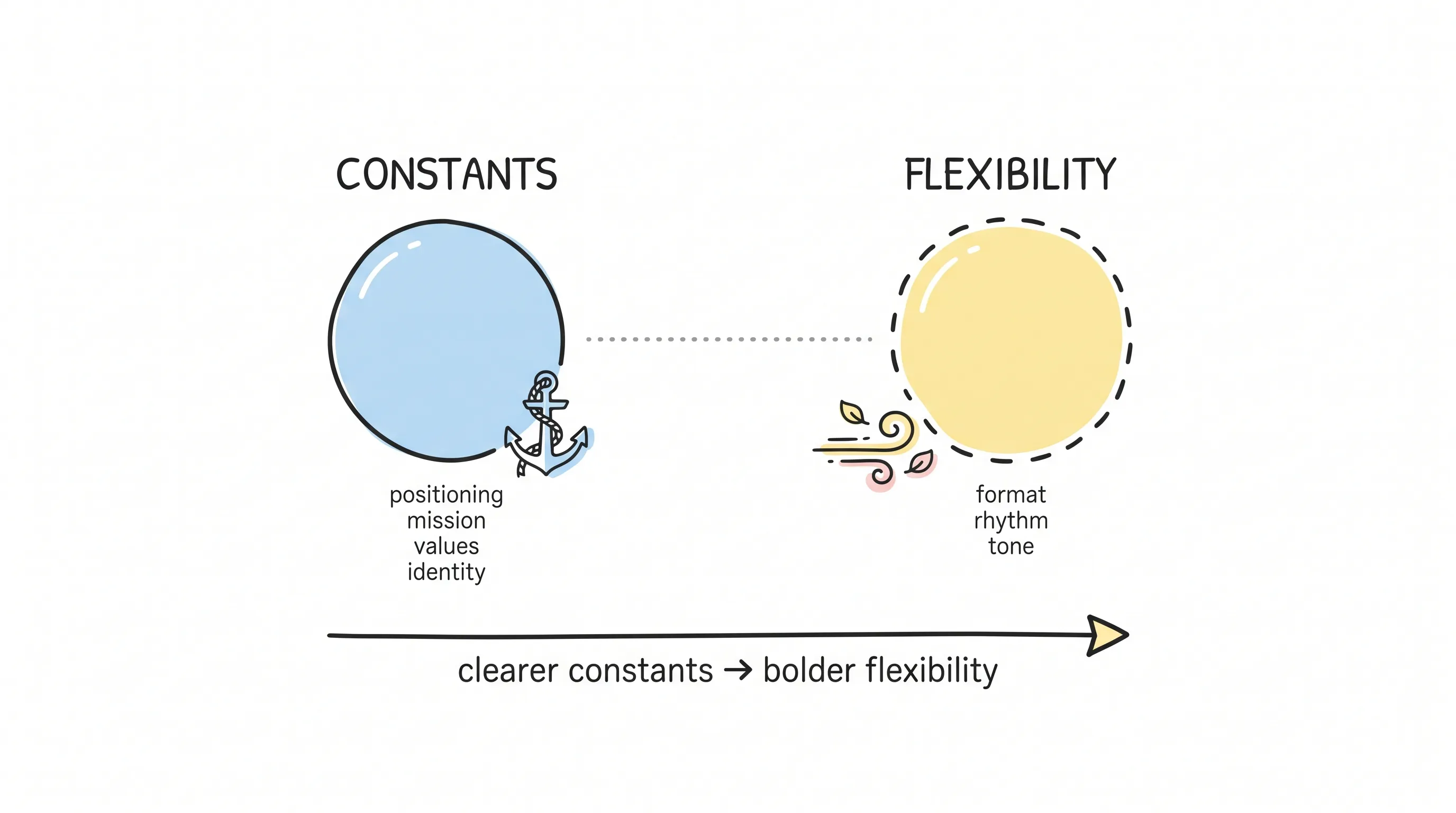
One half is the brand constants: positioning, mission, values, core personality, visual identity. These are guarded and unmoving — don't touch.
The other half is the brand flexibility: what format to use, what rhythm, how much humor, which way the tone leans, how the visuals adapt. This is exactly where you let go.
The relationship between the two halves is subtle: the more clearly the constants are drawn, the bolder you can afford to be with the flexibility. It's like a person. When someone's character is steady, you know how they'll be at the conference table, at dinner, on their personal feed. It's the person whose character is unstable who has to put on an act everywhere.
Good brand governance makes a thousand executions all point to the same brand.
What Teams Lack Isn't an Instruction Book. It's Judgment.
When does a brand system prove its worth?
Not when the rules are clearly laid out — when the situation is brand new and the manual says nothing.
Say a creator pitches a collaboration idea — does it feel right? How far can an executive push the tone in a speech? Does a brand-new content format even need to pass brand review?
The manual can't answer these. All it can tell you is which logo to use and which colors passed approval.
So what do you do? Give the team a way to judge, not a thicker manual.
The most effective approach is unfashionably simple: show the team real work. One bucket: "this is obviously us." Another: "tweak it and it works." And a third: "it's well made, but it isn't us."
This "us, maybe, not us" framework looks crude, but it does serious work. It isn't there to police output; it's there to train judgment. The next time the manual has no answer, the team can come up with one on its own.
Rules teach people to follow rules. Examples teach people to judge.
AI Exposes Exactly How Vague Your Brand Language Is — to the Entire World
This is the part I've been waiting to say.
AI has one trait: brutal honesty. However vague your own understanding of your brand is, that's exactly how thoroughly AI will amplify it.
Try it. Write to the AI: "Our brand voice is innovative, authentic, approachable, and human."
The company next door writes the same thing. So does the one next door to them.
The entire industry is running on roughly the same twenty words. So the answer AI gives them is the answer it gives you. Word for word.
God, this is the most expensive waste there is. Vague brand language used to waste one brief. Now, the moment the AI boots up, that vagueness can be duplicated ten thousand times.
Vague guidance used to be waste. Now it's waste, amplified without limit.
So brand building in the AI era gains one more step: translation. You have to translate your brand thinking into explicit instructions that both humans and machines can execute. Clear principles. Concrete examples. Enough context. Well-drawn boundaries.
The faster production gets, the more vagueness costs. That's the new standard AI sets for brands — and the reason humans remain irreplaceable:
Machines copy what you say. What they can't judge is your sense of proportion.
Brand Stewards: From Gatekeeper to Coach
More channels, more creators, more content — and what's the first instinct of most brand owners?
Add approvals.
One more gate, one more signature. Understandable. The brand is your responsibility; when something goes wrong, it's on you. Of course the instinct is to grip tighter.
But this road doesn't work. When every decision loops back to your one desk, the brand's speed dies on that desk. And honestly, the shape of a brand was never the marketing department's alone to mold. Every time an executive speaks, every line a team member says to a customer, the way every employee represents the company each day — all of it is shaping the brand. Can you really stay on top of all of that?
You can't. Nobody can.
So change roles. The rules that must exist stay, and anything genuinely over the line still gets stopped — that part doesn't go away. But more of the job becomes teaching. Teaching what? Three questions:
Why does this work?
Why does that not feel like us?
Where could we push one step further?
Ask these three questions over and over, answer them over and over. After enough rounds, people across the company start making sound calls on their own, without lining up for your sign-off.
You can't control every decision. You can only teach everyone to think.
One Last Thing
That day over coffee, my friend asked: should we scrap the manual and start over?
No, I said. The manual is the foundation, and foundations don't get torn down. What you need to do is teach everyone to build houses on top of it — so that when they face audiences, formats, and occasions the manual never anticipated, they can still build something that feels like it belongs to our family.
I can compress these two ideas into one line:
Compliance is knowing what's allowed. Fluency is knowing what feels like us.
On the road ahead for brand governance, the competition comes down to that second word.
And here is my wish for you: may you not only hold a set of guidelines in your hand, but have a team that never needs to open it.
Continue reading
Related articles

Cross-Border Business: Time to Upgrade Your AI Toolbox
A learn article explaining how AI tools help cross-border e-commerce sellers clear five hurdles: language, regulation, logistics, payments, and fraud. It outlines a five-compartment toolbox, a five-step adoption path, and metrics such as conversion rate and CLV, while cautioning against over-reliance on AI.

AI Is Taking Over the Dirty Work of Social Media Marketing, One Task at a Time
This learn article outlines four social media marketing tasks AI can handle — audience analytics, content drafting and design, ad targeting and creative testing, and spam moderation — and cautions that taste, judgment, and data security remain human responsibilities.

AI Is Already This Good — Why Is Your Social Media Marketing Still Pure Manpower?
An overview of 18 AI tools for social media marketing, organized into six categories covering audience research, content creation, scheduling, comment and DM handling, ad management, and visual production, plus notes on personalization, prediction, and emerging trends.