
Your AI Is Only as Strong as Your Data
A learn article arguing that AI marketing is limited by data foundations: stale pipelines keep execution reactive, missing writeback splits teams' numbers, and composable versus all-in-one architecture depends on scale. It recommends a data inventory and a small pilot before any platform change.
A few nights ago, I had dinner with an old friend who works in retail marketing.
His member pool holds several million users, and a whole whiteboard was covered in AI ideas: real-time triggers, one-to-one personalization, churn alerts, dynamic offers. A year on, exactly two of them were actually running.
I asked him why.
He thought for a moment, then said: "The ideas are all new. The data is old."
Then he laughed at his own answer. In the past two years, his systems procurement list has turned over three times, yet the data pipelines carrying those systems are still the ones laid five years ago.
I wrote that line down. Because the more I turn it over, the clearer it feels that this isn't just his problem — it's the shared foundation problem of most marketing teams today.
If the foundation is still yesterday's, your AI can only do yesterday's work.
Let's take it apart layer by layer.
What does "real-time" actually mean?
Start with the most common obsession.
Many teams want to switch from "reactive" to "proactive": the customer finishes browsing and the outreach lands; the first flicker of churn risk appears and retention steps in.
The direction is right. But when they actually try, nearly every attempt jams in the same place: the data pipelines.
Courtney Adams, head of content and product marketing at MessageGears, put it perfectly:
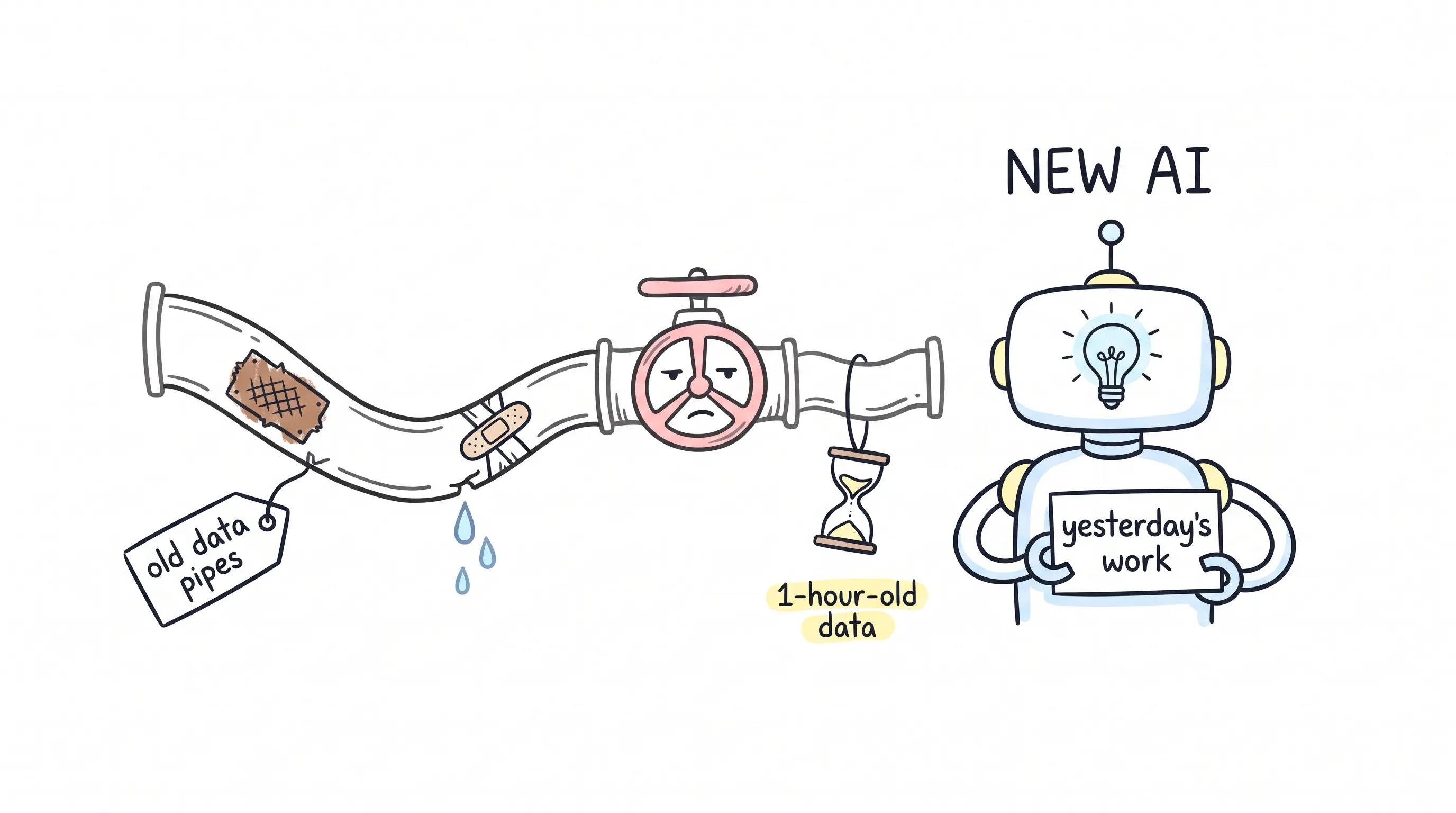
"If your data is an hour old, your execution will always be reactive."
Think about what an hour of lag means. It means the customer's state is frozen an hour ago. Whatever they're doing right now, your system has no idea — it can only guess from a stale ledger. You're running today's roads with yesterday's map.
Talent you can hire. Processes you can tidy up. Those can be solved with money. Pipelines are the one thing no amount of money can speed up. Adams gave a very everyday example: a team wants to activate a new customer attribute. Sounds simple, right? What it actually takes: a dedicated data-science sprint (a short, focused agile work cycle), a custom integration, and a few gnarly SQL queries. The plainest little requirement turns, just like that, into a months-long project.
Oh, and here's the more infuriating part: switching marketing automation vendors won't cure this disease.
The pipes are the same rigid pipes. The latency problem arrives untouched, and moves into the new platform right along with you.
It's like moving house. New home — but you ripped out that old length of water pipe and brought it along.
Jacqueline Freedman, founder of Monarch Advisory Partners, put it even more bluntly: a shiny new tool can't fix what's broken outside of it.
Her advice to management: before you pay for new software, step back and get clear on two things — how information actually flows between your systems, and how people actually use these tools in their day-to-day.
If you don't look at those two things clearly, you'll go on forever blaming the software.
AI amplified the gap
So what's the root disease? Not enough ideas?
Quite the opposite.
Mike Maynard, chairman of the agency Napier Partnership — his team has a favorite saying:
Ideas are cheap; execution is the hard part.
Here's the reality: for the vast majority of marketing teams, the customer data they can actually reach and use is a tiny sliver of what the whole company holds. Jam things at both ends — latency and access rights — and everything downstream clogs. Real-time triggers: impossible. Fine-grained segmentation: impossible. You can design a beautiful multi-touch customer journey, only to discover your tech stack can't reach any of it.
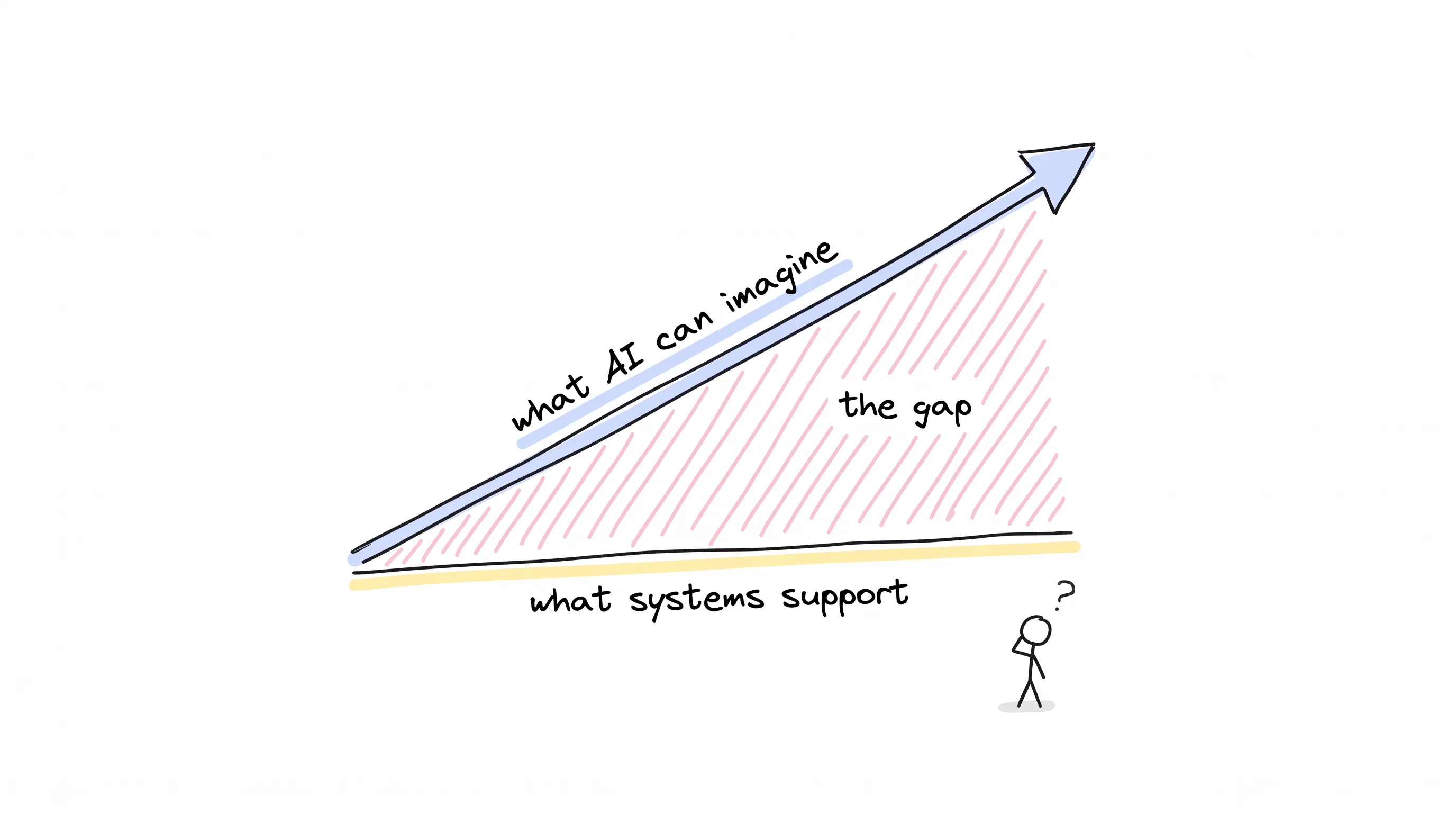
And when AI arrived, that gap didn't shrink. It was amplified.
Why?
Because AI massively expanded "what you can imagine" — and expanded "what your systems can support" by exactly zero.
The distance between imagination and foundation just got longer.
For B2B teams, this is especially brutal. A B2B purchase decision is made by a whole roomful of people: the ones who use it, the ones who gatekeep, the ones who decide, and the ones who pay. If you want AI to speak to that entire room, you have to feed it context that runs deep enough.
What if the context falls short?
The AI just turns up the dosage on generic blasts. You used to send ten thousand template emails a month; now you send ten thousand a day. More diligent, more uniform, and even less read.
That's why so many organizations only come to their senses after going around in circles: it was never that the AI wasn't capable. It's that you couldn't reach your data.
Before signing anything, Freedman suggests every executive ask themselves three questions: Are you solving a real business problem? Untangling an old process? Or is the board just pushing lately, and you owe them a "we're using AI too" checkbox?
The first two are worth doing. The third? In Maynard's words: AI for the sake of AI is a pure waste of time.
Your AI's ceiling is what you feed it
Now for something subtler, and something even more teams fail to do.
How good your AI is depends on how much information you feed it. That's Adams again.
No model, however brilliant, can reason its way to information that doesn't exist anywhere in your company. Customers' key behavioral signals, their latest purchase records, the history of service interactions — if none of that flows in front of the model, the model is blind. And blind with total confidence: wherever it can't see, it will make up an answer with a perfectly straight face.
Hiding inside this is a trap even fewer teams guard against: writeback.
What's writeback? Most teams remember to pull data out of the central data warehouse and forget to write marketing's data back. Who saw a campaign, who clicked, who replied — this engagement data sits scattered in marketing's own little silos and never flows back.
The result: marketing, BI, and data science — three teams, three sets of books, everyone talking past each other. Nobody trusts anybody's numbers, let alone a single source of truth.
Compose, or buy the suite?
With the pipeline disease diagnosed, many teams' first instinct is to redo the architecture: stop leaning on a single all-in-one marketing cloud that bundles everything; break it apart and compose it freely from modules.
That's the "composable architecture" everyone has been hot on these past two years.
Freedman is the most steadfast champion of that school. She has a question that cuts very sharp:
Do you want an all-star lineup, or a building that can be moved in one piece?
She offers another metaphor, and I find it remarkably apt.
An all-in-one platform is like an old house. Livable, sure — but every time you want to redo the bathroom, one swing of the hammer uncovers three landmines buried by a renovation years ago. Every small repair turns into major structural surgery.
A modular architecture is like building your own house. Every room is constructed independently; whichever room displeases you, you tear that one down while the rest stay lived-in. In a market where AI vendors overhaul themselves every few months, this ability to "swap a part without moving out" is worth real money.
But.
Freedman herself immediately adds a bucket of cold water: modularity can't cure internal injuries. "AI can't fix your house's bad wiring. It just makes a broken process run at breakneck speed — and be wrong at breakneck speed."
That line is so good. New tools, broken processes — the output is just bad results at higher speed.
So should everyone break things apart?
Maynard steps up with another bucket of cold water — and for most teams, his is the more relevant one.
Composable is how the big enterprises play. They have engineering teams that can afford the integration, maintenance, and upgrading of dozens of point solutions. How many people does a small-to-mid-size B2B team have, total? Just servicing those integrations would grind them down. For them, one "good enough" all-in-one suite is far more practical than an all-star lineup they could never field.
So the answer is: there is no standard answer. Change any of the three variables — scale, headcount, engineering capability — and the answer changes.
Run the checkup first, then the surgery
Does all this mean tearing everything down for a three-year platform migration?
Not so fast.
On this, all three agree with surprising unanimity: run the checkup first; talk surgery after.
First, take stock of what you hold. Freedman suggests starting from a thorough data inventory: exactly which repositories is customer data scattered across? Who owns each one? And the deadliest question — is there truly a unified "one customer, one view"? Or is everyone holding an incomplete version of their own?
Second, find the broken loops. Use the inventory to locate where the writeback breaks: duplicated records, systems that don't talk to each other, campaign responses flowing into dead ends, never returning to the central warehouse. Those breakpoints are precisely where your pipes leak.
Third, zero in on what matters most. Maynard's reminder: when it comes to collecting data, more is never the goal — accurate is. Sometimes one critical data point outweighs dozens of bustling metrics. His example is a gem: a car buyer's plan for how many years they intend to drive the car. That single number beats chasing them for dozens of browsing behaviors — because the replacement budget, the rhythm, and the decision weight are all hiding inside it.
Think about it. Isn't that exactly how it works?
Finally, three parting words for you
As the conversation wound down, I asked my friend to take home the three most valuable lines from the whole discussion. I'll pass them on to you as well.
The first, about pace. Don't set out to boil the ocean. Pick one specific campaign, get the AI activation working end to end on it, test, adjust, then scale. That's Adams's advice.
The second, about perspective. Walk your own customer journey start to finish — from the day of signup all the way to after-sales support — one touchpoint at a time. You will see everything the reports never show. That's Freedman's advice.
The third, about discipline. Don't let flashy features dazzle you. Keep your eyes on what the customer wants, and on which data you need to serve them well. That's Maynard's advice.
As we parted that day, my friend said he'd go back and run the checkup first; the architecture question could wait until the results were in.
I think that's the right order.
Find out where the water leaks first. Then decide whether to patch the pipes or build a new house.
Here's to getting to know your own pipes, sooner rather than later.
Continue reading
Related articles

Cross-Border Business: Time to Upgrade Your AI Toolbox
A learn article explaining how AI tools help cross-border e-commerce sellers clear five hurdles: language, regulation, logistics, payments, and fraud. It outlines a five-compartment toolbox, a five-step adoption path, and metrics such as conversion rate and CLV, while cautioning against over-reliance on AI.

AI Is Taking Over the Dirty Work of Social Media Marketing, One Task at a Time
This learn article outlines four social media marketing tasks AI can handle — audience analytics, content drafting and design, ad targeting and creative testing, and spam moderation — and cautions that taste, judgment, and data security remain human responsibilities.

AI Is Already This Good — Why Is Your Social Media Marketing Still Pure Manpower?
An overview of 18 AI tools for social media marketing, organized into six categories covering audience research, content creation, scheduling, comment and DM handling, ad management, and visual production, plus notes on personalization, prediction, and emerging trends.