
Your AI Is Counting Inventory. Someone Else's AI Is Learning Your Customers.
An explainer on AI-personalized customer journeys, contrasting back-office AI with customer-facing automation and moving from closed-loop feedback to real-time, action-taking AI.
A couple of days ago I had dinner with a friend who runs a consumer brand.
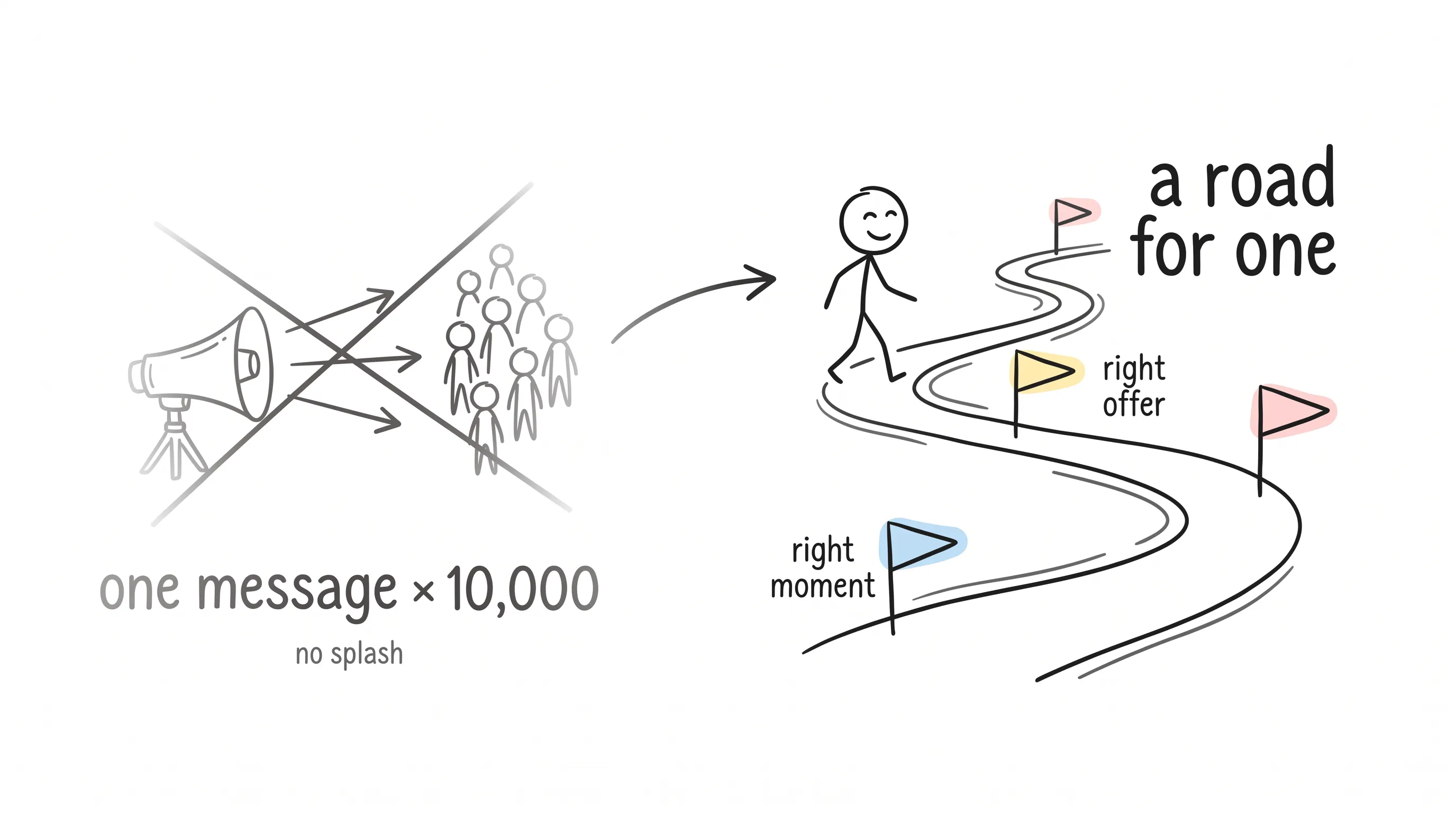
He came to vent: mass text blasts are getting worse and worse. You send out ten thousand messages and it's like throwing stones into the sea — you don't hear a single splash.
I asked him: haven't you been using AI for a while now?
He said: we have. Forecasting sales, optimizing inventory, scheduling production and shifts, reviewing contracts — AI handles all of it, and it has saved us plenty of money.
I said: then have you noticed that all of your AI is in the back office? The place that needs it most, the part where you deal with customers, is still running on methods from twenty years ago.
He froze.
That's what this piece is about: what an AI-personalized customer journey actually is, and why it might be the big opportunity a lot of companies are missing right now.
What Is a Customer Journey?
What is a customer journey?
It's the complete path a person walks from the first time they scroll past your brand, to clicking in for a look, to placing an order, to receiving it, to after-sales, to buying again — or to churning away.
And what is personalization?
It means this road isn't paved for ten thousand people; it's paved for one of them. When they show up, what they see, what lands in their inbox — every stop feels set up just for them.
Sounds lovely. But in the past, this thing had one obstacle you couldn't get around: it couldn't be done.
Why not? Because every step had to be arranged by a human. Ten thousand people, and you'd have to arrange it ten thousand times.
A 20-Year-Old Method That's Due for an Upgrade
For more than twenty years, the customer experience industry has rested on a foundational method called closed-loop feedback (CLF).
What is closed-loop feedback? Plainly, four steps: a customer leaves a bad review, the system logs it, a human follows up to ask "what weren't you happy with," and later on you make a fix or two.
Find the problem, solve the problem, then "close the loop" on the result. Sounds perfectly reasonable, right?
But this method has two built-in flaws.
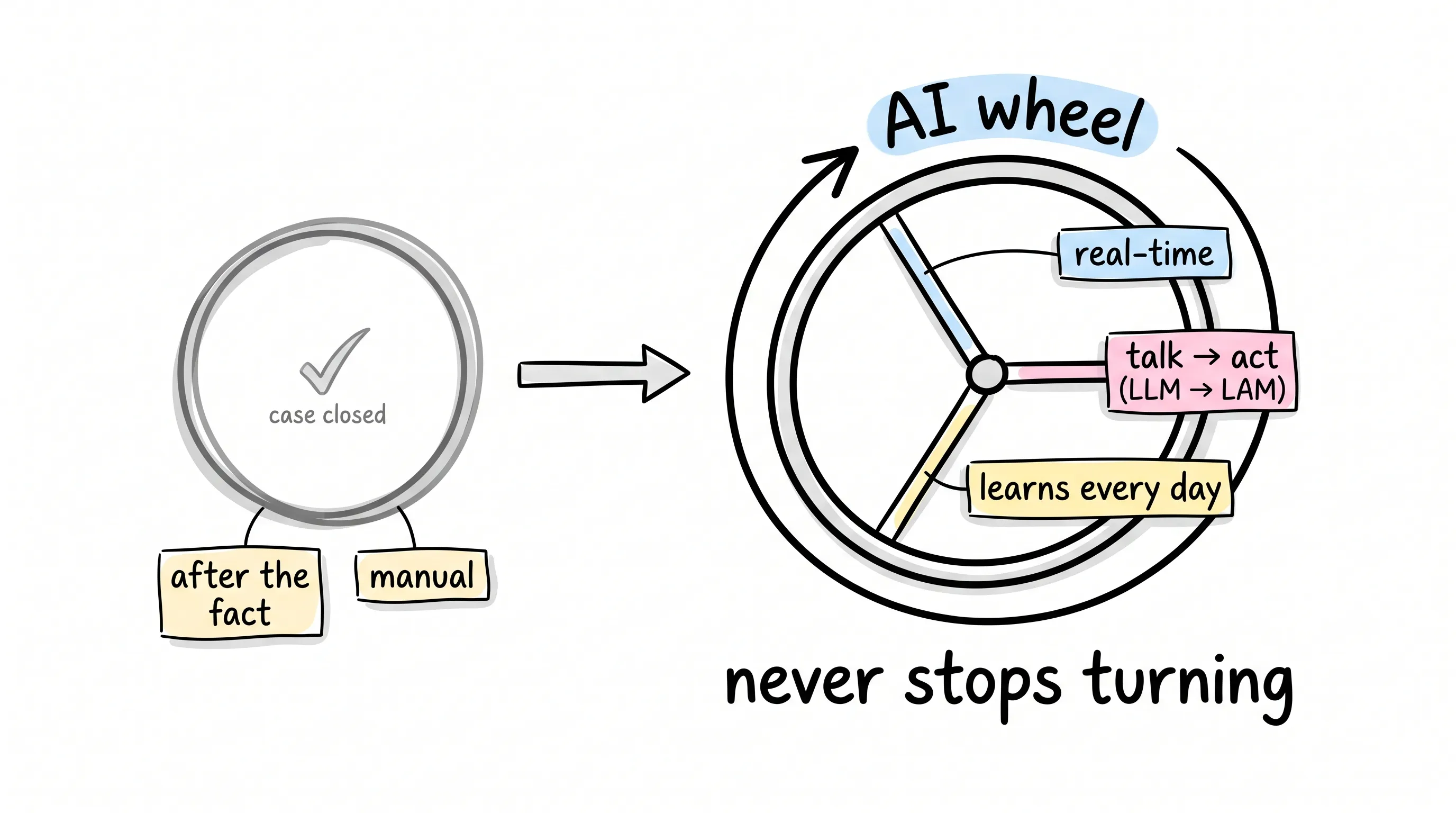
First, it's after the fact. By the time the bad review arrives, the damage is done. You're repairing, not preventing.
Second, it's manual. Every single loop needs a person to close it. Once customers multiply, you run out of people.
So what then? Hire another batch of people, specially assigned to close more loops?
That's like having a leaky water tank and, instead of patching the tank, hiring a roomful of people to bail it out with ladles.
Now that AI is here, this playbook can be changed at the root. Where? Three places.
First: from cleaning up afterward, to adjusting in real time.
AI watches which step of the journey the customer has reached, predicts where they'll get stuck, and — before the bad review happens — moves that pebble off the road.
Friction gets smoothed out before it ever becomes a bad review.
Second: from being able to chat, to being able to act.
These past two years, large language models (LLMs) have been everywhere. But you'll notice the next step in their evolution is from LLM to large action model (LAM).
What's a large action model? A large language model can "talk" — you ask, it answers. A large action model can "do." It can dig through hundreds of millions of behavior records in a few minutes, find the patterns and root causes of customer dissatisfaction, and then act directly: change the journeys that need changing, send the coupons that need sending.
It doesn't just hand you a diagnosis. It performs the surgery too.
Third: from the loop that closes, to the wheel that turns.
With a traditional closed loop, once a case is handled, the loop is closed.
AI is different. It learns from every single interaction. What it learns today, it uses tomorrow; the strategy is always being refreshed.
The loop is no longer something that closes. The wheel is something that never stops turning. The more it turns, the better it knows your customers.
Let's Run Three Numbers
Enough theory. Time to run the numbers.
First number: retail. One retailer used to reach customers by mass blast: the same email to ten thousand people, identical content, no thought for timing. Then they changed the approach with Salesforce Marketing Cloud: first stitch the customer data scattered across every touchpoint into one complete profile; then let the system automatically trigger different journeys based on each person's behavior and purchase history.
Three months. Customer engagement rose 38%, repeat purchases rose 22%.
What's worth pondering even more: the sharpest growth came from the silent users who had long gone quiet. The customers mass blasts could never wake, AI journeys did.
Second number: banking. At one bank, what customers complained about most was how slow loan approvals were — easily five or six days. Then they brought in AI to verify documents and assess risk, and approval time went from 5 days to 5 minutes.
5 days to 5 minutes — what does that mean? 1,440 times faster. Loan applications rose 30% along with it.
McKinsey ran the numbers on an even bigger scale: banks that use AI well can raise customer satisfaction by as much as 35% and cut operating costs by up to 25%. According to Allied Market Research's forecast, the global AI-in-banking market will surge to $130 billion by 2030.
And look at what the peers are doing: JPMorgan uses AI to give customers real-time loan and investment advice, with interactions up 40%; Bank of America's AI assistant Erica has already handled more than 1.5 billion interactions; a European bank used AI to identify customers' financial troubles early and reach out proactively, cutting churn by 22%; Mastercard's AI fraud detection reduced "false positives" by 50%.
What are false positives? Legitimate transactions wrongly treated as suspicious and blocked. Every time a customer is spared a wrongful block, trust ticks up a notch.
Third number: milliseconds. The used-car platform CARS24 built a real-time recommendation system: sequential neural networks, plus Kafka real-time streaming, processing over a million user interactions every day, and within 200 milliseconds it pushes the most suitable car in front of your eyes.
What does 200 milliseconds mean? A human blink takes about 300 to 400 milliseconds.
In other words, before your eyelids come back down, it has already guessed which car you want to see.
Where Does the Data Come From? From Conversations
By now you might ask: personalization, personalization — what does it actually run on? Data. The more complete the data, the closer the journey fits.
So where does the data come from? Many people's first reaction: make customers fill out forms.
Let me ask you: when you fill out a form, are you serious about it?
On most people's forms you'll find "John Doe," "123-456-7890," and a string of perfunctory checkbox ticks.
Here's one from the chain gym brand Posh Fitness that's especially interesting. A prospective customer named Melanie wanted a gym membership. She didn't fill out the form; instead she chatted with the AI assistant on the website for a few minutes. As they talked, like friends talking, she shared her fitness goals, mentioned she had dietary restrictions, said she liked encouraging personal trainers, loved outdoor sports, but was usually busy and needed flexible timing.
A few minutes of conversation surfaced everything a form could never have asked.
And because the chat felt comfortable, she had already warmed to the gym before she even signed up. Trust, banked before the sale.
This is where conversational AI is powerful: while it serves you, it gets to know you.
Consumers eat this up too. The brand consultancy Prophet surveyed and found that 69% of consumers feel excited about brands using generative AI to improve the experience.
You see, consumers don't resent AI. They resent being offended.
But There's a Prerequisite Called Trust
At this point, time to pour a bucket of cold water.
PwC released a consumer survey report in 2024, and it contains a few numbers that every marketer should stare at: 86% of consumers want a seamless experience between online and offline; 59% of consumers expect personalized recommendations; but at the same time, 85% of consumers worry about how their data is collected and used.
Sit with those numbers for a moment.
People want the warmth, but they're afraid of being stripped bare.
So personalization has red lines.
Red line one is called transparency. You must let users know what you collected and what you did with it. Keep it hidden, and sooner or later you crash.
Red line two is called keeping humans in the loop. Another PwC survey shows that 88% of banking customers want "AI's convenience" plus "human warmth" together when major financial decisions come up. Machines handle efficiency; humans handle judgment.
The same technology, used badly, offends. Used well, it cares. The difference isn't the algorithm — it's judgment.
A Use Case Many Companies Never Think Of
Everything above is about using AI to serve customers. Actually there's another direction: use AI to help your team understand customers.
Here's one. Inside Google's Gemini app there's a feature called AI Storybooks, originally meant to generate illustrated, narrated storybooks for children.
Someone ran an experiment with it: they had the AI generate a 10-page storybook starring a customer shopping for a coffee machine — she first does her homework online by asking ChatGPT, then walks into the store, and finally buys the machine.
Each page is a stretch of the journey. With pictures, and voice-over too.
What can this thing do?
Training new employees — ten times more vivid than a dry flowchart. Reporting to executives who've never seen a "customer journey map" — one illustrated page beats three slides. You can even show it to real customers and test which journey design walks smoothest.
The most wonderful part is the last layer: it puts your team inside the customer's skin, feeling their hesitation and struggle at every step.
Empathy is something you can't reason into people. They have to walk it themselves, once, all the way through.
Don't Wait
Finally, a cautionary tale.
In 2024, Google showed off an AI travel planner that promised to weave your personal preferences automatically into custom itineraries. Many people were waiting for it to launch.
And the result? Postponed indefinitely, with no follow-up to this day.
You see, even Google lets a launch slip.
So don't stake everything on "waiting for a perfect tool." Some hotels have already stopped waiting: they use AI to analyze guests' preferences and tailor services; they use AI assistants to take inquiries and manage bookings, pushing response speed up. By the day that tool finally ships, someone else will have already trained your guests' habits.
Waiting won't get you personalization. Building will.
Final Words
Back to that friend from the beginning.
Halfway through the meal, he took out his phone and sent his team a message: next quarter's mass-blast plan, hold off for now.
AI has already made the back office fast and cheap. The growth that comes next hides out front, in every customer who gets treated with real care.
AI makes the service fit. You make it heartfelt.
Here's to switching off that mass-blast machine soon.
Continue reading
Related articles

Cross-Border Business: Time to Upgrade Your AI Toolbox
A learn article explaining how AI tools help cross-border e-commerce sellers clear five hurdles: language, regulation, logistics, payments, and fraud. It outlines a five-compartment toolbox, a five-step adoption path, and metrics such as conversion rate and CLV, while cautioning against over-reliance on AI.

AI Is Taking Over the Dirty Work of Social Media Marketing, One Task at a Time
This learn article outlines four social media marketing tasks AI can handle — audience analytics, content drafting and design, ad targeting and creative testing, and spam moderation — and cautions that taste, judgment, and data security remain human responsibilities.

AI Is Already This Good — Why Is Your Social Media Marketing Still Pure Manpower?
An overview of 18 AI tools for social media marketing, organized into six categories covering audience research, content creation, scheduling, comment and DM handling, ad management, and visual production, plus notes on personalization, prediction, and emerging trends.