
Your AI-Generated Marketing Content May Not Legally Belong to You
A learn article explaining why fully AI-generated marketing content may lack copyright protection, covering legal risks and six practical steps for human-in-the-loop workflows, documentation, and compliance.
A while back, a friend of mine in the consumer-goods business invited me out for tea.
Once we started talking, she lit up: her company had moved its entire content operation onto AI. WeChat articles? Written by ChatGPT. Posters? Produced by Midjourney. What used to keep a copywriting team busy for a month now wrapped in three days, at a fraction of the original cost.
The efficiency was absurd.
I said, congratulations. But before you celebrate, one question:
Is any of this legally yours?
She froze.
What does "yours" mean here? Plainly put: copyright. And what is copyright? It's the law acknowledging that this work was born of you. Anyone who wants to use it, modify it, or make money from it needs your permission first. It's a title deed you hold in your hand.
Was that deed in her hand?
Most likely — no.
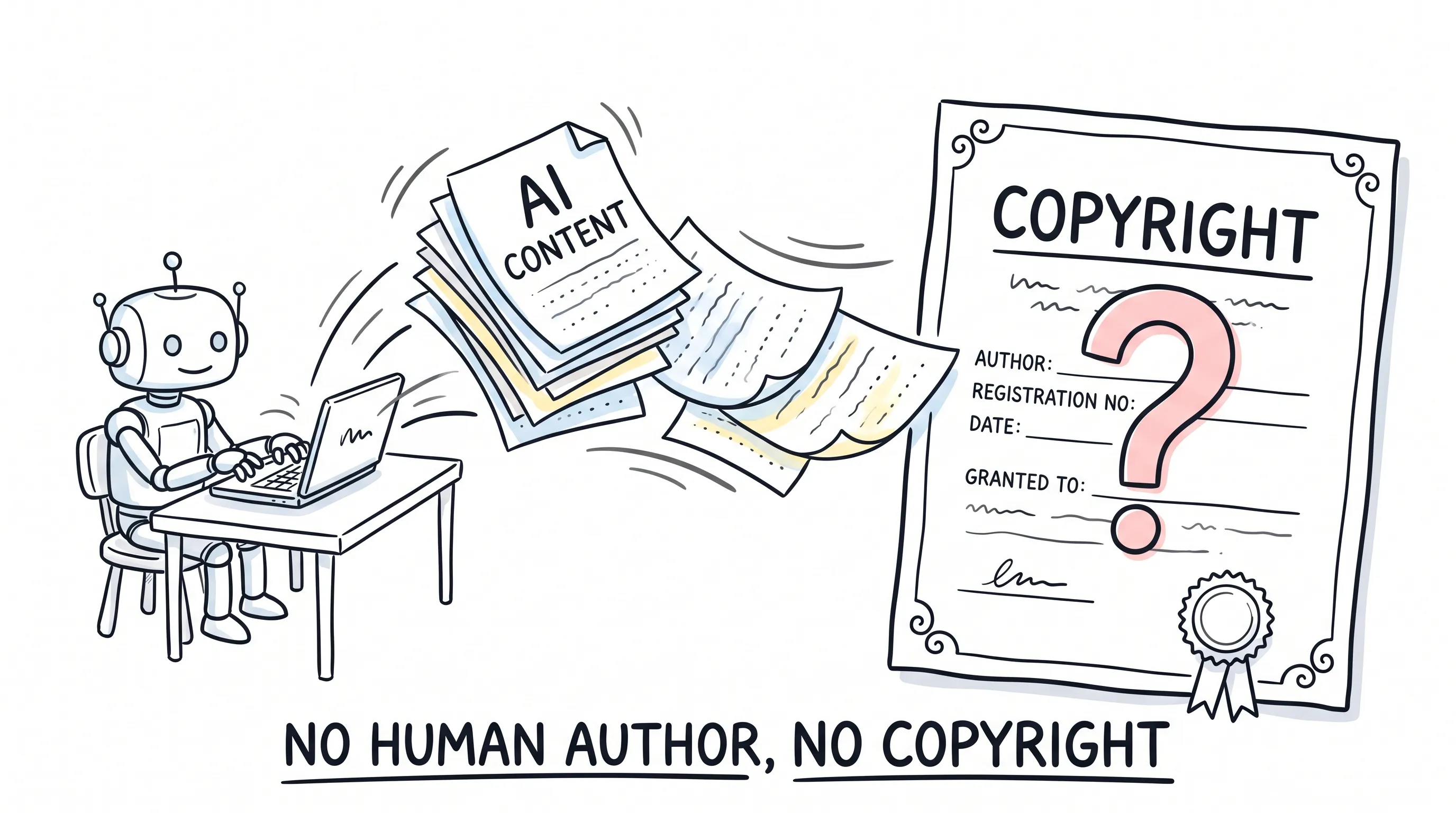
First, the Bad News: The Law Recognizes Humans, Not Machines
US copyright law has one hard-and-fast rule: a work must have "human authorship."
What does human authorship mean? It means real human involvement in the creative act — someone conceives it, someone makes the choices, someone revises, someone makes the final call.
So what if AI did everything from start to finish, and all you did was hit "publish" at the end?
In the law's eyes, that content has no author. No author, no copyright.
I'm not guessing. Someone actually tested this.
A researcher submitted one of his AI-generated images to the U.S. Copyright Office for registration, listing the machine as the author. The Office refused. He pushed back and took the fight all the way to court. In 2023, a federal court ruled against him — the case now known as Thaler v. Perlmutter: AI-generated works without meaningful human involvement are not protected by copyright. In 2025, the appeals court upheld the ruling.
That position is gaining acceptance across a growing number of countries and regions.
The one-line takeaway: No human input, no rights the law will recognize.
The Part That Stings Most: Your Content Is Practically Ownerless
Some will say: fine, no copyright, no big deal — I never planned to sue over my content anyway.
Naive.
Think about it: you spend serious money promoting an AI-generated slogan, and it takes off. Three months later, a competitor lifts it word for word — not a single character changed.
So you take them to court. On what grounds?
The copyright you'd need doesn't exist in your hands. It's not that you'd lose the case — there's no case to bring at all. Legally, your output is practically ownerless property: anyone can copy it, anyone can alter it, anyone can monetize it.
You used AI to push production costs down to a tenth. Great. But content without copyright, however cheap to make, is a giveaway.
The money you saved ends up as the plagiarist's profit.
Three Landmines — and Every One of Them Hurts
Loss is only half the story. The other half is risk.
The first landmine: stepping on someone else. An AI-drawn poster that resembles a brand's visual language; an AI-coined brand name that collides with someone's registered trademark. These disputes aren't the least bit novel anymore.
The second landmine: dirty tools. Vast numbers of AI models were trained on copyrighted works. Whether what they hand you rests on clean legal ground is still an open question in the courts.
The third landmine: you can't prove your own contribution. When trouble hits, the court asks: what did a human actually contribute to this work? You scroll through every chat log and can't find a single revision note of yours.
Game over.
One about other people, one about your tools, one about you.
What Now? Six Moves
This is not a case for banning AI. AI is the most powerful productivity tool of our era — refusing to use it would be foolish. The key is how you ride: treat it as your copilot, not your driver. You set the direction, you watch the road, and at the critical moments your hands stay on the wheel.
Six moves. Skip none of them.
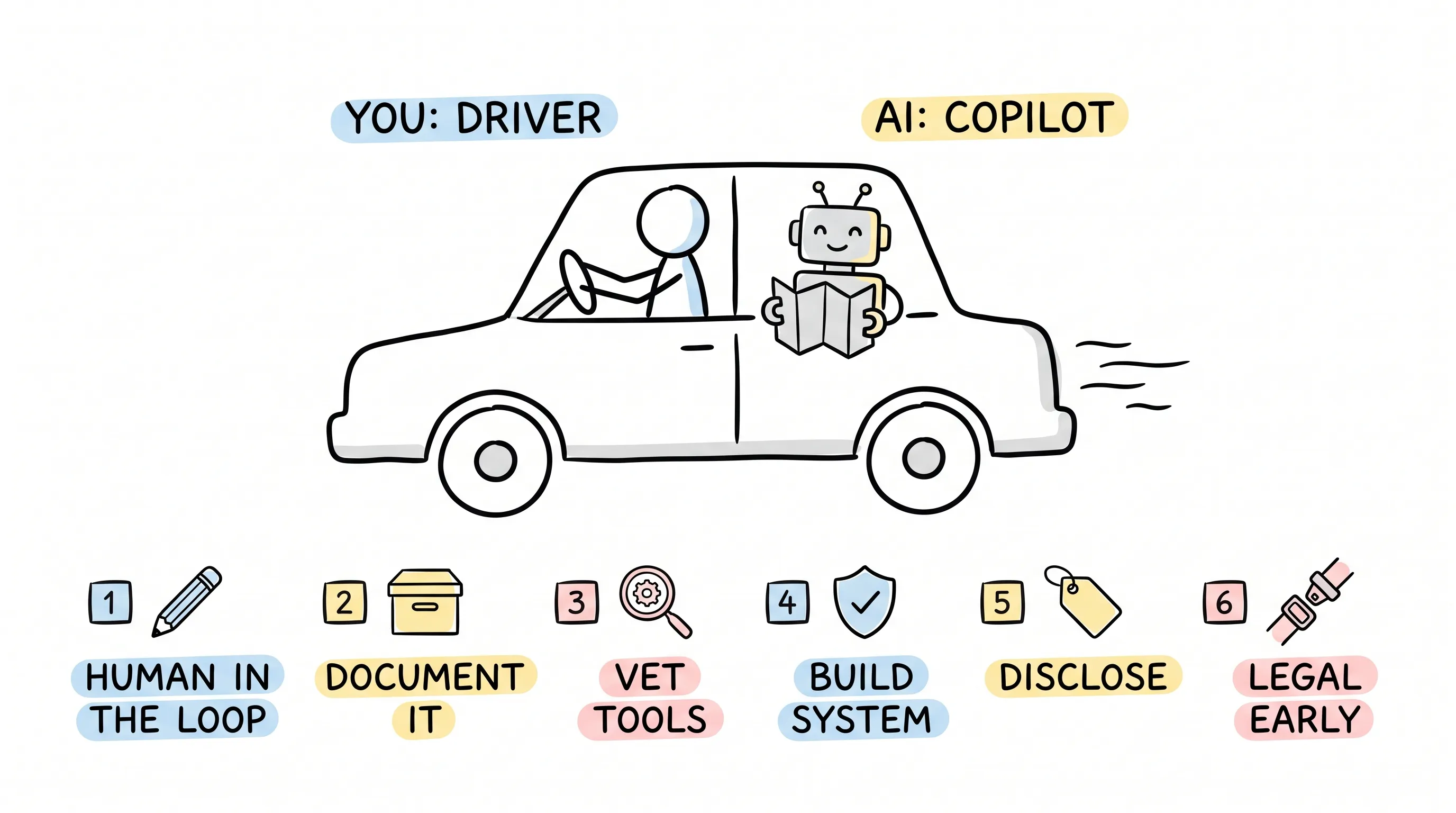
1. Humans must genuinely get in the game.
AI drafts; you revise. Revise to what degree? Until your judgment is visibly stamped on the work: which paragraphs you cut, which words you swapped, why you rejected the AI's first version.
Your choices are the seeds of copyright.
2. Document the process.
Creative work needs bookkeeping too. Archive your prompts, keep a trail of every revision, and write down who made the final call and why.
On a normal day, it's a running log of team collaboration. On a bad day, it's the only evidence you can produce.
3. Vet your AI tools like you vet suppliers.
Don't charge in at the sight of the word "free." Get three answers first: Where did the training data come from? What do the licensing terms say? Can the output be used commercially?
If a vendor can't answer any of the three, think twice before you use it. You check a supplier's credentials before buying raw materials — why would you plug in an AI tool with your eyes shut?
4. Build a system; don't rely on self-discipline.
Which tools are approved, for which use cases, who reviews copy, who reviews images, where the red lines sit — write it all down in black and white, and run it as a real compliance process.
At least one of those red lines: how user personal data may be fed to AI, and how you'll comply with privacy laws like GDPR and CCPA. Don't start studying the rules when the fine arrives.
And don't let the policy live only inside a PDF. Run a workshop, walk the team through it start to finish — ten times more useful than firing off an attachment by email.
Fix the review cadence at the same time: in high-risk sectors like healthcare and finance, review content weekly — or even daily; routine marketing materials, monthly; general business content, quarterly spot checks plus a full audit every six months.
Whatever you do, don't remember it exists once a year.
5. Disclose when disclosure is due.
In many places, the law doesn't yet force you to declare AI involvement. Should you label it anyway?
My advice: label it. What does "AI-assisted" cost you? Nothing. What you get in return: user trust, goodwill from regulators, and a head start on whatever the rules become. For B2B materials and investor documents, state it openly and proudly.
Before the law catches up, transparency is already a competitive edge.
6. Bring legal in early.
One last move. Too many companies meet their lawyer for the first time after something has gone wrong. The right posture is to seat legal at the start of the creative process: choosing tools, they're there; setting policy, they're there; reviewing content, still there.
Legal isn't a fire extinguisher; it's a seatbelt. The extinguisher is for after the crash. The seatbelt keeps the crash from happening at all.
Back to My Friend
So what did she do?
She went back and set one team rule: AI drafts, humans revise until someone can sign their name to the result; every prompt and revision record gets archived; and every quarter, legal reviews the list of tools in use.
Output speed barely slowed.
She said the biggest change: she sleeps at night again.
Marketers love speed, and AI delivers speed like nothing before. But the law walks — and it walks slowly. The gap between your speed and the law's speed is your risk exposure. Close it ahead of time, or it will sit there waiting for you.
AI handles the speed. Your job is to make sure what the speed produces actually belongs to you.
And here's a better wish for you: may you never need that chain of evidence — because no one dares to mess with you in the first place.
Continue reading
Related articles

Cross-Border Business: Time to Upgrade Your AI Toolbox
A learn article explaining how AI tools help cross-border e-commerce sellers clear five hurdles: language, regulation, logistics, payments, and fraud. It outlines a five-compartment toolbox, a five-step adoption path, and metrics such as conversion rate and CLV, while cautioning against over-reliance on AI.

AI Is Taking Over the Dirty Work of Social Media Marketing, One Task at a Time
This learn article outlines four social media marketing tasks AI can handle — audience analytics, content drafting and design, ad targeting and creative testing, and spam moderation — and cautions that taste, judgment, and data security remain human responsibilities.

AI Is Already This Good — Why Is Your Social Media Marketing Still Pure Manpower?
An overview of 18 AI tools for social media marketing, organized into six categories covering audience research, content creation, scheduling, comment and DM handling, ad management, and visual production, plus notes on personalization, prediction, and emerging trends.