
Your AI Employee Is Working Somewhere You Don't Even Know About
Drawing on LeanData's 2026 survey of 157 B2B practitioners, this article examines how AI agents touch customer records across GTM stacks, why data quality gaps and missing audit trails create governance risks, and why teams should sort out data, rules, and accountability before adding more agents.
A while back, a friend of mine who does B2B marketing had lunch with me, and we got to talking about how his company was adopting AI agents. He said something I still remember:
"We're already using AI to reach customers. But honestly — how many AIs are touching our customer data? Nobody can say."
Right away, something felt off.
When I got back, I started digging into the data. Turns out my friend's company is not an isolated case.
In May 2026, LeanData released its 2026 State of AI Go-to-Market Readiness Report, surveying 157 B2B practitioners across revenue operations, marketing operations (MOps), sales, and IT. One number made me stop and stare for a long time:
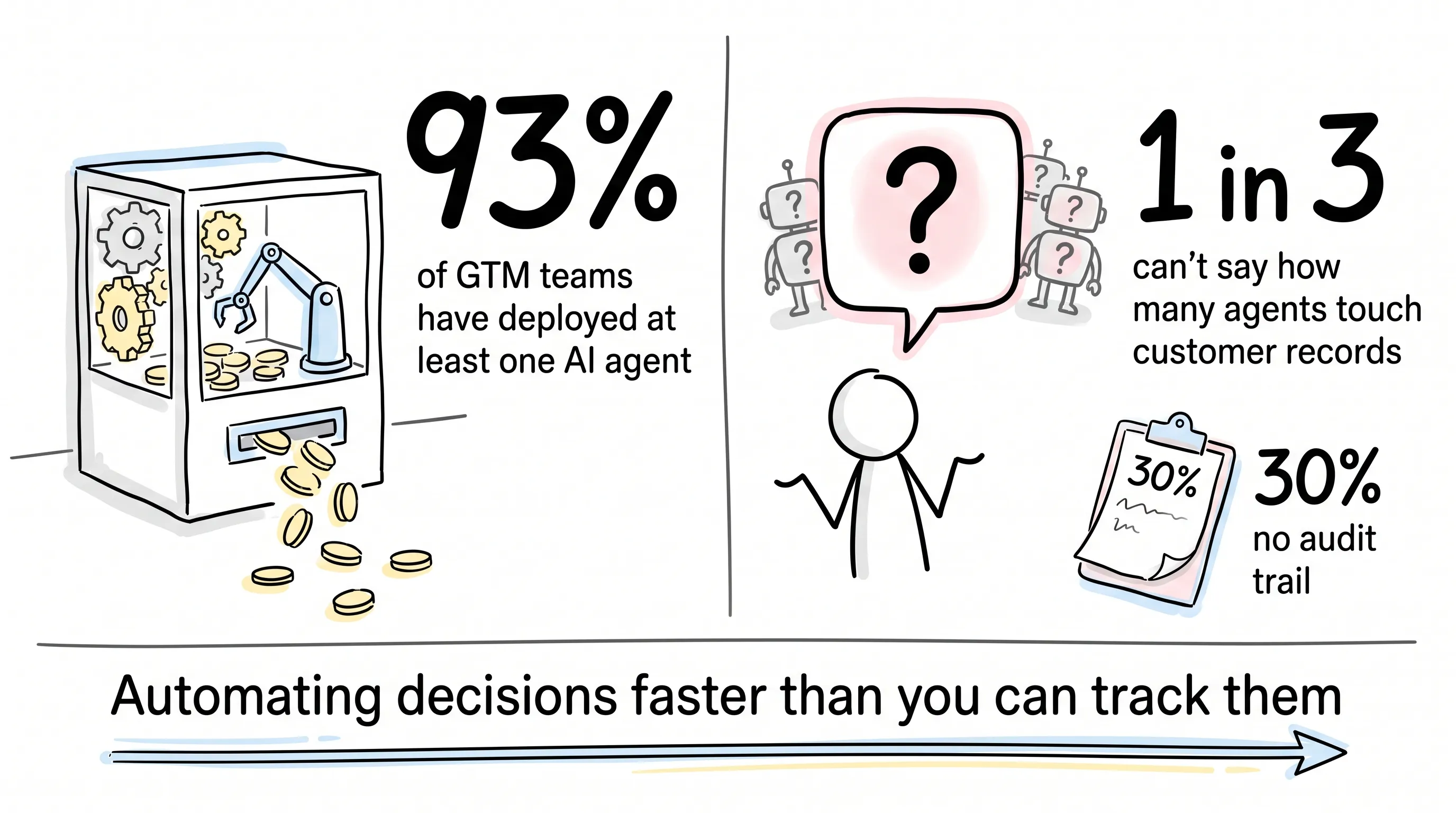
93% of GTM teams have already deployed at least one AI agent.
What is GTM? Go-to-Market — the entire set of moves a company makes to bring its product to market: acquiring leads, scoring them, following up, closing deals. Think of it as the company's money-making machine.
Today, 93% of those machines have AI parts installed.
But hold the applause.
Nearly one in three of the teams surveyed couldn't say exactly how many agents are operating on their customer records. 30% of teams have caught actions with no audit trail whatsoever.
What's an audit trail? A record of who did what to which piece of customer data, and when. Without it, when something goes wrong, you don't even know who to hold accountable.
Put simply: a lot of companies are now automating decisions faster than they can track them.
An Old Problem, a New Amplifier
So here's a question: are the troubles AI agents bring actually new troubles?
Not really.
Think about it: which data do AI agents run on? The same old customer data. Which processes do they run? The same MOps processes that have spent years wrestling dirty data.
Bad data in, AI makes bad decisions — and it makes them far faster, and at far greater scale, than any human.
The report's numbers are striking: 55% of respondents named data quality and AI readiness as the biggest challenge on the road to AI transformation. 70% admitted that data hygiene issues are already dragging down GTM execution.
And then the incidents happen.
27% of teams have watched multiple tools or agents reach out to the same prospect. What does that look like? The customer gets an email from System A on Monday, a call from System B on Tuesday, a push notification from System C on Wednesday. All three systems think "I'm doing a great job." The customer feels exactly one thing: has this company lost its mind?
And 17% of teams have seen an even more awkward scene: a salesperson is negotiating a deal with a customer while a marketing automation sequence is still emailing that same inbox — "come learn about our product."
AI isn't amplifying your capabilities. AI is amplifying the problems you already had.
According to the report, the number-one reason AI projects stall is bad data, at 45%. Next is undocumented processes, 37%. Then silos, 32%.
Look at those three. Which one did AI create? All old problems.
Your AI Employees Come from Three Different Departments
So why are agents so hard to manage?
Because they arrive from too many places.
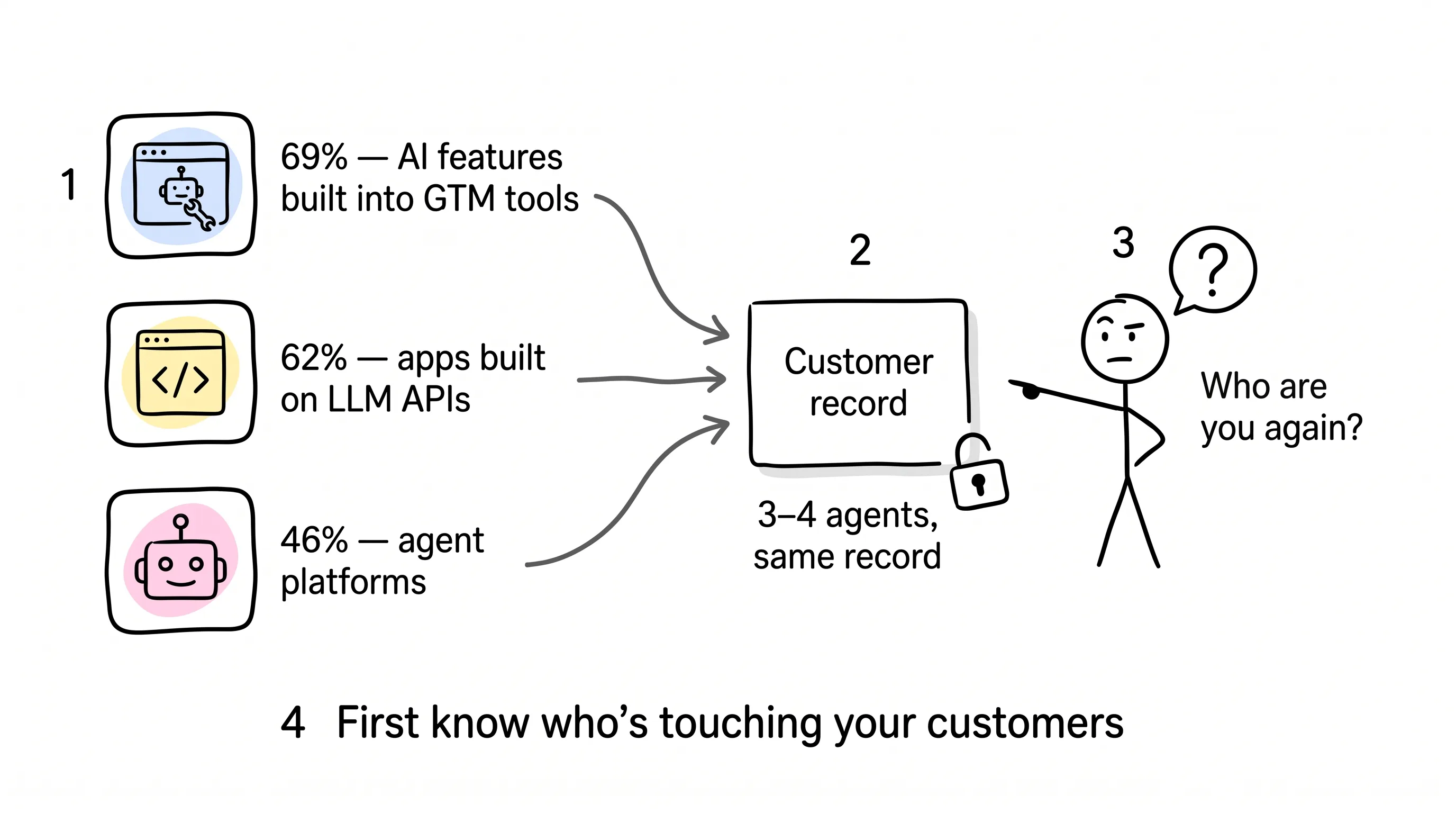
69% of teams use AI features built into their GTM tools — the ones embedded in products like Gong, Outreach, and HubSpot. 62% build their own applications on LLM APIs. 46% are on agent platforms like Agentforce, Copilot, and Gemini Enterprise.
Most teams have all three at once. The most common count is three to four agents.
Let me walk you through a typical scenario.
A prospect enters your system. System one enriches their data. System two scores them. System three drops them into an automated marketing sequence. System four assigns them to a salesperson.
Four systems, each running exactly as designed. And the customer experience? A total mess.
Why? Because they use different data, move at different rhythms, and follow different rules.
It's like a restaurant with four chefs, each glued to their own recipe, never talking to each other. What lands on the table might be four identical bowls of soup.
So before you add the next agent, the real question to ask is not "how strong is this agent?" It's: in the system right now, which agents already have permission to modify customer records? What data are they using? What are they allowed to do?
Ask those questions, and another number in the report will make you smile knowingly: when asked what they want from the technology orchestrating their GTM motions, 31% of respondents picked the same answer — a complete audit trail for every action taken on every customer record. And 21% said agents must play by the same rules as the human team.
Translate that into plain English, and what people actually want is remarkably simple: first figure out who's touching my customers — then we'll talk about intelligence.
The Hard Part Isn't the Technology. It's Who's in Charge.
Agents are this messy — so who's supposed to govern them?
The report's answer: that fight hasn't been settled.
In 42% of organizations, a cross-functional committee owns GTM AI strategy. In 19%, nobody owns it — everything is improvised. In 18%, RevOps is explicitly in charge.
A cross-functional committee sounds lovely, right? Every voice gets into the decision.
But a committee can set direction; it can't set rules. The people who actually maintain the day-to-day operating rules — which agent can touch which piece of data — are the ops teams.
And the ops teams are already exhausted.
66% of GTM operations teams say they either have more work than they can finish, or they barely keep up with day-to-day operations and have zero bandwidth for anything strategic. Only 8% of teams say they're adequately staffed.
8%.
On one side, 93% of teams are rushing to deploy agents. On the other, only 8% of ops teams have any capacity left to keep an eye on them.
This is almost a perfectly engineered recipe for losing control.
So my take is simple: it's not that AI agents shouldn't be deployed — it's that they're being deployed in the wrong order. First take inventory of what you actually have: is the data clean, are the rules documented, can you hold anyone accountable when something breaks. Then let the agents in.
Finally, here's a wish for you: may every AI agent in your company be one you can call by name.
Otherwise, when a customer complaint comes in at 2 a.m., you won't even know who to yell at.
Continue reading
Related articles

Cross-Border Business: Time to Upgrade Your AI Toolbox
A learn article explaining how AI tools help cross-border e-commerce sellers clear five hurdles: language, regulation, logistics, payments, and fraud. It outlines a five-compartment toolbox, a five-step adoption path, and metrics such as conversion rate and CLV, while cautioning against over-reliance on AI.

AI Is Taking Over the Dirty Work of Social Media Marketing, One Task at a Time
This learn article outlines four social media marketing tasks AI can handle — audience analytics, content drafting and design, ad targeting and creative testing, and spam moderation — and cautions that taste, judgment, and data security remain human responsibilities.

AI Is Already This Good — Why Is Your Social Media Marketing Still Pure Manpower?
An overview of 18 AI tools for social media marketing, organized into six categories covering audience research, content creation, scheduling, comment and DM handling, ad management, and visual production, plus notes on personalization, prediction, and emerging trends.