
Your Ads, Not Your Call
A learn article on brand safety in the AI era: how easily AI-generated ads can be replicated or parodied, why purely AI-generated ads may lack copyright protection, and why marketing teams keep adopting AI despite reduced control over their brand.
A while back, I had dinner with a friend who runs a consumer brand. He looked exhausted — the moment he sat down, the venting began.
Last month, his team had used AI to generate a new set of posters. The concepts and the color palette all came from the model — fast and cheap. A few days after they went out, he spotted a knockoff in his social feed while scrolling: nearly identical composition, the logo swapped for another company's, the copy spiced up with a few jokes of its own. It was spreading even harder than the original.
Furious, he went to have it out with them — and discovered they'd simply used an image generation tool too. One monthly subscription. A few dozen yuan.
When I heard this, I drew a sharp breath.
Because this is no longer one man's bad luck. Everyone working in marketing today will run into it in some form — or soon will.
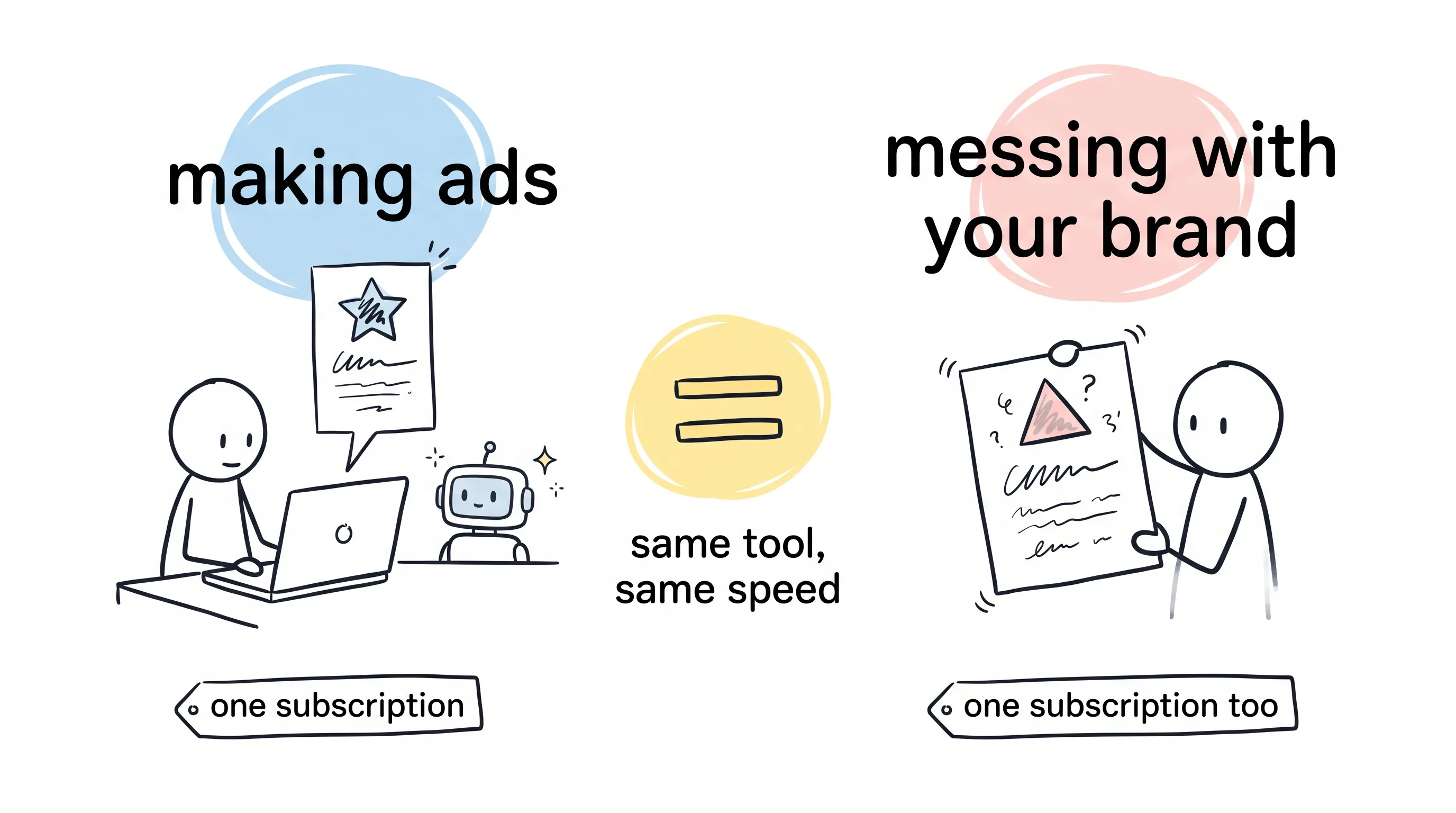
In the AI era, making ads has never been easier. "Messing with" your brand? Just as easy.
What Is Brand Safety?
First, a quick primer.
What is brand safety? Simply put: will your brand image, ad creative, and logo end up being used — in places you can't see — to do things you never wanted them to do?
In the past, the worry was the media environment: would your ad appear next to the wrong kind of content?
Now the problem has escalated. Your ad itself may be something someone else "generated."
So let me tell you three stories.
Story One: You Can't Control It
Dude Wipes, the American brand that sells flushable wipes. When its co-founder and CMO Ryan Meegan was asked about this, he told it straight: anything can happen, and you really can't control it. Anyone, with nothing more than a tool subscription, can recreate your entire brand campaign.
So what do they do?
Keep using AI.
It's not that they don't care — it's that they can't stop. Everyone in the industry is using AI to move faster; if you halt to play goalkeeper, the goal may still get breached while you lose the market first. So their choice is pragmatic: keep running, and handle problems when they actually happen.
It sounds like surrender, but it isn't. These marketers have seen this movie before. VML Chief Innovation Officer Brian Yamada compares the current wave to the early days of social media: people flood into a new space, gather around your brand, and say whatever they please — praise or abuse.
The out-of-control script already ran once, twenty years ago.
Story Two: Parodied for Thirty Years
Back in the 1990s, Mastercard ran a classic ad: "Priceless." You know the formula: two tickets cost this much, a hot dog and a beer cost that much, and the moment of watching the game with someone you love? Priceless.
How iconic is it? So iconic that everyone wants to take a swing at it.
Saturday Night Live used it to riff on the Clinton scandal. In 2000, presidential candidate Ralph Nader shot a campaign ad using its formula to attack George W. Bush — and Mastercard took him to court. In June 2025, the film studio A24 rode the "priceless" meme to promote its movie Materialists.
One ad, parodied for nearly three decades straight. That's the price of being a classic.
More interesting is Mastercard's attitude. Cheryl Guerin, Executive Vice President of Brand Strategy and Innovation, says that as long as the imitation stays tasteful and the portrayal is positive, these parodies actually extend the brand's visibility — exposure you didn't have to pay for.
Turns out a company with its logo on credit cards all over the world sees all this more clearly than you'd ever guess.
When it comes to controlling the narrative, brands have never truly won.
That was true in the social media era, true in the UGC era, and truer still in the influencer age. David Corns, Chief Business Officer at the real estate tech company Opendoor, says that for a while, a single offhand remark from an influencer hit a brand's reputation harder than the brand's own official statements.
AI is just the latest stretch of that loss-of-control curve.
Story Three: Zero Trust
Well then — inside the company, you can surely keep things under control?
One agency is doing exactly that. They build bespoke AI agents for client brands, trained on the client's brand guidelines and past campaign plans, so that everything the agents produce stays locked inside the brand's voice.
Architecturally, they run a "zero trust" setup, and its principle comes down to a single line: never trust, always verify. Employees are encouraged to use the company's in-house AI tools; pop-ups on the interface remind them of proper use; legal runs training sessions on a regular basis; company computers are monitored the whole way through — every input and every output can be audited and traced.
Pretty airtight, right?
But here's the awkward part: what happens when employees clock out, sit down at their own computers, with their own accounts and their own ChatGPT?
You can't. And by default, tools like that train their models on whatever you feed them. You can tell employees never to paste client data into the chat box — but whether anyone actually did, you can't see.
So the executive, who asked to remain anonymous, put it bluntly: what they can audit is only the inputs and outputs on company devices. Beyond that door, it's a different story.
Enterprise-grade, commercial generative models do offer somewhat better protection for brand IP — Yamada concedes that. But the tools on the market hardly stop there, and safeguards have never been a guarantee.
What About the Law?
Many people's first instinct is: sue them.
David Teske, a partner in the technology and privacy practice at the law firm Alston & Bird, poured cold water on that idea: sure, you can send a cease-and-desist letter, but when it comes to AI copyright infringement, no real case has made it to court to this day — and government regulation and industry rules barely exist.
The real sting is this: an ad generated purely by AI may not be protected under current copyright law. Because copyright protection has a precondition: a human creator must be involved. If your ad is AI-generated and someone reuses it verbatim, you may not win the lawsuit.
The money AI saved you may come due as "lost exclusivity."
Coca-Cola is already experimenting with AI-generated ads. And the AI videos flooding social feeds are forcing Meta, YouTube, and TikTok to chew on the same question day after day: how do you open up generative tools without letting users lose trust in the platform?
Knowing the Pitfalls, Why Rush In Anyway?
Because the math is easy.
What AI gives you is real efficiency and speed, and savings you can see. What AI asks of you is an uncertain risk: maybe a parody, maybe a replica.
On one side, certain gains; on the other, uncertain risk. I don't need to tell you how most organizations would choose.
That's not recklessness. That's rationality.
But I like how Opendoor's Corns puts it: treat AI as the copilot of advertising. It's a new frontier, and you have to be ready to adapt at any moment.
My friend came around eventually. If a poster gets replicated, count it as free advertising for the brand; if someone really misuses the brand's image, deal with it then.
When dinner ended, he raced to grab the check. As we left, I asked him: still using AI?
He said: Duh. Of course I do.
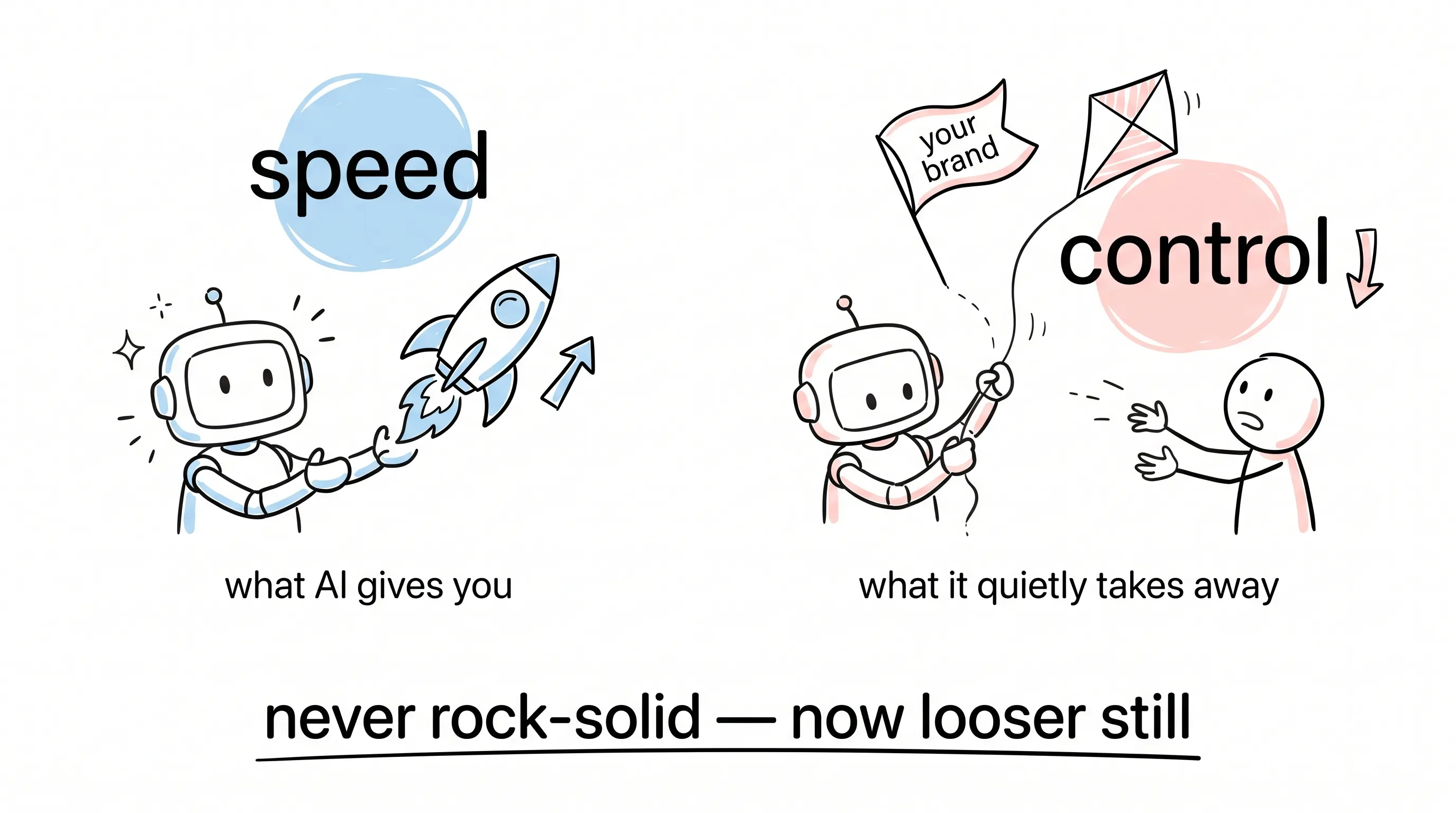
What AI gives you is speed; what it quietly takes away is control of your brand. That control was never rock-solid to begin with — and now it's looser still.
May your AI run fast and stay steady.
And may you never become the star of the next "replica."
Continue reading
Related articles

Cross-Border Business: Time to Upgrade Your AI Toolbox
A learn article explaining how AI tools help cross-border e-commerce sellers clear five hurdles: language, regulation, logistics, payments, and fraud. It outlines a five-compartment toolbox, a five-step adoption path, and metrics such as conversion rate and CLV, while cautioning against over-reliance on AI.

AI Is Taking Over the Dirty Work of Social Media Marketing, One Task at a Time
This learn article outlines four social media marketing tasks AI can handle — audience analytics, content drafting and design, ad targeting and creative testing, and spam moderation — and cautions that taste, judgment, and data security remain human responsibilities.

AI Is Already This Good — Why Is Your Social Media Marketing Still Pure Manpower?
An overview of 18 AI tools for social media marketing, organized into six categories covering audience research, content creation, scheduling, comment and DM handling, ad management, and visual production, plus notes on personalization, prediction, and emerging trends.