
You Use AI for Efficiency—Then Grade It on Revenue: Most Companies Are Handing Out the Wrong Exam
A strategy essay noting that most companies use AI for efficiency while grading it on revenue, and arguing that marketers should focus on customer value, GEO, and AI visibility so their brands appear in AI answers.
A few nights ago, I had dinner with an old friend who used to run a company as CEO.
Somewhere between the appetizer and the main course, we got to talking about AI. Out of nowhere, he asked me: what do you think is actually keeping CEOs up at 2 a.m.?
I said, you tell me.
He counted on his fingers and came up with five questions:
One: can AI help me make more money? Two: can AI upgrade my core strategy? Three: how do I get my management team to actually understand AI? Four: when it comes to AI, should I build it myself, buy it, or find a partner? Five: how on earth should I measure what AI does for my business?
I said, all five hit hard. But have you noticed there's another question sitting underneath all five?
He asked: what question?
How can AI make your company more valuable to your customers?
Before you wave this off as a hollow line, hear me out. When I got home, I dug into some data—and the deeper I dug, the more it looked like this one line is the answer to every AI question being asked today.
A Set of Numbers That Made Me Sit Up Straight
In 2026, the research firms Epsilon and Fuld ran a benchmark study. They asked 257 marketing decision-makers one question: what do you mainly use AI for?
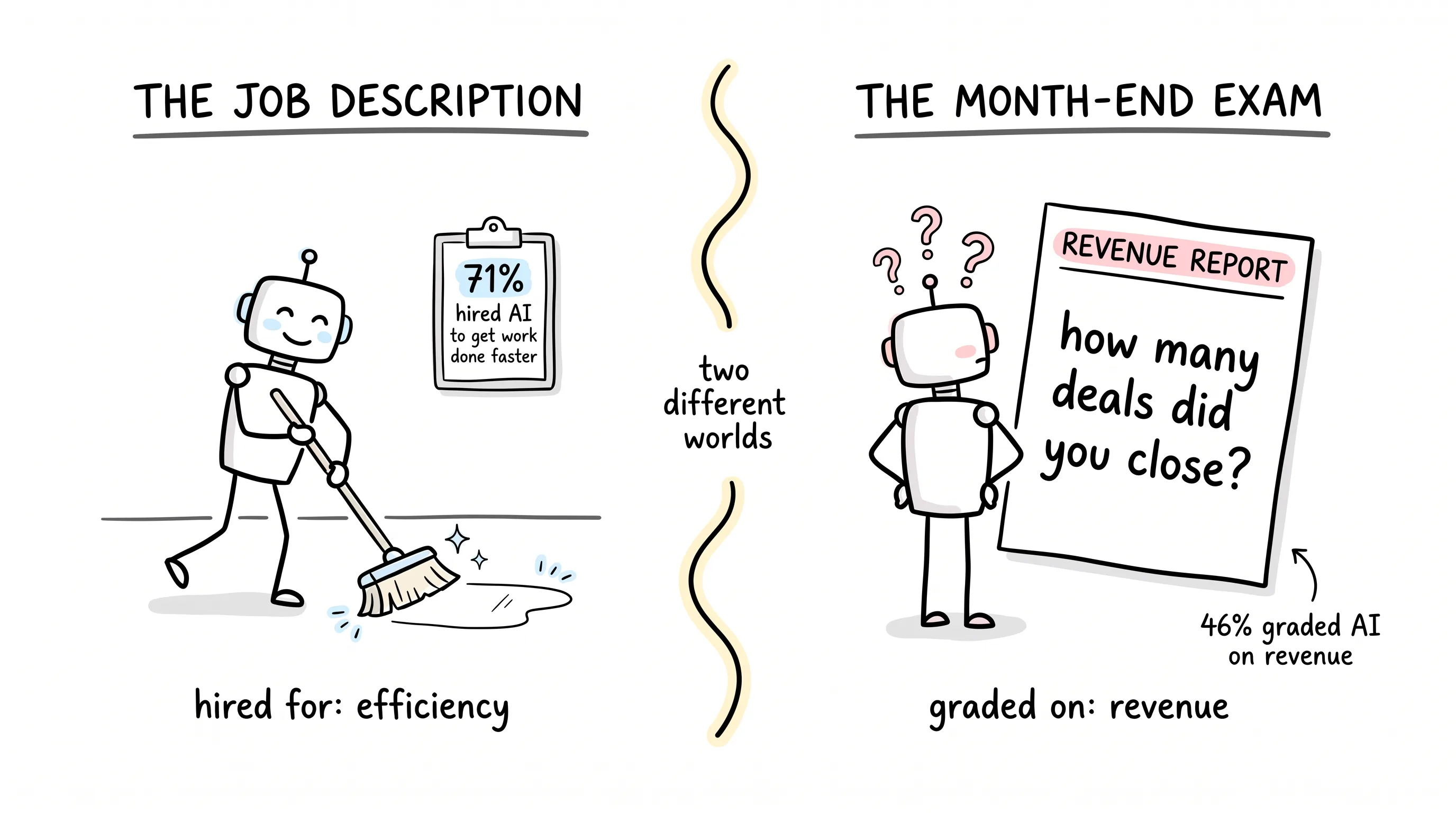
71% said: efficiency. To get my work done faster.
Only 9% said: to create revenue with it.
My first reaction was: isn't that normal? Cutting costs and boosting efficiency—what could be more natural?
Hold on. The same group of people was then asked a different question: how do you measure AI's impact?
46% answered: by revenue. Time saved came in at 36%, cost savings at 16%.
Chew on those numbers for a second.
In the job description, AI is a housekeeper—hired to tidy up the place. On the exam, AI is a sales rep—expected at month-end to show how many deals she brought in.
It's like hiring a housekeeper. She gets the house spotless fast, and you're delighted. Then at month-end you call her over and ask: so, how many new contracts did you close for me this month?
What can she do? She's just as baffled.
Is the problem with the housekeeper? No. The problem is that your use case and your exam live in two different worlds.
That is AI's real predicament inside most companies today. And it's why I keep saying that when AI's shock wave finally lands, it will land on marketing.
Why Marketing, of All Places?
For the past twenty years, marketing played a simple game: buy attention.
Buy a slot on the search results page, buy impressions in the feed, pour people in at the top of the funnel, harvest them at the bottom. At its core, this was a business of spending money: money in, people in.
AI answer engines just took that machine apart.
What do I mean by "took it apart"?
You can't pay your way into a citation inside an AI answer. AI cites only what it considers worth citing. The position isn't bought—it's earned. Earned with what? With your brand's reputation, with the word-of-mouth you've banked in the real world.
Marketers can already feel it. Back to that same Epsilon study: GEO—generative engine optimization, optimizing to show up in AI search—has overtaken conversational AI and data analytics with a 54% adoption rate, making it the most-used AI tool among marketers.
And content generation tools, ranked No. 2 just a year ago? This year, they didn't even crack the top ten.
The first time I saw that shift in the rankings, I did a double take. In a single year, the top tool's job went from "help me write" to "help me get seen."
The wind has shifted.
Five Questions, One Answer
All right, back to my friend's five questions. Hold the sixth question up as your yardstick, and every single one gets an answer.
Question One: Can AI Help Me Make More Money?
Someone has actually run the numbers.
Delta Air Lines CEO Ed Bastian has said that in the long run, AI could lift Delta's profitability by roughly 50%. How? By moving operating margins from around 10% to around 15%, powered by smarter pricing and scheduling.
My goodness. 50%.
But pay attention: everything he describes is in service of a better customer experience.
The more critical ledger runs the other way: how do you keep AI from stealing your profit?
Gartner forecast earlier that by 2026, traditional search traffic will fall by 25%, as product-related queries get intercepted by AI. Adobe tallied up the 2025 holiday season: traffic AI sent to U.S. retail sites grew 693% year over year, and it converted 31% better than non-AI traffic. When I first saw 693%, I assumed it was a typo—went back and double-checked. It wasn't.
Then there's Forrester's finding: companies that lean hard on AI do see clear productivity gains, but their cost savings come in under 10%, and revenue growth under 5%.
Put these numbers side by side and they all say the same thing: productivity is productivity, revenue is revenue, and between them runs a river called customer value.
If your brand isn't inside AI's answers, all the efficiency you've gained will never turn into revenue.
Question Two: Can AI Upgrade My Strategy?
First, a question for you: did you have a strategy in the first place?
A.G. Lafley, former CEO of P&G, co-wrote a book with Roger Martin called Playing to Win, which draws a line: are you playing to win, or playing not to lose?
If you're playing not to lose, the most AI can offer you is defense. Lose a little less, lose a little slower. That's not a strategy upgrade. That's called stopping the bleeding.
If you're playing to win, AI's job is not to reinvent your strategy—it's to take the strategy you already believe in and amplify it to the limit.
Put bluntly, elevating AI into a stand-in for strategy is nothing but an expensive automation show.
Question Three: How Do I Get My Management Team to Understand AI?
The short answer: make them use it every day.
The long answer: find someone who understands both the technology and your strategy, and wire the two ends together. One warning while we're here: feed proprietary data into public AI tools, and it may well end up public.
But Epsilon's data exposes a deeper layer. 67% of C-suite marketing executives believe their organization is already highly mature in AI. Among the senior managers actually doing the work, only 33% think so.
73% of executives find AI tools extremely valuable. The front line? 25%.
You think what the company lacks is training. What it actually lacks is a single scoreboard. Epsilon's own prescription is the same: put leadership and the team on the same scoreboard.
Executive confidence is running ahead of frontline reality. A perception gap like this is far more dangerous than a skills gap.
Question Four: Should We Build AI, Buy It, or Partner?
Menlo Ventures has tallied it up: for 76% of AI use cases, companies chose to buy outright rather than build.
In other words, on this multiple-choice question, most companies have already voted with their feet. My view is the same: buy what's generic; build or partner only on the ground where proprietary capability lives.
And Epsilon's researchers arrived at the same conclusion from another angle: 100% of marketers now use AI, which means using AI itself no longer earns you any advantage.
Just as no company today wins because it installed a telephone.
So what creates advantage? Where you point the AI.
If you use AI to mass-produce marketing content and churn out copy identical to your competitor's, you think you're boosting efficiency. You're actually paying good money to turn yourself into a copy of everyone else: the more efficient you get, the more you resemble your rivals, and the less anyone remembers you.
For every build-buy-partner decision, ask one question: does this make us more distinctive, or just make us look like everyone else at a lower price?
Question Five: So How Exactly Should We Measure AI?
Most companies measure how much work AI did, not what impact AI created.
Epsilon's data shows that marketers have already made revenue their default primary yardstick (46%, ahead of time saved at 36% and cost saved at 16%). The instinct is right. What's wrong is what sits behind those revenue numbers: a use case chosen for internal efficiency was never growing on the tree of customer value in the first place.
For marketing, the thing truly worth measuring is AI visibility.
What is AI visibility? It's this: when your customer asks AI "which brand is best in this category," does your name come out?
AI doesn't care how many ads you bought. It listens to word-of-mouth.
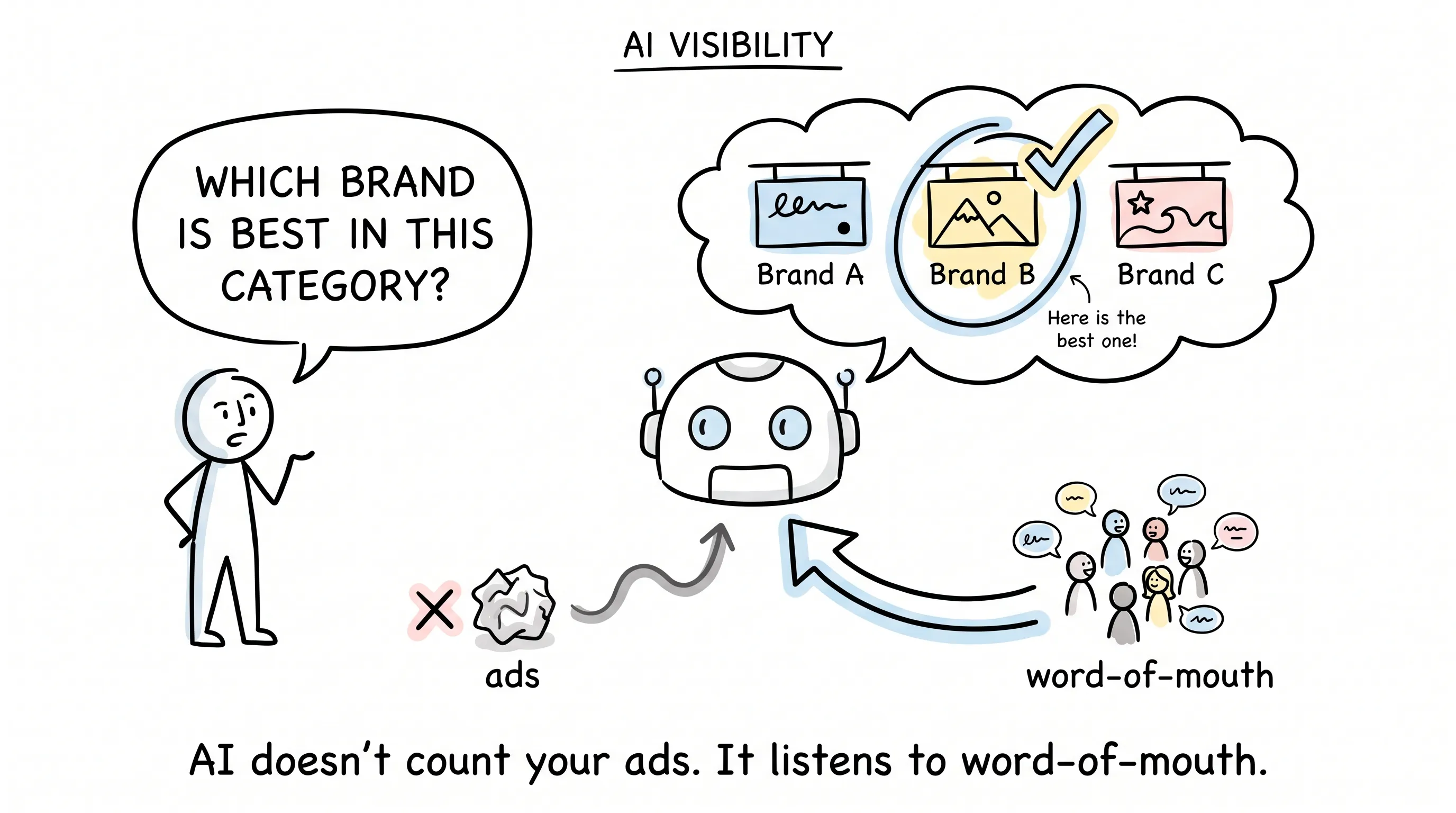
And visibility? The more customers you serve, the more it weighs.
One Last Word
As that dinner was winding down, my friend asked me: so after all that circling, what exactly are you trying to say?
I said, your five questions keep running into the same wall: everyone uses AI diligently and grades it earnestly, but the goal being optimized is always "are we getting better at what we do?" The question that should be asked is: does the person who pays us feel they're getting more for their money?
The former makes you faster. Only the latter makes you worth more.
Use AI to create experiences that make customers feel valued. Once they feel it's worth it, your revenue and your profit will sprout, one after another, through that opening.
That's where AI's value starts compounding.
He said: fine. Tonight I'm going back and pulling out our scoreboard for a look.
I said, you should. And may the exam you're grading be the lesson you're teaching.
Continue reading
Related articles

Cross-Border Business: Time to Upgrade Your AI Toolbox
A learn article explaining how AI tools help cross-border e-commerce sellers clear five hurdles: language, regulation, logistics, payments, and fraud. It outlines a five-compartment toolbox, a five-step adoption path, and metrics such as conversion rate and CLV, while cautioning against over-reliance on AI.

AI Is Taking Over the Dirty Work of Social Media Marketing, One Task at a Time
This learn article outlines four social media marketing tasks AI can handle — audience analytics, content drafting and design, ad targeting and creative testing, and spam moderation — and cautions that taste, judgment, and data security remain human responsibilities.

AI Is Already This Good — Why Is Your Social Media Marketing Still Pure Manpower?
An overview of 18 AI tools for social media marketing, organized into six categories covering audience research, content creation, scheduling, comment and DM handling, ad management, and visual production, plus notes on personalization, prediction, and emerging trends.