
You Just Want Results — It Deploys the Troops: HubSpot Re-Dug Its Platform's Foundations
A couple of days ago, on the opening day of its Unbound26 conference, HubSpot rolled out a batch of updates.
A couple of days ago, on the opening day of its Unbound26 conference, HubSpot rolled out a batch of updates.
My first reaction after reading through them: this is no longer "a few more AI features." This is tearing down the platform's architecture and re-digging the foundations.
What do I mean? Let me walk you through it.
First, a Question for You
When you use AI day to day, how does it feel?
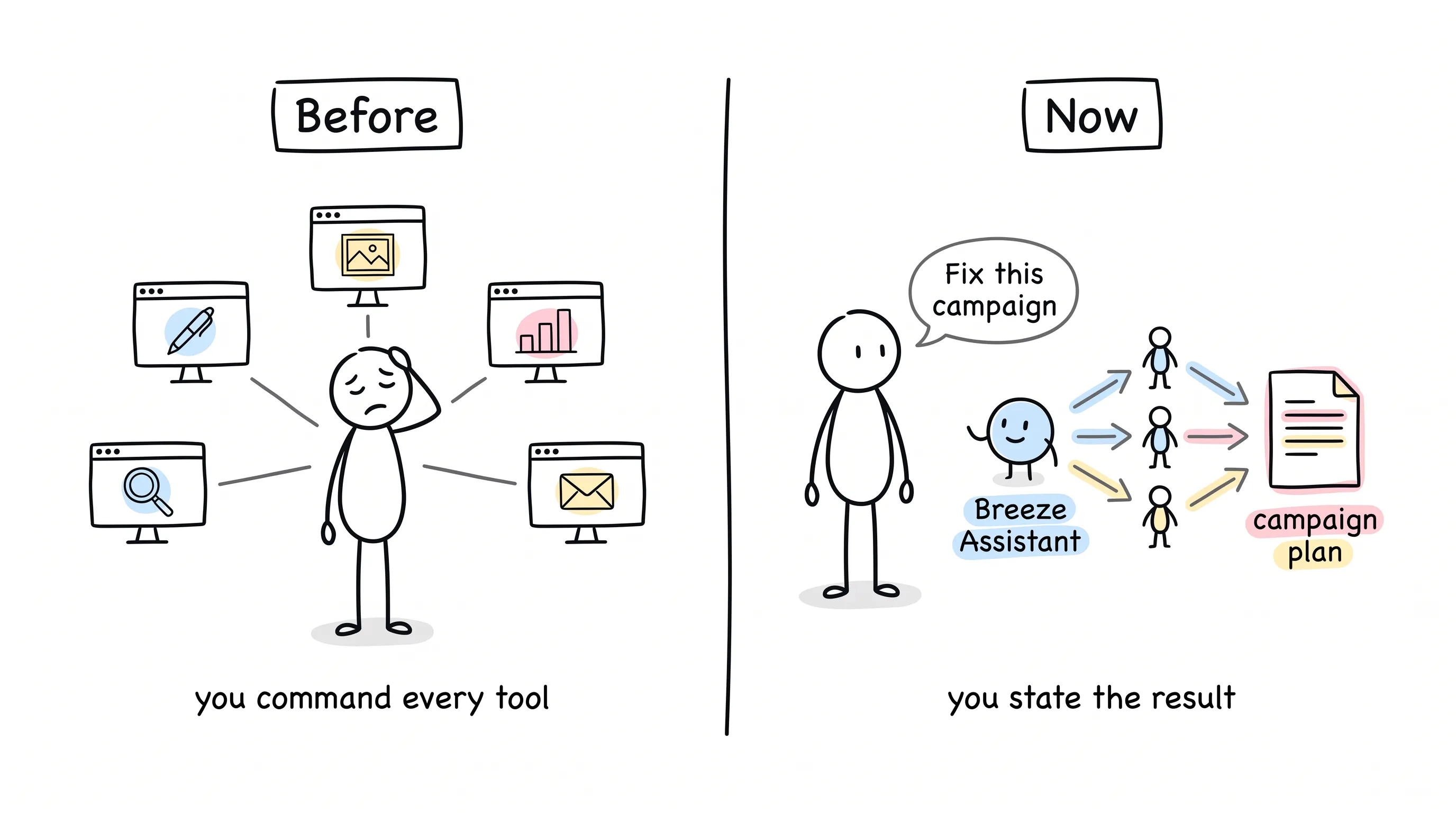
Probably like this: to write copy, you open one tool. To make images, you open another. To analyze data, you open a third. And for every tool, you personally start the conversation, personally feed in the background, personally watch the output.
On the surface, you're the boss of your AIs. In reality, you're the nanny to a dozen of them.
The more AIs you have, the more exhausted you get.
HubSpot's thinking this time is to turn that logic on its head: stop picking tools. Just tell its Breeze Assistant what you want to accomplish. It will pick the right AI agents itself and get the work done.
Your only job is the result.
Before, a human commanded a pile of tools. Now, you state the result, and the AI deploys the troops on its own.
So What Is "Growth Context"?
HubSpot gave the core of this overhaul a name: "Growth Context."
What is Growth Context? Put simply, it pulls together your company's situation, your team's situation, and your customers' situation, and turns it all into "context" that AI can draw on at any moment.
You might think: isn't that just data?
It's not the same. Data is dead. Context is alive.
Let me give you an analogy. Say you hire a brilliant new assistant with an IQ of 180. But on their first day, you hand them nothing: they don't know what your company sells, who your customers are, or where things stood last month. Tell me — how much can they get done?
Smart, but useless.
AI is that assistant. No matter how strong the model is, without context it can't cook up anything — even the finest chef can't make a meal without ingredients.
This time, HubSpot made Growth Context the foundation, and built three buildings on top.
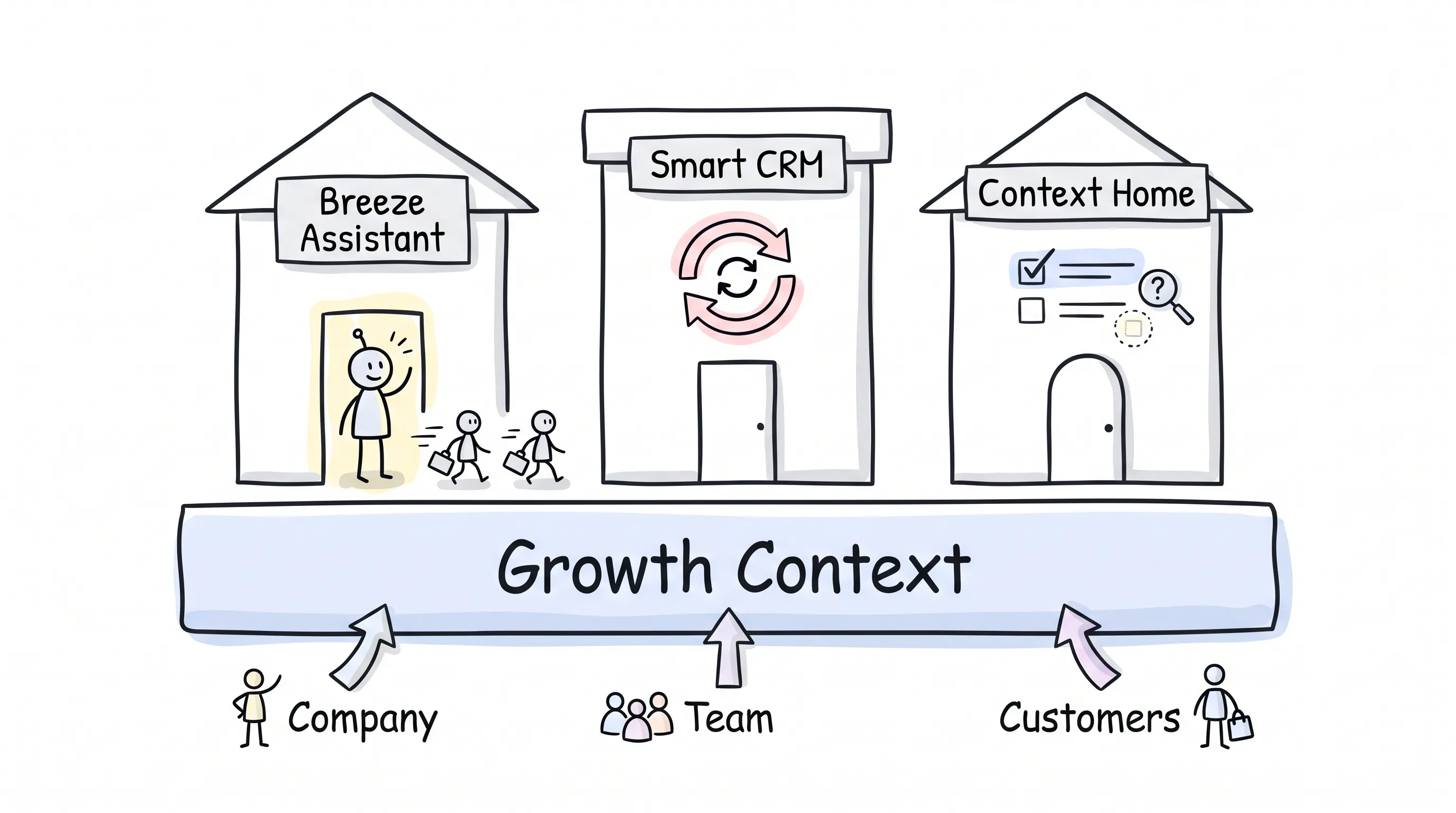
The first building: a redesigned Breeze Assistant. Answering questions, on its own, is no longer enough. Give it a task, and it can marshal the troops — dispatching specialized AI agents to do the work — until what lands in your hands is a finished product: marketing campaign plans, reports, proposals.
The second building: a Smart CRM that updates itself.
The third building: Context Home.
An AI's Memory Can't Run on Manual Labor
Let's take the second building first.
The old CRM had a stubborn, chronic problem: the data had to be entered by hand. A CRM is a customer management system — but a salesperson who has just finished meeting a client may not even be back at the office yet. Who is going to log it into the system? So the customer information in the system is always the version from three months ago.
What good can an AI do, working off an outdated file?
So HubSpot turned Smart CRM into something that "keeps its own records." Calls, emails, meetings — the system captures them and syncs them automatically, instead of counting on employees to type them in.
That's how the context stays fresh.
But everything has a flip side.
On data, HubSpot has hit a wall before. This July, they planned to change their terms of service so the platform could take one customer's data and use it to improve another customer's records. Customers refused to have it — the backlash was loud — and in the end, the company withdrew the clause.
That's the most contradictory thing about the data era: the smarter AI gets, the more it needs your data; but why should your data be free for others to use?
Every company building AI products has to face this question. HubSpot hit the wall once, and took a step back first. Where it goes next is worth every peer watching closely.
Now the third building: Context Home. It scores how complete your team's information is, and tells you where the holes are: this customer is missing a contact; that deal is missing budget details.
Think of it as a health-check report on the AI's "understanding."
Whatever's missing, fill it in. That way, the file in the AI's hands is always fresh, always complete.
On the Marketing Side: AI Finds Its Own Work
What does all of this look like when it lands on marketing?
An example.
Before, these were all things you had to watch yourself: whether your AEO (Answer Engine Optimization) visibility score had slipped — the score that measures whether your content shows up in AI search answers; which campaign segment had stalled; which batch of leads was lying in the system with nobody following up.
Now, Marketing Studio proactively "floats" these things up in front of you.
All you have to say is: this one — fix it.
And Breeze Assistant goes off to call in the crew: content agent, come. Campaign agent, come. Plan the campaign, produce the content, build the personalized nurture sequence — end to end.
Honestly, when I got to this part, one word came to mind: powerful.
The work of AI left behind "helping you write a piece of copy" a long time ago — that's a single task. It is now the whole chain: spot the problem, call in the hands, get the thing done.
And while it was at it, HubSpot widened its ad business. It says it's the first CRM to plug into ChatGPT Ads. Salesforce may not accept that — it depends on how you define "plug into." Either way, leads generated inside ChatGPT will flow back into HubSpot for follow-up and attribution; Microsoft Advertising is on its way in, too.
The bet they're making: string ad engagement, contacts, pipeline, and revenue into one line.
On the Sales Side: 40-Plus Signals Watching Your Customers
The same logic moves over to sales.
The upgraded Prospecting Agent watches more than 40 buying signals. Any new movement on the customer's side, it catches — then helps you piece together the "buying committee" and drafts personalized outreach for you.
The new Mobile Notetaker records conversations and writes up the notes.
Deal Progression takes those records and keeps working: it suggests you update the CRM, drafts the follow-up, and — after you nod — keeps the deal plan up to date.
Revenue Hub goes a step further: you no longer assemble quotes from scratch. Ready-made deal information in the CRM generates them automatically.
In the End, What's Being Contested Is "Remembering"
Coming full circle, have you noticed where HubSpot's whole chess game lands? On taking the "management burden" off your shoulders.
Before, you had to understand every tool and direct every AI agent, like a foreman on a construction site. Now, all you have to do is state clearly what result you want.
Why does it dare to promise this? Because of the Smart CRM and Growth Context foundation: the AI remembers your company and your customers, keeps up with them, and can spot the gaps.
So you see, the second half of the AI race may not really be about whose model is stronger.
The context you give an AI is the output you get back.
This line is for you.
Here's wishing you an AI that "remembers" your customers — and soon.
Continue reading
Related articles

Cross-Border Business: Time to Upgrade Your AI Toolbox
A learn article explaining how AI tools help cross-border e-commerce sellers clear five hurdles: language, regulation, logistics, payments, and fraud. It outlines a five-compartment toolbox, a five-step adoption path, and metrics such as conversion rate and CLV, while cautioning against over-reliance on AI.

AI Is Taking Over the Dirty Work of Social Media Marketing, One Task at a Time
This learn article outlines four social media marketing tasks AI can handle — audience analytics, content drafting and design, ad targeting and creative testing, and spam moderation — and cautions that taste, judgment, and data security remain human responsibilities.

AI Is Already This Good — Why Is Your Social Media Marketing Still Pure Manpower?
An overview of 18 AI tools for social media marketing, organized into six categories covering audience research, content creation, scheduling, comment and DM handling, ad management, and visual production, plus notes on personalization, prediction, and emerging trends.