
Writing Content with AI: Where Does the Money You Save Actually Go?
An Ahrefs survey of 879 marketing and SEO practitioners found 87% use AI for content, with lower per-post costs converting into higher output rather than savings. Most teams keep human review, with AI handling ideation and structure while people retain judgment and final quality checks.
A few days ago, a friend who has spent eight years in the content business invited me out for tea.
He handed me his phone to show me this month's publishing calendar. I counted: 17 long-form articles.
"So you expanded the editorial team?" I asked.
He smiled. No new hires — just new tools. These days, most of their articles start as an AI draft, with an editor polishing them before they go out.
I asked him: aren't you afraid readers will see through it? Aren't you afraid the search engines will come after you?
He said, go home and look at the data.
So I did. In early 2025, Ahrefs ran a survey of 879 marketing and SEO practitioners around the world, fielded from December 2024 through February 2025. One conclusion jumped out: my friend is no outlier.
What Does "Everyone's Using It" Mean? It Means 87%.
Start with one number: 87%.
Of the 879 respondents, 87% already use AI to create content. Only 13% don't use it at all.
You might guess this is a big-company rat race. Small teams could never find the bandwidth, right?
It's the opposite.
Companies with 10 to 49 people: 91% are using it. Enterprises with 1,000 or more: 87%. Even mom-and-pop shops of 1 to 9 people are at 81%.
Big or small, everyone is in.
Using AI to write content is no longer a question of whether to get on board. It's the price of admission.
I've Done the Math for You
How much more work does AI actually get done?
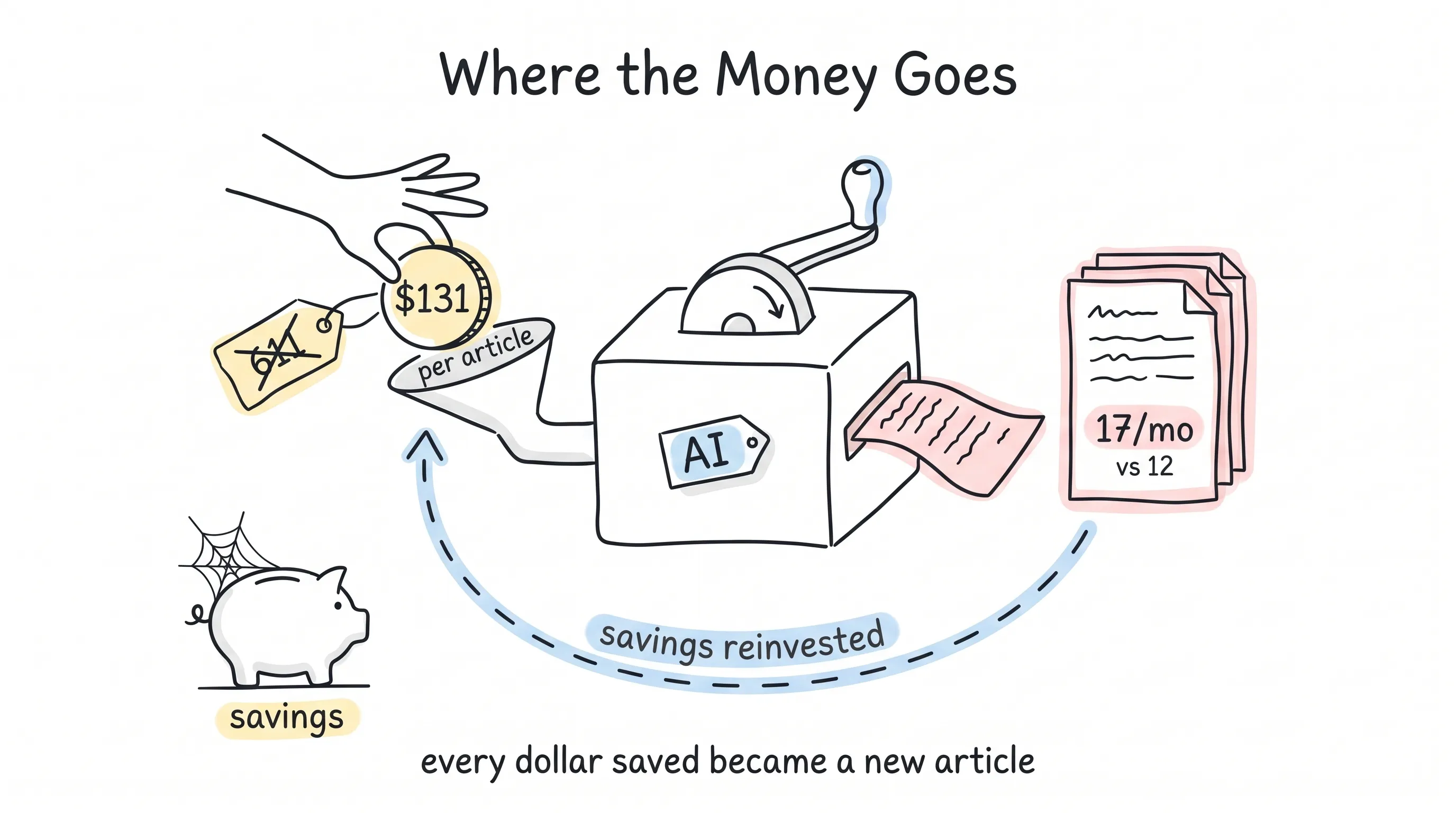
The survey has an answer: companies using AI publish a median of 17 articles per month; those that don't, 12. Nearly 50% more.
By all rights, costs should climb along with output, right?
Quite the opposite.
An AI-assisted blog post costs $131 on average. A human-written one: $611. A 4.7x gap.
Among teams using AI, 87% keep per-article spending under $100. Among teams that don't, only 39% manage that.
With per-article costs that low, surely the total bill comes tumbling down?
Here's the interesting part: companies using AI spend an average of $2,475 a month on content. Those that don't: $2,442.
Practically not a cent saved.
Where did the savings go? Every dollar turned into new output.
Think about it: when everyone gets hold of this "content-printing machine," what happens? Your costs drop — so does everyone else's. Your output rises — everyone else's rises faster. In the end, everybody publishes a few dozen more articles, and nobody makes any extra money.
Every gift fate hands you has already been quietly priced.
AI Plays the First Half
So what exactly is AI being assigned to do?
The most common content type is blog posts, at 87%. Next come website and landing-page copy (64%), social media posts (63%), and email (47%).
Why do blogs lead the charge?
Because blog posts are mostly written for search rankings and carry little brand personality. Put simply: the cost of failure is low. If a post flops, revise it; if that doesn't work, rewrite it. Practice here, and mistakes sting the least.
Look at the workflow stages, and the pattern gets even clearer.
For brainstorming topics, 76% use AI. Building outlines: 73%. Improving existing drafts: 67%. Editing and rewriting: 63%.
And creating images? Just 19%. Translation and localization: 22%.
Notice the pattern: AI's heavy bets all sit in the first half — idea to structure. The human touch that closes things out? We haven't let go of that yet.
Which Tools? ChatGPT Runs Away With It
44% use ChatGPT. Second place goes to Gemini, at 15%. Claude: 10%. Further down, Jasper at 4% and Perplexity at 3%.
A total of 94 different tools showed up in the survey.
Ninety-four. Hardly a concentrated ecosystem — yet the single biggest player has captured nearly half of all users.
And one detail I especially love: 77% go straight to the base models themselves (think products from OpenAI or Anthropic), skipping the wrapper tools in between (repackaged interfaces built on top of raw models).
Simply put: people want the engine, not a beautifully upholstered cockpit.
Is AI Writing Better Than Humans?
This is the most hotly contested question.
65% believe human-written content is higher quality — 36% say "much better." 21% think humans and AI are about equal. Only 14% believe AI writes better.
That's the talk. What about the walk?
Ask about search rankings, and the confidence wobbles. 34% say the two perform about the same, and 32% flatly admit they don't know. 23% think human content ranks better; 11% back AI content.
See? What people profess and what they can actually judge are two different things.
Even more interesting are the penalty numbers.
Hit by search engine algorithm updates: 36% of AI users, versus 40% of non-users.
Hit with manual penalties: 4% of AI users, versus 3% of non-users.
The gaps are all small. But at minimum, we can say this: AI content is not being singled out by search engines the way many feared.
Have Humans Left the Stage? No. They've Changed Positions.
This is the set of numbers that surprised me most.
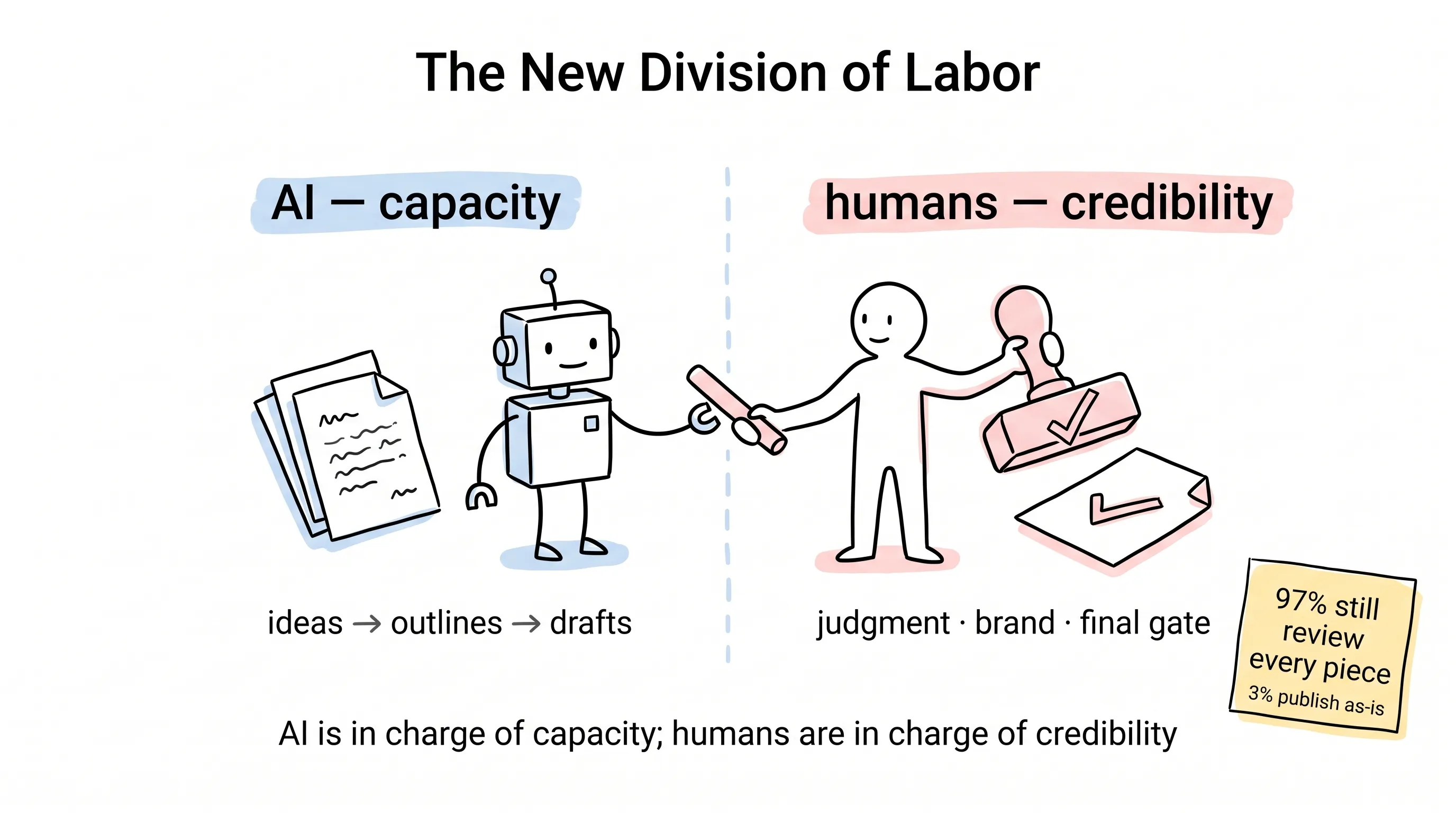
97% of AI-using teams have a review process in place. 80% review every piece by hand, 35% bring in subject-matter experts to check the facts, and 30% hand off to professional editors.
Only 3% truly publish AI output as-is.
And half of all respondents say not one piece they publish is pure AI.
Worried? Of course. Their top concern is accuracy (60%), followed by plagiarism (57%). The accidents they fear most: accidentally spreading misinformation (62%), and a worse reader experience (56%).
So here's the workflow, translated: AI is in charge of capacity; humans are in charge of credibility.
Oh, and one delicate detail: only 16% of companies will admit to readers that "AI was involved in this piece." 84% choose silence.
Everyone's using it. Nobody's saying so.
So Where Does the Money Go Next?
Is traffic actually growing? Ahrefs compared the numbers using data from its own API: websites using AI for content saw median annual organic traffic growth of 29.08%; those that don't, 24.21%. Less than 5 percentage points higher.
Not earth-shattering, but the direction is positive.
How will the money move? 51% of companies plan to increase their AI content investment, 43% will hold steady, and only 6% are preparing to pull back.
Who's most aggressive? Small companies of 1 to 9 people — 69% plan to double down. The most conservative, surprisingly, are enterprises with 1,000 or more employees, at 44%.
The smaller the boat, the faster it turns.
Finally, Back to My Friend
As we finished our tea that day, I asked him: are you still planning to hire?
He said something that has stayed with me: AI has killed off the most grinding part — the stretch from idea to outline. Editors can finally spend their time on "why does this article deserve to be read?"
That sentence might be the whole answer.
Turn the survey's numbers over every which way, and they're really saying one thing: the question stopped being "should we use AI?" long ago. Now it's "where do humans and AI each stand?" AI stands at capacity; humans stand at judgment, at brand, at that final quality gate.
Get your position right, and AI is a lever. Get it wrong, and AI just helps you produce mediocrity more cheaply.
Here's hoping that in an era when everyone owns a printing press, you stay the person who is still needed.
Continue reading
Related articles

Cross-Border Business: Time to Upgrade Your AI Toolbox
A learn article explaining how AI tools help cross-border e-commerce sellers clear five hurdles: language, regulation, logistics, payments, and fraud. It outlines a five-compartment toolbox, a five-step adoption path, and metrics such as conversion rate and CLV, while cautioning against over-reliance on AI.

AI Is Taking Over the Dirty Work of Social Media Marketing, One Task at a Time
This learn article outlines four social media marketing tasks AI can handle — audience analytics, content drafting and design, ad targeting and creative testing, and spam moderation — and cautions that taste, judgment, and data security remain human responsibilities.

AI Is Already This Good — Why Is Your Social Media Marketing Still Pure Manpower?
An overview of 18 AI tools for social media marketing, organized into six categories covering audience research, content creation, scheduling, comment and DM handling, ad management, and visual production, plus notes on personalization, prediction, and emerging trends.