
Would You Really Dare to Publish AI-Written Copy Without Touching It Up?
A learn article discussing whether AI-generated marketing copy can be published without human editing, based on an empirical study comparing AI and human content effectiveness, plus notes on ethics and the human-touch step.
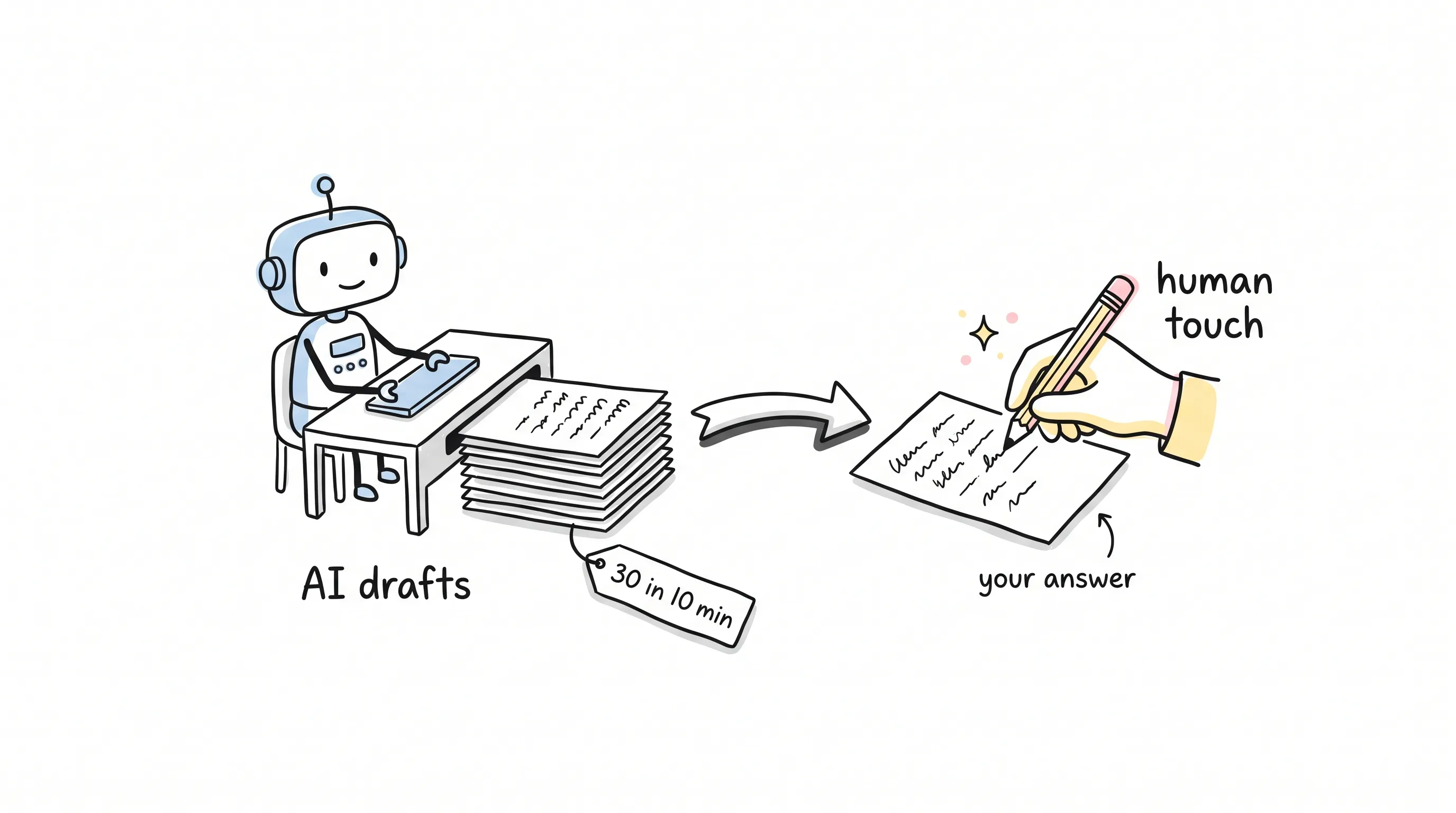
A few days ago, in a group chat of friends who work in marketing, someone posted a screenshot.
A set of launch copy for a new product, with the caption: "AI wrote thirty of these in ten minutes — straight into the publish queue."
The group broke into applause: "So efficient!"
I stared at my screen, wanted to say something to stop it, but going that heavy would make me the buzzkill.
But this stuck with me for days.
Because hiding behind it is a genuinely valuable question: Can AI-generated content be published as-is, with no rework, and actually work?
Has Anyone Seriously Tested This?
You might say, isn't this just the vibe everyone gets from everyday chat? You can smell AI-written content within two paragraphs — something's… off.
A feeling is not evidence.
In 2025, an empirical study took this exact question on as its subject.
What makes the study impressive is how precisely the question was framed. It didn't ask "Can AI write marketing content?" It asked: For the same audience, in the same kind of communication scenario, can AI-generated content — with no rework at all — perform as well as human-created content, or even better?
Note the two constraints:
No rework at all.
The same audience.
Put plainly, what it tested was not "AI's potential" but "AI's ready-made output."
What does ready-made mean? Whatever AI spits out is exactly what you publish. No polishing, no human touch mixed in.
How Did the Study Work?
Where to begin? Start from the move a marketer cares about most: comparison.
The study ran in four steps.
First, it reviewed the prior research — how far people had already gotten with AI in marketing and communication campaigns. Along the way, it also combed through the principles of AI ethics.
Then it got hands-on: designing an empirical study to collect data and answer the original question — can the creative process actually be automated?
Next came the critical part: putting AI-generated content and human-created content in front of the same audience and comparing their perceived effectiveness.
Finally, it pulled the ethics question out on its own, discussing the opportunities and risks of using AI in communication campaigns.
Look: literature, data, comparison, ethics — four steps done, and this whole subject had finally been treated with the seriousness it deserved.
I've always felt that once a topic goes from "everyone's chatting about it" to "someone has tested it with data," our understanding climbs a level.
The Opportunity: Which Tasks Can You Hand Over First?
One of the study's core questions was the initial feasibility of automating the creative process.
Initial feasibility, meaning: as of today, which stations on the assembly line can already be handed to the machine with confidence?
If you're running content marketing for a company right now, let me break it down for you.
First drafts: hand them over. Give AI one product selling point and have it produce twenty versions of the opening, then pick the three you like — this is AI's home turf.
Variants: hand them over. One message, five platforms, five different tones — let AI rewrite them in bulk, and the time savings are substantial.
But there is one step the study specifically calls out: the finishing work between content generation and publishing.
When the study summarized its risks, it explicitly placed "using generated content without any humanization" into the risk zone.
Underline this: used with zero humanization, straight as-is.
This is exactly the step that got skipped.
The Risk: What's Hiding in the Skipped Step?
So what is this step actually doing? Let me offer an analogy.
AI is like a person who has read every post on the internet. What it says is "averaged" out of a massive volume of content. Averaged means safe; safe means no edges; no edges means a reader glances once and scrolls on.
Think about it: do you follow a creator because every sentence they say is correct?
No. You follow them because they have preferences, a voice, the nerve to make judgments, and the occasional lovable mistake. These are precisely the things an AI first draft doesn't have.
So the human-touch step is the work of turning "the average answer" into "your answer." Adding in your position, your examples, whom you dare to offend and whom you're willing to please.
You can do the math: if AI saves you two hours and you spend them meeting clients or working your channels, you win. If you only use them to schedule five more edgeless posts, the time you saved will be clawed back — with interest — in lost trust.
AI handles the speed. Humans handle the human.
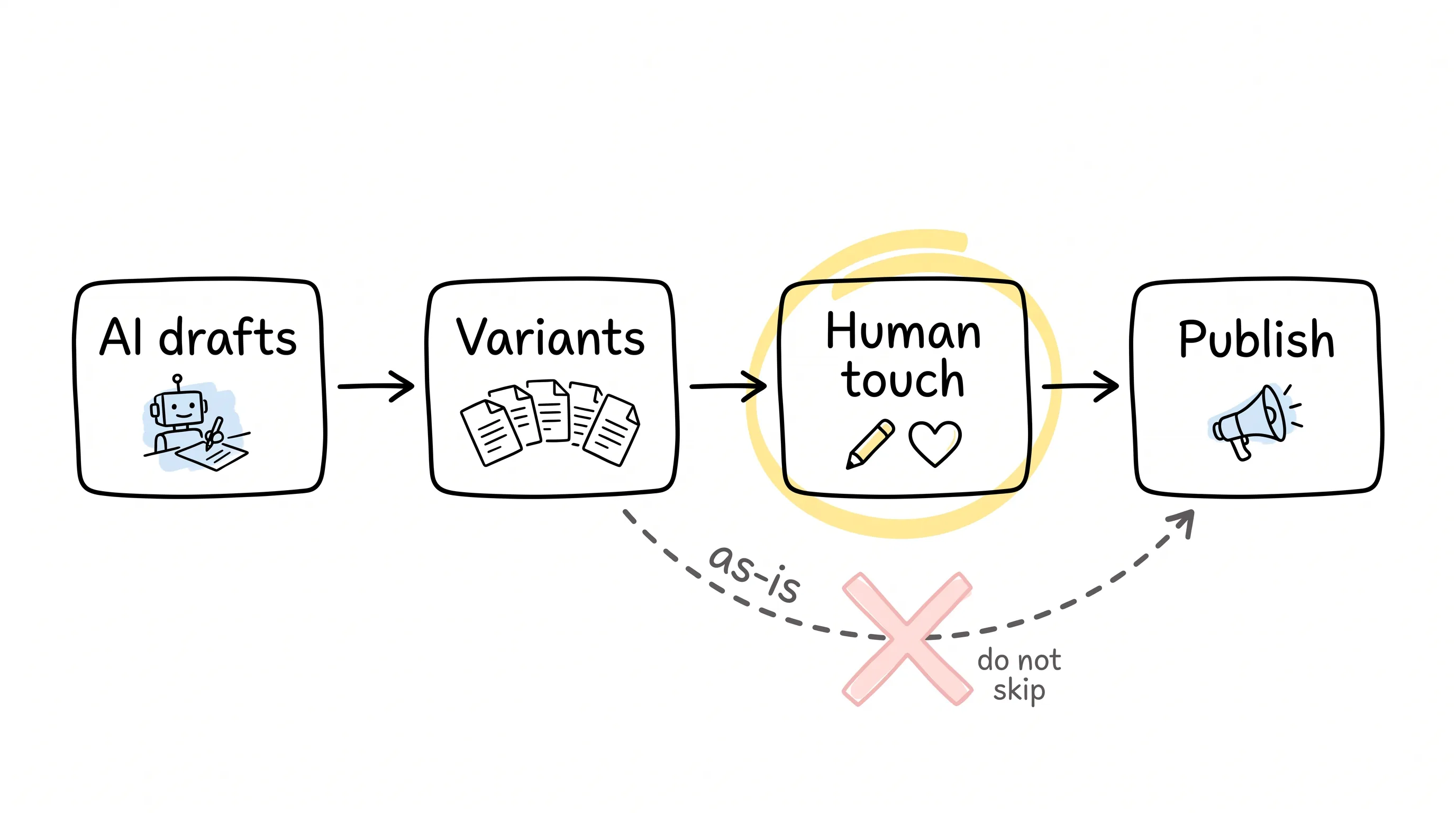
That's probably why the study drew the risk line right here.
And There's a Bigger Tab Than Performance
The study devotes a whole section to ethics.
Some might feel that it's just marketing copy — ethics is laying it on too heavy.
Not heavy at all.
Picture this scene: a follower on social media leaves a comment on what he believes is "human-written" content, earnestly chatting away for a full three hundred characters. He doesn't know there is no one at all on the other end listening.
A machine is doing the talking, and the reader thinks it's a person. That information gap is where the ethics problem begins.
The study puts the principles of AI ethics and the concrete moral questions of communication campaigns on the table together: which opportunities are real opportunities, and which risks will wound trust.
My view is that there is an especially simple test here.
You can let AI be your helper — writing first drafts, producing proposals, making variants, all fine. But don't let it be your stand-in, impersonating a living person on social media in your place.
The line between helper and stand-in is the human-touch step.
Back to That Copy
Later that day in the group chat, I couldn't hold back after all, and replied:
"Don't rush to publish all thirty. Pick one and rewrite it yourself. After you've rewritten that one, look at the remaining twenty-nine and see whether they're still worth publishing."
He replied with an "OK" emoji.
On efficiency, AI has already raised the floor impressively high. But the ceiling of content, to this day, is still held in human hands.
The version that takes the least effort and the version that moves people most have never been the same version.
Here's wishing you never send the least-effort version, unedited, to the people you care about most.
Continue reading
Related articles

Cross-Border Business: Time to Upgrade Your AI Toolbox
A learn article explaining how AI tools help cross-border e-commerce sellers clear five hurdles: language, regulation, logistics, payments, and fraud. It outlines a five-compartment toolbox, a five-step adoption path, and metrics such as conversion rate and CLV, while cautioning against over-reliance on AI.

AI Is Taking Over the Dirty Work of Social Media Marketing, One Task at a Time
This learn article outlines four social media marketing tasks AI can handle — audience analytics, content drafting and design, ad targeting and creative testing, and spam moderation — and cautions that taste, judgment, and data security remain human responsibilities.

AI Is Already This Good — Why Is Your Social Media Marketing Still Pure Manpower?
An overview of 18 AI tools for social media marketing, organized into six categories covering audience research, content creation, scheduling, comment and DM handling, ad management, and visual production, plus notes on personalization, prediction, and emerging trends.