
Winning at AI Marketing Was Never About the Tools
A long-form guide arguing that AI marketing success depends on the operating model rather than the tools themselves, covering use case selection across the funnel, tool evaluation, EU AI Act and GDPR compliance, team roles, and ROI measurement.
A while back, an old friend of mine who works in marketing invited me out for tea. We'd barely sat down — three sentences in, the venting started.
Over the past year, his company had bought more than a dozen AI tools — for writing, for image generation, for lead scoring, for automated reporting, the whole set. Three pilot projects were running at the same time. Impressive fanfare, no question.
Then, at the quarterly review, the boss asked one question: which exact euro did AI earn us? Which exact hour did it save?
The room went silent.
My friend said something went off in his head at that moment. Plenty of money spent, a pile of tools installed — but pointing to a single euro of revenue or a single working hour that AI had actually produced? He honestly couldn't.
I told him this really isn't just his problem. MaibornWolff, a German consultancy that has spent years guiding companies through AI marketing, sees the same scene at client sites: a dozen tools in hand, yet not one working routine that keeps running once the people step away.
So where does the problem lie?
Most people's first instinct: we picked the wrong tool, so buy a better one.
Wrong.
The battle for AI marketing is never won by tools; it's won by the operating model. Who decides, who builds, who reviews, who tests, and who is accountable when things go wrong. If those questions aren't settled, buying more tools just fills up the garage — the car still won't move.
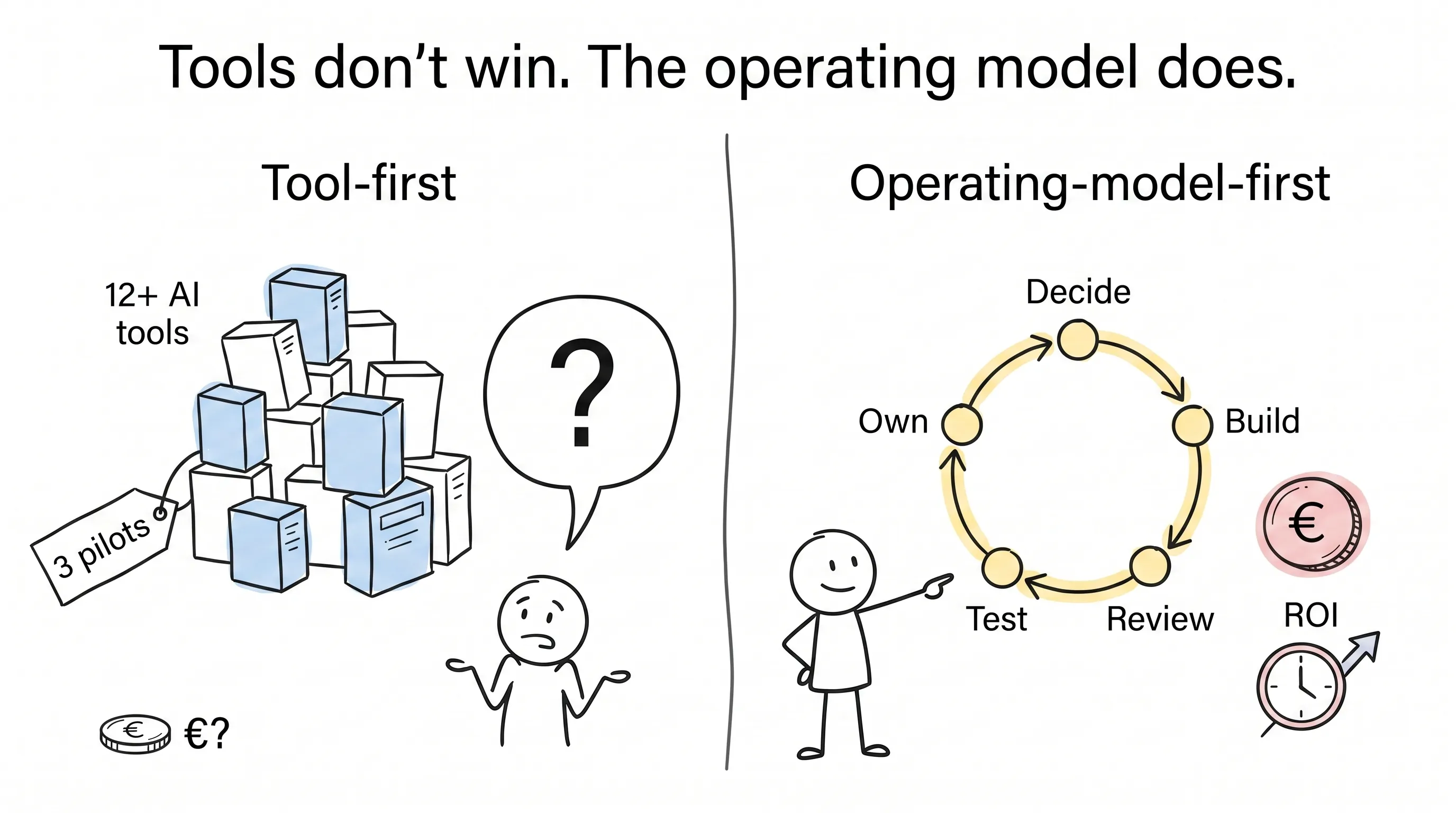
In this article, I'll walk you through the whole thing — from what AI marketing actually is, to how to staff the team and how to do the math. And don't worry: no jargon.
1. First, Align on One Thing: What Is AI Marketing?
Let's start with a health check. Run through every project in your company that carries the AI label, then hold each one against this definition:
AI marketing means using models that learn and generate to derive scalable marketing decisions from customer and market data.
What does "scalable" mean here? That decisions in six categories — content, audience, channel, timing, price, and messaging — are made by the model in real time or near-real time, without a human signing off on each one individually.
I've deliberately kept this definition narrow.
Narrow, because it's a filter. Apply it once and you'll notice that many projects wearing the AI badge aren't AI at all.
For example, a customer goes quiet for 14 days, and a win-back email fires automatically. That's automation — an if-then rule a person wrote in advance; it has never learned anything. But if a model learns each user's optimal send time from historical behavior, that is AI.
Don't underestimate the distinction. Whether something is AI affects not just performance but also whether you carry compliance obligations — more on that later.
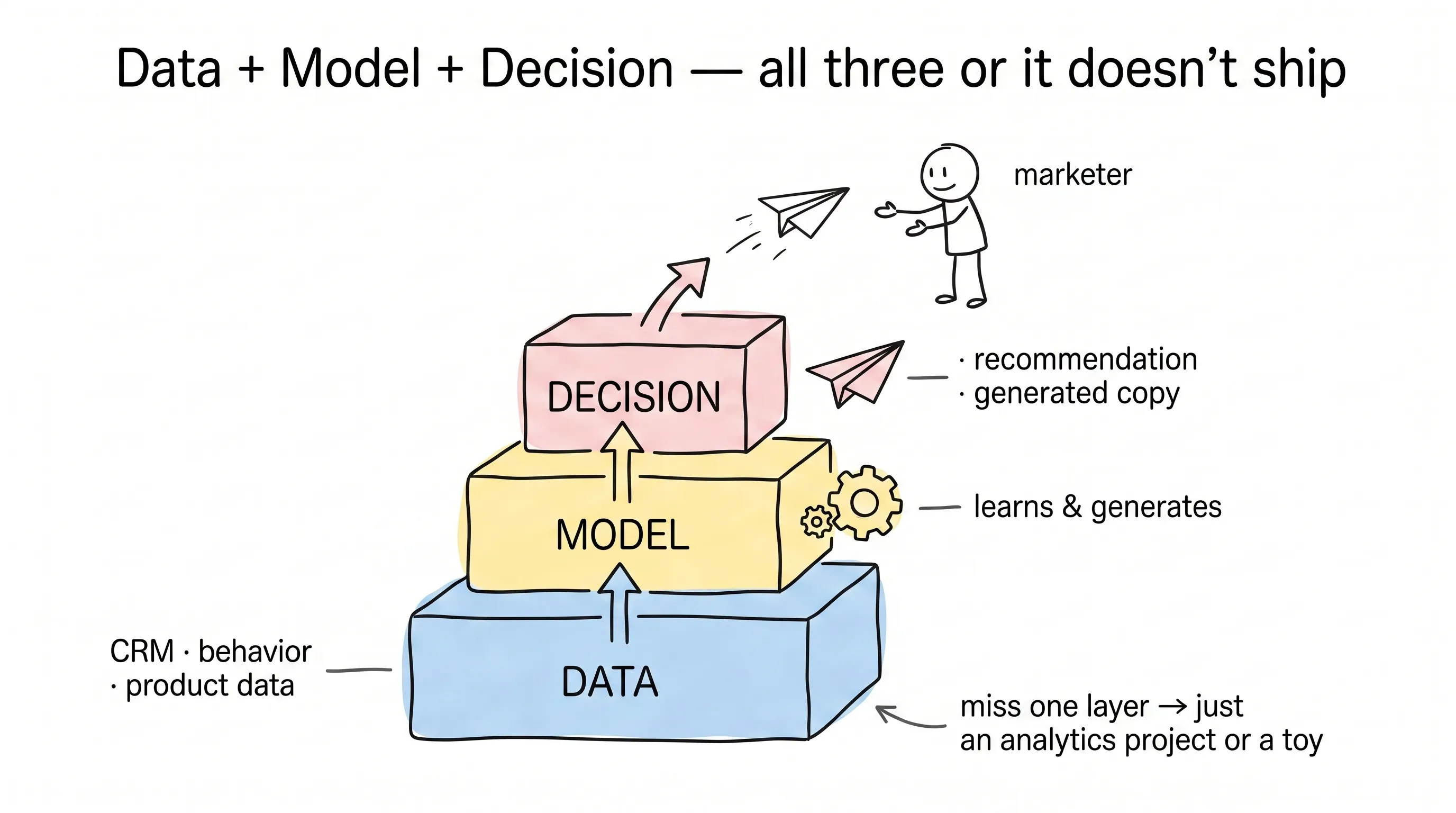
An AI marketing use case that can actually ship needs all three layers: data, model, decision. Data is the foundation — CRM, behavioral data, product data. The model is the engine, doing the learning and generating. The decision is the car that drives out the door — a personalized recommendation, a piece of generated copy. Miss any one layer, and what you have is either an analytics project or a toy. Either way, not a marketing use case.
How many kinds of AI are there? Forget the textbook. Four is all you need to remember.
First, predictive models. They compute: will this customer churn? Will this lead close? The most mature category, in use the longest. But the model only hands you a number — whether to act is the human's call.
Second, generative models. ChatGPT, Claude, Midjourney — they can write and draw. Fastest to adopt, but the worst governed: copyright, hallucinations, brand drift, a heap of unresolved issues.
Third, decision-optimization systems. The most underrated category of all. Multi-armed bandits (algorithms that continuously shift traffic toward whichever option performs best) and reinforcement learning decide, in real time, which image to show the person in front of you and what price to quote. Google Ads' Smart Bidding and Meta's Advantage+ are powered by exactly this. Teams still treating A/B testing as their main weapon are already behind.
Fourth, agents — agentic AI. You give a model tools and memory and let it complete a chain of tasks on its own. In 2026, it has just stepped out of the demo room and into the first production environments. It's also the most dangerous: errors snowball, and when something goes wrong it's hard to trace. So human approval checkpoints are non-negotiable.
The order matters: predictive first, governance for generative right behind it, decision optimization on the big platforms in parallel, and agents last. Do it in reverse, and you're laying carpet before the floor has dried.
2. Why Do Most AI Marketing Efforts Die Halfway?
With definitions aligned, let's look at reality. Why do so many companies' AI marketing efforts eventually go quiet?
It always comes down to the same five ways to die. See which one sounds familiar.
Death by number one: buying the gun before choosing the target. You see what competitors use and what influencers hype, so you buy the tool first and then hunt across the company for a use case to prove the money was well spent. The order is completely backwards. The right order: quantify the pain point first — say, we need 35% more first drafts per week with no loss of quality — then define the use case, and only then pick the tool.
Death by number two: shadow AI. Officially, "we're still developing our strategy." Meanwhile employees have long been doing their daily work with personal ChatGPT accounts — private logins, customer data and business data pasted right in. You can't ban your way out. The only way through is amnesty: provide a company-sanctioned toolkit, with usage guidelines and training.
Death by number three: a rotten data foundation. CRM fields filled in however each person pleases, web data disconnected from product data, user consent status never properly recorded. Build on that foundation, and whatever the model learns will be either skewed or riddled with compliance holes. Cleaning it up takes three to six months. You can't skip this work, and don't try to run it in parallel with everything else — parallel work only creates gridlock.
Death by number four: nobody is accountable. Marketing files the request, IT implements, data protection reviews, the boss wants results. It sounds like everyone has a stake; in fact, no one owns anything. Every use case needs exactly one person who can decide whether it ships and when it gets switched off. Without that person, the pilot won't survive the quarter rollover.
Death by number five: flying blind on ROI. The pilot ends, and the report says "we generated 200 pieces of copy." That's output, not impact. Impact is €18,000 in labor cost saved per quarter, or conversion up 0.4 percentage points. Without a baseline, without a control group, without a payback horizon, a year later you face an unanswerable question: pour in more money, or shut it down? You can't know. You have no data.
Not one of these five deaths is a technical problem. They are all organizational problems. That's the bad news and the good news — because organizational problems have organizational solutions.
3. How to Pick Use Cases? Two Words: Don't Overreach.
Set tools aside for now. I know that's the question you're dying to ask, but the time really hasn't come yet. Use cases first.
A marketing funnel runs top to bottom through four stages: awareness, conversion, retention, and operations. Each stage has a few proven, high-value use cases.
Upstream, in awareness, there are two workhorses: producing content at scale and modeling audiences. Generative models produce the first drafts, human editors take it from there — cutting 35% to 60% of the time. Predictive models continuously mine real customer data for audience segments, replacing the once-a-year gut-feel persona. Then there's lookalike modeling: take your most profitable existing customers and find similar people on the ad platforms — Meta's and Google's platforms ship with this built in — cutting acquisition costs by 15% to 30%.
Mid-funnel, in conversion, is where the money concentrates. Predictive lead scoring: the model computes a close probability for every lead, and high scorers go straight to sales — handling time drops 20% to 40%, and lead-to-opportunity conversion rises 10% to 25%. Real-time personalization: the model decides on the fly who sees what, lifting conversion 5% to 25%. Dynamic pricing can lift gross margin by 2% to 8%, but in the EU this one demands special compliance care — more on that later.
Downstream, in retention — and take note, because here's a fact most companies get backwards.
Money made by keeping an existing customer is three to seven times what you make acquiring a new one. Yet most companies draw up their budgets exactly the wrong way around.
Retention-stage use cases are actually quite mature: churn prediction models work out who's about to leave 30 to 90 days ahead and route them automatically into win-back flows, cutting churn 10% to 25%. And there's next best action across touchpoints, where the model decides what to try with each customer next — and when to shut up — adding 5% to 15% in revenue per customer per year.
The smart play is the reverse: get retention solid first, then use the cash flow from existing customers to fund the more expensive acquisition programs.
Finally, operations. It doesn't generate revenue directly, but without it, every use case above is flying blind. Marketing mix modeling — MMM in the trade — reallocates media budgets and lifts efficiency 10% to 20%. Report automation has the model pull the numbers, spot anomalies, and deliver a first-pass reading for human review, saving 50% to 70% of the time per reporting cycle.
Twelve use cases laid out. Do you want to do all of them?
Absolutely not.
At any one time, run at most two or three use cases per funnel stage. In year one, four to six company-wide, hard cap. The price of greed: a dozen-odd pilots fighting over the same data, people, and budget — and none of them growing up.
4. How to Choose Tools? Take Stock First, Then Spend.
All right — now we can talk tools.
First, a number: in an AI marketing project, the tool itself accounts for only about a quarter of the work. The remaining seventy-some percent is data cleanup, process design, staff training, and quality control. For every €1 of license fees, prepare €2 to €4 to spend outside the tool.
So step one in choosing tools isn't reading the comparison rankings. It's taking stock of what you already have.
Your current platform almost certainly ships with a layer of AI built in. HubSpot has Breeze; Salesforce has Einstein (around since 2016, expanded in 2024 with agentic capabilities as Agentforce); Adobe has Sensei and Firefly. These embedded capabilities cover 60% to 80% of your common use cases, and many are already included in your existing license. If you're on Salesforce, have your architect check exactly what the contract already includes before you talk about buying anything new. Companies under €5 million in revenue: use HubSpot Breeze to the full for 12 months before considering anything else.
Once you've taken stock, the tool landscape reduces to three layers.
Layer one: embedded in the platform. Breeze, Einstein, and Sensei — the ones just mentioned. Fast to value, low compliance burden — the platform carries most of the obligations for you — but generally limited depth.
Layer two: specialist tools. Products that go very deep on one scenario — Jasper for copywriting, Synthesia for digital-human video, Brandwatch for social listening. Buy only when two conditions hold at once: the platform genuinely can't cover it, and the math works out. Before buying, write three questions into the document: which platform capability falls short, and why? Against what baseline does the new tool deliver how much measurable improvement? Who is responsible for this new license across its entire lifecycle? If any one of the three answers is fuzzy, the existing platform is probably enough.
Layer three: build it yourself. Assemble your own application directly on top of the GPT, Claude, and Gemini APIs. The data stays in your own hands, beyond your competitors' reach. But it's heavy lifting: you'll need to maintain engineering and run prompt operations. A rough rule of thumb: self-building is worth a serious evaluation only when a use case's annual specialist-tool spend exceeds €100,000.
Tools are consumables; capability is the fixed asset. Tool names on the market turn over every 12 months, but the playbook that never goes stale is this: define the use case first, then the requirements, then spend only two or three weeks on demo comparisons.
5. Compliance Isn't a Brake — It's a Design Parameter
This next part is one many marketers don't want to hear. But as of September 2026, it's mandatory coursework.
On August 2 of this year, the core obligations of the EU AI Act took legal effect.
Which obligations? For marketing, mainly three transparency requirements. First, AI-generated text, images, audio, and video must carry machine-readable labels. Second, deepfake content — digital-human videos, voice clones, AI influencers — must be clearly disclosed as AI-generated. Third, when users chat with a chatbot, they must be able to tell that the other side isn't human.
Teams that haven't done these three yet: stop dragging your feet. Retrofitting burns engineering budget; building them into new processes as standard practice costs almost nothing.
One more warning: the Act's most heavily penalized category has been outright prohibited since February 2025. Marketing must steer clear of three red lines: subliminal manipulation; exploiting the weaknesses of vulnerable groups — minors, people in financial distress — for targeted attacks; and indiscriminately scraping faces to build databases. Fines run up to €35 million, or 7% of global revenue. Stings, doesn't it?
There's also a deployer obligation that's easy to overlook: confirm in your contracts that model providers meet the compliance requirements for general-purpose AI (GPAI) models, and keep your own ledger — which use case used which model, what data was fed in, how the output was reviewed. Fine-tune a model hard enough and you can flip from user to provider, with your obligations jumping a whole tier.
The good news: the vast majority of marketing use cases fall into the limited-risk and minimal-risk tiers, provided the documentation is solid and the labels are in place. Where people really trip is GDPR. Because GDPR doesn't care whether you're using AI — it reaches every single one of your use cases.
Of the five classic traps, here are the three most typical.
Trap one: fine-tuning models on customer data. You think you're using your own data; in legal terms, this is an entirely new data processing purpose, and the original consent almost certainly doesn't cover it. You need a separate lawful basis.
Trap two: automated decision-making. Under GDPR Article 22, whenever a model makes a decision with a significant impact on a person on its own, that person has the right to human intervention. B2B doesn't escape it either: if a model auto-rejects a lead and sales stops following up, that counts.
Trap three: handling business data on consumer accounts. A team processing customer data through personal ChatGPT Plus or Claude Pro accounts is not adequately covered at the contract level. You need an enterprise contract or an API agreement that contains training-data opt-out clauses and a data processing agreement. Where the data is stored, where the logs live — you must be able to answer at selection time, not when the auditor comes asking.
MaibornWolff's consultants offer a very practical piece of advice: before every new use case goes live, run it through an eight-question checklist. Has the risk classification been done? Is the lawful basis written down? Is the data processing agreement signed? Where does the data land? Are the transparency labels in place? Is a human intervention point reserved? Does it touch employee data — and if so, has it been through the works council? Has the impact assessment been done?
If three of the eight answers are missing, the use case doesn't ship. No matter how beautiful the ROI projection.
6. How to Staff the Team? Five New Roles
Tools, use cases, compliance — in the end, people have to catch all of it. That's the operating model.
Five new roles. Note: five sets of responsibilities, not necessarily five hires.
AI Lead, the operator-in-chief. Owns the use case portfolio, reports to management, coordinates IT and data protection. At small and mid-sized companies, often the marketing lead wearing a second hat at 30% to 50% of their capacity.
Prompt Ops, prompt operations. Moves the whole team's prompts out of private stashes and into version control, watches for model drift, and takes over migration when a vendor changes versions. Right now, the most underrated role there is. Without one, your company's AI practice is a collection of screenshots on everyone's laptops.
Brand gatekeeper, the editor. Writers transition into editors — no longer writing themselves, but reviewing, correcting, and signing off on every paragraph the model produces. Roughly one for every five people writing content with AI. Without this layer, within two or three quarters the brand voice falls apart.
Data Owner. The prerequisite for every predictive use case. Owns data quality, identity resolution, and consent management. When this role is missing, what the model learns isn't insight — it's garbage.
Compliance liaison. Maintains the use case register and drives the eight-question checklist. At small and mid-sized companies, 10% of one person's capacity is enough — but this is the role most often left out. Leave it out, and compliance issues always detonate the night before launch.
All five together: for a small or mid-sized company, 1.2 to 2 people spread across the existing team; for large enterprises, 4 to 7 dedicated roles.
By the way, on skills: internal training almost always beats hiring from outside. Experienced marketers know the business; prompt and data literacy can be learned — six to nine months. Only genuinely hardcore technical work like MLOps is worth an external hire. For a 30-person team, reserve 60 to 90 training days in year one — the highest-leverage line in the AI budget.
7. How to Do the Math? Three Levers, Three Disciplines
Last, let's talk money. The boss doesn't ask about models. The boss asks: what's in it for us?
The value of AI marketing comes down to three levers.
Efficiency: the same work, faster and cheaper. Saves time, saves headcount; payback in six to twelve months. But remember — time saved doesn't automatically become value. You have to deliberately redirect it onto new work, or it simply evaporates.
Effectiveness: the same investment, better results. Conversion rate, acquisition cost, customer lifetime value. Payback takes twelve to twenty-four months, because you have to build baselines and hold out control groups. But this is the lever with the greatest potential.
New output: things you couldn't do at all before. Synchronizing localization across five markets; around-the-clock competitor trend monitoring. Doesn't fit quarterly logic — a strategic investment.
A rough split: 50% efficiency, 35% effectiveness, 15% new output.
When you do the math, three disciplines — every one of them a lifesaver.
First, build the business case on the lower bound of the range. Those industry ranges like 35% to 60% — their upper ends are reserved for teams with solid data foundations and an operating model in place. Only greenlight projects that pay back at the lower bound. If it pays back only at the upper bound, that's a bet.
Second, discount the stack. When three use cases hit the same funnel stage at the same time, the effects don't add up directly — the data overlaps. Take a 30% to 50% discount.
Third, pilots need control groups. Hold out at least 20% of customers from the AI and run a full business cycle. Without a control group, you can't tell whether the lift came from the model or from the season, the market, or some big promotion. Before the pilot starts, the stop criteria go down in black and white: performance falls below the lower bound, sustained bias appears, a compliance problem surfaces, costs overrun by 30% — trigger any one, and you shut it down. Write it down, or you'll sink into the permanent-pilot swamp, with license fees idling away year after year.
Maturity, too, isn't destiny. The consultants grade organizational maturity on five levels, and climbing from level one or two to level three takes a single quarter. A level-three organization, against level-one and level-two peers of the same size, is 30% to 50% more efficient and 10% to 25% better at conversion. On a €5 million marketing budget, that gap comes to several million euros a year.
Several million euros — leaked away through the cracks of the operating model.
Finally, Back to My Friend
That day over tea, I left him three homework assignments: go through the dozen-odd tools and return whatever should be returned; pick the use case where the pain is sharpest and the data most complete, and appoint one person who can actually make the call; print out the eight-question compliance checklist and pin it to the first page of the project docs.
Three months later, he told me: five tools gone, reporting faster, and — for the first time — the boss didn't frown at the review.
AI marketing is hard and simple at the same time. What's hard was never the technology — it's the unglamorous dirty work: naming an owner, cleaning data, doing the detailed math, writing the documentation.
Tools become obsolete; operational capability doesn't. Whoever does this operational homework turns the question everyone else is still agonizing over — which tool to buy — into their own moat.
Here's hoping you never sit through a quarterly review where that one question reduces the room to silence.
Continue reading
Related articles

Cross-Border Business: Time to Upgrade Your AI Toolbox
A learn article explaining how AI tools help cross-border e-commerce sellers clear five hurdles: language, regulation, logistics, payments, and fraud. It outlines a five-compartment toolbox, a five-step adoption path, and metrics such as conversion rate and CLV, while cautioning against over-reliance on AI.

AI Is Taking Over the Dirty Work of Social Media Marketing, One Task at a Time
This learn article outlines four social media marketing tasks AI can handle — audience analytics, content drafting and design, ad targeting and creative testing, and spam moderation — and cautions that taste, judgment, and data security remain human responsibilities.

AI Is Already This Good — Why Is Your Social Media Marketing Still Pure Manpower?
An overview of 18 AI tools for social media marketing, organized into six categories covering audience research, content creation, scheduling, comment and DM handling, ad management, and visual production, plus notes on personalization, prediction, and emerging trends.