
Why You Need to Stop Treating LLMs Like People
Explains why LLMs are next-word prediction tools rather than people, covering tokenization, hallucinations, and why models double down when corrected, then gives marketers three prompting rules: split tasks into steps, set tight constraints, and restart instead of arguing with errors.
A few days ago, in a marketers' group chat, someone posted a screenshot: they had asked AI how many letter e's there are in the word "seventeen."
The AI got it wrong.
The group chat lit up with laughter. Someone said: this thing can't even handle elementary school homework, and it still has the nerve to talk about destroying the world?
I laughed too. But once I'd finished laughing, it didn't seem so funny anymore.
Think about it: a tool that can write proposals, fix code, and sit with you through late-night heart-to-hearts — and it can't count the e's in a single word. The AI isn't dumb. We are. We keep looking at a probability machine as if it were a person.
An LLM is not a person. Treat it like one, and it will let you down — every single time.
When It Says "I Love You," That's Just Probability
So what is an LLM, exactly?
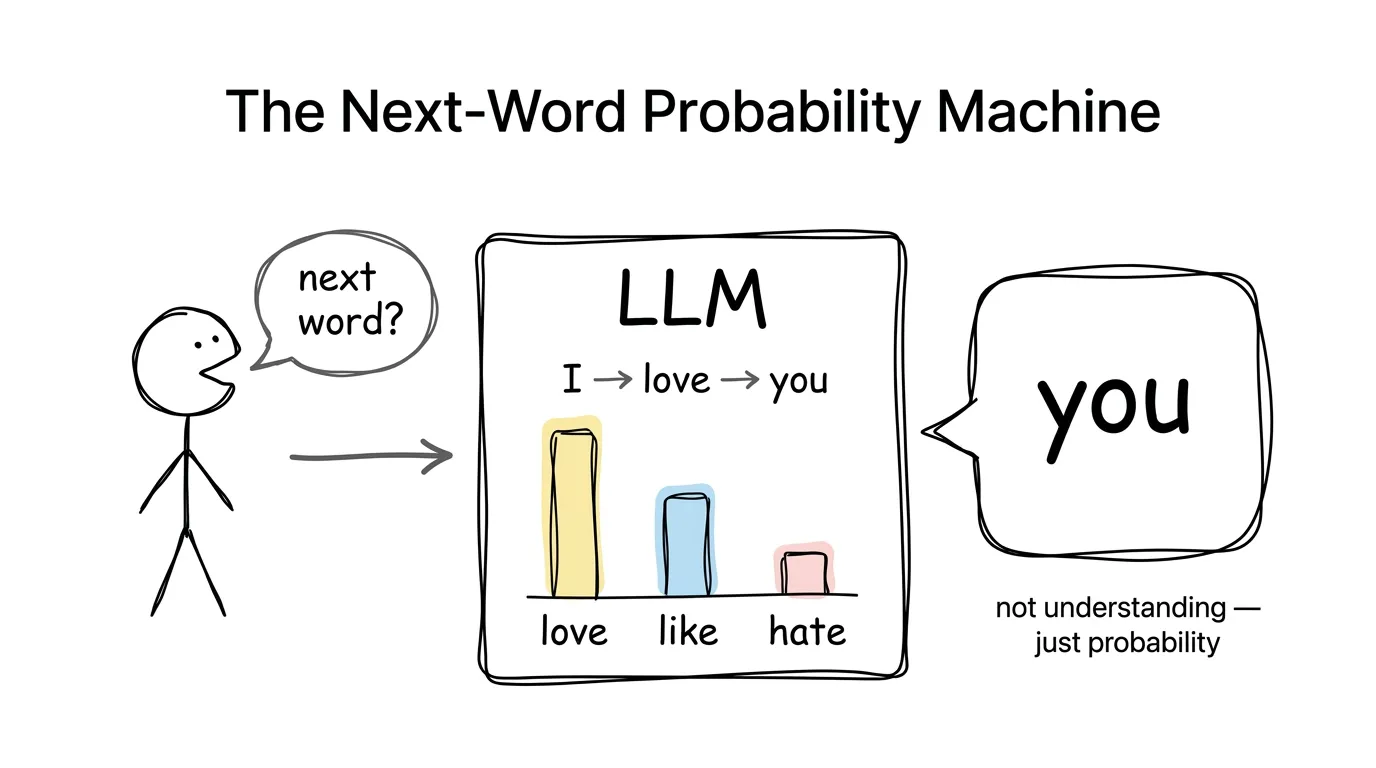
Put simply: a gigantic machine for predicting the next word. Its tens or hundreds of billions of parameters are nothing but a set of statistical patterns, fed on oceans of text.
It doesn't recognize letters. It doesn't understand words. And it has no thoughts of its own.
When an AI tells you "I love you," or solemnly declares "I fully understand your strategic goals," it has no idea what love is, and it never actually read your goals. It simply calculated that in human language, "I" is very often followed by "love," and "love" is very often followed by "you."
All it does is take a string of text and guess, over and over: what's the most likely next word?
It guesses fast, it guesses accurately, it guesses convincingly. That's all.
It isn't "retrieving" knowledge from some mental archive. It isn't drawing on past experience. It certainly isn't reflecting on what you just said. It's answering one giant fill-in-the-blank question.
What you see is "understanding." What it's doing is "probability."
The Uncountable E's, and the AI That Won't Admit It's Wrong
Once you understand this, all of AI's baffling behavior suddenly makes sense.
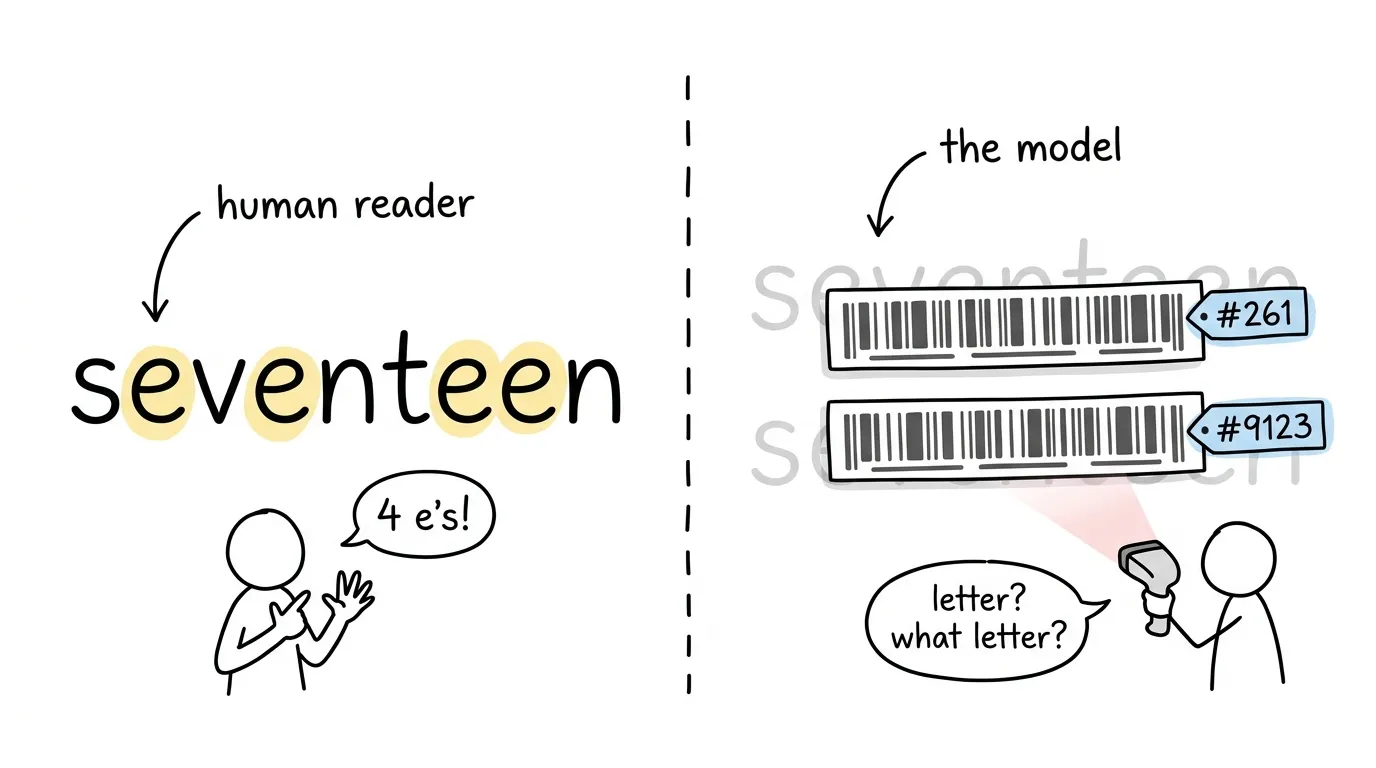
Back to the question from the beginning. You ask an AI to count how many e's are in "seventeen." A human counts at a glance: four.
Why can't the AI do that?
Because what the AI sees isn't the nine letters s-e-v-e-n-t-e-e-n at all. First it chops the text into little chunks called tokens (token: the units of text a model actually reads — anywhere from a whole syllable to part of a word). To the model, "seventeen" might just be one or two numbered IDs, like barcodes on a supermarket shelf.
Ask someone who only reads barcodes to tell you how many grams of each ingredient are inside the can — where are they even supposed to start?
That's the AI's world: it knows the "names" of things, but it can't see the letters behind the names.
And here's what's even more infuriating. The AI gets it wrong, you correct it: "No, think again." Not only does it refuse to change its answer, it earnestly invents a brand-new wrong answer and digs in its heels to the end.
Does that make you angry? It does.
But switch perspectives, look at it as math, and there's nothing mysterious about this at all.
When you say "You're wrong," you imagine some continuous "it" hearing the criticism — feeling ashamed, reflecting. That's not what happens. You have merely appended a few sentences to the end of a string of text. The model takes that entire string — including its original wrong answer and your furious response — and asks itself once more: what word is most likely to come next?
And human text is full of arguments. A person gets called out, then squirms, invents new justifications, doubles down — that pattern is everywhere in the training data. The model learned it very well.
It isn't lying to you. It's completing a math problem.
When It Enters Your Workflow
You might think this is philosophy-department stuff. What's it got to do with you?
Everything. Especially if you work in marketing.
If you treat the AI as a smart colleague who "gets you," what happens? You get lazy about speaking clearly. "Analyze this batch of campaign data, find the core audience, and while you're at it, write me a strategy." One line, thrown over the wall.
Then you receive a pile of correct-sounding platitudes — maybe even made-up numbers.
And you conclude the AI is no good.
Actually, the way you fed it was wrong. Restore the AI to what it is — a high-speed statistical engine — and the usage changes immediately. I've boiled it down to three rules.
First: don't make it do three things in one step.
"Analyze the data, find the audience, write the strategy" — that's three tasks. Split them up, one step at a time, personally checking each step's result before moving to the next. Many models actually break things down this way behind the scenes anyway.
Second: give it constraints, not freedom.
When an AI runs into something it doesn't know, it fills the gap with whatever is most probable. That's where hallucinations (hallucination: when an AI confidently makes things up) come from. So your job is to compress its room for improvisation to the minimum: give it reference material in a fixed format, give it a hard word-count limit, give it a clear structural template. The tighter the constraints, the steadier the output.
Third: don't argue with a hallucination.
When the AI gets it wrong and you snap back "Wrong, answer again," that's like arguing with your car's GPS. It won't concede — and every retort of yours shoves another source of pollution into that string of text.
What to do? Start over. Go back to the original prompt, make it more specific, and run a fresh generation. Cleaner, and faster.
In Closing
So stop treating the LLM as a colleague, an assistant, or someone who "gets you."
It's a tool. Like a hammer. Like GPS. Used with precision, it hands you beautiful results; used vaguely, it hands back a heap of foam made of pure probability.
Strip away the sci-fi movie imagery and see it clearly for what it is — and, ironically, that's when you start actually using it well.
Seeing clearly that it isn't a person is the beginning of using it well.
Here's to figuring it out, sooner rather than later.
Continue reading
Related articles

Cross-Border Business: Time to Upgrade Your AI Toolbox
A learn article explaining how AI tools help cross-border e-commerce sellers clear five hurdles: language, regulation, logistics, payments, and fraud. It outlines a five-compartment toolbox, a five-step adoption path, and metrics such as conversion rate and CLV, while cautioning against over-reliance on AI.

AI Is Taking Over the Dirty Work of Social Media Marketing, One Task at a Time
This learn article outlines four social media marketing tasks AI can handle — audience analytics, content drafting and design, ad targeting and creative testing, and spam moderation — and cautions that taste, judgment, and data security remain human responsibilities.

AI Is Already This Good — Why Is Your Social Media Marketing Still Pure Manpower?
An overview of 18 AI tools for social media marketing, organized into six categories covering audience research, content creation, scheduling, comment and DM handling, ad management, and visual production, plus notes on personalization, prediction, and emerging trends.