
Why Does Your Ecommerce Team Spend Half Its Time Babysitting Ad Platforms?
Explains how ecommerce teams lose time juggling Meta, Google, TikTok, and LinkedIn ad dashboards, with conflicting attribution and manual budget work, then walks through Adle, an AI ad automation tool for Shopify, noting its reported results are vendor-supplied.
A couple of days ago, I had dinner with a friend who runs a Shopify store.
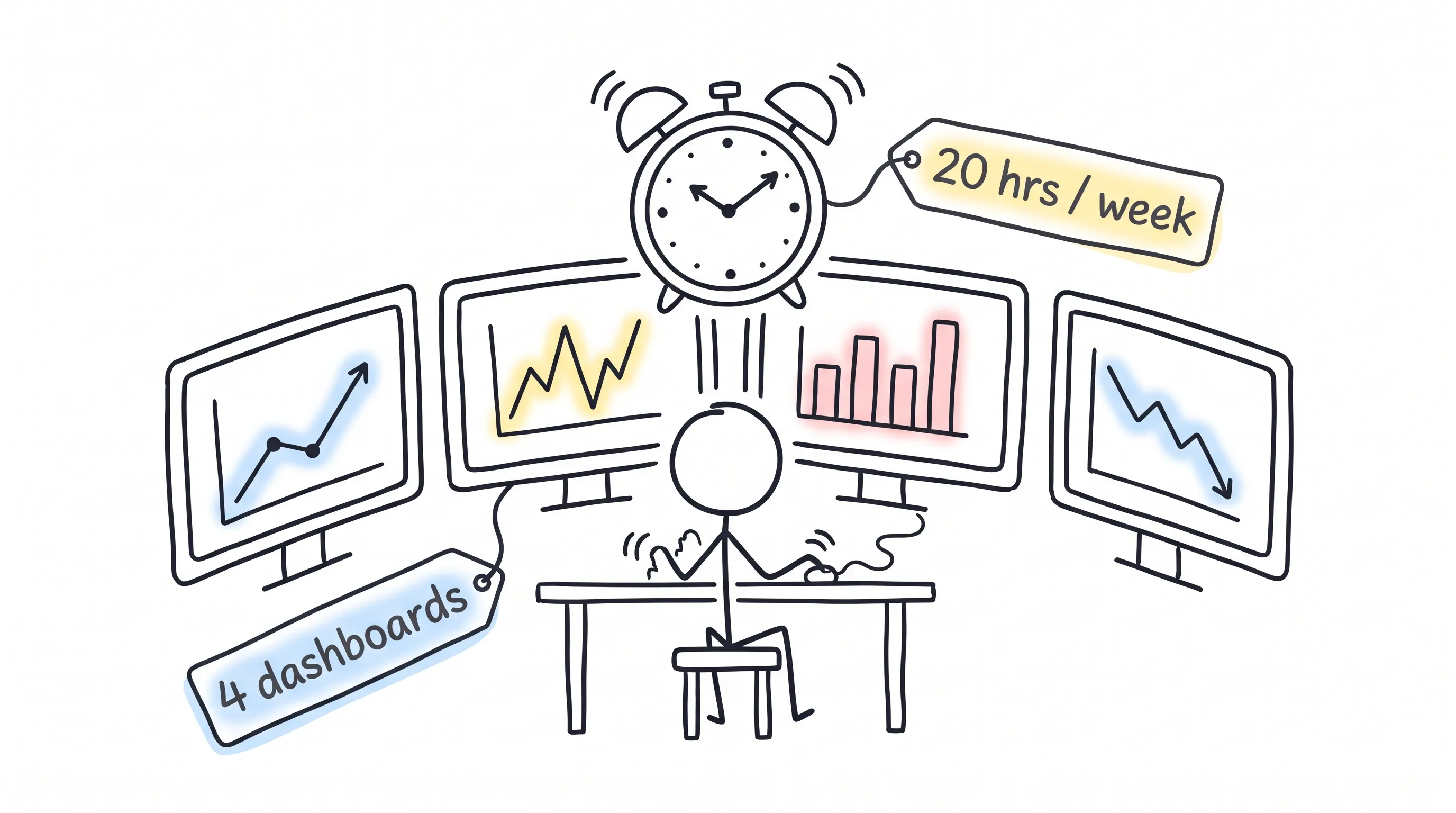
He's built a home goods brand doing a few million dollars a year — not huge, but healthy. Halfway through the meal, he pulled out his phone and showed me: four ad dashboards, all open in a neat row. Meta on one, Google on another, TikTok on a third, LinkedIn on the fourth.
I said, are you running ads, or running a control room?
He said the one running the control room wasn't him. It was his assistant.
What Is Omnichannel Advertising?
What does omnichannel advertising mean?
It means you sell from one store, but you have to buy traffic in four completely different places. Four dashboards, four interfaces, four sets of optimization rules, four sets of reports.
The hassle itself, you can live with — grit your teeth and it passes.
What you can't live with is the second problem: the numbers fight each other.
Meta claims this order came from its ads. Google says no, it was mine. TikTok's Pixel sits next to everyone else's tracking code, and they step on each other's toes. Four reports sit in front of you, each telling its own story, each with its own attribution.
In the end, you simply cannot work out one thing: this month's ad spend — did it actually make money?
What is ROAS (return on ad spend)? You spend one dollar on ads, and it brings back a few dollars in sales. Simple enough, right? But when four platforms each keep their own books, the same dollar can get counted three times.
The third problem is the deadliest: humans can't keep up with the speed of machines.
In ecommerce, a hit product has a window. If a product takes off on TikTok today and you wait until you're back at work tomorrow to adjust the budget, the window may already have closed. Think about it — manual optimization comes down to four words: humans have to sleep. For the eight hours a human is asleep, nobody is minding the ads.
My friend's assistant spends roughly 20 hours a week babysitting those four dashboards.
Twenty hours. Two and a half workdays. One person, one week, half of it spent clicking a mouse.
So What Now?
That's why, over the past couple of years, all kinds of "ad automation" tools have been popping up. The logic is more or less the same: since the four platforms can't be merged, let AI take over as the hired hands in the middle.
Adle is one of them, built specifically for the Shopify ecosystem. It positions itself as an "AI marketing copilot" serving ecommerce teams of 5 to 20 people.
How does it work? I took it apart, and it comes down to four steps.
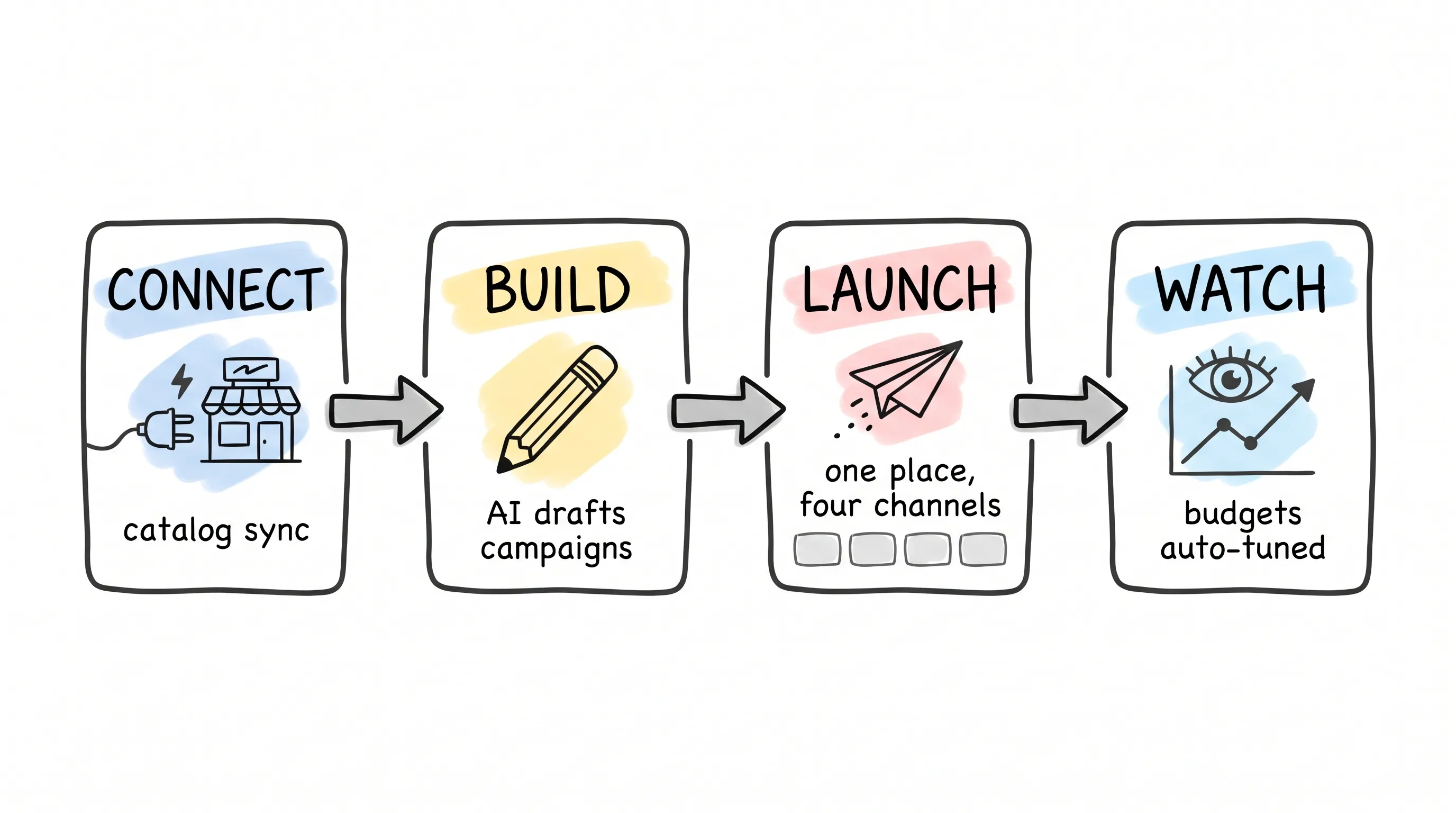
Step one, connect. Hook up the Shopify store, and the product catalog syncs automatically. New products listed, prices changed, items out of stock — the ads follow in real time. What this step kills off is the task ops people hate most: reconciling data between two systems.
Step two, build. The AI builds ad campaigns product by product, with dynamic retargeting and lookalike audiences. What are lookalike audiences? Put simply: find the people who have bought from you, then go fish for another batch of people who look just like them.
Step three, launch. All four platforms go live together, and tracking gets managed in one place. Attribution is calculated on one consistent basis — at least you'll know where the money went.
Step four — the step I find boldest: watch. The system monitors real-time sales data on its own, automatically raising budgets on products that are performing and automatically stopping the ones that aren't.
This used to be a job title: ad ops specialist — clicking a mouse all day. Now the machine clicks the mouse, and the human watches the dashboard.
Advertising is shifting from "operator" to "commander." Your hands no longer need to be fast, but your eyes must be sharp.
The Numbers
The figures are Adle's own: more than 250 Shopify stores have plugged in, average ROAS is up 2.3x, and manual operations are down 85%.
A womenswear team with $2 million in annual revenue says its ad management time dropped from 20 hours a week to 2, and ROAS actually rose 40%. There's also a home and garden brand doing $500,000 a year that saved several hundred hours from catalog sync alone.
Fair warning: these numbers are the vendor's own figures. Whether they carry any inflation, I don't know — you'll have to go test that for yourself. But the direction, I believe.
Two more honest observations. It can automatically generate ad creatives that match your brand's tone, and it gives direct recommendations on which products deserve more budget — but on data compliance, it's still halfway through its SOC 2 certification, not done yet.
Who Is It For?
Ecommerce teams of 5 to 20 people. With fewer people, four dashboards are more than a small team can manage; with more, you usually already have a dedicated growth team with its own playbook.
For smaller stores, running the ads yourself is enough — don't bother.
Toward the end of that dinner, my friend asked me: so what am I supposed to do with my four dashboard accounts?
I said, rather than asking me, ask your assistant. Ask her one question: would she like to come out of the control room.
Here's wishing your mouse-clicking hours an early return — back to where they truly belong: sleep.
Continue reading
Related articles

It's 2026: Stop "Buying" AI Tools for Your Marketing Team — Start "Hiring" AI Agents
This learn article explains how AI agents differ from standalone AI tools in marketing, outlines three agent categories — build-your-own platforms, CRM-native agents, and vertical tools — and covers use cases across SEO, social media, advertising, and reporting, plus criteria for choosing one.

Did the Money You Spent on AI Marketing Ever Come Back?
A guide to measuring AI marketing ROI across three layers: ad reports, sales pipeline, and the financial ledger. Covers metrics such as ROAS and CPA, eight dashboard metrics, industry benchmarks, and common measurement mistakes.

How to Pick a Creative Automation Platform: First, Figure Out What These Eleven Actually Do
A learn article sorts eleven creative automation platforms — including Bannerflow, Celtra, Smartly.io, and Storyteq — into four functional groups and proposes five evaluation questions covering publishing reach, automation depth, ease of adoption, team fit, and verifiable evidence.