
Why Does the AI in Your Marketing Department Keep Gathering Dust?
This article explains why AI marketing tools often sit unused: companies treat capability building as tool buying. It covers what AI marketing can do, common failure points like poor data and siloed systems, and a four-step path from goal setting to launch and monitoring.
A few days ago, an old friend of mine who works in marketing invited me to dinner.
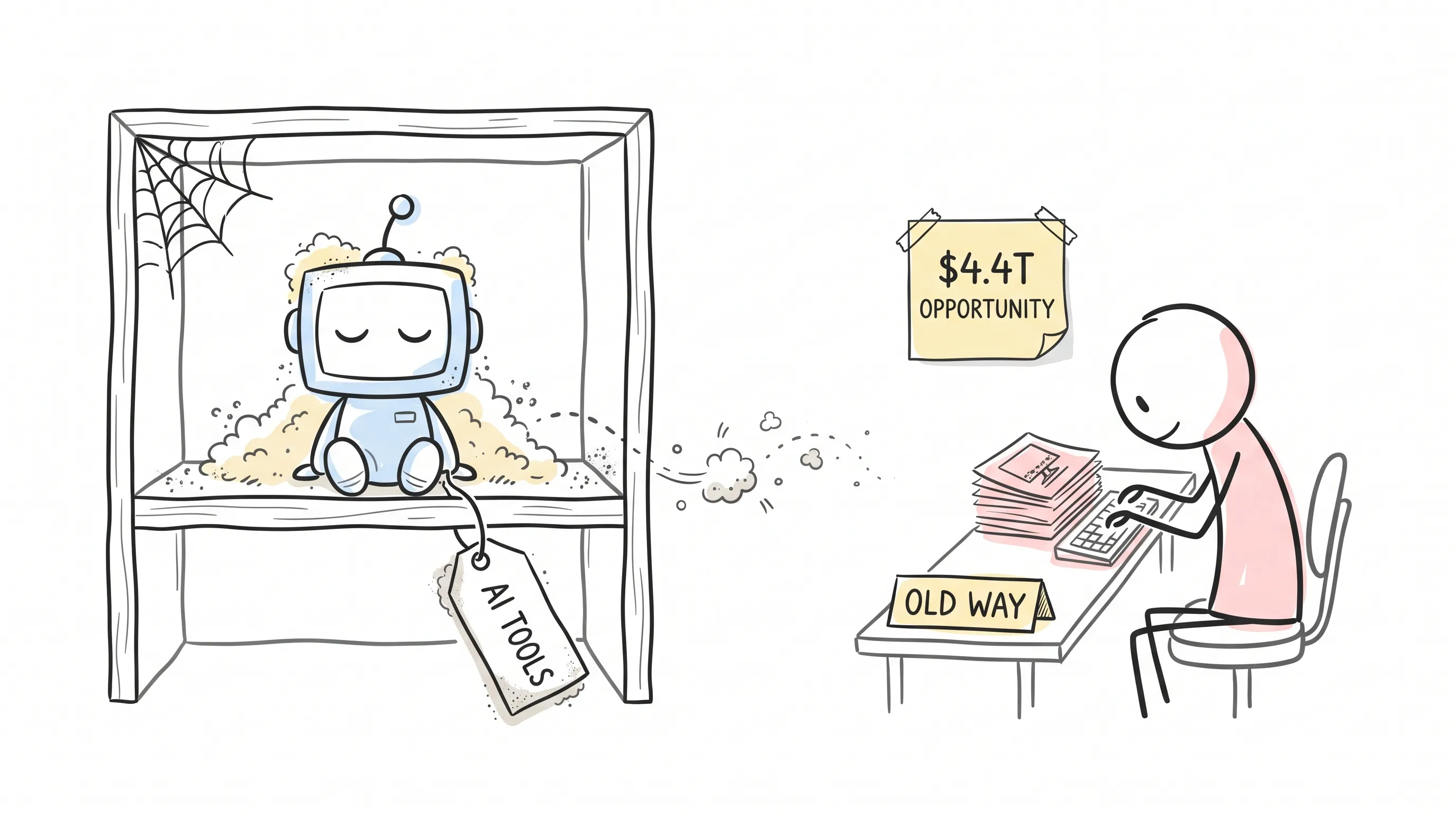
We had barely sat down — before he'd even ordered — when he let out a sigh. Over the past two years his company had spent serious money on AI: content tools, customer-service chatbots, ad-buying systems, a whole suite of it. And the result? The copy still got written the same old way, the weekly reports still went out the same old way, and the biggest thing those tools did was make an appearance in the boss's review meetings.
He asked me: is AI marketing just hype?
I told him it's not that AI doesn't work — it's that you turned "building a capability" into "buying tools."
The difference between the two is what I want to break down for you today, piece by piece.
First, let's put a few numbers on the table.
In 2023, McKinsey published a report estimating that generative AI could add as much as $4.4 trillion a year to the global economy. What does that mean? Roughly the size of adding another Germany to the world.
In 2024, McKinsey found that the share of companies worldwide using AI had climbed to 72%.
The IBM Institute for Business Value runs an annual CEO survey; more than seven in ten top-performing executives believe competitive advantage depends on who holds the most advanced generative AI.
So there you have it: the bosses believed it, the budgets got approved. Then why does everything they bought end up gathering dust?
Let's take it one layer at a time.
1. First, What Can It Actually Do?
What is AI marketing, exactly?
Simply put, it means letting machines do three kinds of work for you: crunching the data, reading the customer, and handling the grunt work. All those tongue-twisting terms you've heard — natural language processing (NLP), machine learning — once they hit the ground, this is the work they do.
Think about it: if you were handed an intern who worked for free and never slept, what would you have them do?
At nine in the morning, put it on writing. Blog posts, emails, ad copy, video subtitles — all of it in one go, then translated into eight language versions while it's at it. One set of marketing assets, reshaped to look native on whichever platform it lands on.
The wave began in 2022, when ChatGPT arrived. Since then, when it comes to content, humans just set the tone; the machine handles the first draft.
At noon, put it on targeting — the precision work inside your customer base. It slices millions of customers, by interest, by behavior, by spending habits, into individual, recognizable faces. What to promote, to whom, and when: it lays it all out, clear as day.
In the early afternoon, the customer-service bot takes the shift for you. The chatbots of years past memorized a script and answered everything but the question. Today's generative AI assistants can actually hold a conversation — they meet the customer at whatever step of the journey they're on, and clear support tickets fast and clean.
By late afternoon, it's minding the store for you. The "you may also like" on an e-commerce site often has a swarm of tireless AI agents behind it, watching your every click and calculating what you're most likely to pay for next.
At dusk, time to go over the ad spend. Programmatic advertising means machines buying ad placements for you, everywhere. Armed with your history, your preferences, and the moment you're in, they serve ads to the right people — and conversion rates run a notch higher.
And at night, it's still working overtime on three fine-grained jobs: combing through reviews and ratings, pulling the sentiment out of tens of thousands of complaints to tell you what people are praising and what they're slamming; watching for shifts in search-engine rules and nudging your pages up the rankings; and automating the busywork — data entry, transcription, scheduling, posting — one chore at a time.
Good grief. That's not an intern — that's an entire extra floor of reinforcements.
And here's the kicker. It turns historical data inside out to tell you which product might take off, how to price it, and which leads are worth chasing. Think about what used to frustrate marketers most: more data than they could ever get through, a gold mine sitting right there while they could only stare at it. Now the excavator has rolled in.
AI's value isn't in how smart it is. It's in the fact that it never gets tired.
2. So Why Do Most Companies Fail at It?
But everything has a flip side.
You pay a fortune to bring in a Michelin-starred chef. Then you open the fridge and find half the ingredients expired and the other half of unknown origin. Can he cook a good meal with that?
AI is that chef. Data is what's in your fridge.
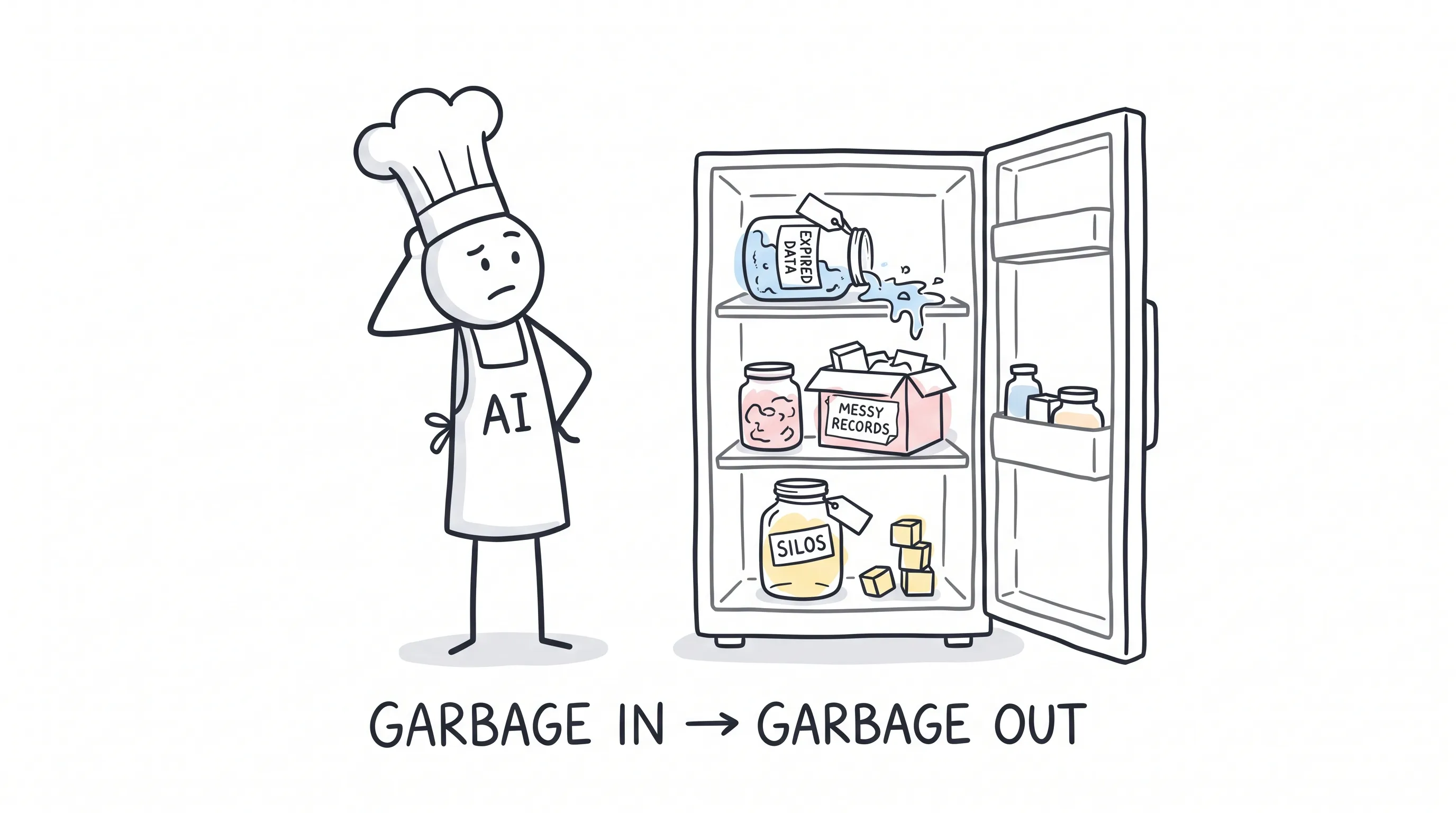
Garbage in, garbage out. AI won't turn bad data into good decisions — it will only make bad decisions faster.
That's why companies that take AI marketing seriously all start the same way: cleaning up their data, honestly and painstakingly. Align the definitions, scrub out the errors. However advanced the tool, if what you feed it is crooked, everything that comes out will be crooked too.
The second hurdle is data locked away in a pile of separate systems: one CRM, one web-analytics stack, one sales platform, none of them talking to each other. The AI is left standing at the warehouse door in complete darkness. The fix? Build pipelines. Only when data runs between systems in real time can it truly "see."
Third, training. AI is like a new hire: put it on the job without training and it's bound to cause trouble. If you want it chatting with customers in a tone people like, you have to feed it plenty of customer-preference data — and maybe staff a few dedicated data scientists. That's why the companies out front go ahead and train proprietary models that understand only their own business, rather than making do with general-purpose tools.
Fourth, playing by the rules. AI feeds on user data every day, and the red lines drawn by privacy regulations are not for crossing. The price of a violation is massive fines plus a reputational collapse — and you can't afford either one. Manage the data well, and be upfront about how the AI works and where it's used; only then will users dare to hand you their trust.
Fifth, keeping watch. Launch isn't the finish line — it's the starting line. Set targets in advance, reconcile the metrics on a regular cadence, feed in fresh data every so often, and adjust when results fall short. And when machines take over half of your employees' work, training and management have to keep up; if you haven't thought through which things must stay with humans, everything before this was for nothing.
Now look at that list: which of these has anything to do with buying?
Not one.
3. Ready to Start? Where Do You Begin?
It's a tangle of threads, so let me compress it into four steps.
Step one: get clear. Don't open the product catalogs yet. Pull the boss and everyone who owns a piece of this to one table, and talk about only two questions: Where are we stuck right now? What do we want AI to change for us over the long run? Once that's aligned, choosing tools and setting metrics falls into place on its own.
Step two: find the right people. People who understand data science and machine learning don't usually grow on marketing-team trees. Either hire them yourself or bring in an outside provider. Hiring is expensive, but the capability lives in your own house; outsourcing is fast, but the capability lives in someone else's. Weigh how much you're willing to invest.
Step three: inspect the goods. Before launch, check two things: is the data accurate, and are the rules being followed? If the training data is skewed, every insight will be skewed too; if the privacy homework for users isn't done properly, the money you saved will sooner or later be paid back with interest — with your reputation thrown in.
Step four: launch, then keep watching and adjusting. When a new workflow lands, people will struggle to adapt, so change management has to come first. After that, it's continuous feeding and continuous calibration, so the machine gets more accurate the more you use it.
Oh, and one more thing: choosing the tools turns out to be the easiest part. If the first three steps are solid, the right one on the shelf will practically jump out at you.
At the end of that dinner, my friend asked me: so tell me, what should we do next week?
I said: don't buy anything. First, go clean up that pile of customer data in your CRM — the records with phone numbers typed in wrong.
He froze for two seconds, then laughed: that's it?
Yes. That's it.
In the battle of AI marketing, everyone can afford the tools — but the ammunition you have to make yourself. Whoever gets their data, processes, and people in fighting shape first is the one who claims their own share of that $4.4 trillion.
And here's a wish for you: may every dollar of AI budget you spend come back with an echo.
Continue reading
Related articles

Cross-Border Business: Time to Upgrade Your AI Toolbox
A learn article explaining how AI tools help cross-border e-commerce sellers clear five hurdles: language, regulation, logistics, payments, and fraud. It outlines a five-compartment toolbox, a five-step adoption path, and metrics such as conversion rate and CLV, while cautioning against over-reliance on AI.

AI Is Taking Over the Dirty Work of Social Media Marketing, One Task at a Time
This learn article outlines four social media marketing tasks AI can handle — audience analytics, content drafting and design, ad targeting and creative testing, and spam moderation — and cautions that taste, judgment, and data security remain human responsibilities.

AI Is Already This Good — Why Is Your Social Media Marketing Still Pure Manpower?
An overview of 18 AI tools for social media marketing, organized into six categories covering audience research, content creation, scheduling, comment and DM handling, ad management, and visual production, plus notes on personalization, prediction, and emerging trends.