
Why Does AI Insist on Letting You Watch It Work?
The article examines why AI assistants such as Claude, ChatGPT, and Gemini stream their working process to users, links this to the psychology concept of the labor illusion with cited experiments, and advises making real effort visible to clients to build trust.
The other day, I was using AI to look something up, and I stumbled onto an interesting scene.
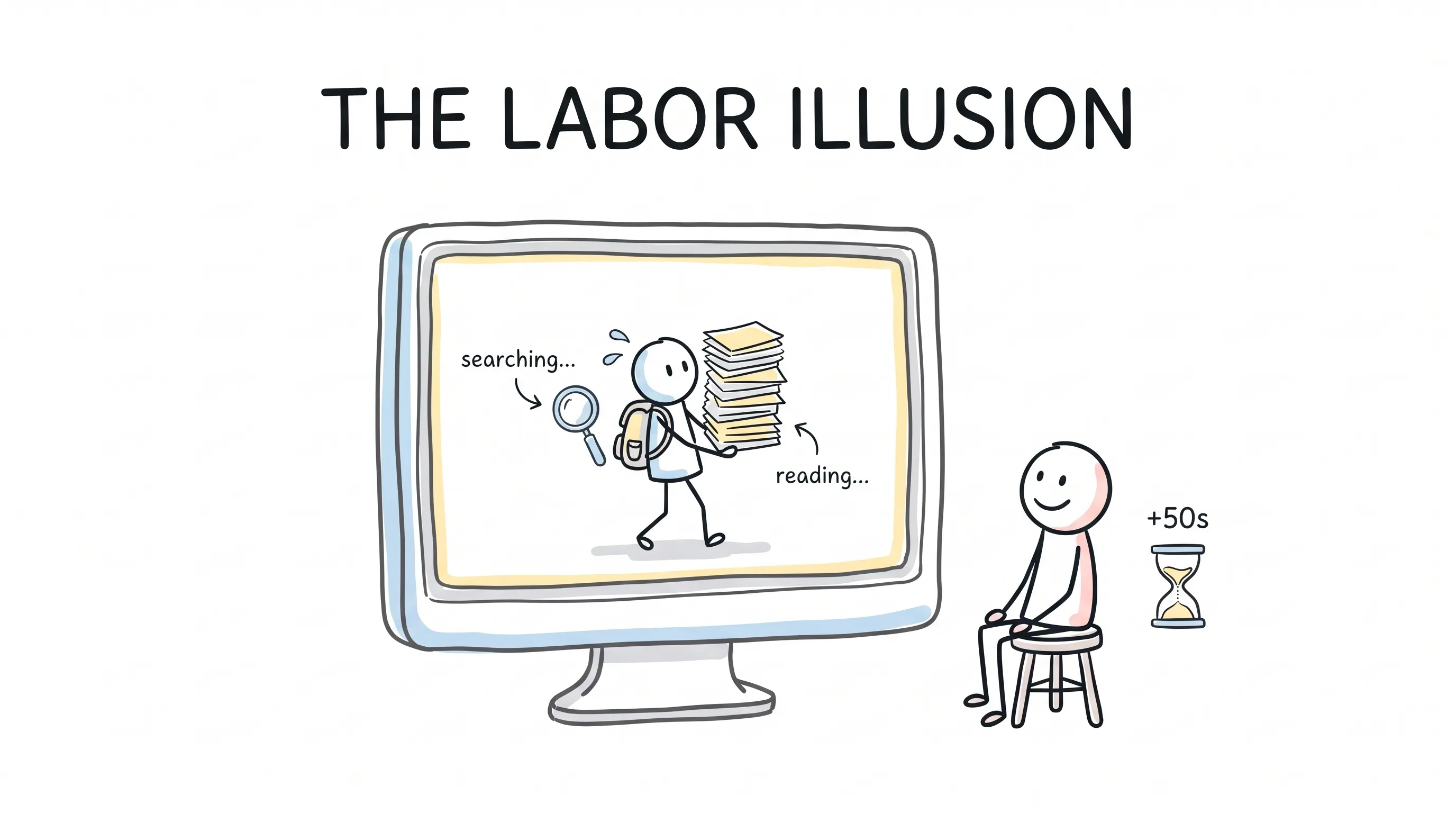
On screen, it kept spinning as it streamed its work live: searching these websites... opening this document... Hmm, something about this approach seems off—let me think this through again.
Who does that remind you of? A customer service rep making calls, flipping through files, and pulling up records right in front of you.
Honestly, I couldn't look away.
And once I snapped out of it, a question popped into my head: why show me any of this?
The Official Explanation—Do You Buy It?
In 2025, every AI player made the same move at nearly the same moment: putting the "thinking process" on display. Claude, ChatGPT, Gemini—not one of them sat this out. You can see what it searched, what it read, and which assumptions it overturned along the way.
Why do it? Anthropic, the company behind Claude, has given three reasons.
One: it lets you check the answers. The more closely you check, the more you trust it.
Two: it exposes the places where what the model "thinks" and what it "answers" don't line up.
Three: it's fun to watch.
The first two sound perfectly legitimate. The third is where things get interesting. Fun to watch?
Would you build a product that hundreds of millions of people use every day, and then put a detail on the interface—just because it's "fun"?
I don't buy it. Behind any detail placed in front of hundreds of millions of users, there's a reason—one somebody has run the numbers on.
So what's the fourth reason?
Patience. First, let me tell you about two experiments.
First, Two Experiments
The first: 2011, Harvard.
Two professors set out to challenge a piece of received wisdom in the journal Management Science: in service scenarios, is faster always better?
They recruited 266 people to use a flight-booking website, something like Skyscanner or Kayak: you type in a destination, and the site pulls back fares from the various airlines for you to choose from.
There was a catch. One group saw a lone spinner on a white background, and nothing else. The other group saw the spinner plus a real-time scrolling list: searching this airline... searching that one... fares popping up one after another.
The wait times were staged too, randomly set anywhere from 10 to 60 seconds.
When the results came in, they stopped me cold the first time I read them: the group that watched the search process rated the same batch of results 8.1% higher than the group stuck staring at a white screen and a spinner.
Even more striking: even when the transparent version spun longer, people still judged it better. Same flights, 50 extra seconds of waiting, and the ratings were still higher.
They weren't done yet. They brought in 118 more people for a forced choice: a fast-but-black-box site versus a slow-but-transparent one, both returning exactly the same results.
Most people picked the slow one.
Think about it: people waited longer and ended up happier. Does that make any sense?
The second experiment: 2022. Three researchers—Dimitrios Tsekouras, Ting Li, and Izak Benbasat—published a study in the journal Information and Management trying to pin down one question: when a system "shows effort" to its users, does that actually change how users rate it?
They ran two rounds of experiments. In one, 306 people used a car-shopping search engine; in the other, 294 people used a dating app, the kind that matches you with people and spins while it loads.
Participants were split into groups: some had to put in effort of their own first, some didn't; some watched the system spin and "calculate results" for a full seven seconds, while others got their results instantly.
Here's the key: every group ended up with exactly the same recommendations.
The only difference was those seven seconds of spinning.
And the result? The group that had watched the spinner rated the recommender system significantly higher.
Seven seconds. Nothing extra actually got done. The rating went up anyway.
So What Is the Labor Illusion?
Both experiments point to the same thing. In psychology, it's called the Labor Illusion.
What is the Labor Illusion?
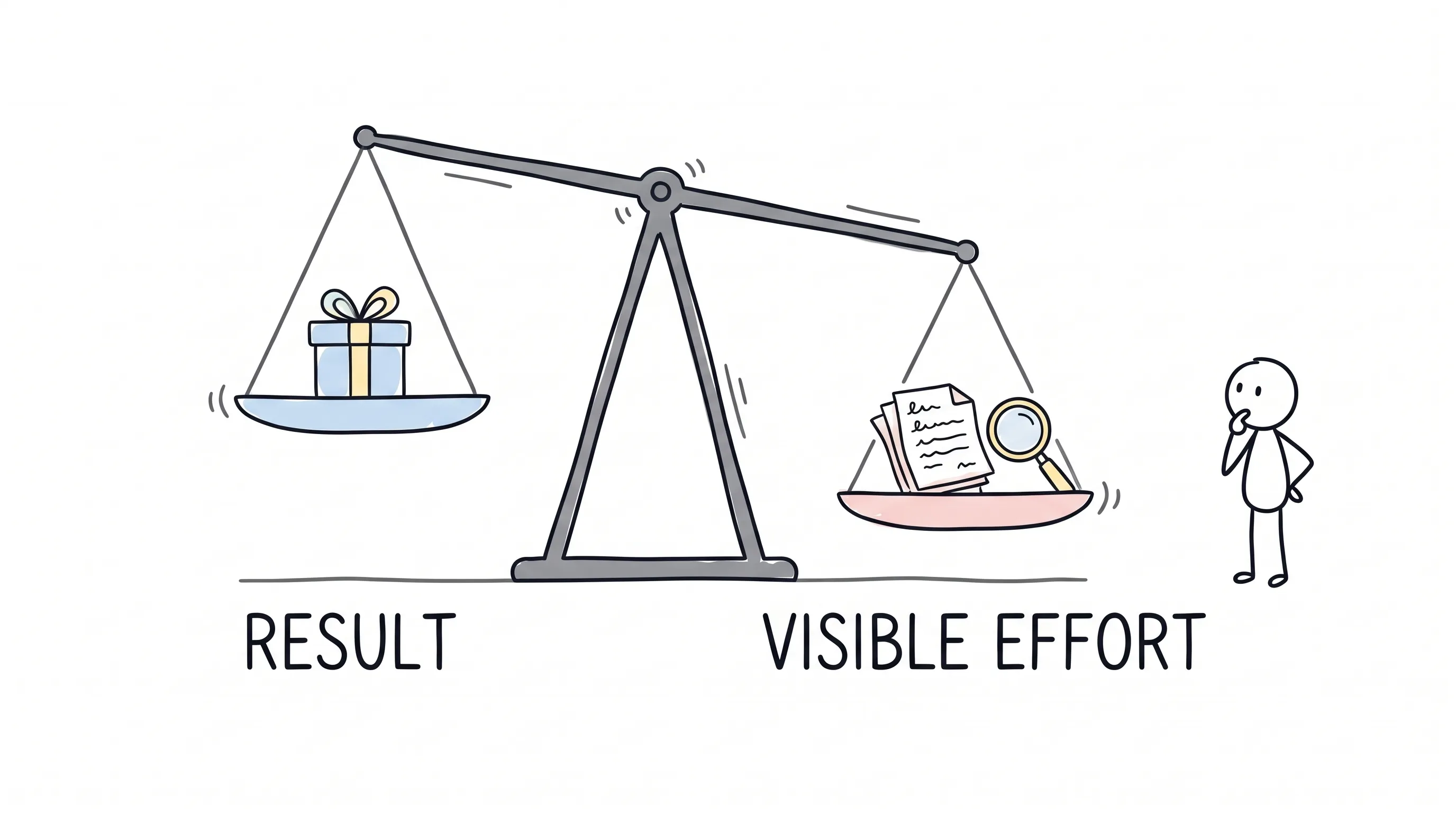
It's this: people judge something not only by whether the outcome is good, but also by how much effort went into it. With one precondition—that effort has to be visible to them.
Because it's visible, it's credible. Because it's credible, it's valuable.
Now look back at Anthropic's three reasons, especially the "fun to watch" one. Truth is, I don't believe a product used by hundreds of millions of people would write a single extra line of code for "fun".
I'd rather believe the fourth reason—the one nobody said out loud:
Once you see how hard it's working, you trust it more—and you'll wait for it more willingly.
OpenAI and Anthropic will probably never admit it. But anyone in marketing knows it in their gut: each of us carries an inner scale, and it weighs not just the thing itself, but the effort that went into making it.
So between a slow engine you can see straining, and a black box whose effort you can't see, most people will take the former.
What Does This Have to Do with You?
You may not work in AI. But odds are you make products, run services, and deliver work.
Picture a scenario. A client hands you a project, and you spend three days heads-down. How much material you combed through, how many versions you revised, how many proposals you killed—none of it registers with them. On delivery day, you say: done.
Why should their internal score be high?
In their eyes, those three days and one hour are no different.
So give them a "transparent loading screen".
Before you start, send a message: "I've sorted out three approaches, and I'm going to start with the first one."
Along the way, check in: "This route isn't performing well, so I've switched tactics."
At delivery, lay the process out: which paths worked, and where you took detours.
The work is still the same work—but now they've seen the labor.
And when they size you up afterward, the very same job carries completely different weight.
But then again.
This whole playbook rests on one premise: the effort has to be real. If all you build is an idling loading screen with nothing inside, it looks fresh at first glance, falls apart at the second, and by the third, your clients are gone.
You can fool someone once. Nobody hands you a second chance.
One Last Thing
The next time you watch an AI "work live" on screen—which websites it searches, which documents it reads, even how it second-guesses itself along the way—don't just enjoy the novelty.
It's a performance of labor, staged for you.
And you're gladly waiting those extra 50 seconds for it.
May your hard work always be seen.
Continue reading
Related articles

Cross-Border Business: Time to Upgrade Your AI Toolbox
A learn article explaining how AI tools help cross-border e-commerce sellers clear five hurdles: language, regulation, logistics, payments, and fraud. It outlines a five-compartment toolbox, a five-step adoption path, and metrics such as conversion rate and CLV, while cautioning against over-reliance on AI.

AI Is Taking Over the Dirty Work of Social Media Marketing, One Task at a Time
This learn article outlines four social media marketing tasks AI can handle — audience analytics, content drafting and design, ad targeting and creative testing, and spam moderation — and cautions that taste, judgment, and data security remain human responsibilities.

AI Is Already This Good — Why Is Your Social Media Marketing Still Pure Manpower?
An overview of 18 AI tools for social media marketing, organized into six categories covering audience research, content creation, scheduling, comment and DM handling, ad management, and visual production, plus notes on personalization, prediction, and emerging trends.