
Why AI Personalization Always Falls Short
A long-form guide on why AI personalization often fails due to misaligned data, timing, and teams, walking through ten steps from unified customer profiles and dynamic segmentation to omnichannel orchestration, uplift measurement, and governance guardrails.
A while back, an old friend who runs a retail business invited me out for tea and started talking about the expensive AI personalization system he'd just rolled out.
So I asked: how's it working?
He didn't answer directly. Instead, he told me a story. Last week, a customer had just finished a heated argument with a support agent on the phone, still fuming, when her phone buzzed with an enthusiastic promotional text message.
Good grief. That's not personalization. That's walking straight into the line of fire.
He asked me: the model is fine, the data is all there — how does it end up like this?
I told him: you've just put your finger on the root of the problem.
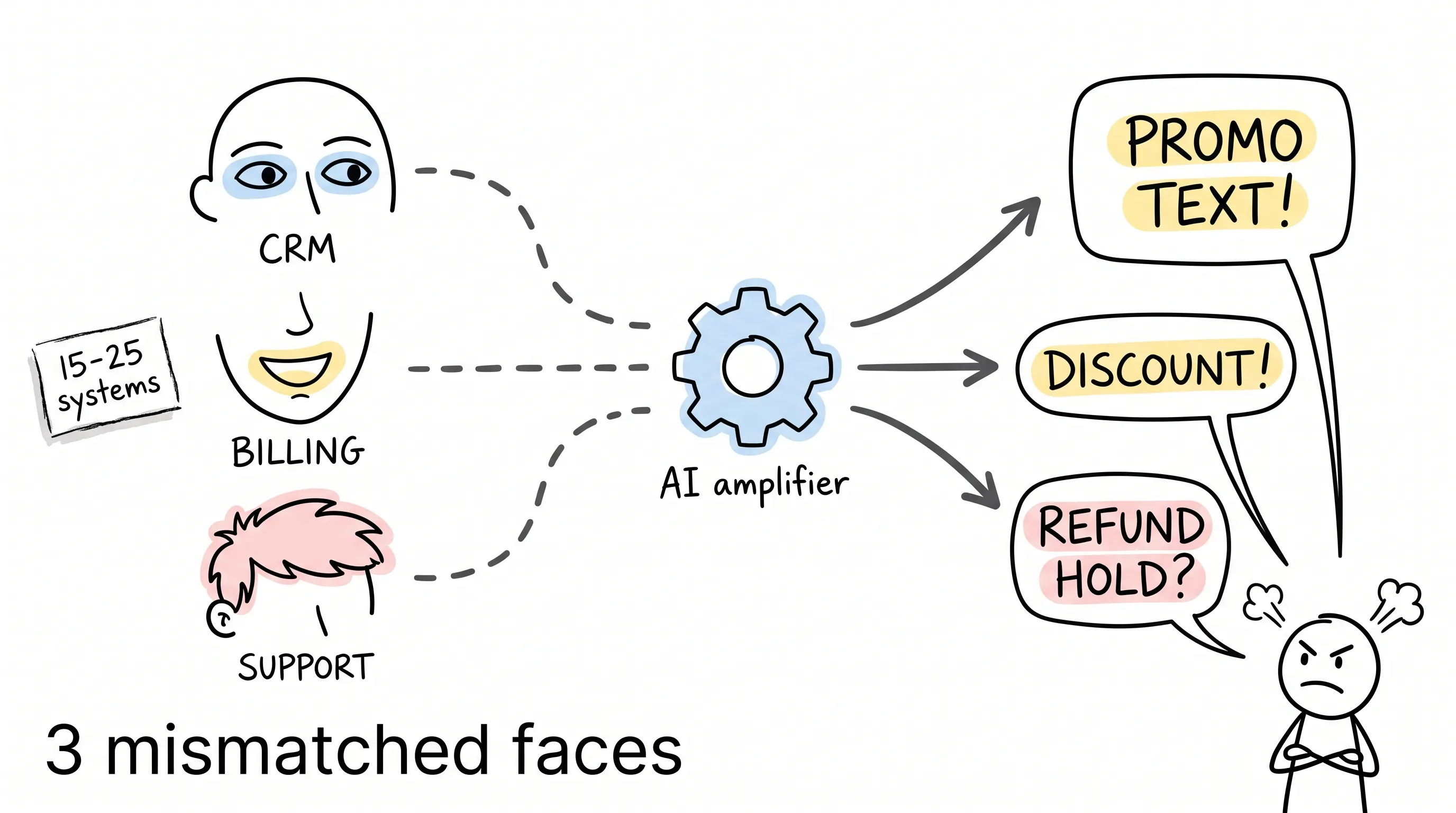
Most personalization doesn't fail because the technology isn't advanced enough. It fails because of alignment. Customer data, outreach timing, and team actions — three things that never line up. AI is just an amplifier: feed it three mismatched faces, and it will send three messages that contradict each other.
Why do I say that? Let's take the whole thing apart.
How Personalization Comes Apart
Start with the most common break points.
The first break point: customers grow three faces. Any decent-sized company scatters customer data across 15 to 25 systems. The same person is one record in the CRM, another in billing, another in customer service. When AI tries to build a profile from three incomplete faces, the portrait comes out crooked.
The second break point: the lists are dead, but the customers are alive. Many teams refresh their segment lists only once a month — yet a customer can be comparison-shopping one second and demanding a refund the next. You're fighting today's battle with yesterday's list.
The third break point: departments pull in different directions. Marketing chases conversion, support chases satisfaction, the tools don't talk to each other, and the KPIs don't recognize each other. So the moment a customer files a complaint, the promo text lands. That's exactly what happened to my friend.
The fourth break point: reactions are too slow. Plenty of companies still run data pipelines that batch-update once a day. The signal appears the instant a customer abandons the cart, but the system won't see it until tomorrow. By the time you react, the customer is long gone.
The fifth break point: compliance jams up the process. Especially in heavily regulated industries like healthcare and finance, rules like CCPA allow you to use only clearly authorized data. If consent checks still rely on humans reviewing items one by one, by the time the approval comes through, the message has long expired.
So you see — the solution isn't producing more content. It's cleaning up the data and speeding up decisions.
Where to begin? With the data, naturally.
Step One: Piece the Customer's Face Back Together
What is unified data? It means building a single profile for every customer — identity, behavior, transactions, and service records all pieced onto one face. The usual approach is to connect a CDP (Customer Data Platform) to the CRM, so what the AI receives is no longer fragments but a complete human being.
Once the profile is filled in, you can also ask customers directly.
Here's a number worth pondering: 83% of consumers are willing to volunteer their preferences — as long as the experience you give them in return is thoughtful enough. This kind of customer-provided data has an industry name: zero-party data (data customers volunteer).
But don't open with a 30-field form. That isn't preference collection — that's an exam. The smart move is to ask one high-value question per visit, conversational, one sentence at a time. The profile gets richer and richer, and the customers never feel pestered.
And here's a step you shouldn't skip: before wiring up the AI, give your data a physical. Check the sources, reconcile the fields, look at update frequency, deduplicate. If the foundation is shaky, everything built on it is wasted.
Step Two: Make Segmentation Move
With the data in order, segmentation can start moving.
What is dynamic segmentation? The list follows the customer wherever they go, instead of you pre-drawing a list and waiting for people to walk in.
Think about it. One person clicks into the pricing page again and again; another walks past without stopping. Are those two in the same group? The first one radiates urgency. Static lists can't see that difference. AI can: the system re-scores in real time, and whoever's behavior changes moves to a new group.
The results speak for themselves. HubSpot's data shows that segmented campaigns generate 760% more revenue than unsegmented ones; predictive targeting outperforms demographic-only targeting by up to 20% in conversion rate.
760%. You read that right.
But getting the segmentation right isn't enough — the signals have to be wired to actions:
- Repeated visits to the pricing page? Time for sales to step in.
- An open ticket? Pause every promotion.
- Usage trending down? Kick off the retention flow immediately.
One detail deserves a long look: someone browsing the cancellation page needs retention, not an upsell. Get that judgment wrong, and everything that follows is wasted effort, no matter how polished.
A B2B SaaS company scored its sales leads with more than 40 behavioral signals and lifted its close rate by 30%. Segment right, and the money is just sitting there.
Step Three: Don't Wait for Things to Happen — Predict Them
Segmentation answers "who is this customer, and what state are they in right now?" The next question is: which move should I make?
That's called Next Best Action — the industry abbreviation is NBA. Don't laugh. It has nothing to do with basketball.
The old playbook was to wait: wait for the cart to be abandoned, then trigger a win-back email. The new playbook is to compute first: before the customer acts, you've already calculated how likely each person is to churn and how likely they are to buy. Personalization shifts from "reacting after the fact" to "deciding before it happens."
What does the model look at?
Browsing tempo. Three visits to the pricing page in one hour versus one visit a week — those are two entirely different levels of intent. Service status. A ticket carrying genuine anger means the right move is to hold back the routine sales email and route the customer to a real customer success manager. Then transaction history, plus business constraints — margin floors, inventory levels — all fed in together. Only then does the model dare to pick the move that fits the moment.
Here's one guardrail I want to underline: confidence. When the model isn't sure, it should fall back to a neutral action, or simply ask the customer another question. An absurd recommendation damages trust more than no recommendation at all. It's fine if the machine is occasionally slow-witted. It is not fine if it talks nonsense.
Let me give you this year's example. Early this year, Sandler used AI agents with real-time CRM context for sales outreach and cut its sales cycle in half.
Impressive.
So the scores are computed. Who carries them to the customer? That's step four.
Step Four: Deliver the Action on the Spot
Next Best Action computes "what should be done"; the real-time recommendation engine handles "give it now."
Behind the engine sits a decision layer that blends intent scoring, journey ranking, and business rules. It also understands context: if a customer is upset, don't push products — offer an installation guide; if a customer needs a person, step aside and route them to a human agent.
BSH's approach has always struck me as textbook: a customer stares at one product page and leaves without buying, so the next email doesn't pitch anything else — it answers that product's specific questions. Add-to-cart rates visibly climbed. It's that simple: whatever is on your mind, that's what I answer.
Here is a scary number: sessions that include an AI recommendation module show an average order value 369% higher.
Where to start? Don't be greedy. Begin with the two biggest leak points: cart abandonment, and the places where onboarding stalls. Get one working end to end, then hand it to the orchestration layer to scale.
Speaking of scale — step five is where the real battle begins.
Step Five: Omnichannel, One Voice
Getting one decision right is one thing. Getting email, web, app, and support bots to say the same sentence at the same moment is another.
That's the orchestration engine's job. It doesn't just run if/then; it watches real-time behavior and sentiment, and can pause, delay, or reroute at any moment. The instant a customer shows a trace of irritation, the system should stop advancing the campaign as planned.
Orchestration has one iron rule — I call it "brakes-first": if a customer has any unresolved service issue, promotions stop on every channel. Not one channel. All of them. Wait until the ticket closes.
Is that strictness worth it? Look at the numbers. Triggered messages convert 624% better than batch-and-blast email. And companies that orchestrate well capture 10% to 20% more revenue while cutting costs 15% to 25%.
How to start? Three things: audit whether each channel's real-time data coverage is sufficient; confirm the engine is fed clean, unified signals; then pick the messiest handoff point for a pilot — say, the moment sales hands off to delivery. Once it runs smoothly, expand outward.
One warning: if the data isn't clean, even the smartest orchestration logic is garbage in, garbage out. The old saying isn't new, but in this scenario it's true down the line.
With channels in place, it's time to grind on content.
Step Six: Grow Content and Offers from Templates
However many channels you have, each message still has to be written, one by one. Write that far, and people break down.
The solution is modular templates. Weld the legal language and brand language in place, immovable; leave headlines, products, offers, and images as slots for the AI to fill on the spot. The welded parts keep you compliant; the fill-in parts keep you relevant. One template system can carry personalized campaigns at the tens-of-millions scale, without rebuilding from scratch every time.
The power of this move is clear from two companies.
Kroger uses machine learning for personalized offers across 150 million customer touchpoints, issuing 1.9 billion unique coupons a year. Written by hand? A century wouldn't be enough.
Klarna went further: 80% of its copy is written by AI, saving $6 million in image production costs alone — and the freed-up money and capacity went straight back into more personalization campaigns.
But when you give AI authority over offers, draw a hard boundary. Put the margin floor and inventory caps directly into the decision rules, or the AI will discount things wildly for the sake of conversion, or promote products that aren't even in the warehouse.
That's marketing messages covered. The other half of the battlefield is customer service.
Step Seven: Bots Should Do the Work, Not Just Point the Way
You've surely met that kind of support bot: you ask where your package is, and it flings a link to the shipping policy at you.
A good virtual agent connects to the back-end systems — orders, subscriptions, inventory — and can tell you outright: "Your package is in Memphis." Between those two experiences lies a chasm.
The key: service messages and marketing messages should draw on the same customer profile and the same decision rules. Before the bot speaks, it should be able to see your ticket status, the pages you recently viewed, whether your mood is up or down — only then does what it says carry context.
Camp Network does it this way: train Breeze AI on its own knowledge base, then connect real-time service data. This year it reached 70% of questions deflected by AI, leaving human agents free for the genuinely hard problems.
The 70% deflection rate is only a byproduct. The real prize is people freed up to do the hard work.
But bots must not fight to the end. Watch sentiment the entire time; the moment it turns negative, step aside and hand over to a human with the full conversation record and a list of "what's already been tried." Never make customers pour out their grievances a second time — that's a second injury.
Compliance needs early thought, too: mask sensitive data before it enters the model; if the confidence score falls below threshold, either ask a follow-up question or escalate to a human; use RAG (Retrieval-Augmented Generation) to pin every answer to reviewed content, so that anything the system says can be traced to a source.
Step Eight: Let Events Drive the Whole Journey
What ties all of these pieces together in real time? Events.
What is event-driven? The moment a meaningful signal changes, the action happens on the spot — no waiting for someone to schedule it.
For example:
- Three visits to the pricing page within an hour. Sales should step in.
- Seven days without a reply, while the customer keeps browsing with high intent. AI drafts a contextual follow-up email.
- A key feature unused for seven days. Push a usage resource proactively, or have the customer success manager check in.
Once triggers are live, the real question to watch is: which triggers genuinely moved conversion and retention? Some signals deserve an instant response; others are just noise. Don't let the system pick up jumpy habits.
The guardrails remain the same two: while a high-priority ticket is open, suppress all promotions; and identity data must stay clean, or every trigger fires at the wrong person and every moment is mistimed.
Those event logs have one more use: they feed the next layer — measurement.
Step Nine: Measure Lift, Not Noise
This step is where ordinary companies and leading companies truly pull apart.
What do most teams measure? Impressions, click-through rates, messages sent. Lively numbers.
But lively isn't the same as incremental. The real metric is lift: how much did the outcome change because of this message, this touchpoint?
There's a dedicated algorithm for this, called uplift modeling: for each user, estimate the difference between "saw the message" and "didn't see it." It answers not "did the touchpoint happen?" but "did the touchpoint work?"
Pair it with AI-driven parallel experimentation. A traditional A/B test runs one variant and waits two weeks; AI optimization runs hundreds of micro-tests simultaneously, across audiences and versions, and surfaces winners in real time. Dozens of times faster.
To run tests cleanly, take a few rules: keep a central test registry so two experiments don't collide; pick one unit of experimentation — user, account, or session — and use it end to end without switching; before launch, write down the success metric, the minimum lift, and the stopping conditions, and once it's running, no changes allowed.
And one rule I most want to stress: always keep a holdout — a group that receives absolutely nothing. Without one, you can't tell whether the growth came from your journey or just the rising tide. For automations that run forever with no end date, the holdout is the only proof they're still working.
At the macro level, AI personalization lifts revenue by roughly 5% to 15%. Whether you get to eat that bite depends on whether you can measure it.
One last piece — the part that governs all the rest.
Step Ten: Build the Brakes into the System
The faster personalization runs, the more it needs brakes.
How do you install brakes? Write them straight into the workflow. Price floors, discount caps, rules for regulated content — block invalid content before the message leaves the building, not recall it after it's gone out.
Consent status must travel with events, queryable on every channel in real time. The moment a user unsubscribes, every activation system syncs within 24 hours. Not a minute slower — that's how you earn a fine.
Every AI decision gets a log: why it did this, and on what basis. Compliance teams must be able to flip through it, audit it, and spot early signs before model drift grows too wide.
And some decisions belong to humans, forever:
- Sentiment turns negative — skip the AI, route straight to a senior agent.
- Regulated offers — legal or compliance approval first.
- A high-value deal is stuck — AI drafts, a human reviews before it sends.
- Confidence too low — escalate to human review.
AI handles speed; humans handle steadiness. Don't get that division backwards.
Finally
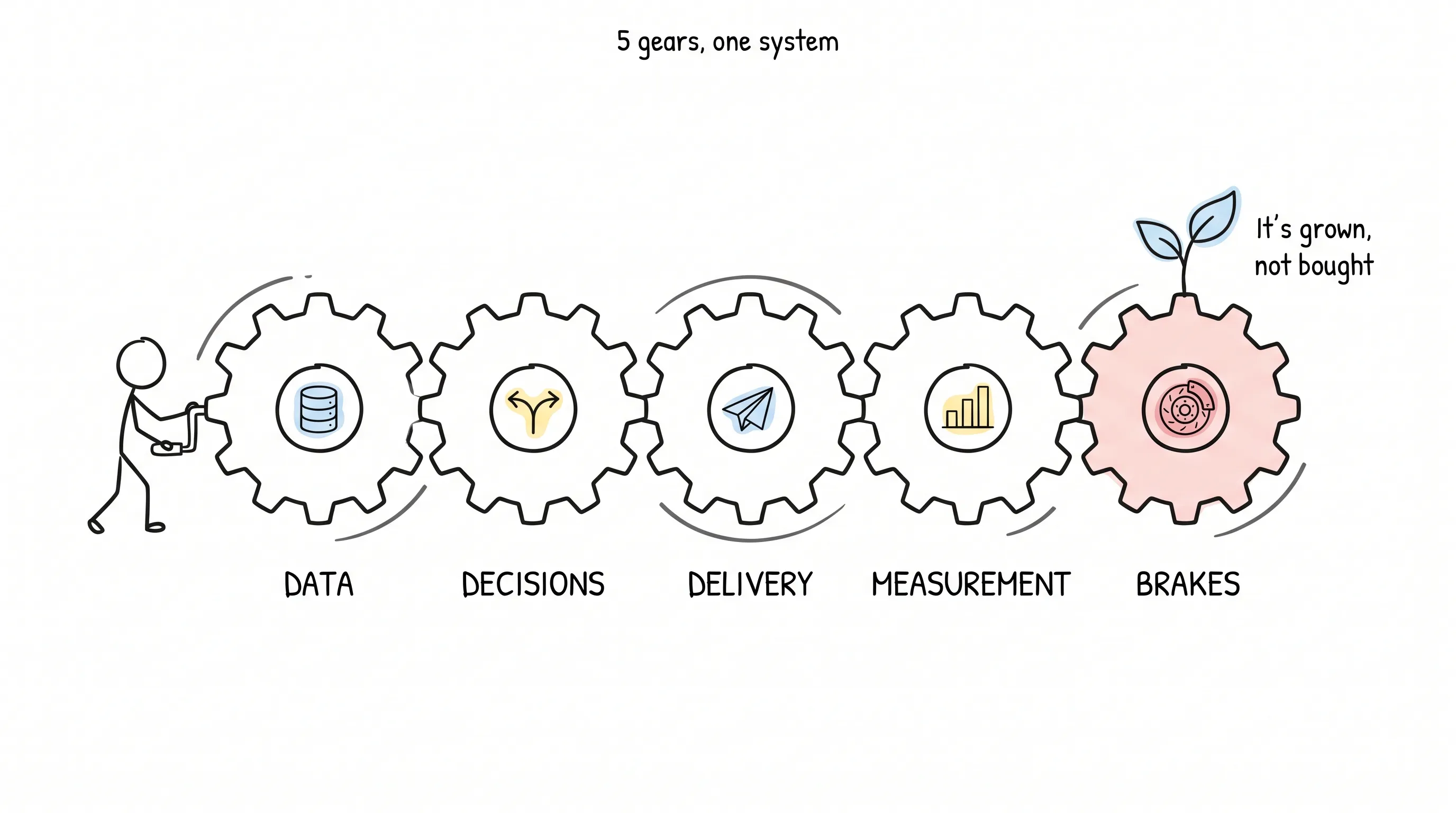
Ten strategies, covered. If I had to compress them into one sentence: personalization isn't bought. It's grown.
What you buy is a model. What grows is a system. Data, decisions, delivery, measurement, brakes — five gears meshed together before anything turns.
Don't rush the rollout. Data first, then decisions, then orchestration, then governance — one step at a time. Prove one high-value journey end to end, measure the lift, then expand.
A set of numbers fits nicely at the end: companies that lead in personalization grow revenue about 10 percentage points faster each year than those that lag. Over ten years, that isn't a gap. It's two different species.
Here's to your next promotional text never landing on someone who just finished being angry.
Continue reading
Related articles

Cross-Border Business: Time to Upgrade Your AI Toolbox
A learn article explaining how AI tools help cross-border e-commerce sellers clear five hurdles: language, regulation, logistics, payments, and fraud. It outlines a five-compartment toolbox, a five-step adoption path, and metrics such as conversion rate and CLV, while cautioning against over-reliance on AI.

AI Is Taking Over the Dirty Work of Social Media Marketing, One Task at a Time
This learn article outlines four social media marketing tasks AI can handle — audience analytics, content drafting and design, ad targeting and creative testing, and spam moderation — and cautions that taste, judgment, and data security remain human responsibilities.

AI Is Already This Good — Why Is Your Social Media Marketing Still Pure Manpower?
An overview of 18 AI tools for social media marketing, organized into six categories covering audience research, content creation, scheduling, comment and DM handling, ad management, and visual production, plus notes on personalization, prediction, and emerging trends.