
Who's Running Your Meta Ads at 3 A.M.?
An explainer on using AI agents for Meta media buying: which tasks suit automation such as research, creative production, testing, and budget pacing, which decisions stay human, a staged rollout with guardrails, common failure modes, and how native tools like Advantage+ and TikTok's Ads MCP relate.
Picture this.
Friday, 4 p.m. You've been staring at an ad that's been running for half a month. The numbers look good, and the itch hits: raise the budget. Your hand slips — +50%.
Monday morning you check back, and your stomach drops. The ad set has been kicked back into the learning phase (Meta's relearning window for an ad set), and Meta is making you pay tuition all over again: the account only stabilizes once it racks up roughly 50 conversions. A week — gone.
In media buying, the most expensive cost often isn't money. It's an itchy trigger finger.
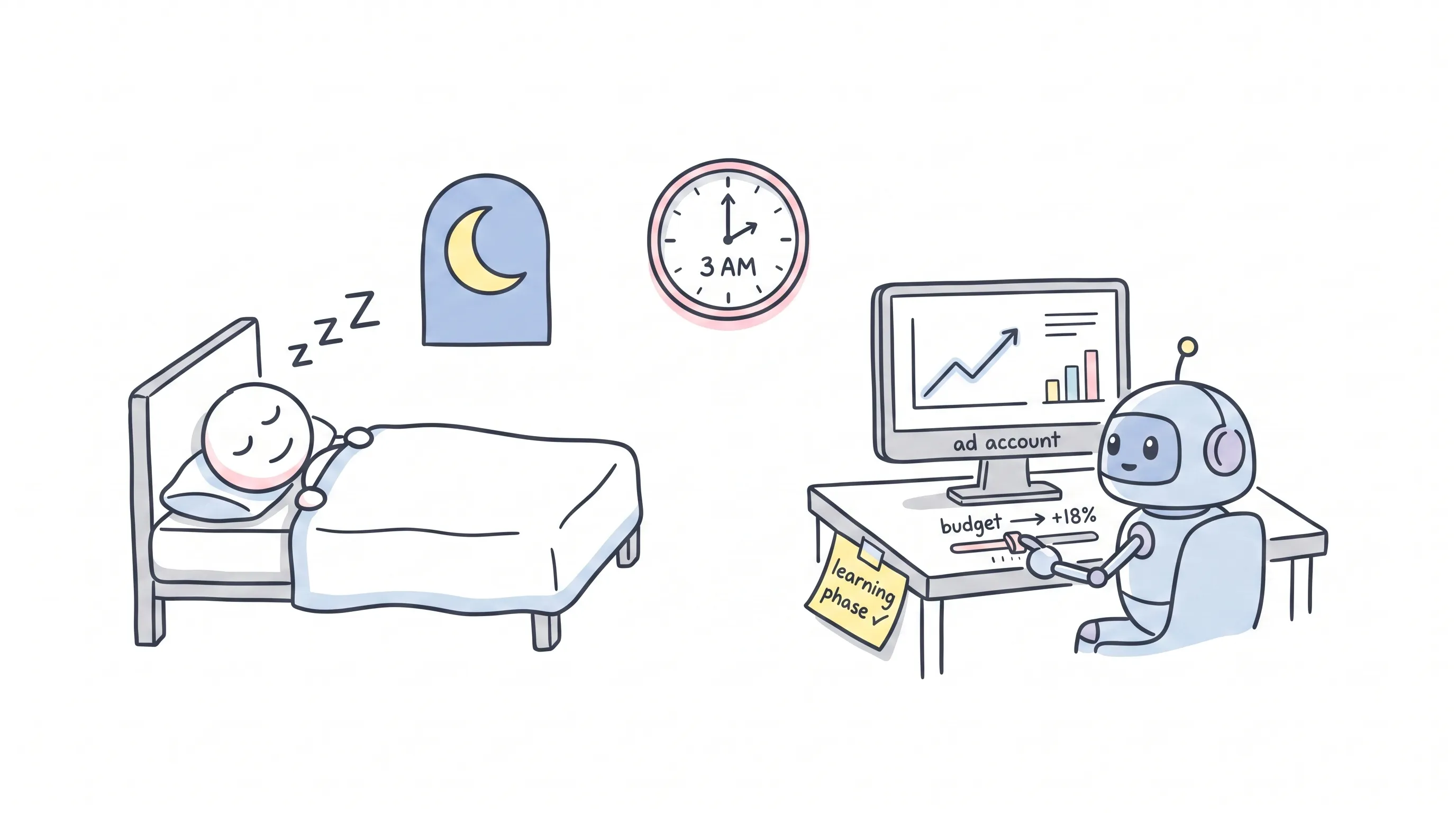
Over the past two years, a new character has walked into the media buying world: the AI agent. It claims to watch your account 24/7 — studying competitors, producing creatives, running tests, adjusting budgets, killing fatigued ads — and at 3 a.m. it just keeps working.
Let's get the ugly part out of the way first: this is not a "fire your media buyer, hire an AI CMO" story. What agents take over is tactics; strategy stays yours. Which jobs you can hand over, and which ones will blow up in your face if you do — I'll go through them one by one.
Why Now, of All Times?
AI media buying has been hyped for years. So why did things only become real once these two pipes got connected?
Pipe one: access. Meta lowered the entry bar to its Marketing API: previously you needed 1,500 API calls within 15 days to unlock higher permissions; in 2025 that dropped to 500. With the bar lowered, third-party agents can finally get their hands on "write access" to ad accounts — able to act, not just watch through the glass.
Pipe two: creatives. In October 2025, Meta's Andromeda delivery system went live worldwide and changed the underlying logic: when picking creatives, it now reads mostly the signals of the creatives themselves. The result: creative volume became the single biggest performance lever. Accounts running 15 to 20 active ads with different hooks (the opening seconds of an ad, designed to stop the scroll) see ROAS (return on ad spend) 20% to 35% higher than accounts still recycling the same 3 old creatives. That's no longer an optimization — it's a generational gap.
Do the math. Producing 20 creatives with different hooks, by hand, every week? Not realistic. And yet this is precisely the kind of work machines are best at.
Once the pipes connected, this stopped being a concept and became a business.
Which Jobs Can Machines Actually Handle?
Let's start with what can be handed over. The Superscale team runs this loop on real accounts every single day, and they've broken down, in detail, what they let agents do. I find it credible.
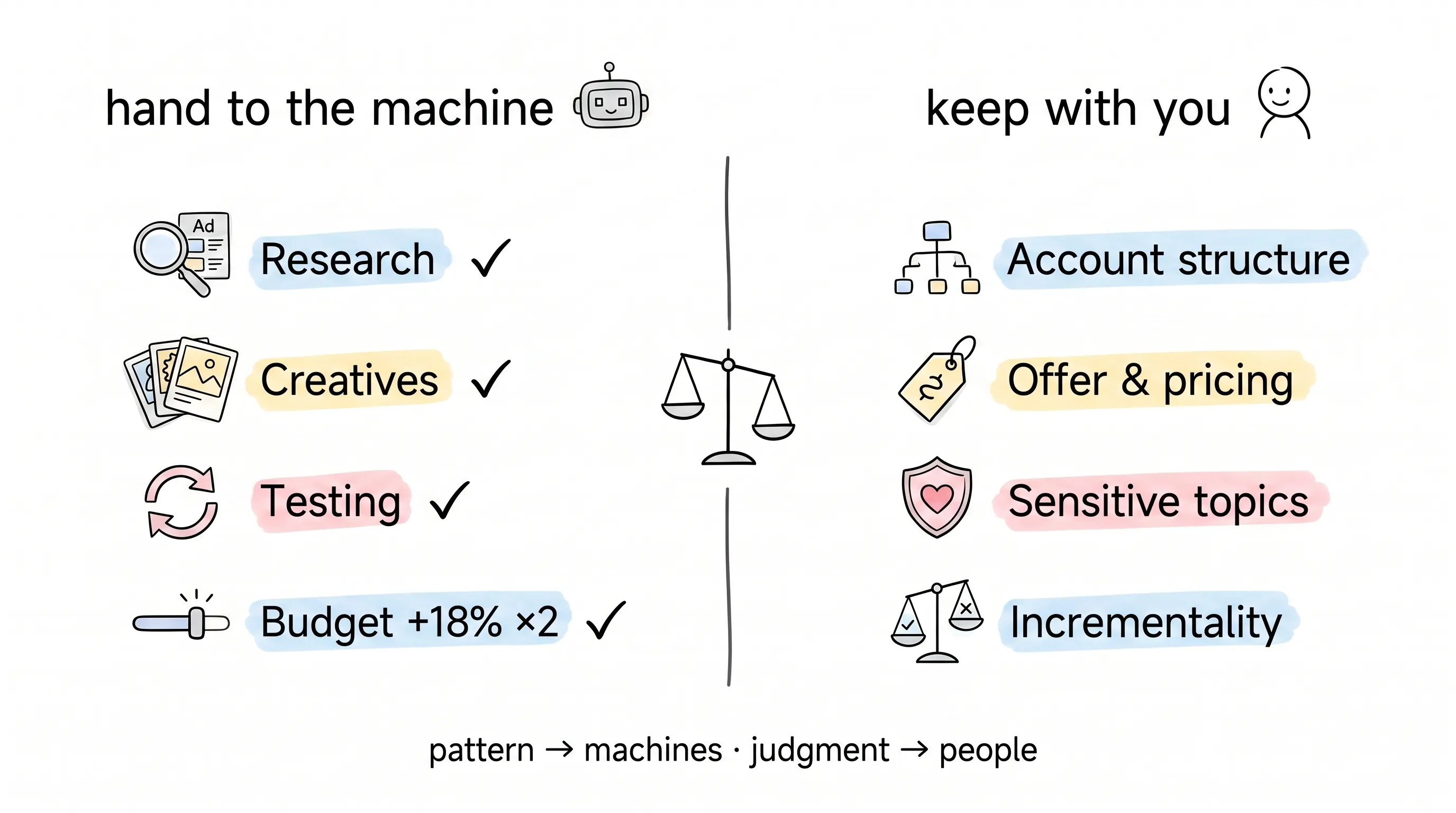
Research. An agent combs the Meta ads library, pulls out every ad being run in your niche, and singles out the ones that have stayed live a long time. Why pick the long-runners? The logic is plain: no one keeps burning money for months on purpose, so long-running roughly equals working. Yes — it really is that simple. A human doing this loses an entire afternoon; a machine can do it every day.
Creative production. Once you know which angles can run, generate in bulk: copy, scripts, finished cuts — statics and video together, ready to launch the moment they're done. This is the ammunition you feed Andromeda.
Testing and rotation. Spin up variants, watch the data, cut whatever can't run, copy the winners and build another round. No waiting for Monday's review meeting.
Budget adjustments. This is where humans get itchy fingers the most. First, a definition: what is the learning phase? Meta's algorithm needs a window of time to figure out how an ad set should spend its money, and during that window it's slow and expensive. When you move budget inside a CBO (campaign budget optimization) campaign, any single move must stay under 20%, because the moment you exceed 20%, the ad set is thrown back into the learning phase and starts over. That Friday move of yours, +50%? The price was 50 conversions, plus a week of stability. An agent doesn't get itchy: it moves +18%, twice, with 48 hours in between, and the learning phase doesn't budge an inch.
Killing fatigued ads. What is fatigue? An ad's frequency climbs to 3.5 to 4.0 and CTR drops 20% off its peak — those are the standard signals. Stop it when it's time, and put the winning concept back up in a new skin. This is the highest-frequency decision in the whole account — perfect work to hand to a machine.
Switching Advantage+ on and off. Once a SKU has banked enough conversions, move it up from manual ABO (ad-set-level, manually set budgets) into Advantage+ Shopping; if the volume drops, fish it back out. A watch-the-numbers, follow-the-rules, once-a-week call like this can be automated too.
Do you see the common thread? All of these jobs are high-frequency, high-volume, and rule-following.
Which Jobs Must Never Be Handed Over?
The remaining half is your lifeblood.
How the account is structured, how the channels are configured — touched once a quarter, driven by judgment, not patterns. How do you design the offer and the pricing? An agent can only optimize inside the offer you give it; it cannot build an offer. Content touching health, finance, children, or politics: AI mass-produced creatives occasionally blow up, and one wrong hook is a disaster. These categories must go through human review — not a single ad may be published automatically. And incrementality testing: you need to look at the holdout group's real performance, not the handful of numbers on the platform's dashboard.
The boundary, in one blunt line:
High-frequency, pattern-matchable work goes to machines. Low-frequency, think-it-through work stays with people.
Draw this line badly, and you get exactly what happened to the "agentic platforms" of 2024 and 2025.
Oh, and there's one more calculation worth doing: once this model works, it isn't one buyer watching three accounts — it's one experienced operator, with agents, covering twenty-plus accounts.
Want In? Don't Let Go on Day One
When Superscale rolls this out for clients, the pacing goes like this — and I think it's worth copying.
Connect the pipes first. Go through Meta's officially approved apps and Marketing API integration — none of those scrapping-the-webpage back-alley routes. That interface-scraping stuff shatters the moment Meta redesigns a page, and it can't survive several thousand small calls a day. One more heads-up: on many platforms, write access to your ad account is a paid-tier feature. Superscale, for instance, starts at the Pro tier, $199 a month — first make sure the tier you're buying can actually take action.
Draw the guardrails second. Before an agent touches budget, you need to have the cage welded shut: an account-level daily spend cap, a per-ad spend cap (their default is $5,000 — the moment daily burn hits that number, a human gets called), a ROAS or MER (marketing efficiency ratio) floor, and whether the attribution window is 1-day-click or 7-day-click. The agent can only optimize inside the cage; it should never have the ability to walk out of the cage.
Then hand over control in four steps. Step one: run in read-only mode for 72 hours, where it only makes suggestions — "I suggest pausing this one," "I suggest scaling that one" — and a human nods on every single one; keep budgets pressed down to half of normal first. You're verifying it, not gambling on it. Step two: switch on budget pacing only, with creative moves still manual, and compare for a few days whether the way it moves budget matches what you were thinking. Step three: turn on creative rotation and let it kill fatigued ads and duplicate the winners on its own — this is where the 24/7 benefit starts to pay out, because fatigue doesn't take weekends off. Step four: switch on variant generation and let it run the full loop on a 24-hour cycle — research, generate, test, reallocate, kill, redo — every night, without pause. Your job changes from "approve every decision" to "watch the cage, check the logs now and then."
Oh, and one more thing has to stay within arm's reach: a kill switch — one click, and everything stops. More on that later.
Isn't Advantage+ Already Automation?
This is the question I get asked most. Not the same thing — they're not even on the same floor.
Advantage+ Shopping is automation inside Meta's building: targeting, placements, creative selection, budget allocation, all within a single Meta account, all by Meta's rules. It can automatically test 150 creative combinations, and the results are real: in Meta's published numbers, Advantage+ Sales ran a 3.14 ROAS, versus 2.70 for comparable manual ads — a 16% lift. Use it when it fits.
But.
It optimizes inside Meta's walls. It doesn't produce your creative pool, doesn't know your true gross margin, and doesn't know what your MER looks like when you view Meta and TikTok together. It also carries a chronic ailment, never cured since 2024: inflated new-customer acquisition costs.
An agent is the floor above. It works across accounts and across platforms, wired with your guardrails, your attribution data, your creative production line. To put it in a picture: Advantage+ is one plane's autopilot; the agent is air traffic control, deciding which plane flies which route and when to switch to autopilot.
Google runs the same script. Performance Max is the counterpart to Advantage+, and Veo produces video for advertisers directly inside Google's own ecosystem. Every platform is the same: the native agent allocates whatever you hand it — and what you hand it is not its problem.
What About TikTok?
Playable — and it got easier this May. At TikTok World on May 12, TikTok launched the Ads MCP server, so from then on third-party agents can build ads and optimize through a standard protocol, no more grinding through the back-end interface. Of the four big platforms, it was the last to turn in its homework; Google, Meta, and Amazon were all ahead of it.
But TikTok is a faster battlefield. A Meta creative can run 14 to 21 days; on TikTok it's usually downhill by day 7, and a lot of concepts are gone in 3 to 5 days. You read that right — 3 to 5 days! So if you have an agent handling TikTok at the same time, the creative loop has to run twice as fast, and for early fatigue signals don't look at CTR — look at the 3-second view rate. One more note while we're here: TikTok's Events API still trails Meta's CAPI by a stretch on match quality, so the confidence bar for decisions has to be set higher.
Put it together and you get one picture: two native agents at the bottom — Meta's Advantage+, TikTok's Smart+ plus Symphony; one independent agent on top, feeding them material and deciding what stays and what goes.
When Does It Go Wrong?
Anyone who tells you to get on board without talking about risk is being irresponsible. Here's roughly where things actually break.
The learning phase getting reset over and over. When Meta pushes an algorithm update, the running ad sets effectively re-enter learning — an agent can't prevent that. What it should at least not do is stack its own moves on top of a platform update; the reliable practice is bundling its changes into one batch so the learning phase resets once, not ten times. Before signing a contract, ask the vendor this question directly.
iOS's attribution black hole. Global ATT (Apple's App Tracking Transparency prompt) authorization rates sit around 50%, and after the double-consent flow, usable IDFA falls to 25% to 30%. Making decisions off iOS data from Meta's dashboard alone is like driving with half a map. The fix is triangulation: Meta CAPI (Meta's Conversions API), GA4, plus another layer of MMM/MTA (marketing mix modeling / multi-touch attribution — Triple Whale, Northbeam, that class of tool); if the platform-reported ROAS and the model's number diverge by more than 15%, escalate to a human. When iOS data looks too beautiful, be suspicious first and happy second.
CBO starving your best ad set. The agent, trying to control frequency, squeezed the budget of the winning ad — and Meta's CBO logic turned around and handed the money to the bad one. This trap is hard; no one handles it perfectly yet. When you run into it, the agent has to escalate the campaign back to ABO.
Policy changes 83 times a year. Meta changed its ads system 83 times in 2025 alone. A rules script you wrote yourself can crack on every one of those changes. That's exactly why using a maintained platform is more cost-effective than nursing scripts of your own.
Broken data sources are the most frightening. If the numbers fed to the agent are wrong, it will make a whole pile of wrong decisions very quickly and with total confidence. The defenses come down to a few things: spend caps, a ROAS floor, decision logs, plus a kill switch that stops everything in one click. Superscale's team has run unattended overnight campaigns for a year and a half at a monthly spend in the $200K range, and the kill switch has been pulled exactly twice — both times an upstream data source problem, not the agent being dumb.
The point of a cap is to turn a catastrophe into a loss with a cap on it. That sentence is worth copying down.
Last, Some Straight Talk
Plenty of products on the market call themselves an "AI marketing agent," so here's a filter for you.
There's a company that makes this kind of product, called Superscale. They plug into Meta, TikTok, and Google — read accounts, produce creatives, watch the data, publish directly — and their customers include Taxfix (agent-produced creatives lifted CTR by 45%), SumUp (running in 8 languages at the same time), and Blinkist. HubSpot's CMO Kipp Bodnar called it "the best autonomous AI marketing agent I've seen so far." But they're also honest about it: their reputation on G2 is shallower than the enterprise-grade incumbents', and their channel coverage isn't as complete. For enterprise-scale creative production, Smartly.io goes deeper; for mid-sized, Meta-only setups, take a look at Madgicx Autopilot; if you want deterministic rules with less AI, Revealbot is a veteran option.
And the budget threshold? Below $25K in monthly spend, a rules engine or a part-time media buyer may be the better deal. Above $100K per account, the math does itself: human-speed creative production can't keep up with Andromeda's appetite.
Of all their advice, my favorite is this one: any vendor that claims to be a "fully automated AI CMO," yet can't clearly say what their own agent can't do — walk away.
Back to that Friday afternoon from the beginning.
Your hand slipped, +50%, a whole week wasted. An agent doesn't get itchy: it goes +18%, twice, 48 hours apart. While you sleep, it watches frequency and CTR; while you spend the weekend with your family, it puts the winning concept back up in a new skin.
At this point, the technology is no longer the problem. The remaining question is whether you can bear to hand over half of that budget slider.
Here's to sleeping a full night soon. The 3 a.m. ad account really doesn't need you personally watching it anymore.
Continue reading
Related articles

Cross-Border Business: Time to Upgrade Your AI Toolbox
A learn article explaining how AI tools help cross-border e-commerce sellers clear five hurdles: language, regulation, logistics, payments, and fraud. It outlines a five-compartment toolbox, a five-step adoption path, and metrics such as conversion rate and CLV, while cautioning against over-reliance on AI.

AI Is Taking Over the Dirty Work of Social Media Marketing, One Task at a Time
This learn article outlines four social media marketing tasks AI can handle — audience analytics, content drafting and design, ad targeting and creative testing, and spam moderation — and cautions that taste, judgment, and data security remain human responsibilities.

AI Is Already This Good — Why Is Your Social Media Marketing Still Pure Manpower?
An overview of 18 AI tools for social media marketing, organized into six categories covering audience research, content creation, scheduling, comment and DM handling, ad management, and visual production, plus notes on personalization, prediction, and emerging trends.