
Who Did AI Learn Its Answers From?
A learn article on Muck Rack's July 2025 'What AI Reads' study: over 95% of AI citation links come from non-paid sources, about 85% of them earned media, and half of answers include news coverage. It covers how recency, question type, and publisher authority shape citations and what this means for GEO.
Let me ask you something.
When was the last time you opened a search box and typed in a string of keywords?
I've noticed a habit of mine changing lately. I used to search first whenever I hit a problem; now, my first move is to ask an AI. Ask about home renovation, ask "which brand is best" — within seconds it hands me an answer that looks remarkably put-together.
But after using it for a while, a question started nagging at me: who did it learn all these answers from?
That's not a casual question. There's a pile of money riding on it — how many brands' communications budgets, how many PR teams' KPIs, all staked on this one question.
Funny thing, though. A few days ago I came across a study from Muck Rack that counted this out in real dollars.
How the Numbers Were Run
Muck Rack is a company that makes PR software. In plain terms, it's the kind of tool that helps brands manage media relations, track coverage, and push out press releases. They also have a product called Generative Pulse, which does one thing: watches how your brand shows up in AI answers.
In July 2025, they did something that sounds dumb but is rock solid.
The study has a blunt name: "What AI Reads." They designed hundreds of thousands of questions, all deliberately modeled on real users: drawn from every industry, some naming a specific company, some deliberately not. Then they threw the whole batch at the six mainstream web-connected models of the moment: two versions of ChatGPT, two of Gemini, two of Claude.
Every time an AI answered, it tossed out a pile of citation links. They scraped those millions of links one by one, sorted them, counted them.
The question was simple: when AI answers, what exactly is it reading?
The First Number Stopped Me Cold
Take a guess: of all those links AI cites, how many were paid for?
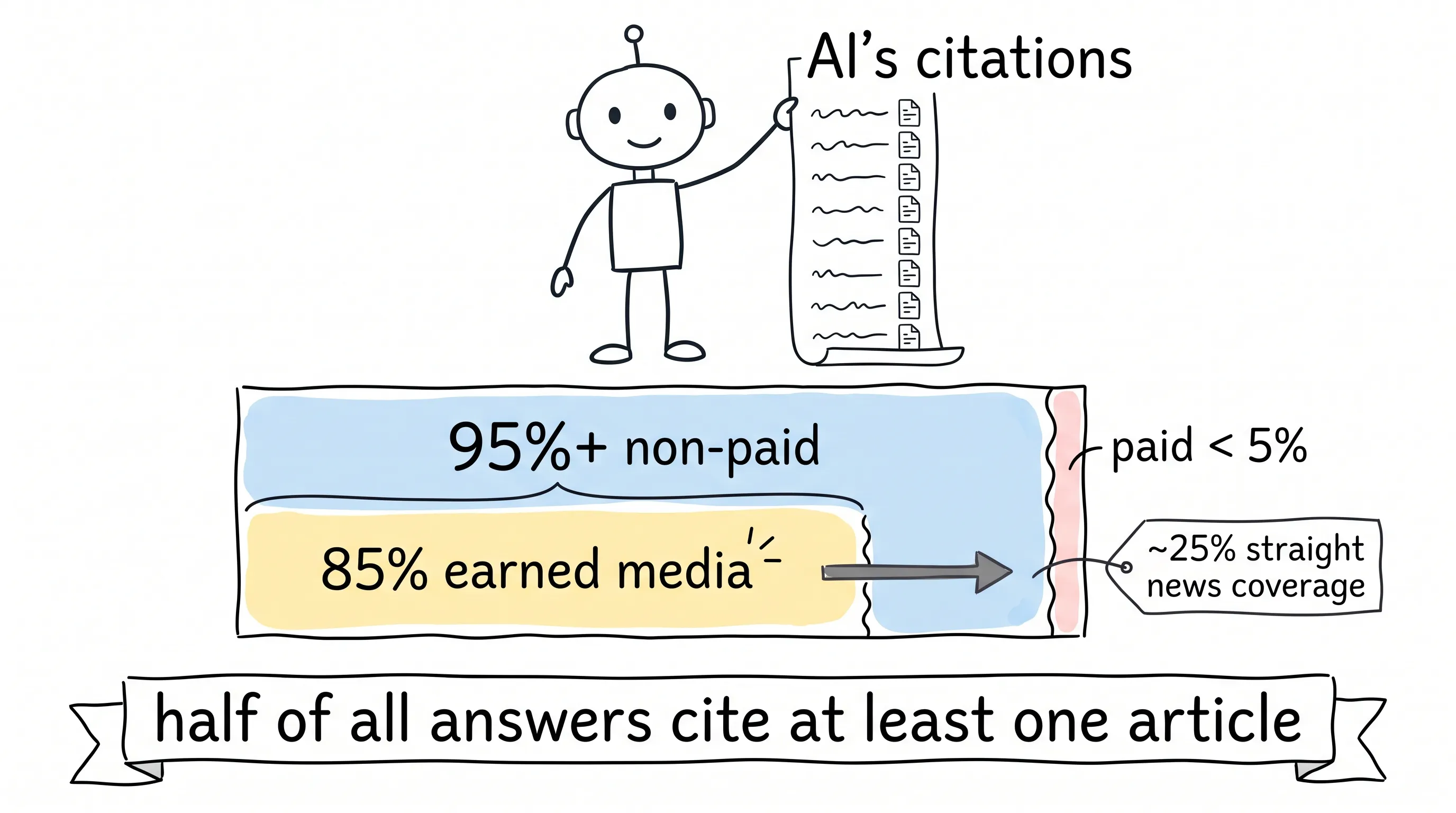
Less than 5%.
Over 95% of citations come from non-paid sources. And 85% of that 95% is what's called earned media.
What is earned media? Let me put it in plain words: coverage you earn.
When you pay a media outlet for space, that's paid media. When your story has real news value, and a reporter writes about you on their own initiative, or an industry report name-drops you unprompted — that kind of exposure, bought with nothing but substance, is earned media.
One more number: roughly a quarter of citations come straight from news coverage.
In other words, the reference material AI flips through while answering is overwhelmingly reporting, not ad space.
And across all answers, half carried at least one such article.
Good grief. What does that mean? It means behind every piece of media coverage there may stand a reader that never sleeps: AI. You thought that article was written for a few thousand people. Turns out AI is reading it too.
Honestly, when I first saw the 95% figure, I didn't quite dare believe it. I went back and re-read the methodology several times before I felt comfortable writing it down for you.
Citations Aren't Decoration
You might say: AI attaching citations is just window dressing, right? The answer is going to say what it was going to say anyway.
The researchers thought of that too. They ran a controlled test: same questions, once with citations on, once with citations off.
The model outputs changed noticeably.
That shows AI really is reading those articles as it writes its answers. Research first, then pen to paper.
Think of it as an open-book exam. The references aren't a decoration tacked on after you hand in the paper — they're the reference sheet you keep flipping through mid-exam. Whatever is written on the sheet is what ends up on the answer.
And what AI flips through is the coverage the media published just this moment.
How to Get Picked by AI
The study dug one layer deeper: these are all articles — why do some get cited while others sink without a trace?
They found three variables.
First: how fresh.
The OpenAI-family models are especially sensitive to recency. You're asking about current events, opinions, a trending story? AI clearly favors new content. Old news gets picked far less often.
Second: how you ask.
This one is particularly interesting. Ask a "which product should I choose" advice-seeking question, and AI will search sources on the spot and give you dynamic citations. Ask an encyclopedic question like "who founded company X," and it usually reaches straight into stale training data — can't even be bothered to attach citations.
The livelier the question, the more diligently AI digs.
Third: who published it.
Reuters, Axios, the Financial Times, AP, TIME, Forbes, NPR, CNN — these high-authority outlets get cited noticeably more often. But note: even among the names on that list, performance varies. Making it into a big publication doesn't mean you get to coast.
What's more worth chewing on is the other end: some small, sharp vertical sites — Good Housekeeping, Investopedia, for example — also get cited at remarkably high rates.
See it now? AI the librarian has its preferences — but inside those preferences there's a narrow door: you don't have to be a giant. You just have to be authoritative enough in your field.
If You're in Communications, Rerun the Math
Put the three variables side by side, and PR teams have to redo their accounting.
The old KPI: how many stories you placed, how many columns you bought.
Now you have to add one: does your brand show up in AI answers.
The industry has even coined a new term for it — GEO, Generative Engine Optimization — plus a close cousin called AIO. The names sound intimidating, but it boils down to this: you used to optimize web pages for search engine crawlers to read; now you optimize content for AI, the reader.
Tactically, two moves are very concrete:
-
Concentrate your firepower on high-authority media. Don't sprinkle it thin.
-
Align your publishing rhythm with AI's taste. Don't sit on what matters — publish while it's fresh.
One Layer Deeper
Zoom out a little.
Over the years, the entry point for information keeps changing addresses: first portals, then search, now AI. Every time it moves, a batch of gatekeepers changes shifts.
In the search era, which page your website ranked on decided whether you were seen. In the AI era, the rules are steeper. Search gives you ten blue links; AI hands you one answer.
One answer means, by default, only one correct.
And that answer is written according to the coverage AI cites. So here's the question: if coverage about you is scarce, outdated, or flatly negative, how will AI introduce you to other people?
In AI's eyes, a brand that's never been covered is roughly a brand that doesn't exist.
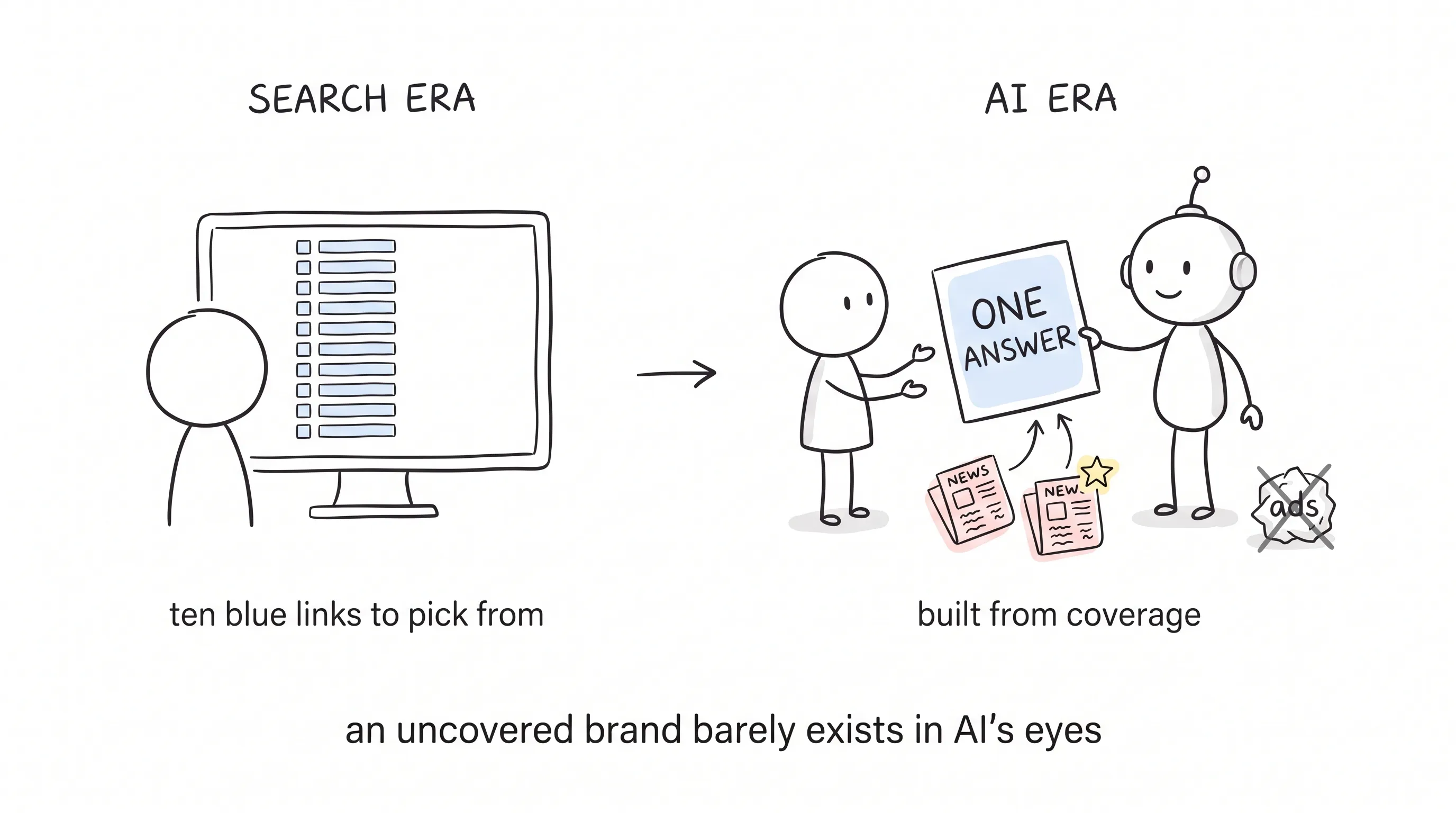
That's not a scare tactic. Half of all answers contain media coverage, and AI is reading it in real time as it answers. Coverage is the raw material from which AI gets to know the world. If the raw material doesn't contain you, it can't make you up.
Of course, this is a snapshot from July 2025, and AI's tastes keep shifting. Muck Rack's co-founder and CEO has a line I remember well: AI's behavior patterns change extremely fast, and the brands that thrive will be the ones actively watching where they stand inside AI and adjusting their play on the fly.
Finally
Back to the question we started with: who did AI learn its answers from?
Now you know: from the coverage reporters chose to write on their own initiative — the kind where not a cent of page fee changed hands.
So next time you ask an AI a question and it hands you a smooth, confident answer, click open the citations beneath its answer.
You'll see AI, article by article, vouching for this era's media coverage.
And what it reads depends, more and more, on one thing: whether you — or your team — went out and seriously earned that coverage.
Here's wishing you get picked by AI soon.
Continue reading
Related articles

Cross-Border Business: Time to Upgrade Your AI Toolbox
A learn article explaining how AI tools help cross-border e-commerce sellers clear five hurdles: language, regulation, logistics, payments, and fraud. It outlines a five-compartment toolbox, a five-step adoption path, and metrics such as conversion rate and CLV, while cautioning against over-reliance on AI.

AI Is Taking Over the Dirty Work of Social Media Marketing, One Task at a Time
This learn article outlines four social media marketing tasks AI can handle — audience analytics, content drafting and design, ad targeting and creative testing, and spam moderation — and cautions that taste, judgment, and data security remain human responsibilities.

AI Is Already This Good — Why Is Your Social Media Marketing Still Pure Manpower?
An overview of 18 AI tools for social media marketing, organized into six categories covering audience research, content creation, scheduling, comment and DM handling, ad management, and visual production, plus notes on personalization, prediction, and emerging trends.