
Who Are Your Product Descriptions Written For?
Explains why uniform product descriptions fail different buyer segments and walks through a research-based workflow: RFM and clickstream data, clustering, prompt-driven AI copy generation, cosine-similarity checks, plus privacy and ethics considerations.
A few days ago, I had dinner with a friend who runs an e-commerce business.
He poured out his troubles: his store carries 80,000 SKUs, each one with its own product description. His copywriting team of six works overtime every day, writing themselves into questioning their life choices.
I asked him: who are these descriptions written for?
He paused, puzzled: "For... customers."
I said, no. "Written for all customers" is about the same as written for no one at all.
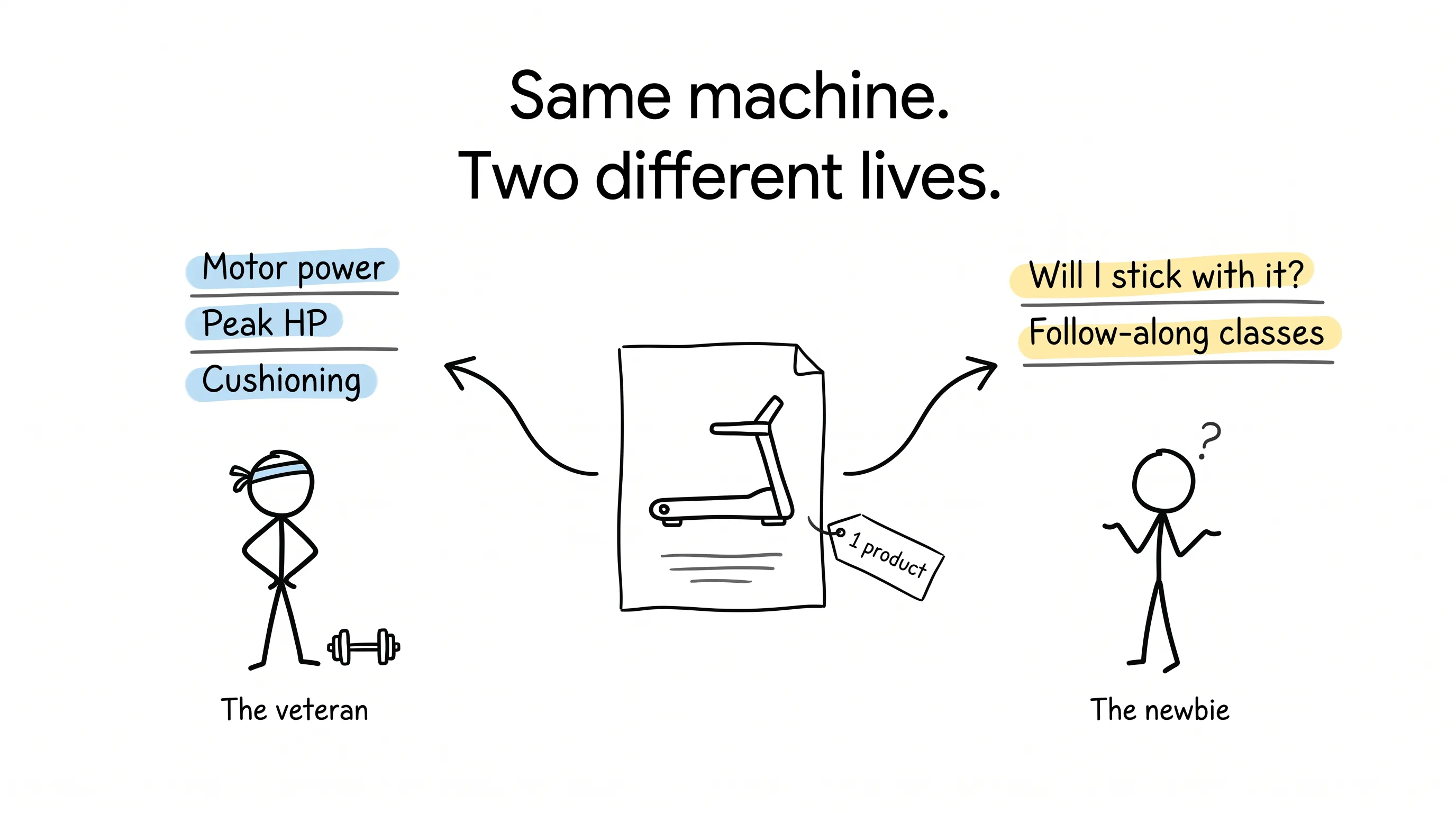
Think about it. A gym veteran of ten years, and a newbie who signed up yesterday and already wants to quit, are buying the same treadmill. Should the pitch they get be exactly the same?
The veteran wants motor power, peak horsepower, and cushioning specs.
The newbie wants to know: will this be hard to stick with? Are there follow-along workout classes? Will it sit around gathering dust?
Same machine. Two different lives. One set of copy.
This is the quiet ache of many e-commerce platforms: uniform pages, uniform descriptions, and every user sharing the same face.
Copy written for everyone is copy written for no one.
Personalization Is More Than Recommendations
When it comes to e-commerce personalization, the first thing that comes to mind is probably "Recommended for You."
And yes, recommendation systems have been around for years. What they solve is: which products to show you.
But there's another problem they have never solved: how to talk to you about those products.
What is a product description? It's the bridge between a product and a buyer. Whether that bridge is built right directly determines whether you dare to place the order.
So can we go one step further? The same product page, with the layout fine-tuned per segment and the copy rewritten per segment.
This idea is called the "morphing interface." What is a morphing interface? The same store, based on the behaviors and preferences of different customer segments, grows several versions of its pages. The fitness veteran sees the specs version; the weight-loss newbie sees the encouragement version.
Sounds great. But run the numbers, and you break out in a cold sweat.
Suppose you have 300,000 products and want to serve 5 customer segments. That's 1.5 million sets of descriptions. A skilled copywriter turning out 20 a day, never stopping to eat or sleep, would need more than two hundred years.
By hand, this road is a dead end.
So Where Do You Start?
In 2025, a research team put this idea to a serious test. The conclusion made my eyes light up: generative AI can genuinely get this done.
How did they do it? Three steps.
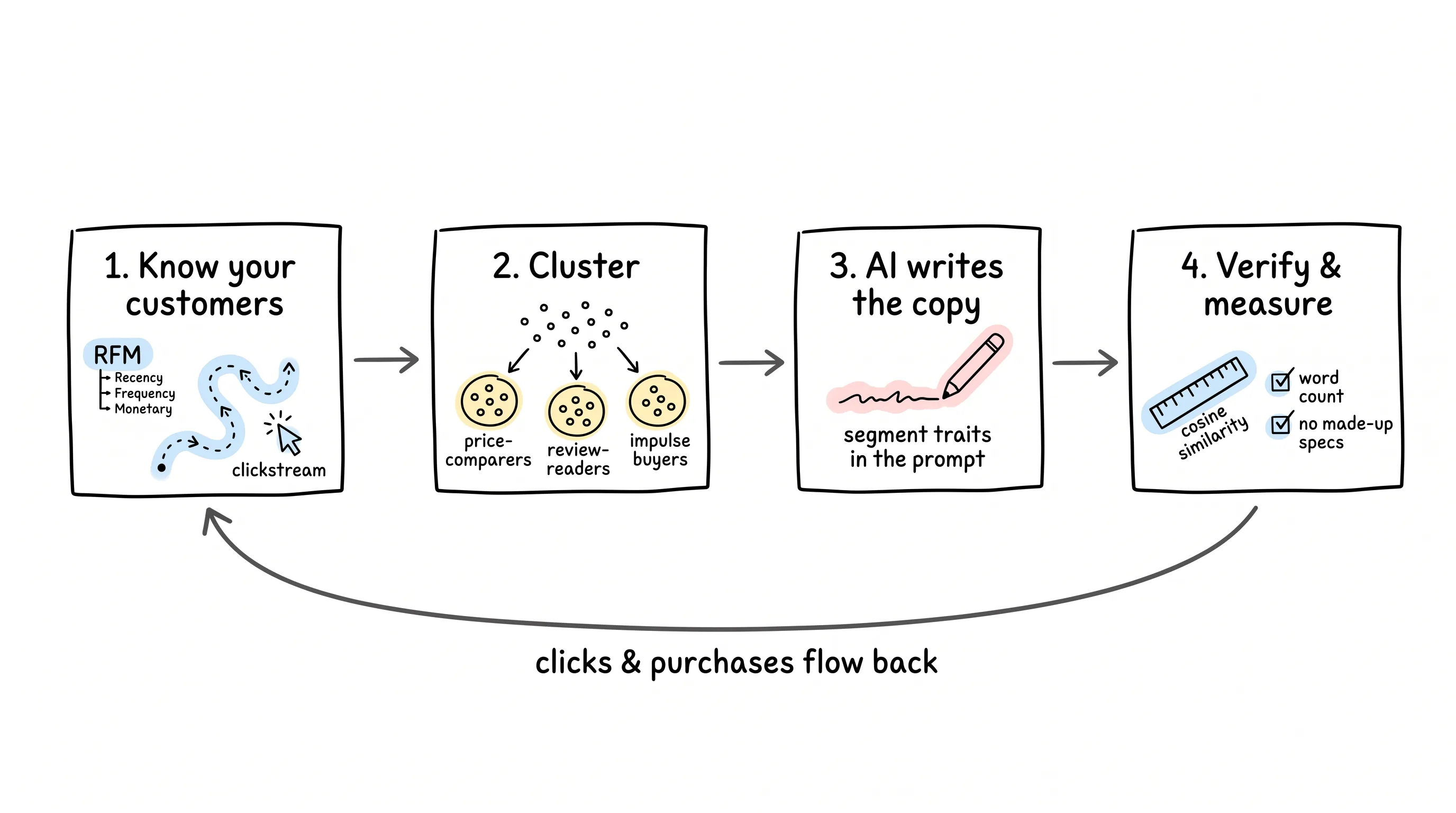
Step one: find out who the customers are. It comes down to two things. One is RFM (Recency, Frequency, Monetary) — when you last bought, how often you buy, and how much you spend each time. The other is the clickstream, which records where you wandered in the store, where you stopped, and what you clicked. This data is already sitting in the back office; most stores just never put it to use.
Step two: group the customers. With a clustering algorithm, you let the machine sort people with similar behavior into clusters on its own. The price-comparers, the review-readers, the impulse buyers — each into their own pile.
Step three: write the segment traits into the prompt and let the AI write the descriptions. For example, tell ChatGPT: "Write a 150-word treadmill description for budget-conscious entry-level users, emphasizing value for money."
Generation isn't the end of it. You have to verify: is the word count right? Are any specs made up or wrong? And you have to measure: is the copy written for segment A really different from the copy for segment B?
How do you measure? With a ruler called "cosine similarity." What is cosine similarity? In plain language: it scores how similar two pieces of text are. The closer to 1, the more they look like twins; the closer to 0, the more they belong to two different worlds.
The interesting part is that this ruler wasn't originally built for AI. AI-generated text has a characteristic: nearly infinite variants. Given the same requirement, it writes something slightly different every time. So the researchers made a special adaptation, letting it measure the changes genuinely caused by "segment differences."
Finally, whether users clicked or bought — that data flows back in, and the descriptions keep iterating. A closed loop.
The Results Are Interesting
So does the AI actually do as it's told?
The answer is crisp: as long as the prompt includes segment traits, the generated descriptions come out significantly different. Include them or leave them out — the gap is huge.
But there's one loose end: in 26.7% of cases, the descriptions for different segments failed to pull their differences apart to a statistically significant level.
26.7% — roughly one in every four attempts, the AI was "hedging," muddling the segments together.
The reason, once you spell it out, is simple: the descriptions are too short. In the space of a few sentences, even the most vivid segment traits have no room to stretch. But as long as the description is long enough, the differences between segments open up completely.
You see, this is just like people. Ask a copywriter to convey "who this is for" in 30 words, and they can only produce a rough sketch; give them 300 words, and the distinctive stroke cuts through immediately.
It's not that the AI can't write — you have to give it room to put pen to paper.
Oh, and one detail made me smile knowingly: this study, devoted specifically to "AI writing product descriptions," used ChatGPT to polish part of the words in its own paper.
Painfully real. The dragon slayer rides a dragon, too.
But There's Always Another Side
Don't saddle up just yet. Two things you have to think through first.
First, data. Personalization runs on user behavior data. Collecting it, processing it, feeding it to the AI — every step is squarely within the law's reach. Cross the privacy line, and it's a serious incident.
Second, ethics. Showing different content to different people — where is the boundary? Emphasizing value for money is being considerate; if it turns into invisible discrimination — different dishes for different people — that's a public wreck. And someone, always, has to answer for what the AI generates.
How fast the technology can run is one thing; how solidly the guardrails are built is another.
Finally, Back to That Dinner
At the end of the dinner, I told my friend: your worry — 80,000 products and 6 copywriters — can't be solved by adding people; you have to change the way you produce.
From "one set of copy to rule them all" to "one segment, one face."
AI can help you write all thousand of those faces.
But the one who decides which face to show — that's still you.
Here's hoping you get this new way of producing content up and running soon, too.
Continue reading
Related articles

Cross-Border Business: Time to Upgrade Your AI Toolbox
A learn article explaining how AI tools help cross-border e-commerce sellers clear five hurdles: language, regulation, logistics, payments, and fraud. It outlines a five-compartment toolbox, a five-step adoption path, and metrics such as conversion rate and CLV, while cautioning against over-reliance on AI.

AI Is Taking Over the Dirty Work of Social Media Marketing, One Task at a Time
This learn article outlines four social media marketing tasks AI can handle — audience analytics, content drafting and design, ad targeting and creative testing, and spam moderation — and cautions that taste, judgment, and data security remain human responsibilities.

AI Is Already This Good — Why Is Your Social Media Marketing Still Pure Manpower?
An overview of 18 AI tools for social media marketing, organized into six categories covering audience research, content creation, scheduling, comment and DM handling, ad management, and visual production, plus notes on personalization, prediction, and emerging trends.