
Where Does Your Ad Money Actually Go? Let's Talk About AI Ad Management
A guide to AI ad management platforms that matches five common pain points, from broken attribution to enterprise scale, to tools like Cometly, Revealbot, Optmyzr, and Smartly.io, with the core advice to fix attribution before adding automation.
A few days ago, a friend of mine who runs a cross-border e-commerce business invited me to dinner.
We had barely sat down before he started venting. "Open my phone and look," he said. "One dashboard for Meta, one for Google, one for TikTok, plus a LinkedIn account. Four dashboards, dozens of campaigns, thousands of ad creatives." His entire workday, he explained, was spent bouncing between these dashboards — shuffling budgets by hand, staring down the numbers with his own two eyes.
He said, "I feel like I'm not doing marketing anymore. I'm a security guard, patrolling all day."
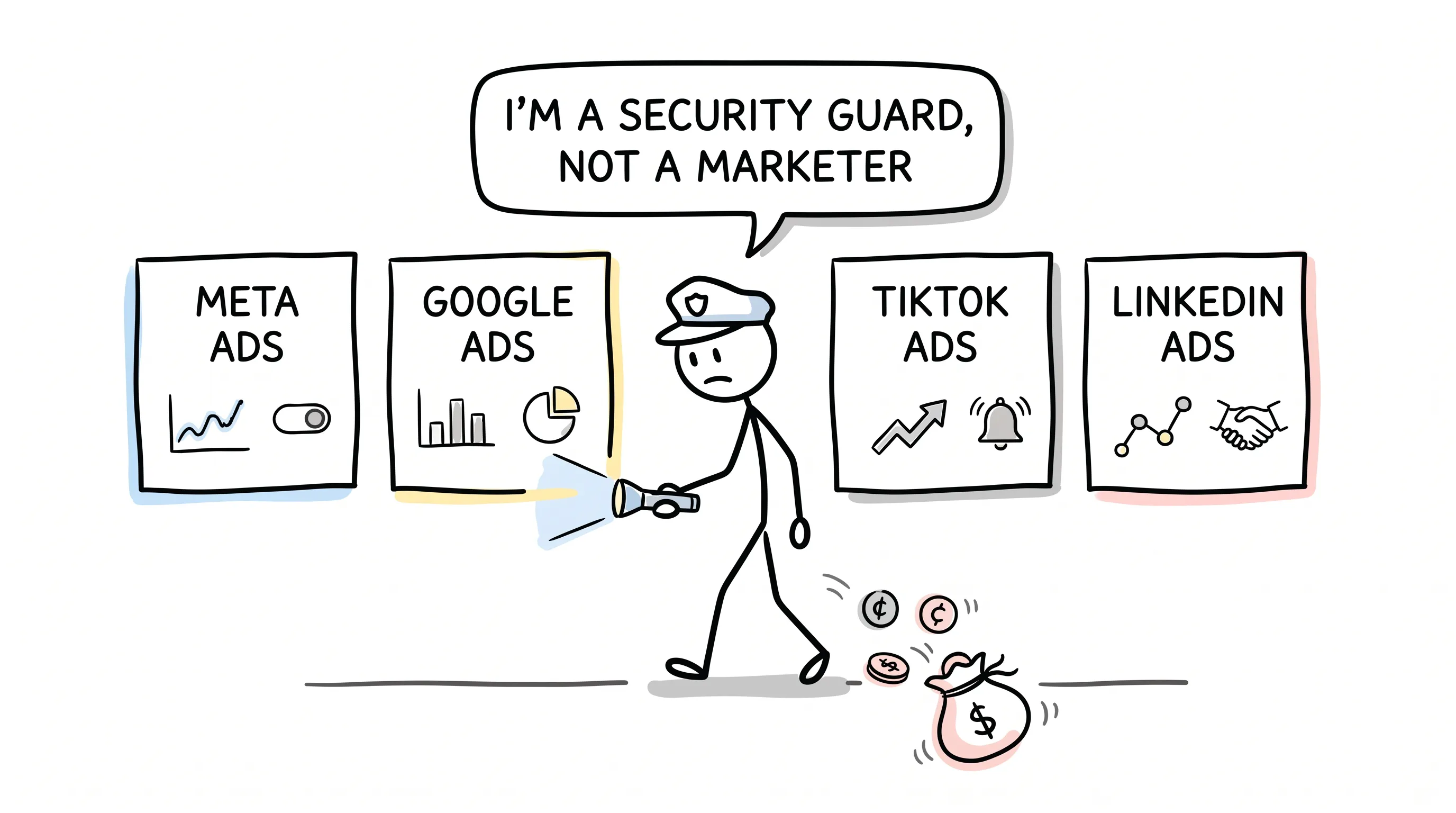
I laughed when I heard this. After I finished laughing, I told him about a category of tools I'd been looking at lately — and he put his chopsticks down.
Today I'm writing up that conversation. If you're running ads on more than one platform, there's a good chance you'll find it useful.
First, Get Clear: Which Kind of Pain Do You Actually Have?
What is an AI ad management platform, exactly?
Plainly put: it's a machine doing the repetitive work for you. It adjusts the bidding. It moves the budget. It picks out the creatives that are winning and shuts down the ones that aren't.
But hold on before you rush to pick a tool.
All the tools on the market wear the same "AI ad management" label, yet they treat completely different diseases. Pick the wrong prescription and you won't cure anything — you'll just burn a subscription fee on top of it.
I've sorted them into five kinds of pain. Find the one that's yours.
Pain #1: The Money Is Spent, but You Don't Know Where It Went
This is what hurts my friend the most. And it's what most people should fix first.
Think about it: those dashboard reports you scroll through every day — is that data even accurate?
Ever since Apple tightened its privacy policies, traditional tracking has essentially been severed. A user taps an ad on their phone, but the conversion happens later, on your website, inside your CRM. For that stretch of the journey, the ad platform is blind, and the data is broken.
Feed broken data to AI, and what does AI give you? Guesses.
This is why Cometly comes first. Garbage data produces garbage advice, no matter how smart the AI is.
What Cometly does is swap out the way data gets collected at the foundation: server-side tracking. From the ad tap, to landing on the website, to placing an order, to entering the CRM — it records every touchpoint and stitches them into one complete journey. Then it feeds that enriched conversion data back to Meta and Google, so the platforms' own algorithms get smarter too.
Once the data is complete, its recommendations actually mean something: which ad genuinely drove revenue, which channel is actually making money. Multi-touch attribution also lets you compare different attribution models and see clearly which path a customer took, from first touch to closed deal.
Who is it for? Growth teams and SaaS companies running multi-channel campaigns that have been battered by attribution problems. Pricing isn't public — it's negotiated based on your ad budget and business. You can book a demo first.
Pain #2: Every Rule Runs on Human Effort — You've Become a Human Robot
The second kind of pain is execution fatigue.
Some tasks don't need AI to be brilliant. They just need it to not forget. Pause spending when the budget burns past a certain number. Swap the creative when it wears out. If you're watching for these manually in the dashboard, you're checking eight times a day.
Revealbot exists for exactly this. Its rules engine is powerful — how powerful? You can run two opposite actions on the same campaign at once: pause the ads showing creative fatigue, and shift the money to the one that's performing. You define the logic yourself, and the moment conditions are met, it executes automatically. It also watches each creative's performance curve and flags you to swap it the moment engagement starts slipping — don't wait for the data to collapse before reacting.
It's built around Meta and TikTok, starting at $99 per month. The bigger the budget it manages, the higher the price.
Also in the Meta ecosystem: if your pain is on the creative side, look at Madgicx.
It has two features I find genuinely interesting. One is called AI Audience Clusters: it analyzes your existing customer data to surface high-value segments you might be missing — usually better than hand-picking interest tags on gut feel. The other is creative prediction: before a new ad goes live, it estimates how it will perform based on your account's history and broader market trends. Think of it as a sieve the creative passes through before launch.
Starting at $44 per month. Built for e-commerce and direct-response marketing teams spending $5,000 or more per month on Facebook and Instagram.
Is your main battlefield Google Ads? Then it's a different company: Optmyzr.
This one was founded by ex-Googlers, and it specializes in complicated Google Ads accounts. One-click optimizations cover the daily chores — negative keywords, bid adjustments, ad copy testing. More advanced players can use its script library and rules engine to automate any repetitive task. If you run Shopping campaigns, pay attention to one of its ideas: optimize for profit, not just ROAS (return on ad spend). A high ROAS doesn't necessarily mean you're making money — a lesson many media buyers only learn after paying tuition.
Starting at $208 per month. PPC agencies and professional teams use it to reclaim their manual hours.
What if the budget is small and the team is tiny? Don't reach for heavy artillery.
Adzooma takes the minimalist route: its opportunities engine scans your account, lists everything that could be optimized, and executes with one click. There's also a performance score that grades you against industry benchmarks, so you can see exactly where you're losing points. Google, Facebook, and Microsoft Ads, all managed from a single dashboard. The free tier is enough to get started; paid plans run $99 per month.
Small teams need efficiency, not fancy tricks. This is enough.
Pain #3: The Operation Is Too Big for Any Human to Manage
If your budget runs into the millions of dollars, spread across a dozen countries and multiple languages, the tools above won't cut it.
Smartly.io is the enterprise answer. Its dynamic creative optimization (DCO) can programmatically permute headlines, images, videos, and calls to action, generating thousands of creative variants in one go, then letting the data pick the winners. The biggest headaches of multi-country advertising — localization, compliance review, version management — it turns into workflows, and it plugs into your asset library and analytics stack. Meta, Google, TikTok, Pinterest, Snapchat — all of it, one dashboard.
Enterprise pricing, negotiated against your budget. If your operation is small, stay away. Pure waste.
More aggressive than Smartly.io is Albert AI.
Other tools make recommendations and let a human make the call. Albert doesn't. It makes the call itself, and executes: audiences, creatives, channels, bids — it tests relentlessly, adjusts relentlessly, learns relentlessly. How the budget gets split across channels, it reallocates automatically based on performance. No approval from you required.
Who is it for? Mid-to-large brands with many channels, steady creative output, and the willingness to hand over the wheel. You have to accept an algorithm making tactical decisions on your behalf. Some people enjoy letting go like that. Others can't sleep at night. Think it through before you sign up.
Pain #4: It's Not Your Money — It's Your Clients'
Friends at agencies, your pain lives somewhere else: dozens, even a hundred-plus client accounts. Check them one by one and the day is gone.
Acquisio was built for this exact scenario. A multi-client dashboard lays your entire portfolio out on one screen, and it alerts you when an account goes sideways. The most practical feature is white-label reports: your own logo, your own metrics, delivered straight to the client. The professional polish stays intact, and you no longer spend Friday night face-down in spreadsheets building weekly reports.
Pricing is based on client count and budget. Agencies with roughly ten or more clients get the best value out of it.
Pain #5: You're Just Starting Out — and Afraid of Stepping into the Traps
New business owners with a monthly budget under $10,000 — don't overcomplicate things.
WordStream's signature is the "20-Minute Work Week": every week it surfaces the highest-priority optimization actions, and you spend 20 minutes working through them. Its free Google Ads and Facebook audit tools list out every problem in your account, then tell you why it's wrong and how to fix it. For you, this is learning while you spend.
Starting at $49 per month. Simple — but sufficient.
So How Do You Choose? In One Line
Your budget size and your role decide which tool you should buy. Not the other way around.
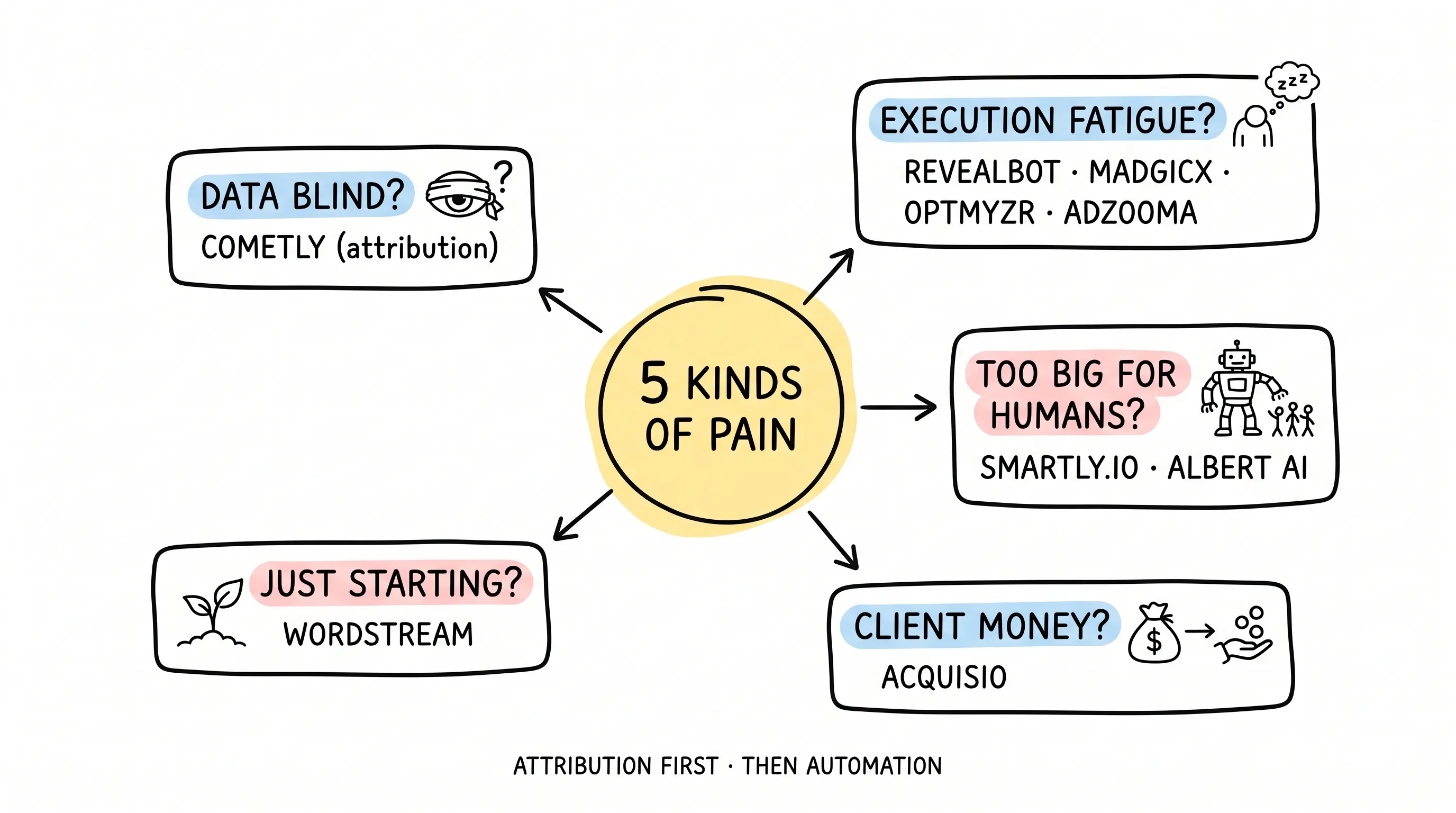
Don't know where the money went? Fix attribution first — look at Cometly. Exhausted by execution? Choose by your main battlefield: Meta and TikTok, look at Revealbot and Madgicx; Google, look at Optmyzr; small operations, look at Adzooma. An operation too big for humans to manage? Pick one of Smartly.io or Albert AI — the latter is the more aggressive bet. Managing money for clients? Acquisio. Just starting out? WordStream.
My final advice to my friend was this: don't expect one tool to solve everything. The most common combination is one attribution tool plus one channel automation tool. The first keeps the data honest; the second keeps the execution fast.
Attribution decides where you strike. Automation decides how fast you strike. Don't get the order backwards.
One Last Thing
After dinner, my friend said he'd get his attribution straightened out first, then consider automation.
I think that judgment is right. All of these are good tools, but the order in which you take the medicine matters: see the books clearly first, then chase efficiency.
Here's wishing you this: every dollar of ad money you spend, you'll know exactly where it went.
Continue reading
Related articles

Cross-Border Business: Time to Upgrade Your AI Toolbox
A learn article explaining how AI tools help cross-border e-commerce sellers clear five hurdles: language, regulation, logistics, payments, and fraud. It outlines a five-compartment toolbox, a five-step adoption path, and metrics such as conversion rate and CLV, while cautioning against over-reliance on AI.

AI Is Taking Over the Dirty Work of Social Media Marketing, One Task at a Time
This learn article outlines four social media marketing tasks AI can handle — audience analytics, content drafting and design, ad targeting and creative testing, and spam moderation — and cautions that taste, judgment, and data security remain human responsibilities.

AI Is Already This Good — Why Is Your Social Media Marketing Still Pure Manpower?
An overview of 18 AI tools for social media marketing, organized into six categories covering audience research, content creation, scheduling, comment and DM handling, ad management, and visual production, plus notes on personalization, prediction, and emerging trends.