
When Users Start Asking AI, Who Speaks for You?
An explainer on GEO (Generative Engine Optimization), covering technical steps like crawler management, structured markup, and site speed, plus content practices such as topic authority, exclusive data, and answer-first writing to get cited in AI answers.
A few nights ago, I needed to look up something fairly technical. My finger was already hovering over the search box — I paused for a beat, then opened my AI assistant instead.
Thirty seconds after I asked, the answer appeared. Underneath it sat two or three cited sources.
I stared at those sources for the longest time, and suddenly one thing hit me:
We used to make content and compete on search rankings. Now, plenty of people never even open that page of ten blue links anymore. They ask AI, and AI hands them the answer directly.
So here's the question: if users stop clicking, how does your content get seen at all?
What Is GEO?
The goal of traditional SEO is to rank your pages high and win a click. This new playbook has a name: GEO — Generative Engine Optimization.
What is GEO, then?
Put simply: it means that when AI assembles its answer, it treats your content as a library of raw material — as a source it is willing to cite by name.
Before, you had to squeeze onto the first page of search results. Now, you have to squeeze into the AI's answer.
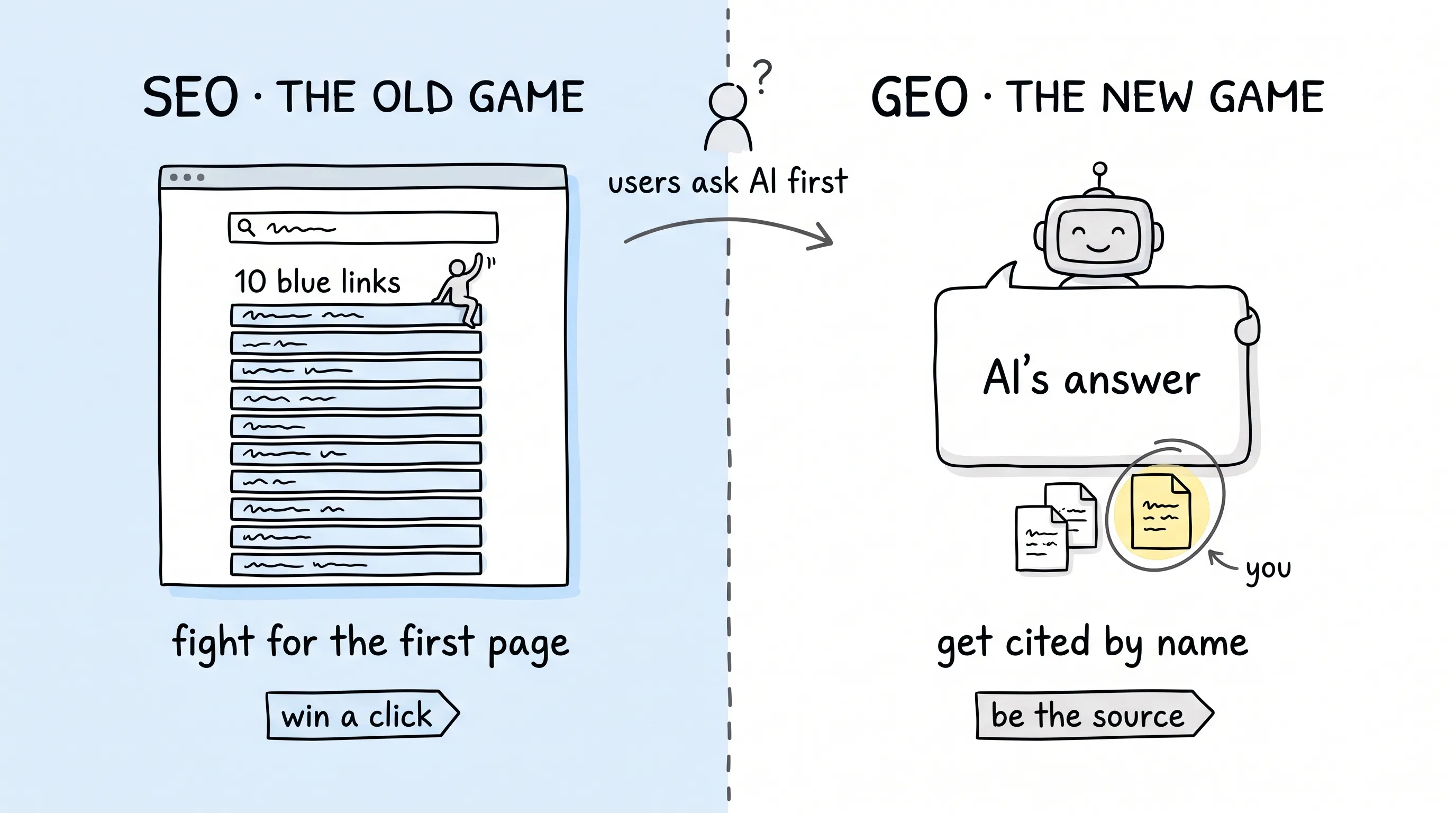
The two moves look alike — underneath, they are completely different.
Why different? Think about it: what is AI's biggest weakness? Making things up — in the trade, it's called hallucination. To fabricate less, AI prioritizes citing authoritative, verifiable sources. So whoever gets cited when AI generates its answer gets the new traffic of this era.
That's where the opportunity lies.
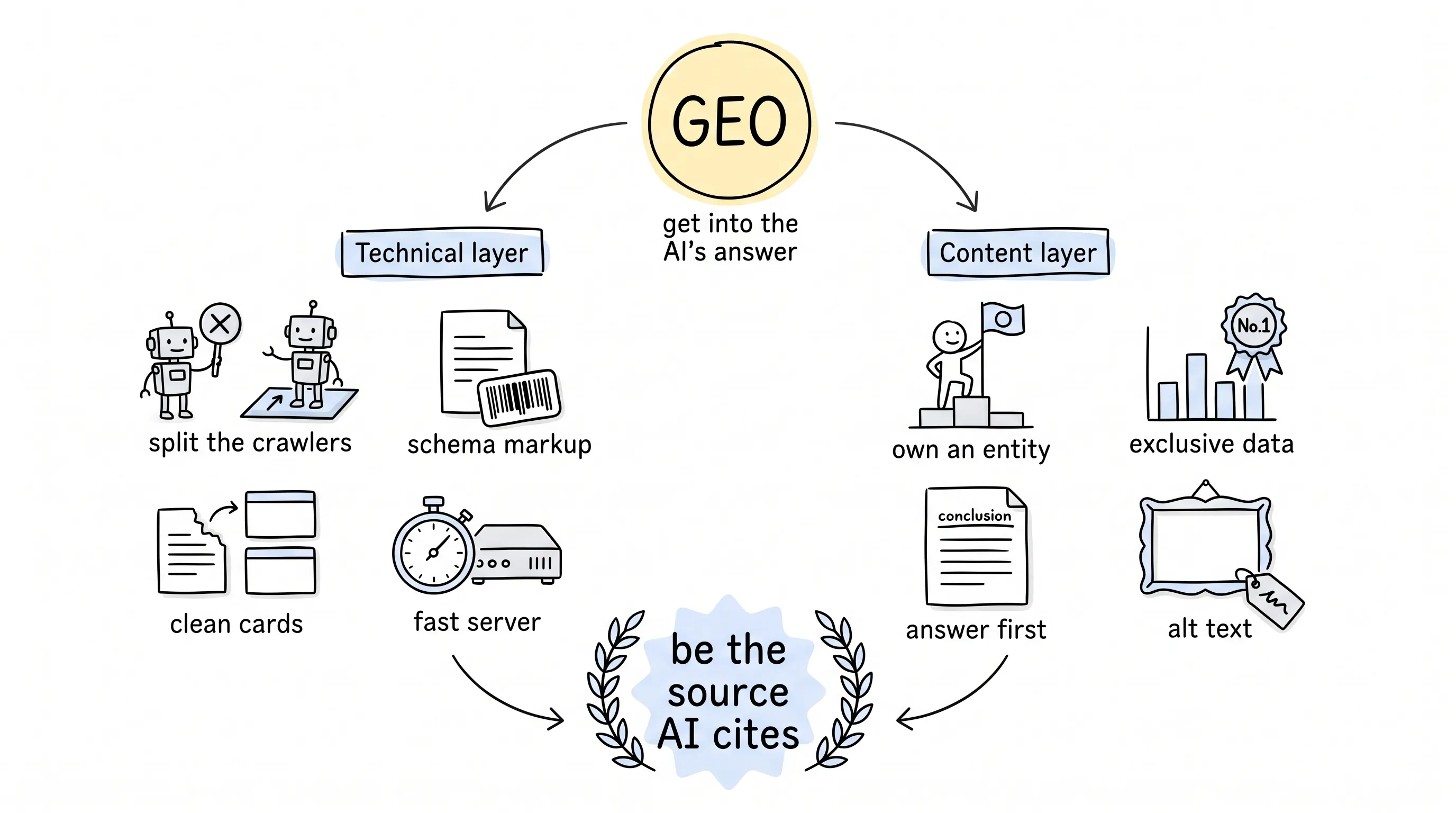
So how do you get AI to cite you? Two things: technically, make your site crawlable, readable, and quotable; on the content side, make AI believe you're trustworthy and worth citing.
Start with the Technical Layer
First thing: tell the two kinds of crawlers apart.
The crawlers AI platforms send to scrape your site actually come in two kinds. One is the training crawler — GPTBot, for example. It's there to copy notes: it reads your content, remembers it, and turns it into part of itself. The other is the real-time retrieval crawler — like ChatGPT-User or PerplexityBot. It shows up the very moment a user is asking a question, quiz in hand, looking up sources on the spot.
You have to treat these two crawlers differently. In your robots.txt, keep the training crawlers out, and protect your intellectual property. Let the retrieval crawlers in — because only if you let them in can AI possibly cite you when users ask related questions.
Blocking the wrong one is a loss. Letting in the wrong one is a loss too.
Second thing: put a barcode on your content.
Goods in a warehouse with a barcode: one pass of the scanner gun, and the product name, specs, and price all come out. Without one, someone has to dig through it by hand.
Schema.org structured markup is the barcode of your content. Organization, Product, HowTo, FAQPage — tag everything that should be tagged. When AI parses your page, it doesn't have to guess what entity or relationship a passage describes; it just reads the labels.
Third thing: cut your article into clean cards.
AI doesn't read your article by swallowing it whole. It tears the page into small paragraph-sized cards, stores them in its retrieval index, and pulls out and cites whatever it needs.
So keep paragraphs short — one thing per paragraph — and keep the H2, H3 hierarchy clear; skip the flashy layouts. If the cards it tears off are clean, AI can lift a whole paragraph and cite it whole. If what you serve up is a pot of mush, AI won't even know which part to cite when it wants to.
Fourth thing: don't let your server be the bottleneck.
Real-time retrieval happens the instant a user asks — just those few seconds. If your page won't open on mobile or your server responds slowly, AI won't wait — it just moves on.
One second too slow, and you're out.
Now the Content Layer
Once you've passed the technical bar, AI can read you. But AI reading you isn't the same as AI wanting to cite you. Why should it cite you?
First, be the authority on an entity, not a hauler of keywords.
Around your core brand and your industry's terminology, take one topic and go deep and thorough on it, weaving a dense web of topic clusters (interlinked pages that cover one subject from every angle). When you write, lean on declarative sentences — subject, verb, object laid out crystal clear, one opinion set down plainly at a time.
Why? Because when AI extracts claims, it extracts sentences that are cleanly structured and confidently stated. Hedged, vague language — AI won't dare cite it.
Second, publish data nobody else has.
On this point, I believe it is the single highest-value move in all of GEO.
What AI fears most is citing the same secondhand information as everyone else; it favors the exclusive. Your industry surveys, your accumulated user data, the first-party research you publish — to AI, these are exclusive sources.
If it wants to cite an exclusive statistic and yours is the only one on the entire web, then it has no choice but to cite you. You become the origin.
Rather than fighting for ranking among ten thousand aggregator pages, be the source that everyone ends up citing.
Third, put the answer at the front.
AI comes to your content already carrying a question. So for technical and explainer content, lay out the conclusion, the definitions, and the key takeaways at the top, paired with summary tables and bullet lists. Answer directly first, unfold the background after.
This is our chronic bad habit as writers: too much buildup. Readers can't stand it — and AI has even less patience for it.
Fourth, make your images legible to AI too.
Voice search and visual search are coming in. Every image, every chart, every flowchart you publish should carry accurate alt text (the text description attached to an image) and captions.
AI can't see pictures — it can only read words. If you don't write it, the image might as well not be there.
Finally, About Traffic
Some will worry: if users get their answers straight from AI, will my organic search traffic get swallowed up?
Yes. Some of those clicks are genuinely not coming back.
But behind the answer, there always stands a source. AI's job is to assemble the answer; your job is to become where the answer comes from.
Just like that night, when I stared at those two or three citations for the longest time. Next time, I hope you're the one in that spot.
Here's wishing that AI always picks your content.
Continue reading
Related articles

Cross-Border Business: Time to Upgrade Your AI Toolbox
A learn article explaining how AI tools help cross-border e-commerce sellers clear five hurdles: language, regulation, logistics, payments, and fraud. It outlines a five-compartment toolbox, a five-step adoption path, and metrics such as conversion rate and CLV, while cautioning against over-reliance on AI.

AI Is Taking Over the Dirty Work of Social Media Marketing, One Task at a Time
This learn article outlines four social media marketing tasks AI can handle — audience analytics, content drafting and design, ad targeting and creative testing, and spam moderation — and cautions that taste, judgment, and data security remain human responsibilities.

AI Is Already This Good — Why Is Your Social Media Marketing Still Pure Manpower?
An overview of 18 AI tools for social media marketing, organized into six categories covering audience research, content creation, scheduling, comment and DM handling, ad management, and visual production, plus notes on personalization, prediction, and emerging trends.