
When "Good Enough" Becomes Worthless
A learn article arguing that mass-producing "good enough" AI content erodes its value, and walking through building AI reviewer panels and virtual focus groups to create fast quality feedback loops, plus a roundup of recent AI model and tool updates.
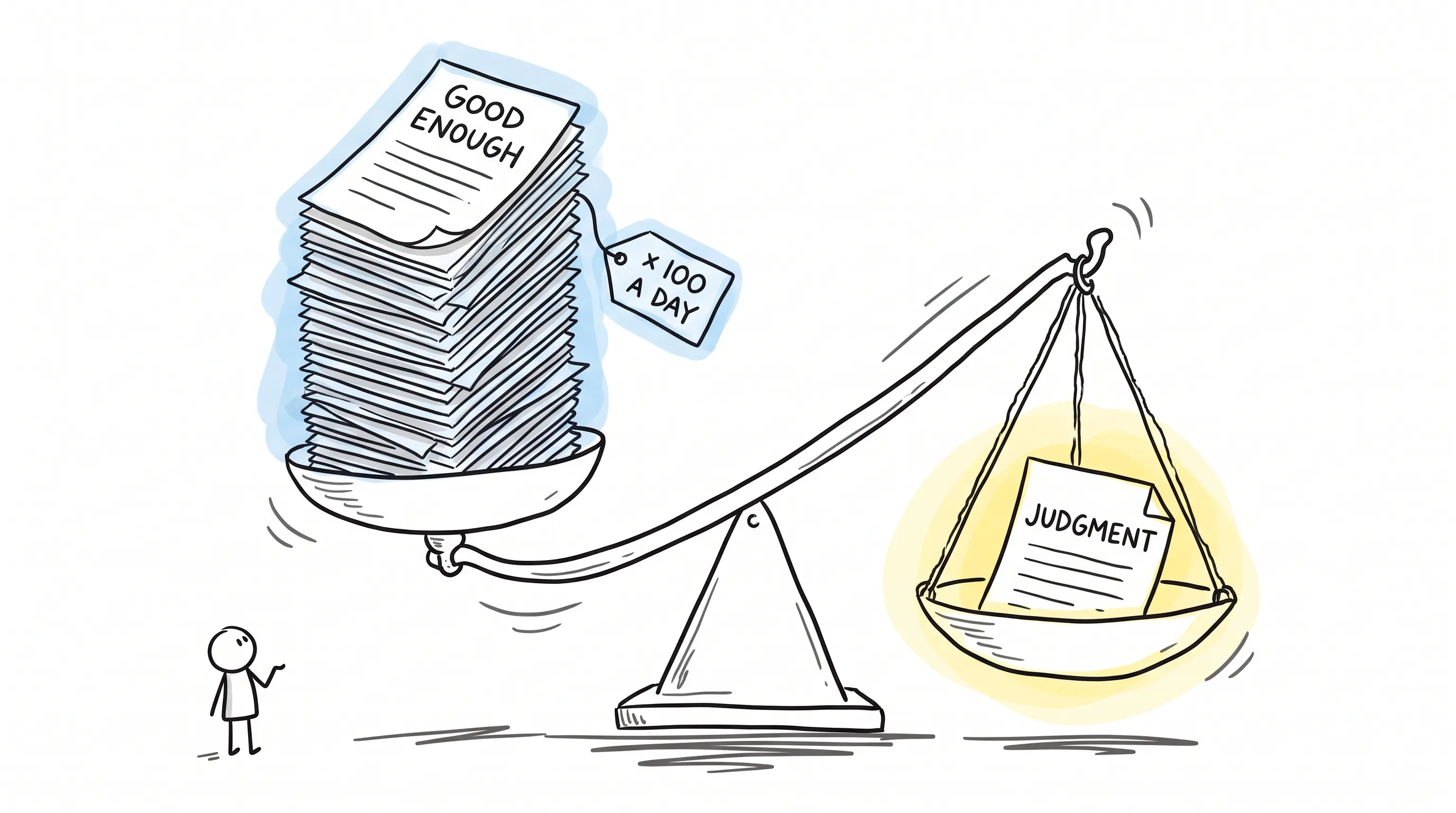
A few days ago, a friend of mine — a marketing director for over a decade — invited me out for tea. The first thing he said when we sat down: he was getting nervous.
Nervous about what? His company had adopted AI, and his team's output had multiplied several times over. Weekly reports, social posts, white papers — as many as they needed, on demand. Yet the numbers wouldn't move, and customers weren't buying. He asked me: we keep producing more and more — so why does it all keep becoming worth less?
I told him: that question happens to be the most important one you can ask at this stage.
Start With a Tiny Trick
Before we get to the main event, let me share a small discovery that genuinely delighted me recently.
Next time you install a new AI tool and open the chat box, don't rush to type your question. Try typing @ first. Then try /.
In many tools, an entire layer of features hides behind those two characters. And almost nothing — no popup, no hint — will ever tell you they exist.
Take ChatGPT. Type @ and a menu pops up: attach files, search the web, pull Deep Research into the conversation, summon any plugins or skills you've connected. Type / and you get something more like a row of quick switches: fork the current conversation into a new one, switch models mid-chat, file this conversation into a project, jump straight to personalization settings.
This hidden door isn't unique to ChatGPT. Claude, Gemini — most modern AI assistants have their own version. The menus differ; the logic is the same.
The features were always there. What was missing was the entrance.
Next time you open a new tool — even an old one you've used for years — type @ or / before you conclude "I've got this all figured out." Something might have been waiting there for you all along.
What Is "Intellectual Obesity"?
OK, back to my friend's nerves.
I recently came across an AI strategy consultant named Austin Marchese, who coaches executives on using AI to scale their businesses. He coined a term I particularly like: intellectual obesity.
What is intellectual obesity?
It's taking in more than you can digest.
AI has driven the cost of producing "good enough" content down to nearly zero. So everyone is gorging: more articles, more reports, more slide decks. On the surface, it looks like a boom.
But think about it: if you can write a hundred pieces a day, so can your competitors. The moment everyone can mass-produce, "more" stops meaning anything.
When the cost of "good enough" approaches zero, "good enough" becomes worth nothing.
So the advantage has flipped. It used to be about who produced fastest and most; now it's about whose work is genuinely good. That's why my friend's output keeps climbing while its value keeps falling — he's flooring the accelerator on the wrong racetrack.
No Feedback, No Quality
So what do you do? How do you raise the quality?
Marchese's idea is elegant: before asking AI to write more beautifully, bring in your feedback loop.
Think about it: what does a writer lack most?
Feedback. And the fast, merciless kind. Wait for a human to give it, and it's slow — always softened with polite hedging. Your boss is too busy, your client guards every word, and by the time the revision notes arrive, three days are gone.
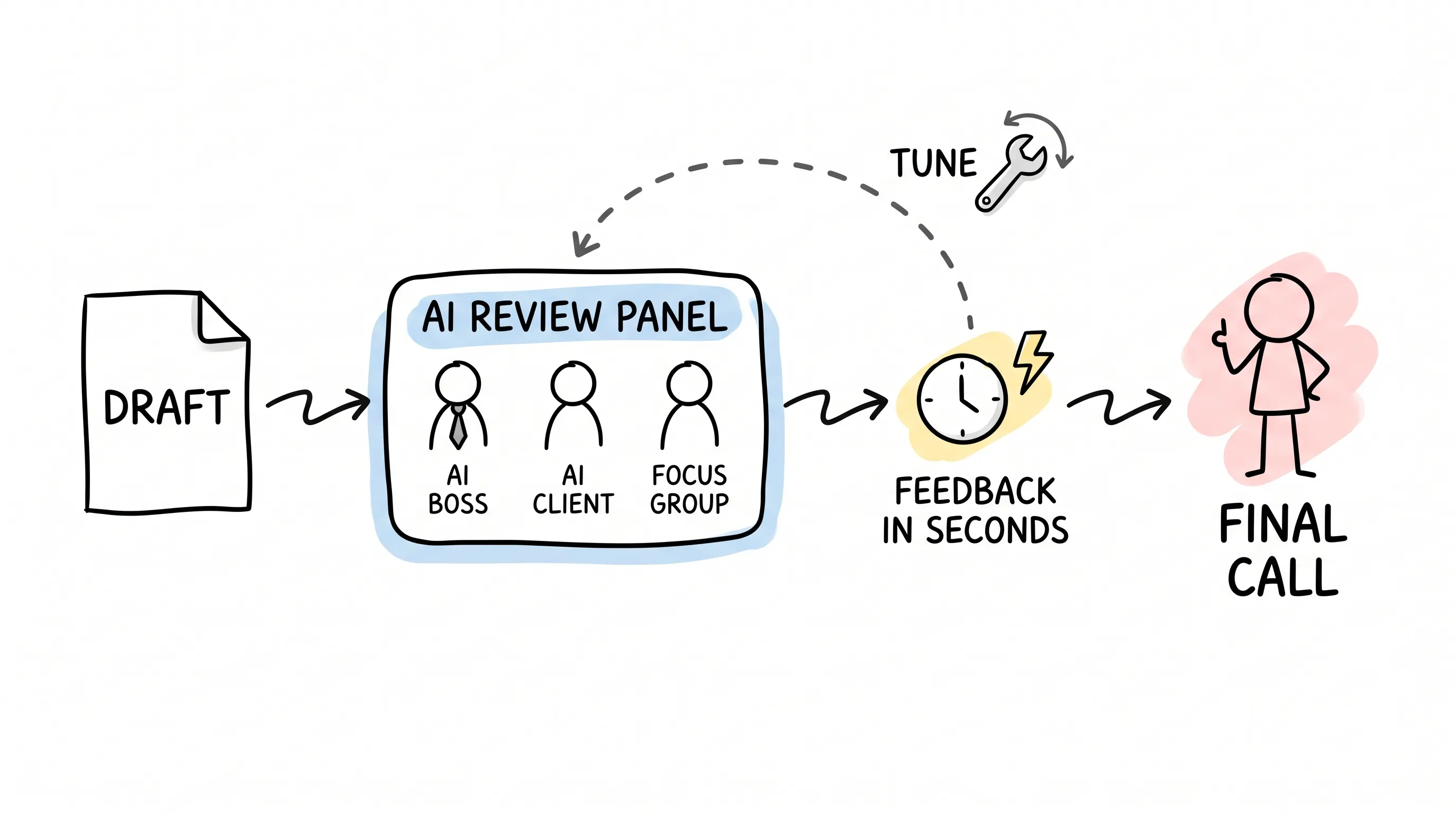
Marchese's approach is to build a "clone review panel" inside your AI first.
Move one: create an AI version of your boss, an AI version of your client, or an AI version of the kind of reader you most want to win over. When a piece is done, it passes this gate before any human sees it. Feedback that used to take days is compressed into seconds.
Move two: assemble a virtual focus group. Big brands have run these for decades — it used to mean hiring a roomful of real people at serious cost. Now one person with one AI tool can put one together: pull in several virtual reviewers with different perspectives — one playing the picky client, another playing the outsider who keeps asking "what does this actually mean?" — and let them stress-test your work in rotation.
Let your work take a hundred cuts before any human ever sees it.
This System Will Be Wrong on Day One
At this point you might be wondering: what if the AI's feedback is just noise?
Now you're asking the right question. This system will absolutely be off on day one — and that's part of the method.
Marchese runs it as an iteration loop: does the AI not sound like your boss? Fix the settings. Tone too polite? Feed it examples. Every time its take diverges from what a real person would say, you make one correction. Like a piano tuner, a small turn at a time.
Tune it long enough and one day you'll notice: what the AI reviewer says is nearly indistinguishable from what your boss would actually say.
At that point, you effectively have an internal review panel that charges no salary, answers the call anytime, and never gets tired. Spend the time you save on the things only you can do: judgment, and the final call.
The machine tears the work apart, round after round. The human makes the final call.
A Few More Things From the AI World
Finally, a quick tour of a few recent developments in the AI space — all worth a look.
Google has put its music generation model Lyria 3.5 into Gemini and its developer ecosystem. Higher audio quality, more expressive vocals, and smoother controls for picking a genre, applying a template, or setting the length. Scoring a video, writing a brand jingle, customizing a birthday song for a friend — the barrier just dropped another notch.
Gemini's voice capabilities are also moving into Google's own productivity suite. Gmail can dig through your inbox conversationally to find things; Docs can turn the ideas you rattle off aloud into a structured draft; Keep can turn the mental mush of a voice memo into a clean, crisp checklist. It's rolling out to subscribers first, with business editions to follow.
The models got updates too. Google shipped Gemini 3.8 Flash — stronger at coding, agentic tasks, and complex reasoning, with no increase to the entry price. Alongside it comes a security-focused Cyber variant, built for defenders vetted through the Fairwind Program, for vulnerability hunting and automated patching.
Over at OpenAI, GPT-6 Astra has landed. It's the company's first broadly deployed model whose cybersecurity capability reaches "Critical" — the highest tier of its internal Preparedness Framework. Jailbreak resistance and prompt-injection defense are both substantially stronger than the previous generation, GPT-5.6 Sol. Interestingly, OpenAI itself admits: in adversarial environments, this model will be harder to monitor.
The more capable the model, the harder it is to watch. That's the homework the whole industry has to tackle together next.
Back to My Panicked Friend
I told him about the hidden doors behind @ and /, and urged him to stop competing on output. First build an AI review panel and get the quality feedback loop in place.
A week later he told me: he'd cut his drafts by half — and yet the numbers finally started to move.
You see, what everyone is panicking about was never that AI got too strong. It's that everyone is furiously producing "good enough."
Production is no longer worth anything. Judgment is.
Here's to staying intellectually lean.
Continue reading
Related articles

Cross-Border Business: Time to Upgrade Your AI Toolbox
A learn article explaining how AI tools help cross-border e-commerce sellers clear five hurdles: language, regulation, logistics, payments, and fraud. It outlines a five-compartment toolbox, a five-step adoption path, and metrics such as conversion rate and CLV, while cautioning against over-reliance on AI.

AI Is Taking Over the Dirty Work of Social Media Marketing, One Task at a Time
This learn article outlines four social media marketing tasks AI can handle — audience analytics, content drafting and design, ad targeting and creative testing, and spam moderation — and cautions that taste, judgment, and data security remain human responsibilities.

AI Is Already This Good — Why Is Your Social Media Marketing Still Pure Manpower?
An overview of 18 AI tools for social media marketing, organized into six categories covering audience research, content creation, scheduling, comment and DM handling, ad management, and visual production, plus notes on personalization, prediction, and emerging trends.