
When Buyers Ask AI to "Recommend One," Why Should Your Brand Be the Name It Drops?
An explainer on how PR teams can make brands visible in AI-generated recommendations by building entity authority, choosing vertical outlets over big logos, and treating expert quotes as reusable data assets.
A few days ago I had dinner with an old friend who works in PR.
She's been in the business for over a decade, and her playbook is second nature by now: write press releases, pitch reporters, maintain media relationships, and chase down coverage in a handful of major outlets along the way.
I asked her one question: these days, when your buyers want what you sell, nine times out of ten they start by asking AI — "recommend me a reliable so-and-so." At that moment, does your client's brand ever show up?
She paused, then said: honestly, I've never had to think about that.
I knew exactly where she was coming from. Because the PR playbook is being rewritten. What used to decide whether a brand got seen was reporters and editors; now there's a new gatekeeper — AI. When buyers ask ChatGPT, Gemini, or Google's AI Overviews for a recommendation, whoever they name makes the shortlist.
Fractl's head of digital PR and AI innovation, Nicole Franco, explains how to handle this shift especially well. Fractl is a data-driven digital PR agency that has landed plenty of national-level coverage for its clients. Here's her thinking, broken down piece by piece.
What Is an Entity?
First, a word: entity.
What's an entity? Simply put, it's an object AI "knows." Your brand is an entity. Your product is an entity. And the genuinely knowledgeable expert at your company — what insiders call an SME, a subject-matter expert — is an entity too.
When AI answers a "which one would you recommend" question, it doesn't pick brands at random from everywhere. It picks from the entities it knows and trusts.
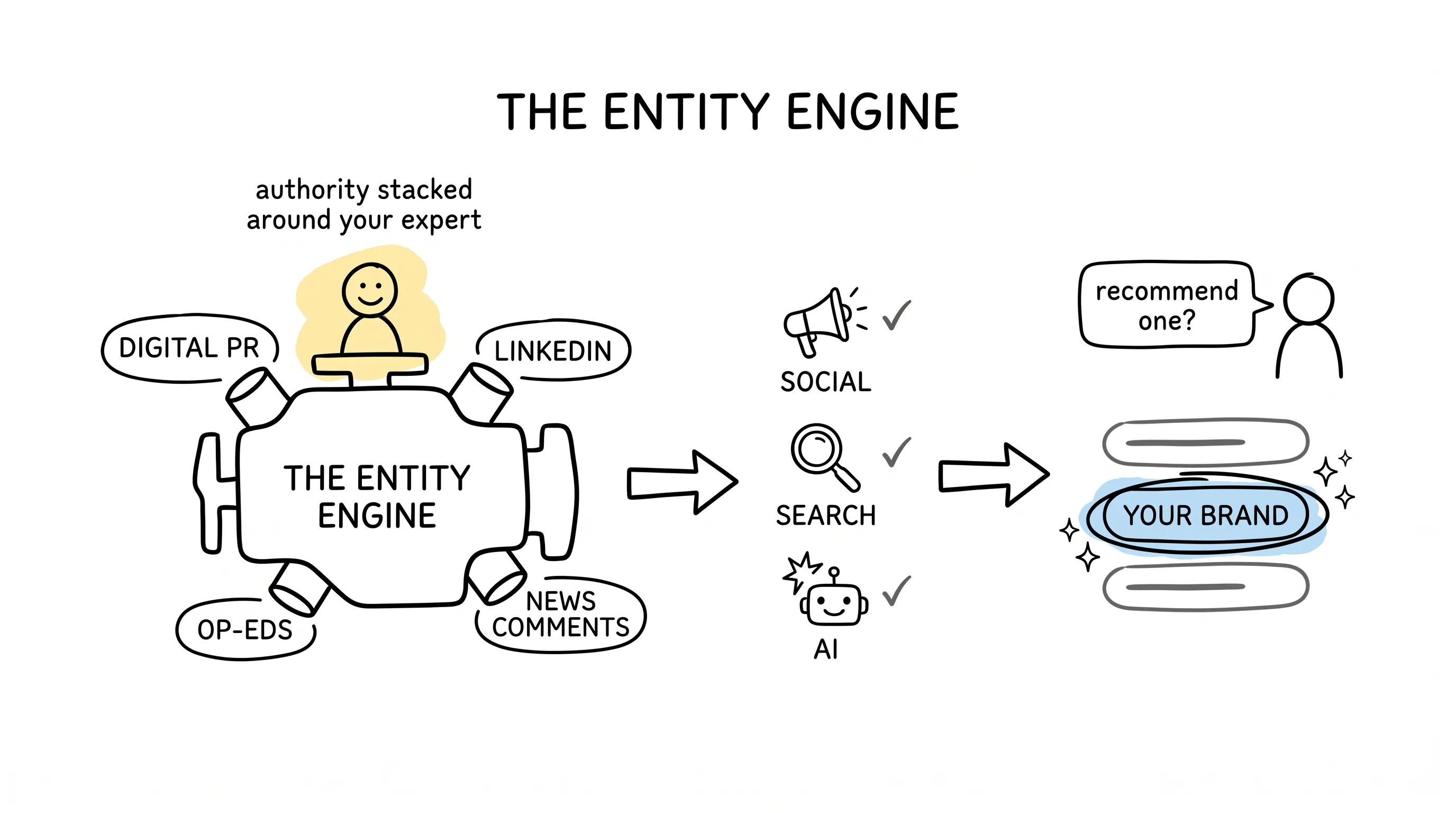
That's why Franco says people in PR need a new algorithm: stop spreading your energy across one press release after another. First take stock of which entities you have, set a unified set of metrics for them, then create content and repurpose content around those entities.
Which things, specifically? Digital PR campaigns, LinkedIn posts that amplify media coverage, op-eds under expert bylines, expert commentary on breaking news.
Before, these were four things, four teams, four budgets.
Now, they're four cylinders of one engine.
And what is that engine for? Stacking up authority around your experts — until social recognizes it, search recognizes it, and AI recognizes it too.
Authority Depends on Context
Step two: choose your outlets. Here Fractl has a counterintuitive finding, tested against its own data — it stopped me short the first time I heard it.
High-authority big media: good. But "good" only counts inside your brand's context.
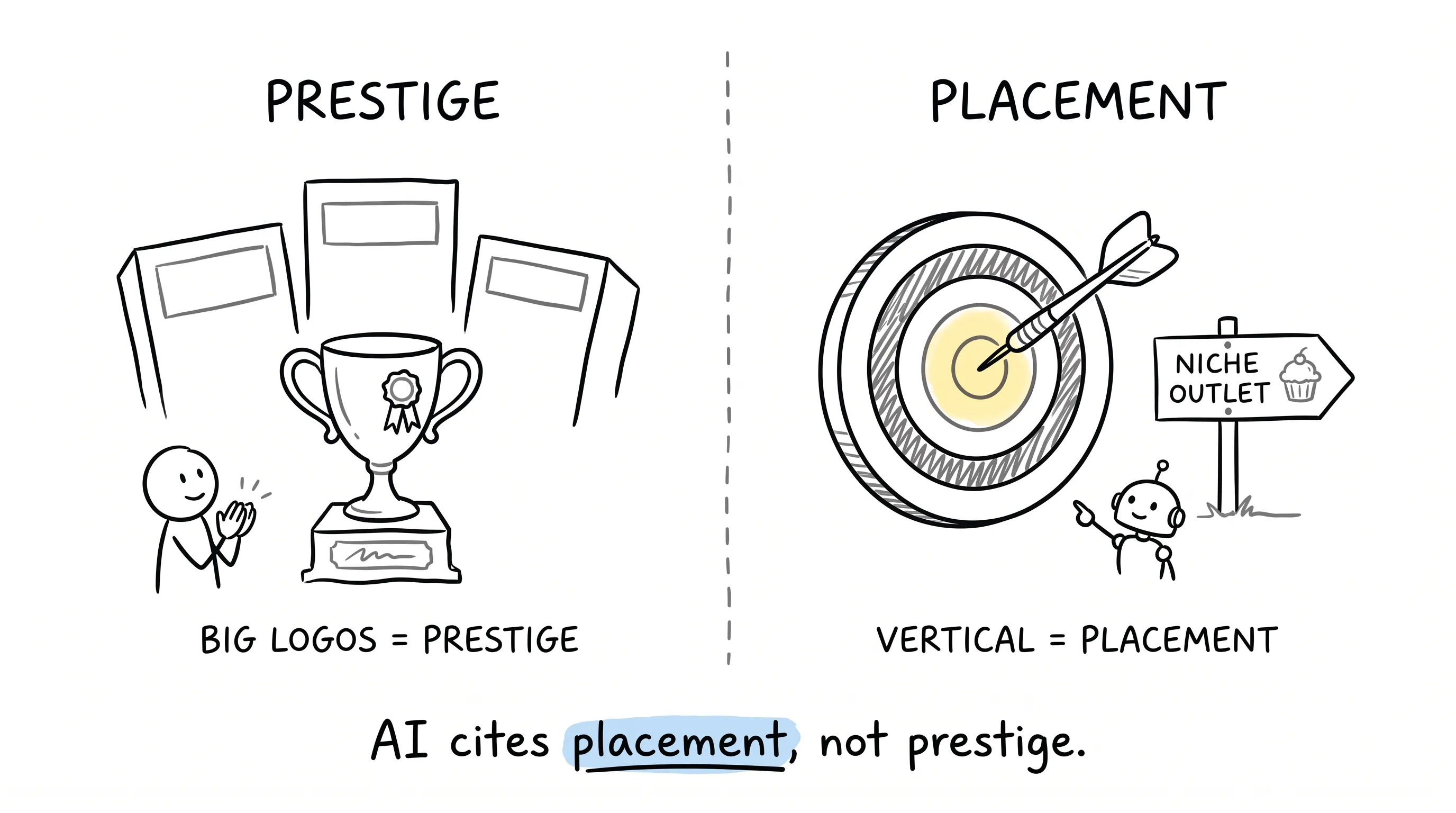
Take an example. You're a food brand, and you want AI to mention you when it answers food questions. Then a write-up in a lifestyle recipe site (think All Recipes) may work better than a business-finance heavyweight with far more search clout.
Flip it around and it clicks: when someone asks AI "what should I cook this weekend," does the AI go dig through recipe sites, or the food section of a finance magazine?
But if you're in the recruiting or HR business, the priorities flip entirely.
Why? Because which sources a model cites comes down to two things: where your category's audience actually hangs out, and which sources it habitually cites when answering questions in that vertical.
So stop chasing big logos on autopilot. Big logos buy you prestige; vertical outlets buy you placement. AI cites placement, not prestige.
Treat Expert Quotes as a Data Asset
Step three is Franco's most brilliant play, in my view: run expert commentary as a structured data asset that can scale.
What does that mean?
Put yourself in a reporter's shoes. The moment a story breaks, the "expert comments" flooding their inbox can fill it to bursting — half polished-to-a-gloss press releases, half instantly recognizable AI slop, machine-generated filler.
What do reporters want? Raw material they can drop straight into a story. Franco's point, roughly: treat quotes as data points, as sound bites — the raw, unpolished, truth-telling kind, the kind that adds real flavor to a story.
In one line: stop feeding reporters "opinions." Feed them "material they can use directly."
And that changes the whole way you work. Instead of squeezing out a perfectly safe, perfectly smooth statement for every breaking story, build a repeatable system: the moment breaking news hits, your experts can deliver short commentary within hours — with emotion, with substance, and ideally with a hint of surprise.
Nobody shares a press release. A great quote travels on its own.
The more this kind of commentary gets quoted, the more layers of authority your SME stacks up. Reporters quote you, the coverage feeds AI in turn, and the next time AI answers this question, it's more likely to mention you. That's how the flywheel starts turning.
Back to That Dinner
After the meal, I told my friend: everything you've learned about pitching reporters and nurturing relationships wasn't learned in vain — keep using it.
But remember: it no longer decides the finish line.
The finish line is this: when a buyer asks AI to "recommend one," AI names your client without missing a beat.
The math for PR teams is simple: twist the four content lines into one entity engine, change the media target from "biggest" to "best fit," and upgrade expert quotes from "press releases" to "reusable data assets."
Three things. None of them expensive. All of them start now.
Here's to your brand moving into AI's shortlist, soon.
Continue reading
Related articles

Cross-Border Business: Time to Upgrade Your AI Toolbox
A learn article explaining how AI tools help cross-border e-commerce sellers clear five hurdles: language, regulation, logistics, payments, and fraud. It outlines a five-compartment toolbox, a five-step adoption path, and metrics such as conversion rate and CLV, while cautioning against over-reliance on AI.

AI Is Taking Over the Dirty Work of Social Media Marketing, One Task at a Time
This learn article outlines four social media marketing tasks AI can handle — audience analytics, content drafting and design, ad targeting and creative testing, and spam moderation — and cautions that taste, judgment, and data security remain human responsibilities.

AI Is Already This Good — Why Is Your Social Media Marketing Still Pure Manpower?
An overview of 18 AI tools for social media marketing, organized into six categories covering audience research, content creation, scheduling, comment and DM handling, ad management, and visual production, plus notes on personalization, prediction, and emerging trends.