
What Kind of Email Deserves to Be Opened?
An explainer on hyperpersonalized email marketing: how CRM data and AI create individualized content, timing, and recommendations, plus privacy compliance and data-quality caveats.
A few days ago, I cleaned out my inbox.
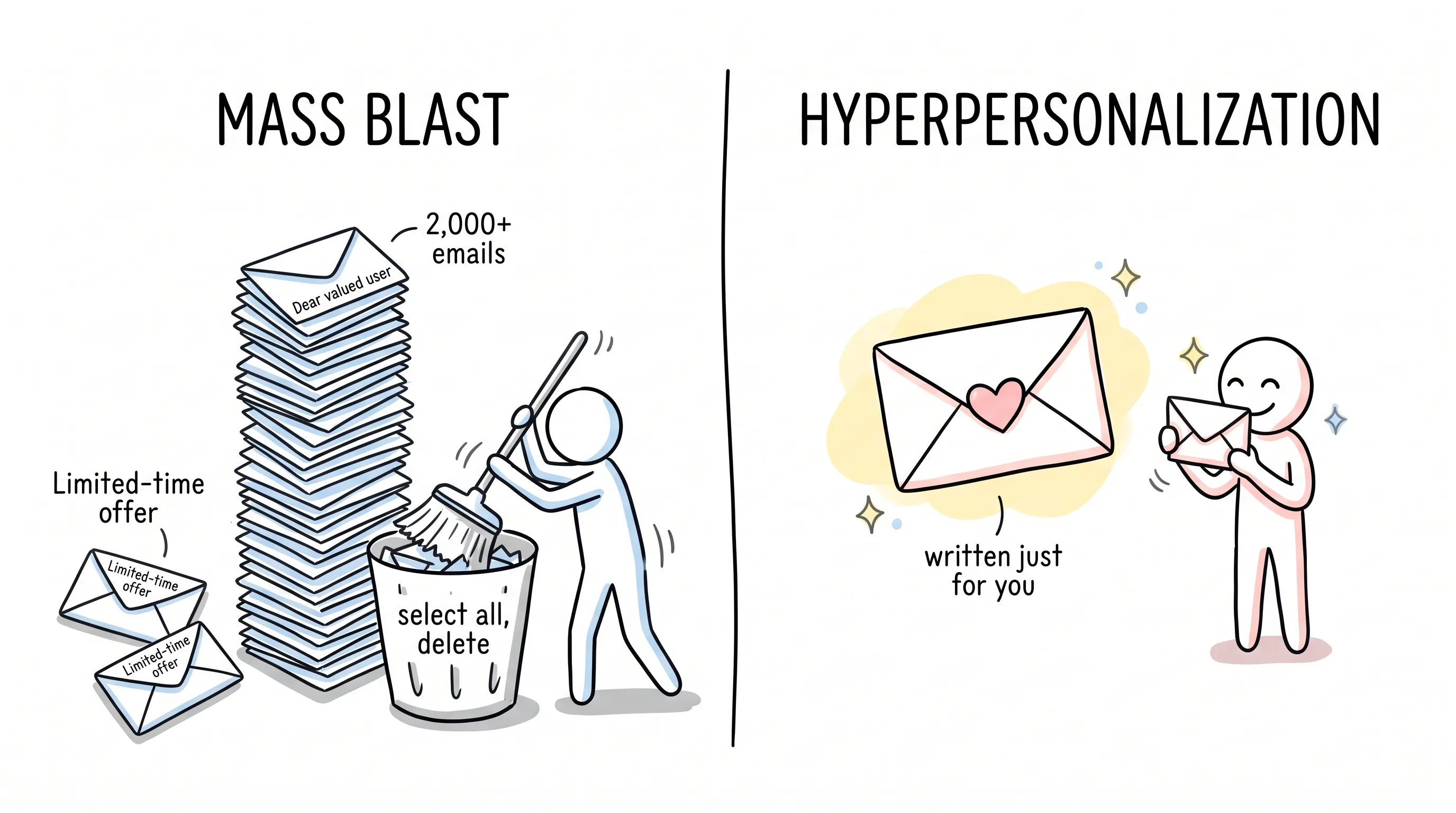
More than 2,000 unread. I spent an hour on it, and in the end did something brutal: select all, delete.
And in the middle of deleting, I noticed something: of those 2,000-plus emails, hardly a single one was written for "me."
A dozen different senders, but the content all looked about the same. "Dear valued user." "Limited-time offer." "Last three days." They weren't written to me; they were written to the "segment" I belong to.
Think about it: what do the emails you actually stop to read look like?
It's the kind that feels like it was written just for you.
That's what I want to talk about today: hyperpersonalization.
What Is Hyperpersonalization?
Email marketing has been through roughly three stages.
The first stage: the mass blast. One set of content, sent to 100,000 people. Maximum efficiency, minimum conversion.
The second stage: personalization. "Hello" becomes "Hello, Mr. Zhang," and the recipient's name gets stuffed into the subject line. It looks one step closer, but the core hasn't changed: the content is still the same set — only the greeting got warmer.
The third stage is hyperpersonalization.
What is hyperpersonalization? It's taking the data sitting in your CRM, plus AI's predictions, and calculating a separate email for each person: where are they in the journey right now? What do they care about? What time should it go out for them to be most likely to open it?
Put plainly, personalization changes the salutation; hyperpersonalization changes the content.
I once came across a data point: hyperpersonalized emails close at roughly six times the rate of mass blasts.
What does six times mean? Say you send out 100,000 blast emails and land 200 orders. Switch to hyperpersonalization, and the same reach might bring in 1,200. You didn't do a thing extra — the additional 1,000 orders all grew out of "relevance."
Pretty powerful.
Where Does the Fuel Come From?
Start with the data. Where does data come from? The CRM.
What is a CRM? A customer relationship management system. Put plainly, it's the diary a company keeps on every customer.
What they've bought, which pages they've browsed, what they've asked support, whom they've interacted with on social media. Scattered, these bits and pieces aren't worth much; once they flow into the CRM, a living, breathing person comes into focus.
With that diary, you finally know how far down the purchase path they've come, what they truly care about and what they fear, which line to say — and which line, said right now, would be an intrusion.
Here's an example. A software company: brand-new signups receive getting-started guides, as if terrified you won't figure it out; two-year veterans receive updates on advanced features, as if terrified you haven't heard. Same moment, two emails, two directions. And nobody has to babysit any of it — the CRM workflows run themselves.
Or this: last weekend you kept coming back to a pair of shoes and didn't buy. Wednesday morning, an email arrives: the size you looked at is back in stock. You won't think of it as an ad. You'll think: it gets me.
And the Engine?
Data is the fuel; AI is the engine. Specifically, AI does four jobs here.
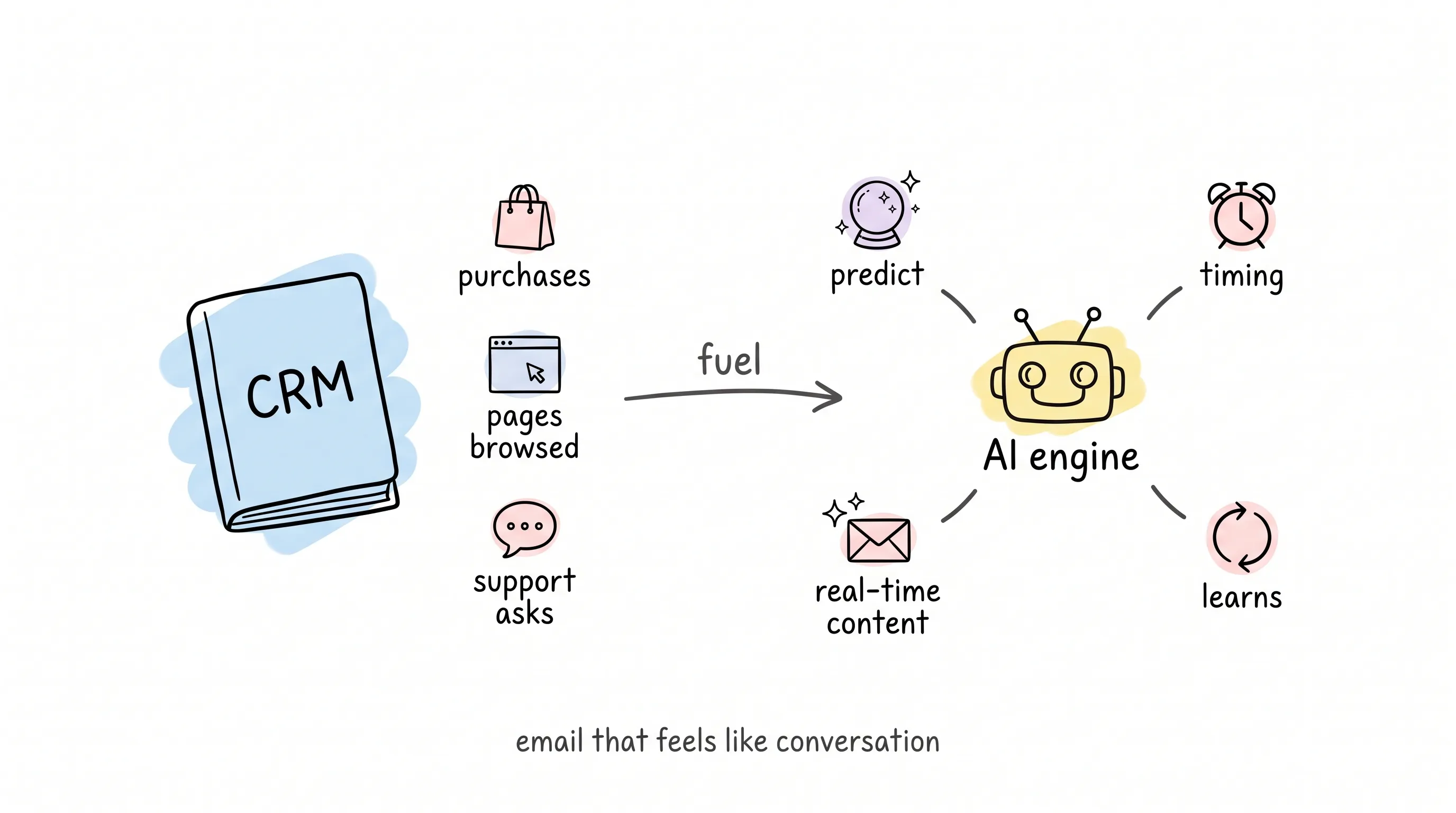
First, prediction. From a person's past behavior, it guesses what they'll want next. You just bought a camera, and it lines up lenses and memory cards to push your way. Upselling and cross-selling run on exactly this move.
Second, nailing the timing. Everyone opens their inbox differently — some scroll at 8 a.m., some read at midnight. AI works out the best moment to reach this particular person. The same email, sent at the right time, gets a whole different open rate.
Third, content that changes in real time. Within one promotion, the products shown to person A and to person B can be completely different. Subject lines, images, recommendations — all of it adjusts on the spot to each person's behavior.
Fourth, the more it learns, the sharper it gets. Every email sent — opened, clicked, or ignored — is feedback. AI keeps calibrating against it, so the next one understands you a little better.
Send enough of these, and email stops feeling like push. It starts feeling like conversation.
But There's Always a Flip Side
Hyperpersonalization isn't something that takes off at the press of one green button.
The first hurdle: privacy and compliance. Europe's GDPR (General Data Protection Regulation) has drawn the lines clearly: how data may be collected, whether it can be used, and what happens when a user changes their mind. Consent is a gate you cannot go around.
The second hurdle is harder to spot: the data itself is dirty.
The phone number a customer left two years ago was changed long ago. The need they cared about six months ago isn't the need they have now. Do "personalization" with stale data, and there are two ways it ends.
At best, the pitch is wildly off the mark, and the user just thinks your system is dumb.
At worst, it lands on private matters they never wanted mentioned. They feel offended — and one tap later, they've unsubscribed.
So in the end, the real contest isn't algorithms. It's how clean your data is.
If the data isn't clean, the smarter the machine, the more confidently it's wrong.
Looking Ahead: No Going Back
Inboxes will only get more crowded, and the competition only fiercer. Blast emails are the cheapest to send — and the first to be thrown away.
Meanwhile, the emails computed one by one from your behavior will feel less and less like marketing, and more and more like the natural continuation of a conversation.
For businesses, the math works. When email is relevant, people click; more clicks, more purchases; more purchases, more people who stay. Better still, automation carries all of it — not a single extra hire, and scaling tenfold doesn't sting.
For the first time, efficiency and experience don't have to be a trade-off.
Back to Those 2,000 Emails
That day, inbox cleared, I looked at all that emptiness and felt an unexpected pang.
More than 2,000 emails, and I'd missed nothing. Anyone who truly had something to say to me would write again.
May your next email not become the 2,001st swept away by select-all-delete. May it be read as a letter. One glance, and the recipient knows: this letter was waiting for them.
Continue reading
Related articles

Cross-Border Business: Time to Upgrade Your AI Toolbox
A learn article explaining how AI tools help cross-border e-commerce sellers clear five hurdles: language, regulation, logistics, payments, and fraud. It outlines a five-compartment toolbox, a five-step adoption path, and metrics such as conversion rate and CLV, while cautioning against over-reliance on AI.

AI Is Taking Over the Dirty Work of Social Media Marketing, One Task at a Time
This learn article outlines four social media marketing tasks AI can handle — audience analytics, content drafting and design, ad targeting and creative testing, and spam moderation — and cautions that taste, judgment, and data security remain human responsibilities.

AI Is Already This Good — Why Is Your Social Media Marketing Still Pure Manpower?
An overview of 18 AI tools for social media marketing, organized into six categories covering audience research, content creation, scheduling, comment and DM handling, ad management, and visual production, plus notes on personalization, prediction, and emerging trends.