
What Kind of Business Is Helping Others Go Global?
A learn article explaining the cross-border e-commerce enabler business: it reviews a list of 97 companies, their funding and geographic distribution, and profiles the top five — BigCommerce, Global-e, ANKA, Zonos, and Flow — covering localization, payments, logistics, and tariff compliance.
This month, an industry list quietly got an update.
It's a short list: 97 companies. But as I went through it line by line, I found it more and more interesting. Because it's about a business most of us rarely pay attention to: cross-border e-commerce enablers.
So what is a cross-border e-commerce enabler?
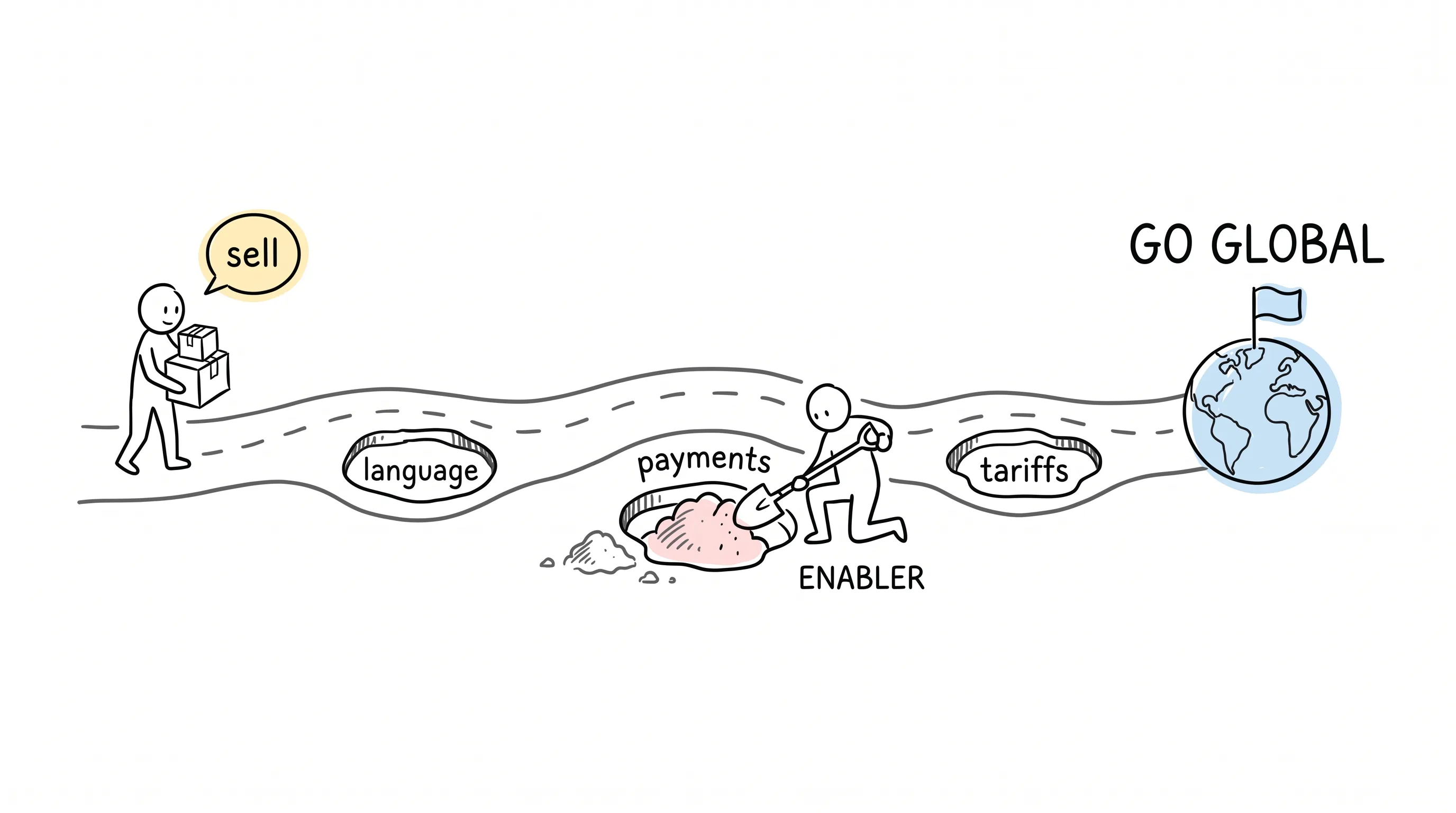
Here's a simple way to think about it. Say you want to sell your goods abroad. Right away, a pile of chores shows up at your door: local languages, pricing, payments, logistics, tariffs, customs clearance, compliance. None of them is hard on its own. But every single one is a hassle.
So some companies do these chores for a living. You just sell. As for the potholes on the road to going global — they fill them in.
This business of "helping others go global" is what we call a cross-border e-commerce enabler.
What Does This Business Look Like?
Start with some numbers.
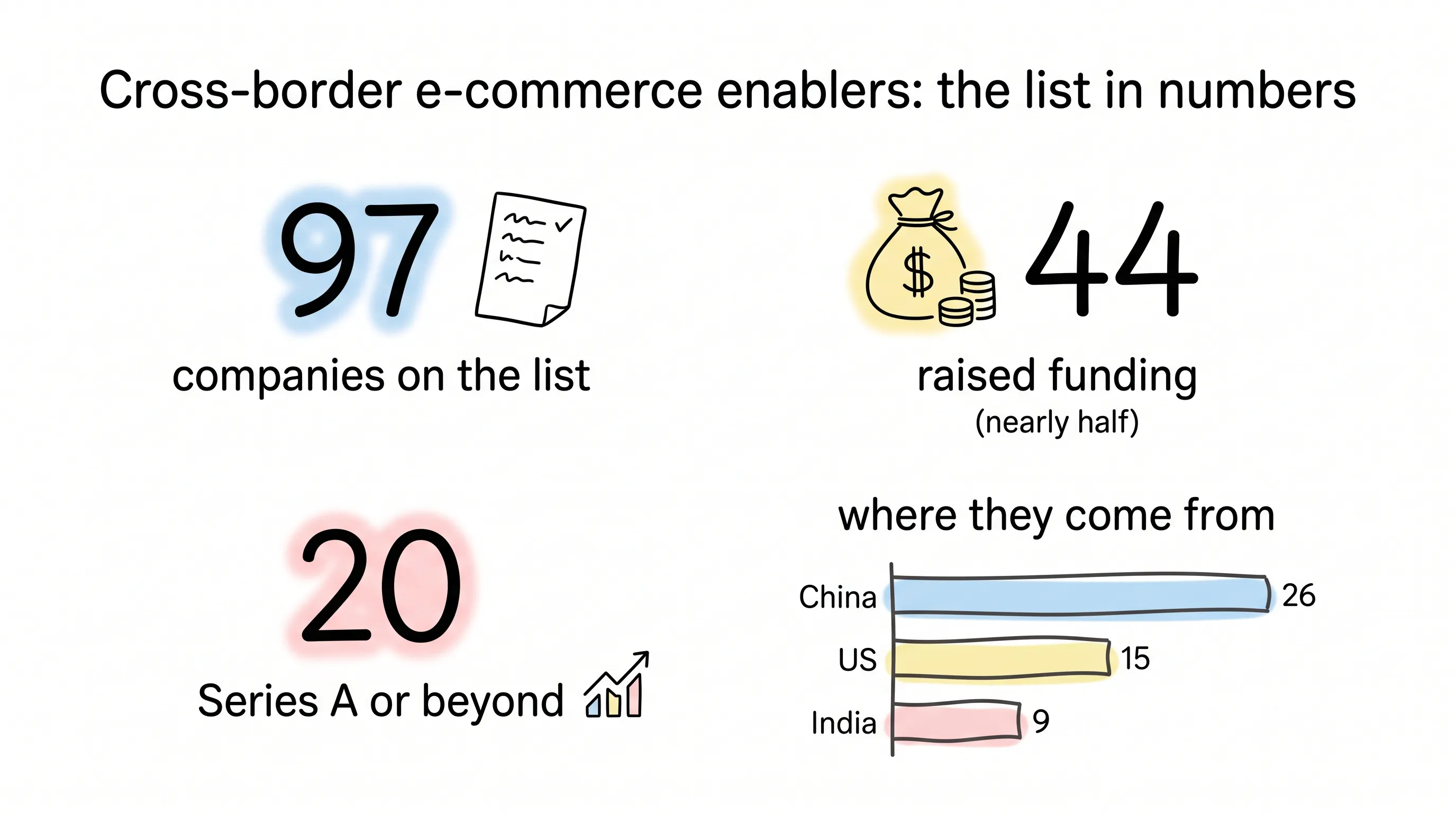
Of the 97 companies, 44 have raised funding — nearly half. And 20 have made it to Series A or beyond.
Now look at where they come from. The biggest group might surprise you: China, 26 companies. The US next, 15. India third, 9.
One more detail: quite a few of these founders are alumni of Columbia Business School, Columbia University, and IIM Bangalore (Indian Institute of Management Bangalore).
Think about it. On the surface, going global is about moving goods. Underneath, it's all knowledge: knowing local regulations, knowing tax codes, knowing consumers. This isn't grunt work. It's brain work.
The Top 5 Are Five Different Ways to Play
Let me take the top five companies on the list, one at a time.
First, BigCommerce. Founded in 2009, now public, with $233 million raised to date from investors including Goldman Sachs and Floodgate. It gives merchants a platform for building an online store: how to set up the shop, how to manage the inventory — the tools are all there. And it doesn't stop once the store is built. It offers implementation, project management, and technical guidance. It even writes its own articles and reports, teaching you how to run a store. Think of a property developer who sells you a bare-shell apartment — and throws in the renovation. Rank it against the 1,100+ companies in the category, and it comes in at No. 3.
Second, Global-e. Founded in 2013, also public, with $100 million raised to date. Picture this: a customer in France opens your store. The page is in French. Prices are in euros. The payment method at checkout is one he uses every day. To him, this is simply a French store. That's exactly what Global-e does — and it uses data to tell you which markets are worth entering and how to optimize. So what is localization? Making sure the customer abroad never feels you're abroad at all.
Third, ANKA. Founded in 2016, now acquired, with $13.5 million raised to date from investors including the IFC (International Finance Corporation). It builds each merchant a website with its own domain name, connects it to social media and e-commerce platforms, and lets one dashboard handle orders, shipping, and payments. What stopped me cold was the place name: Abidjan, Côte d'Ivoire, West Africa. Not Silicon Valley. Not Beijing. Turns out the business of helping others go global is not a developed-market monopoly.
Fourth, Zonos. Founded in 2009, Series A, with $69 million raised to date. It chews on the hardest bone on the cross-border road: tariff and tax compliance. Product classification, automated. Landed costs, calculated automatically. Customs paperwork, managed automatically. And on the side, it verifies product information, keeps an eye out for under-invoicing, and screens against restricted-party lists. Is this work tedious? Painfully so. But precisely because it's tedious, whoever chews through it holds the moat.
Fifth, Flow. Founded in 2015, now acquired, with $50 million raised to date from investors including NEA and Bain Capital Ventures, the venture arm of Bain Capital. Its philosophy is the full package: localized browsing, pricing control, local checkout, global shipping and returns, A/B testing, ad-driven customer acquisition. One unbroken chain, end to end. It even keeps fraud and compliance risks out of the merchant's way.
A Slow Business, Ready for Harvest
One number stopped me for a good while.
Over the past ten years, this space has added an average of 4 new companies a year. This year, it added 1.
Way too slow, right?
Then it clicked. This is not a fast business: operations are heavy, compliance is heavy, localization is heavier still — you can't rush it. In a slow business like this, only the toughest survive.
But another set of signals is more interesting. Of the top five, two are public, and two have been acquired.
Half the companies have found their exit. This business has entered its harvest season.
Back to that list from the start. Ninety-seven companies, all really doing the same thing: filling in the potholes on the road to going global, one by one.
What you see as a pothole, someone else sees as a business.
Wishing you fair winds as you go global. And if you do fall into a pothole, don't panic — somewhere out there, there's a whole business built to fill them in for you.
Continue reading
Related articles

Cross-Border Business: Time to Upgrade Your AI Toolbox
A learn article explaining how AI tools help cross-border e-commerce sellers clear five hurdles: language, regulation, logistics, payments, and fraud. It outlines a five-compartment toolbox, a five-step adoption path, and metrics such as conversion rate and CLV, while cautioning against over-reliance on AI.

AI Is Taking Over the Dirty Work of Social Media Marketing, One Task at a Time
This learn article outlines four social media marketing tasks AI can handle — audience analytics, content drafting and design, ad targeting and creative testing, and spam moderation — and cautions that taste, judgment, and data security remain human responsibilities.

AI Is Already This Good — Why Is Your Social Media Marketing Still Pure Manpower?
An overview of 18 AI tools for social media marketing, organized into six categories covering audience research, content creation, scheduling, comment and DM handling, ad management, and visual production, plus notes on personalization, prediction, and emerging trends.