
What Is Omnichannel Personalization? It Means You Recognize the Customer, No Matter Which Door They Walk In
A learn article explaining omnichannel personalization, covering customer journeys, data management, just-in-time personalization, and BCG's MIDAS framework.
A few days ago, I went to the mall to buy running shoes.
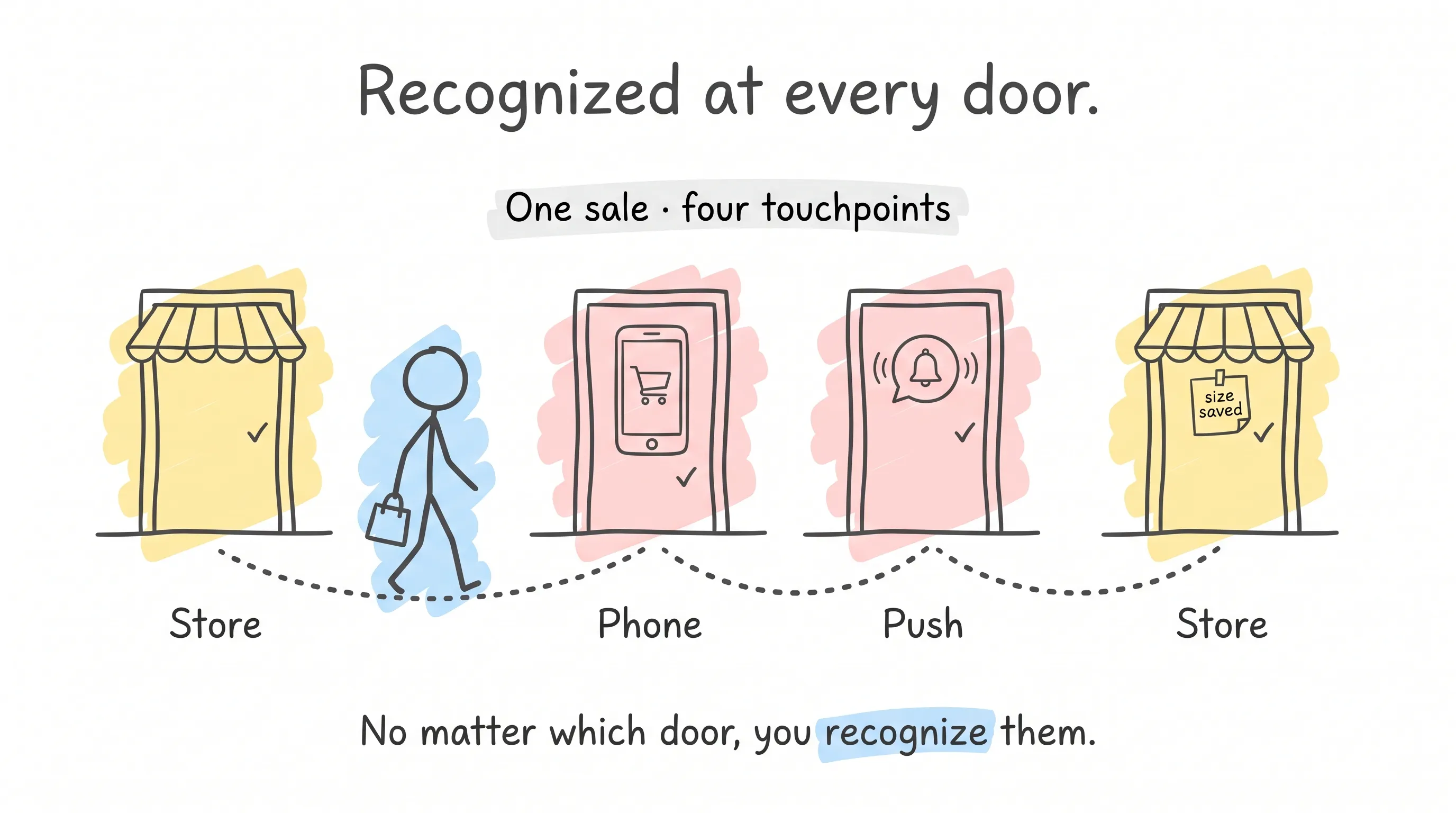
I tried on three pairs in the store. All good. But I didn't buy. I walked out, pulled out my phone, and added the pair I liked best to my cart. The next morning, the app pushed me a coupon: another ¥100 off those shoes as a member. I placed the order. That afternoon, I passed by the store, and the salesperson said they'd set my size aside — come swap them anytime if the fit wasn't right.
That single sale crossed four touchpoints. Store, phone, push notification, store. And yet the whole way through, I never once felt the jolt of "switching channels."
The moment I stepped out of that store, a single thought popped into my head: this store really gets me.
Omnichannel means this: no matter which door a customer walks in through, you recognize them.
That's what I want to talk about today.
First, a Look at the Market
A couple of days ago I came across a set of numbers that stung a little.
Adobe runs something called the Digital Price Index, which tracks price movements for goods sold online. It showed that in November 2022, and across that entire year, e-commerce growth and online spending were both slowing. Electronics and computers — the two biggest categories in e-commerce — saw prices drop 13.4% and 18% year over year. Why the drop? Fewer people buying.
Interestingly, newer categories like groceries and pet supplies actually went up in price — up 13.7% and 11% year over year, respectively.
On one side, gadgets people can't bring themselves to splurge on; on the other, cat and dog food they'll buy no matter what. Behind this contrast sits a simple fact: wallets are zipped shut, and people are choosier about what they buy.
When the market turns cold, many business owners' first instinct is to floor the accelerator on customer acquisition.
And that is precisely the most dangerous move. Because acquisition keeps getting more expensive, and while you're sprinting to pull people in up front, your existing customers are quietly walking out the back.
The colder the market, the more your money has to come from existing customers.
BCG research put a number on it: satisfied customers are 80% more likely to spend more.
Eighty percent. That's nearly double.
And satisfied customers also bring you new ones. They post about you, they talk about you over dinner, they recommend you to colleagues. A satisfied customer is a sales force you never have to pay.
The Customer Journey Changed a Long Time Ago
If you want to keep existing customers, you first have to be clear on one thing: what exactly does "customer journey" mean today?
Ten years ago, the customer journey was simple: walk in, browse, pay, leave. The journey ended at the cash register.
And today? The journey begins the first time you hear of a brand. Maybe a short video, maybe a friend's word at the dinner table. Then comes comparison shopping, ordering, delivery, using it, after-sales service, repeat purchase. The purchase is just one second in the middle.
The customer journey starts at the first encounter. Its best-case ending is: they can't leave.
So what does that demand of a business?
Holding onto "one store online, one store offline" doesn't work anymore. All your touchpoints have to be stitched into one complete web. That is omnichannel.
One set of numbers shows just how far ahead of companies customers already are. Salesforce published a "State of the Connected Customer" report, with two figures in it:
60% of customers expect companies to "get them." To know what they want without their saying it.
74% of respondents said they routinely use multiple channels to start and finish the very same transaction.
Picture this: inside your company, the online team and the offline team have two sets of KPIs, two systems, and are still fighting each other for customers. Meanwhile your customer is bouncing freely between online and offline, and doesn't think of "channels" as a thing at all.
Channels are your internal problem. To the customer, there's only you.
Doing the Math on Personalization
Omnichannel is the skeleton; personalization is the soul. Connecting the touchpoints isn't enough — at every one of them, the customer has to feel "this was made for me."
Is it worth the effort? Let's do the math.
I once came across this claim: companies that are truly proficient at personalization can deliver growth rates 10% higher overall.
BCG ran an even starker calculation: companies pour an astronomical amount of money into mass promotions every year, but much of it is thrown at people who were going to buy anyway. Shift 25% of that money into personalization, and ROI rises by 200%. Worked out, that's a growth opportunity worth more than $70 billion a year.
Move 25% of the budget, get a 200% lift in return.
That's serious leverage.
Of course — the premise is you know how to do it. Personalization done badly is just harassment. So what does "doing it well" look like?
Two Pillars
BCG's experts break this into two levers, and the split is sharp.
Pillar one: technology and product.
However you play the concepts, the core of customer experience is always the product or service itself. Every initiative has to answer the same question: does it create value for the customer? Is it actually good to use? If it can't answer those two questions, the smoothest-connected touchpoints in the world won't save it.
Pillar two: data management.
What is data management? It's merging the touchpoints scattered across channels into one complete picture of the customer, so that when they want to switch channels, they can switch in stride, without noticing a thing.
Think of a hotel you stay at often. The front desk knows you. They know you like a firm pillow, and the sparkling water you drink is already in the minibar. You never have to "introduce yourself again."
The endpoint of data is this: the customer never has to introduce themselves again, at any touchpoint.
One caution, though. Data collection should be broad — online, offline, third-party, all of it. But collecting is only step one; the real gap lies in analysis and execution. There are far too many companies whose pile of data just sleeps on a hard drive.
There's another layer: many companies get stuck on legacy systems — data silos, each fiefdom running its own pile; redundant systems, the same capability bought three times. Before you attempt personalization, check the foundation.
Going Further: Just-in-Time Personalization
BCG offers one more step beyond this: just-in-time personalization.
What is it? Personalization used to be seasonal: last quarter's report comes out, you analyze it, adjust, and it takes effect next quarter. But the market changed ages ago.
Just-in-time personalization uses large-scale data analytics to sense shifts in buying patterns in real time. Foot traffic data, search trends, consumption forecasts — these are high-frequency leading indicators. You should check them the way you check the weather forecast: whether the day will turn, you need to know before you leave the house.
By the time the report tells you it's cold, you've already caught the cold.
Only at this point has a company truly moved from "occasionally touching the customer" to "becoming part of the customer's life."
The MIDAS Touch
Before I close, I really want to share a framework BCG came up with. The name alone is brilliant: the MIDAS touch.
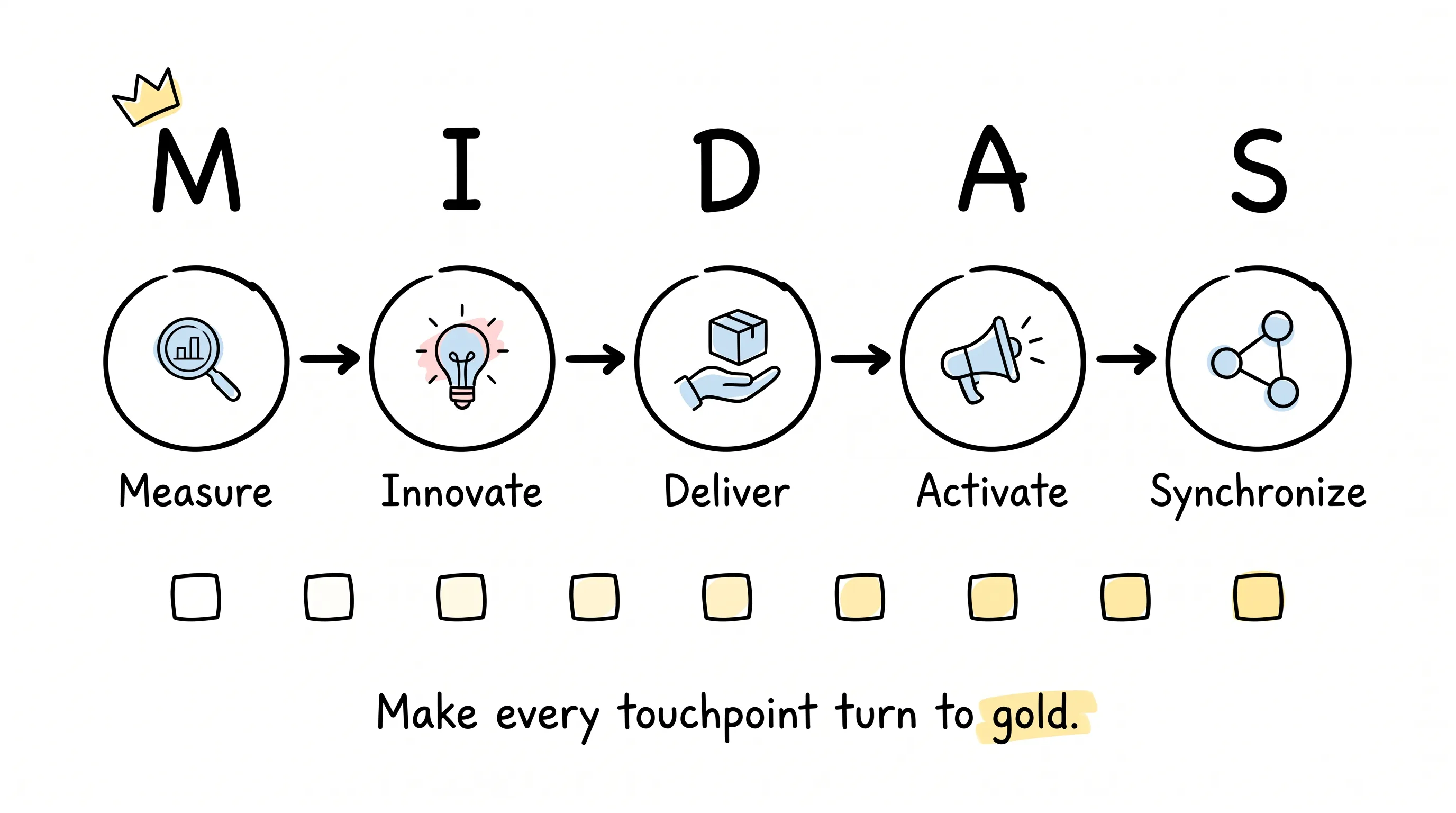
Midas — king of Greek myth, the one who turned everything he touched to gold. The ambition of this framework is right there in the name: make every touchpoint along the customer journey turn to gold at the moment it's touched.
It lines the work up as a sequence: Measure, Innovate, Deliver, Activate, Synchronize. From seeing the situation clearly, to redesigning the solution, to execution, activation, and omnichannel alignment — one step at a time, in order.
This playbook has market endorsement too. In early 2023, the Forrester Wave recognized BCG as a Leader in customer experience strategy consulting, calling out two things in particular: first, its market analysis is rigorous and its data sources rich; second, it has its own ROI model that can calculate whether money invested in customer experience is actually worth it.
As for execution on the ground, BCG Platinion zeroes in on four areas: business impact, experience design, target architecture, and end-to-end process and technology. Understand technology's impact across the whole value chain first; talk experience after.
Beyond that, they distilled five priorities, which I think every company chasing omnichannel personalization should copy straight into their notebook:
- Data collection and privacy. Collect fully — and collect correctly and compliantly — or the data will never be usable.
- Unlock AI. Go step by step, use case by use case, and make AI the engine of personalization.
- Digitize journeys end to end. Core processes like operations, planning, and support all need to move online and actually run.
- Modularize content. Only when content is broken into building blocks can it be dynamically assembled by person and by scenario.
- Interconnect systems. Only when channels and applications form one web do you have the foundation for a next-generation personalization architecture.
A Final Word
Now, back to those running shoes from the beginning.
The shoes were good shoes. But what made me remember that store is that I never once had to "introduce myself again": the salesperson knew me while I was trying shoes on, the app remembered what I'd looked at, and the second time I walked in, they'd even held on to the size I was hesitating over.
What customers want is, depending on how you look at it, a big thing or a small thing:
Every step they take with you, they hope to be recognized.
The companies that manage this won't freeze, no matter how cold the market gets.
Here's wishing you become that store — the one customers recognize at a glance.
Continue reading
Related articles

Cross-Border Business: Time to Upgrade Your AI Toolbox
A learn article explaining how AI tools help cross-border e-commerce sellers clear five hurdles: language, regulation, logistics, payments, and fraud. It outlines a five-compartment toolbox, a five-step adoption path, and metrics such as conversion rate and CLV, while cautioning against over-reliance on AI.

AI Is Taking Over the Dirty Work of Social Media Marketing, One Task at a Time
This learn article outlines four social media marketing tasks AI can handle — audience analytics, content drafting and design, ad targeting and creative testing, and spam moderation — and cautions that taste, judgment, and data security remain human responsibilities.

AI Is Already This Good — Why Is Your Social Media Marketing Still Pure Manpower?
An overview of 18 AI tools for social media marketing, organized into six categories covering audience research, content creation, scheduling, comment and DM handling, ad management, and visual production, plus notes on personalization, prediction, and emerging trends.