
What Is Mind-Reading Marketing? Letting 100 Million People Hear 100 Million Different Messages
An explainer on AI-powered "mind-reading marketing": real-time personalization at every touchpoint, an FMGsuite e-commerce case study, and three starting steps like dynamic welcome messages and predictive recommendations.
A while back, I walked into a boutique.
The moment I stepped in, I stopped short.
The lighting was warm, the music was a tune I liked, and the few pieces on the display shelf were exactly the ones I had been staring at through the shop window for ages. A store associate came over, and the very first sentence they said spoke straight to my heart.
The feeling, in that moment: this store had been opened just for me.
Have you ever asked yourself a question: could you bring this kind of experience online?
Not just bring it online. It would also have to serve 100 million people at once, with every single person seeing the version made just for them.
Ten years ago, that would have been a pipe dream. Today, AI has turned it into reality.
What Is "Mind-Reading Marketing"?
I gave it a name: mind-reading marketing.
What is mind-reading marketing?
It's AI reading three things in real time at every touchpoint (every moment a customer comes into contact with your brand): your intent, your context, and your mood in this very moment. Then, based on that, deciding what recommendation, what offer, what content to show you.
Note the word "real time."
This isn't that "stalker"-style ad chasing — you searched for running shoes yesterday, and today your whole screen is running shoes. What it reads is this moment: whatever you're hesitating over right now is exactly what it catches right now.
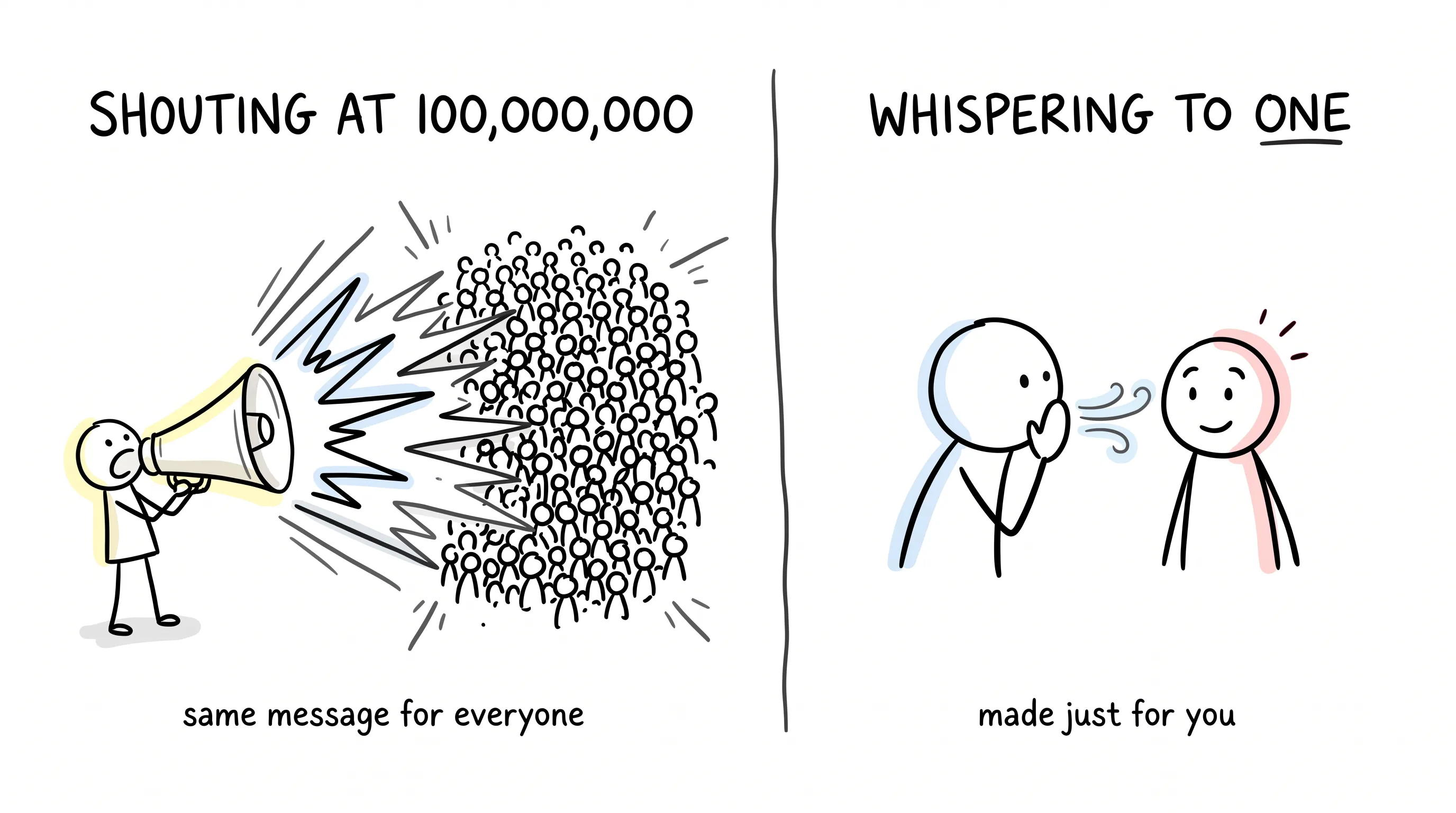
Why did marketing of the past shout the same sentence at 100 million people?
Because it had no idea who you were. Shouting was the cheapest way to be heard.
Now, AI can read who you are. Marketing's playbook has flipped — from "shouting at 100 million people" to "whispering to one person."
A whisper sounds far better than a shout.
Let Me Tell You a Real Case
Reasoning alone won't get you anywhere, so let me tell you a real case.
There's a company called FMGsuite that builds marketing software for financial professionals. On its e-commerce side, three things had long been a headache: a slow website, checkout that kept failing, and a data integration with Salesforce that ate time and effort.
Customers waited for pages until they ran out of patience; at checkout, payments kept erroring out halfway through; and once sales finally closed a deal, the data still had to be moved by hand.
Then FMGsuite made up its mind to rebuild the e-commerce experience from the ground up, bringing in a specialist team to solve these three problems one by one.
And the result? Let me run the numbers for you.
Page loads got 40% faster, and conversion rates rose 30%.
Payment errors dropped 25%, and successful transactions grew 15%. What does that mean? Of every 100 transactions that were all but closed, a dozen or so used to get stuck at the payment step and slip away. Now, that money stays.
Manual data entry was cut in half. The time saved freed people up for more valuable work.
Notice: not one of these three fixes was about "showing off." The slow became fast, the broken became right, the tedious became effortless.
The most valuable thing about AI personalization isn't being cool — it's untying, one by one, the small, grinding knots in a business.
Where to Start? Three Steps, None of Them Hard
At this point you may be thinking: I get the logic, but how does my business start?
No need to concoct some grand masterstroke. Three steps, and not one of them is hard.
Step one: dynamic welcome messages. Stop greeting every visitor with the same hard-coded "Welcome." Let the message change in real time based on where the visitor came from and the path they've browsed. Returning customers and new customers should be seeing two different sentences.
Step two: smart triggers. A customer just added an item to the cart, then closed the page in hesitation? The system responds instantly: a small coupon, or a message that dissolves their doubt. It shows up at the exact moment they need it. A second too early, it's an intrusion; a second too late, it's a lost sale.
Step three: predictive recommendations. Before the customer says a word, guess what they'll want next. Like the associate at that boutique — before you even asked, the item was already in your hands.
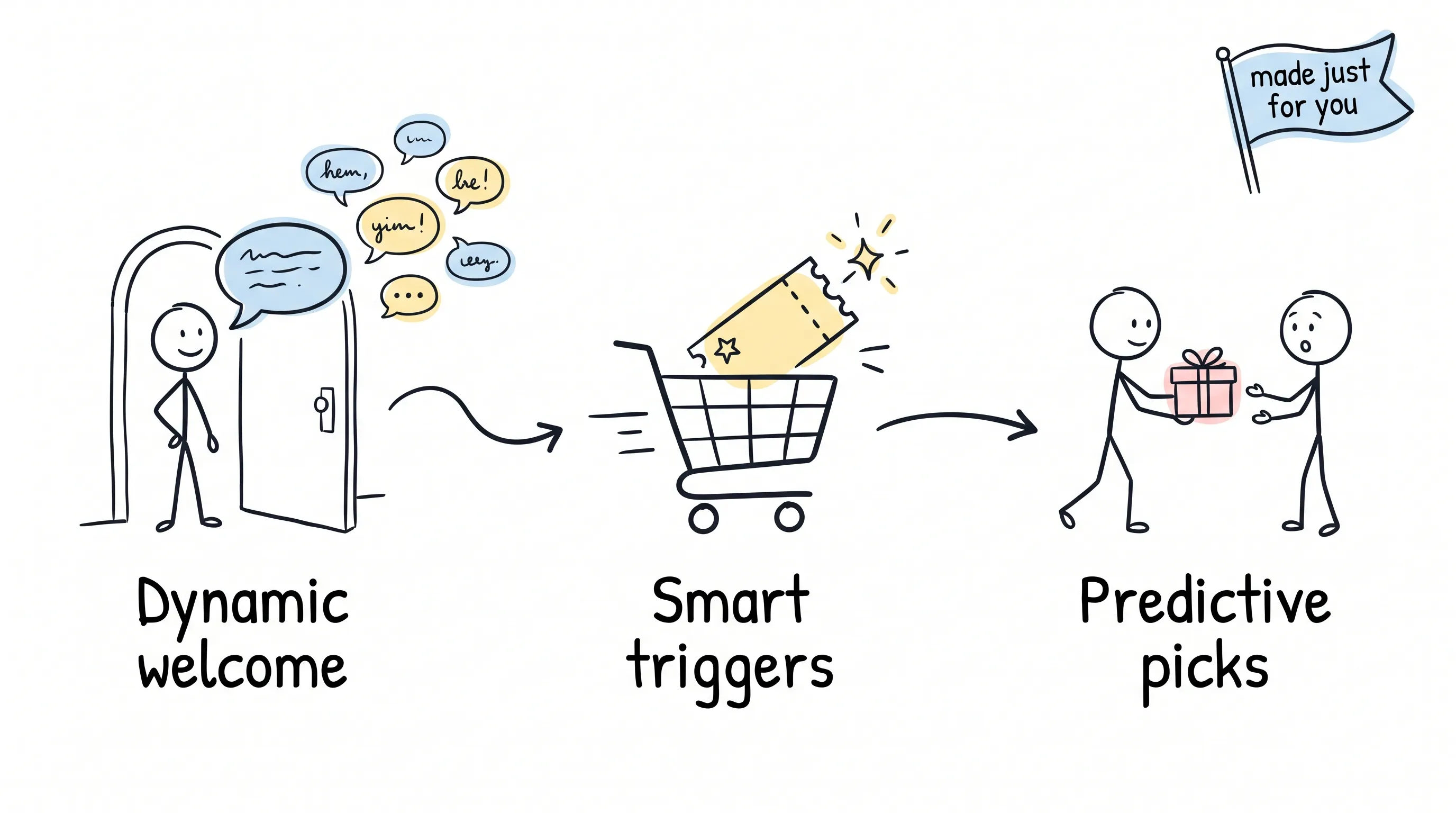
Start with one of the three. Once it works, add the next.
A Closing Word
Back to that boutique from the opening.
Good marketing chases exactly that feeling: every customer believes the store was opened just for them.
And what AI does is take that "handmade, made-for-you" feeling and deliver it, with machines, to 100 million people at once.
Personalization is no longer a bonus in marketing — it's the price of admission.
If the experience isn't right, customers won't even want to start a conversation with you.
May the day come soon when everyone who walks into your store hears that whisper: "This was prepared for you."
Continue reading
Related articles

Cross-Border Business: Time to Upgrade Your AI Toolbox
A learn article explaining how AI tools help cross-border e-commerce sellers clear five hurdles: language, regulation, logistics, payments, and fraud. It outlines a five-compartment toolbox, a five-step adoption path, and metrics such as conversion rate and CLV, while cautioning against over-reliance on AI.

AI Is Taking Over the Dirty Work of Social Media Marketing, One Task at a Time
This learn article outlines four social media marketing tasks AI can handle — audience analytics, content drafting and design, ad targeting and creative testing, and spam moderation — and cautions that taste, judgment, and data security remain human responsibilities.

AI Is Already This Good — Why Is Your Social Media Marketing Still Pure Manpower?
An overview of 18 AI tools for social media marketing, organized into six categories covering audience research, content creation, scheduling, comment and DM handling, ad management, and visual production, plus notes on personalization, prediction, and emerging trends.