
What Is Marketing ROI? The One Math Class Marketers Need to Make Up in 2026
An educational article explaining what marketing ROI is, the CAC and LTV metrics behind it, six common places marketing budgets leak, and six fixes covering positioning, high-intent search traffic, conversion-rate optimization, and creative testing.
A couple of days ago, I had dinner with an old friend who has spent more than a decade in marketing.
He runs the marketing department at a consumer goods company, with tens of millions of yuan passing through his hands every year. A few drinks in, he told me something that still gives him chills.
At the quarterly review, his boss flipped the slide deck to page three and stopped. The boss said: impressions, engagement, reads — I've heard all of that. Answer me one question: of the money you spent, how much profit came back?
He froze. For a moment, no answer came.
When I heard this, I was actually happy for him. Because the question was exactly the right one.
What Is Marketing ROI? First, Do the Math
Plenty of people spend ten years in marketing without ever seriously working out this number.
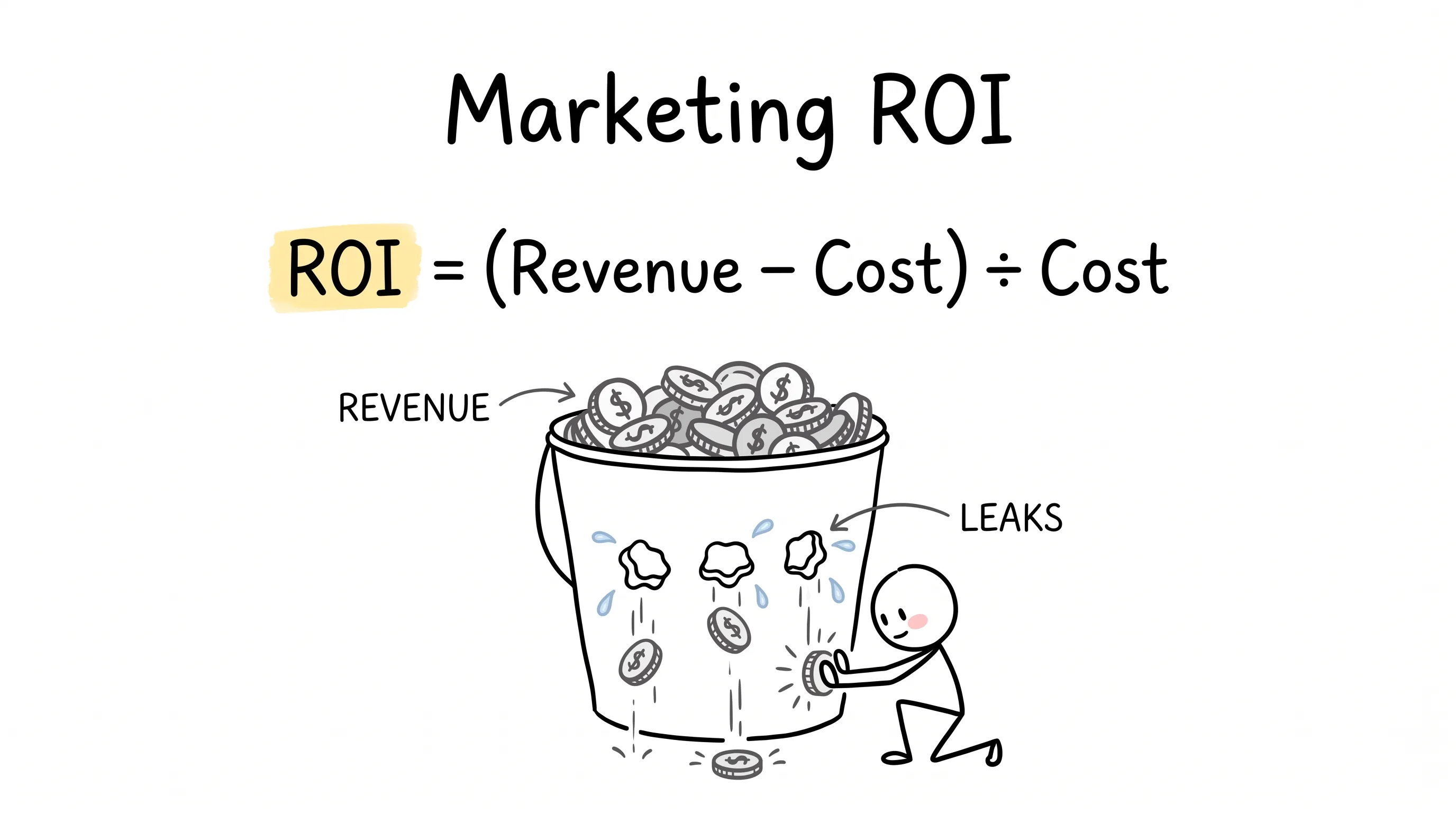
Put bluntly, it comes down to one formula:
Marketing ROI = (Revenue from Marketing − Marketing Cost) ÷ Marketing Cost
Spend 1 million, bring back 3 million in revenue, and your ROI is 2.
Simple, right.
But used on its own, this formula will fool you. Especially in B2B and high-ticket businesses, where deal cycles are long — today's ad spend may not turn into a contract until three months later. So one ROI number isn't enough. You also have to keep your eye on this string of metrics:
Customer Acquisition Cost (CAC), Lifetime Value (LTV), lead-to-close rate, sales cycle, channel efficiency, repeat purchase rate.
What does healthy look like? The CAC you pay must be clearly lower than the money that customer goes on to make you. That's the bottom line. A business whose LTV can't carry its CAC dies faster the bigger it grows.
Why Does This Question Sting So Much in 2026?
This math has always been the same. It's just that in the past, many companies could paper over it with pretty vanity metrics.
Impressions up, traffic up, cost per click down — and the quarterly review turned into a victory lap.
Today, that trick doesn't fly anymore.
Several forces are pressing down at the same time.
Budgets are getting tighter. In Gartner's surveys of marketing leaders, one signal comes through consistently: expectations keep rising while budgets get scrutinized over and over. Every penny has to justify itself.
Acquisition keeps getting more expensive. The traffic dividend has bottomed out, and the cost of reaching the same customer is multiplying.
Consumers are getting harder to please. Google's consumer insights research (Think with Google) keeps confirming one thing: people's expectations for speed, relevance, and usefulness climb year after year. A page that loads a little slow, a pitch that feels a little canned — and they walk.
And then there's AI. Your competitor uses AI to test 20 versions of creative in one day; you ship one version a week.
Stack these four forces together and the conclusion is a single sentence: wasting a click costs far more than it used to.
The era of spraying budget and hoping is over.
Where Does the Money Leak? Six Holes in Total
When ROI won't climb, nine times out of ten it isn't because "marketing doesn't work."
It's the system leaking.
Let me count them for you. There are six common holes. As you read, see which ones are yours.
Hole one: fuzzy positioning that leaves everyone cold.
"Innovative." "Customer-centric." "Results-oriented." Your competitors are using these words too. When a sentence could be true of any company, it says nothing at all. If users can't remember you, they naturally won't choose you.
Hole two: data managed in separate silos.
SEO sits with one person, paid campaigns belong to another, CRM lives in IT, and nobody reads the web analytics. The same group of customers gets hit three times by three departments using three different yardsticks. McKinsey's growth marketing research and HubSpot's data both point to the same conclusion: high-growth companies are the ones that braid data, creative, and customer experience into a single rope.
Hole three: optimizing for clicks, not for deals.
Clicks are cheap and plentiful, and the report looks good. But the people who arrive are spectators, not buyers, and every link downstream suffers for it. How precise your traffic is matters far more than how much it costs.
Hole four: landing pages that drive customers away.
A user, moved by the ad, clicks through. And then? The page won't load in 5 seconds — gone. They can't find "what exactly do you sell, and why should I trust you" — gone. The form asks for 11 fields — gone too. You paid to bring someone to the door, then shut the door with your own hands.
Hole five: first-party data sleeping in the warehouse.
Privacy rules keep tightening and third-party data gets harder to buy. That makes the customer data you've built yourself the most valuable asset you own. Yet many companies pile it up and never once use it for proper segmentation or outreach.
Hole six: creative that never gets tested.
The same tagline with a different opening, a different emotion, a different piece of evidence can perform several times better. But many companies do this: make one version, roll it out everywhere, and pray.
Until these six holes are plugged, whatever budget you add leaks right out.
Where to Start Patching? Six Fixes, In Order
Fix number one: sharpen your story first.
Before optimizing any single ad, optimize the sentence behind the ad: why should a user choose you? Why now? Why should they believe you?
One test: within 10 seconds, can you make a stranger understand what you're better at than anyone else? If you can't say it, don't spend yet.
Don't underestimate this one. Once the story is clear, ads, landing pages, sales scripts, and emails all benefit across the board. Fix it in one place, and performance rises everywhere.
Fix number two: catch the people who are already looking for you.
Traffic comes in two kinds: one is browsing, one is searching. Browsers need nurturing; searchers need catching.
What is high-intent traffic? It's someone who already knows they have a problem and is hunting the world over for a solution. In search channels, these keywords cost more per click and don't come in big volume, but their close rate crushes broad traffic. Google's research on search behavior shows it again and again: at the moment of decision, people use search to confirm the answer.
When profit is under pressure, catch the searchers first; talk about the browsers later.
Fix number three: treat content as a conversion asset, not just a traffic asset.
Which content actually brings in deals? Not the trend-chasing 100k+ hit. It's these: comparison pages that spell out exactly how you differ from A and from B; problem-and-solution pages; case studies with real results; pricing explanation pages; and objection-handling pages that answer hesitation head-on.
This content isn't elegant, but it answers questions on behalf of sales. When you write it, the person in your mind is the one who's hesitating — not the search robot.
Fix number four: raise the conversion rate before you talk about more ad spend.
This is the one sentence I most want you to take home today.
Let's run the numbers. You spend 1 million on ads, conversion rate is 2%, that's 2,000 customers, CAC of 500 yuan each. Now change nothing else — just fix the landing page and the pitch, and lift the conversion rate to 2.4%.
Same 1 million in spend, 2,400 customers, CAC down to 417.
You didn't spend one extra yuan, and every additional customer is pure profit.
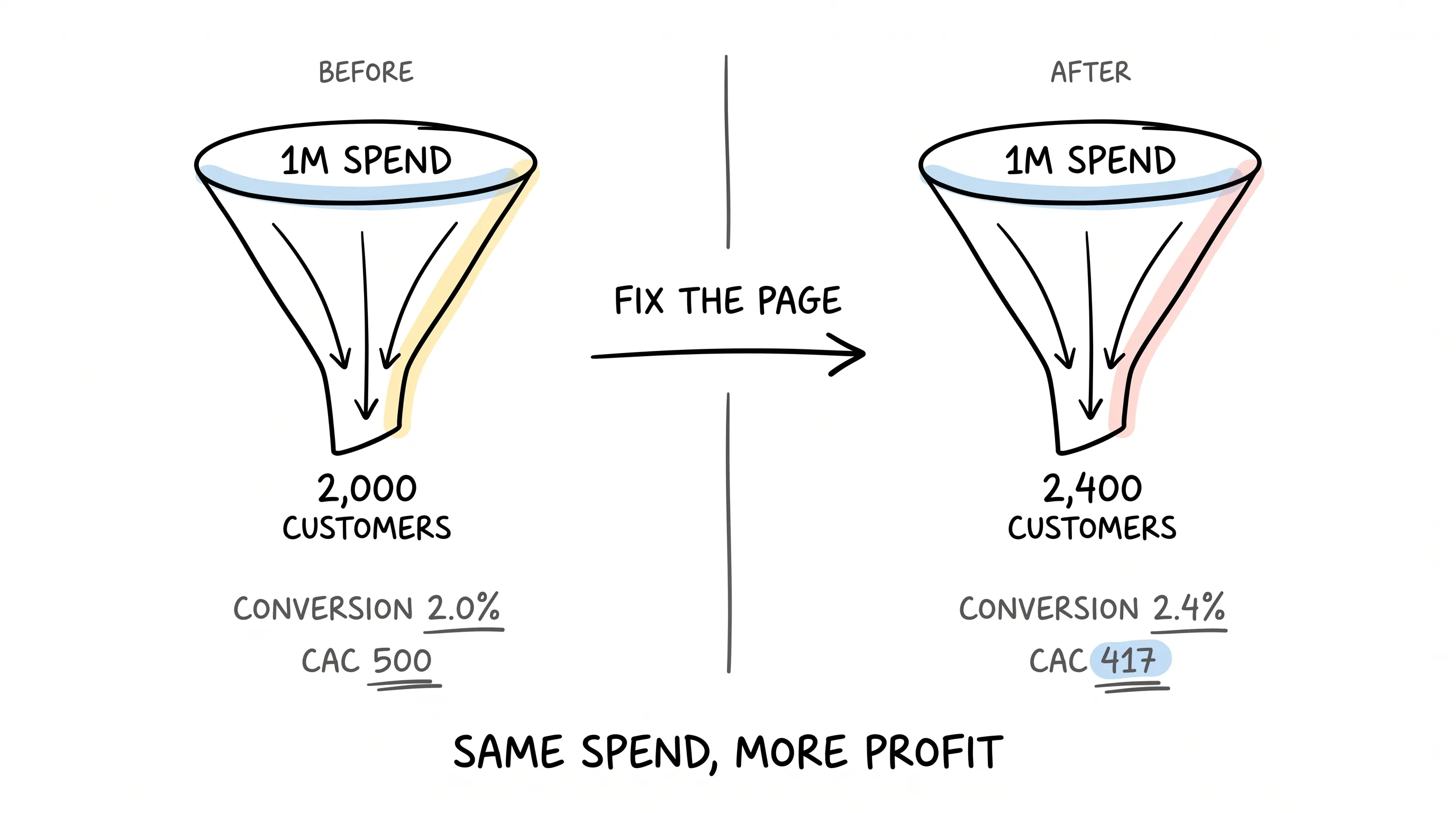
Flip it around: if the conversion rate doesn't move and you add another 1 million in spend, most of the extra money is pouring water into a leaking bucket.
How do you raise it? Headlines that talk like a human, evidence up front, forms trimmed by a field wherever possible, mobile that works first, promises bold enough to put in writing. CXL's large body of experimental research proves the very same lesson: one test beats ten arguments.
Fix number five: get marketing and sales onto the same number.
Marketing says lead volume is up 40%. Sales says they're all junk leads.
This conversation plays out every day in countless companies. Both people are telling the truth, but the two sides don't speak the same language.
The fix isn't complicated: both sides define together "what counts as a qualified lead." What the target customer looks like, which signals show they truly want to buy, how soon after a lead arrives follow-up is mandatory, who gets the credit when a deal closes. Salesforce's State of Marketing survey found something similar: the tighter data and teams are connected, the better the results.
Fix number six: let AI speed you up, but don't let it take the helm.
What AI can do: segmentation, personalized email, ad variant testing, predictive budget allocation, report automation. Fast and done well.
But there's one thing AI can't do: decide who we should actually talk to, and what to say.
If the strategy is wrong, AI will only help you be wrong faster. Get the direction clear first, then hand the accelerator to AI. Reverse the order, and you're using a machine to amplify noise.
Brand Isn't a Cost. It's a Discount.
After these six fixes, there's one more layer many people never think of.
Many companies split "brand" and "performance" into two departments, two budgets, as if one handles appearances and the other handles substance.
That's the biggest misunderstanding of all.
Think about it: someone who knows and trusts you, and a complete stranger, see the same ad. Who clicks more easily? Once inside, who buys more easily? Before buying, who asks fewer questions?
The answer is obvious.
Brand isn't the department that spends money. Brand is the department that makes every other department cheaper.
Decades of advertising effectiveness research back this up. The UK's IPA (Institute of Practitioners in Advertising) has accumulated decades of case data, and Google has analyzed similar questions. The conclusions all point to one thing: long-term brand building and short-term performance conversion must be kept in balance. Go performance-only, and the more you buy, the more expensive it gets. Go brand-only, and distant water can't quench a thirst this close.
One hand on today's conversions, the other banking trust for the long run. These two have never been either-or.
Before You Go, Ask Yourself These 7 Questions
- Are the metrics we report the profit numbers the boss cares about, or just the ones that look good to us?
- Is what's coming in customers who want to buy, or spectators just here for the show?
- Do our landing pages deserve the ad money we spend on them?
- Are all our acquisition eggs in one basket?
- Which pieces of content actually brought in deals? Can you name them?
- Does our story live up to our pricing?
- Are marketing and sales reading the same map?
Whichever one you can't answer — that's your leak.
Finally, Back to My Friend
At the end of that dinner, I handed his boss's question right back to him: "Then go back and show him the math. How much went out, how much came back, where it's leaking, and how much more you'd earn once it's plugged. One spreadsheet, make it clear."
Three months later, he sent me a WeChat message: the quarterly meeting was over. The boss read the spreadsheet and asked exactly one question: how much extra budget do you need to plug these holes?
See what happened? The same question went from "what did you do with all that money" to "if I give you more, how much will you earn back?"
That's the power of getting your ROI math right.
Marketing has never lacked campaigns. What it lacks is a system map that says things clearly and lays the math out plainly.
Money hasn't become harder to earn. What's become harder is the muddle-headed way of spending it.
Here's to getting your own numbers straight.
Continue reading
Related articles

Cross-Border Business: Time to Upgrade Your AI Toolbox
A learn article explaining how AI tools help cross-border e-commerce sellers clear five hurdles: language, regulation, logistics, payments, and fraud. It outlines a five-compartment toolbox, a five-step adoption path, and metrics such as conversion rate and CLV, while cautioning against over-reliance on AI.

AI Is Taking Over the Dirty Work of Social Media Marketing, One Task at a Time
This learn article outlines four social media marketing tasks AI can handle — audience analytics, content drafting and design, ad targeting and creative testing, and spam moderation — and cautions that taste, judgment, and data security remain human responsibilities.

AI Is Already This Good — Why Is Your Social Media Marketing Still Pure Manpower?
An overview of 18 AI tools for social media marketing, organized into six categories covering audience research, content creation, scheduling, comment and DM handling, ad management, and visual production, plus notes on personalization, prediction, and emerging trends.