
What Is GEO? When Customers Stop Searching and Start Asking
An explainer on GEO (Generative Engine Optimization): how AI-generated answers decide which brands get cited, and how open content, YouTube transcripts, and press releases can improve AI visibility.
A few days ago, an old friend of mine who works in B2B marketing came to me to vent.
He said his company's website had great SEO — their core keywords had held steady on the first page of search results for years. Then last month his sales team came back and told him: several customers said they'd found the company's competitors by asking AI.
Those customers never even scrolled to his page.
He asked me: is this game about to change?
I said yes. And there's a new term you'd better understand right now. It's called GEO.
What Is GEO?
GEO — Generative Engine Optimization.
What's a generative engine? ChatGPT, Claude, and the other large language models (LLMs). You ask one a question, and it doesn't hand you a list of blue links. It hands you an answer.
SEO fights over where you rank on Google's results page. GEO fights over whether an AI mentions you and cites you when it answers someone else's question.
The old battleground was ranking. The new battleground is citation.
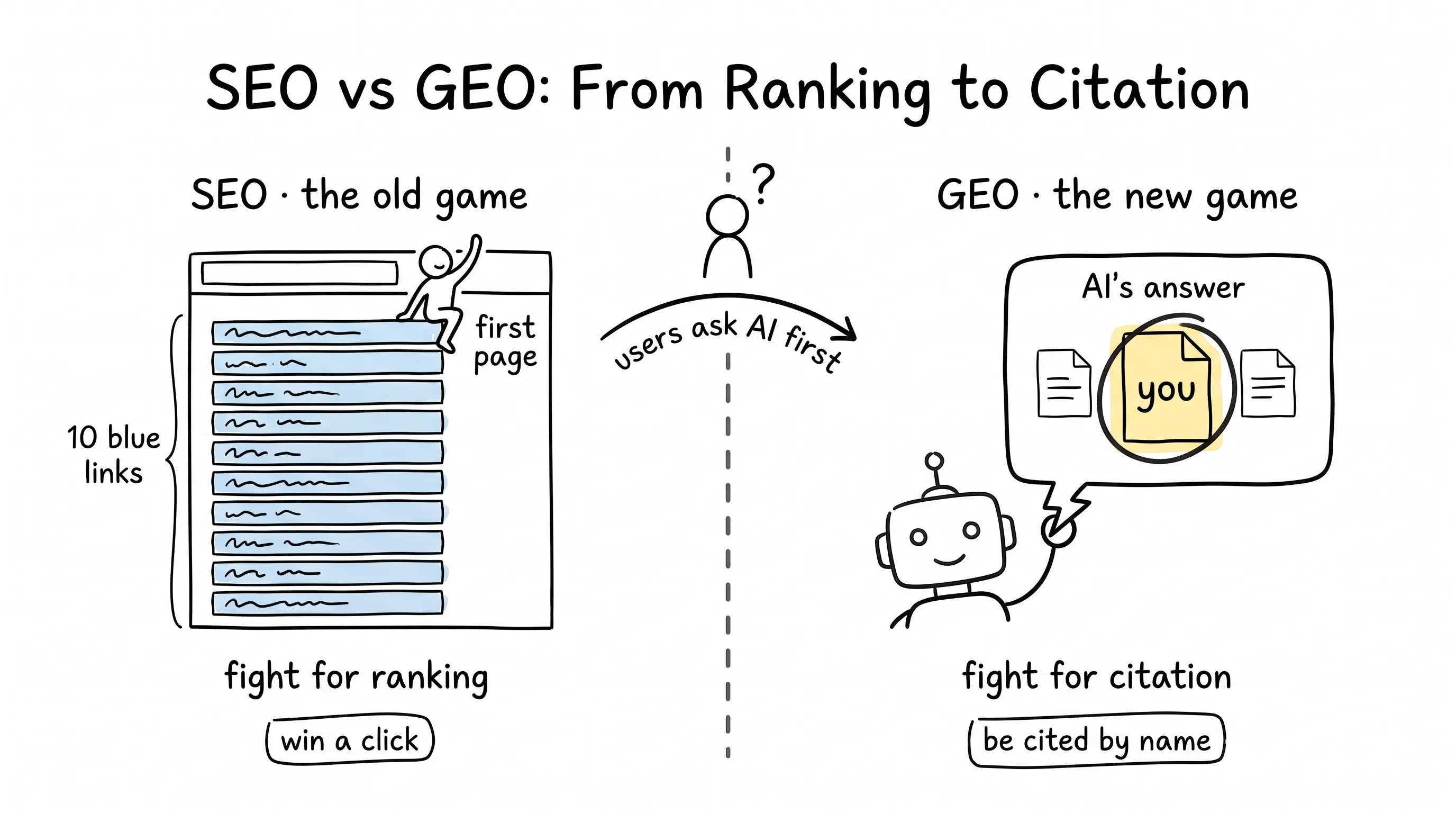
When a user asks an AI, "Which vendor's solution should we go with in our industry?" — does your name appear in the answer? If yes, you exist. If no, as far as the user is concerned, you don't exist.
How important is that? You tell me.
The Logic Is Really the Same as SEO
Don't let the new buzzword scare you. The underlying logic of GEO is strikingly similar to SEO's.
Think about how SEO works. A crawler sweeps through every page of your website, counts the words you use, assigns a score, puts everything in order — and when a user searches, it lays out the results by score.
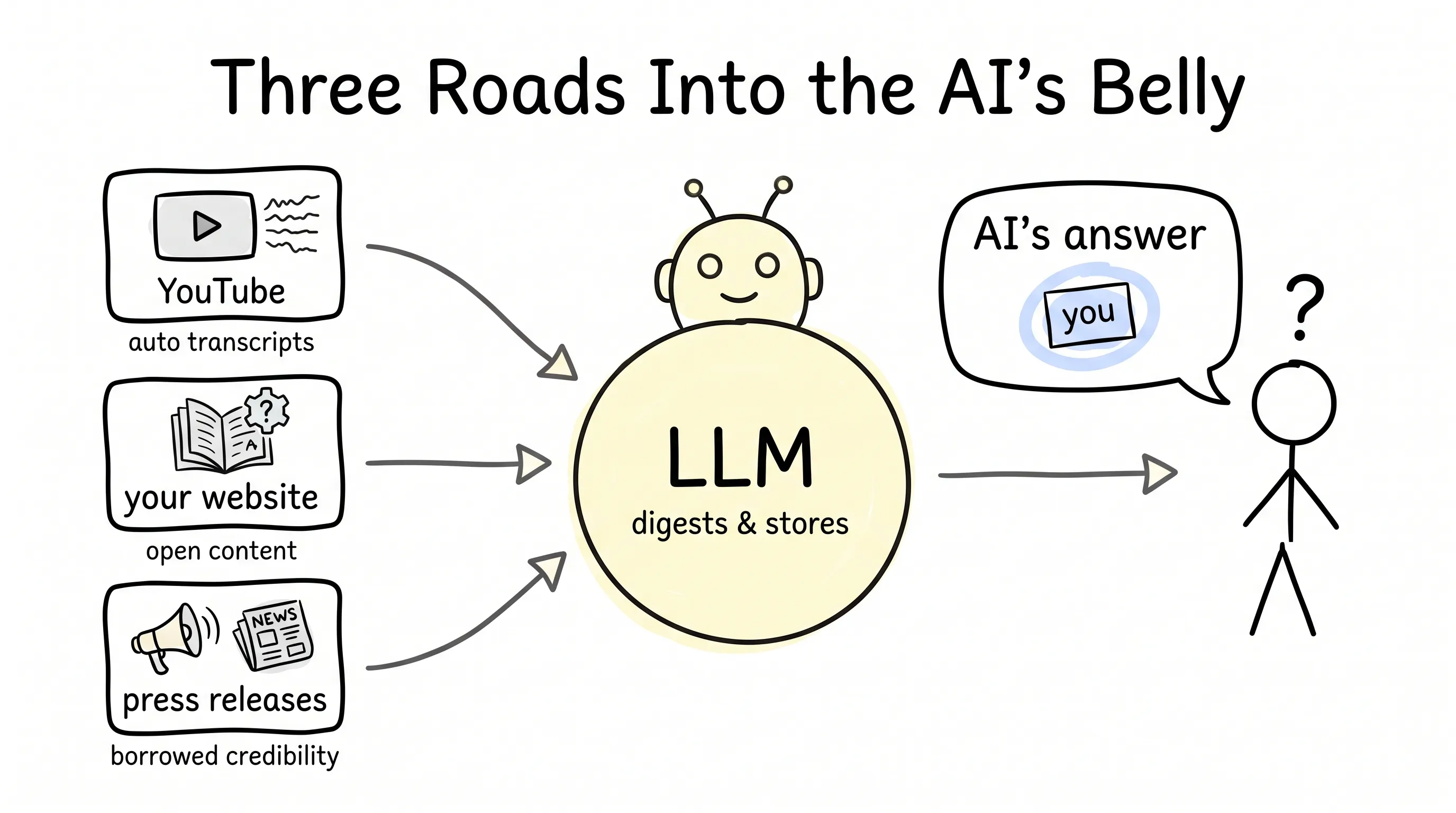
GEO runs on the same machinery. A crawler grabs your content and feeds it to a large model. The model digests the information, aggregates it, and stores it in its belly. When a user asks a question, it answers from that inventory.
The way to verify it is the same, too. In the SEO era, you searched your own company on Google to see where you ranked. In the GEO era, you ask ChatGPT and Claude the industry questions, and see how they answer — whether they mention you.
So what does a large model rank things by? Credibility.
All of GEO is a contest over credibility. The more credible you are, the more the AI cites you.
The First Iron Rule: Tear Down the Wall
So how do you actually get an AI to "see" you?
Rule number one, and the most counterintuitive one: stop locking up your content.
What does locking up mean? Gated content (content locked behind a form until you hand over an email address). The whitepapers, industry reports, and in-depth guides people have to unlock before they can download.
B2B marketing ran this play for over a decade, all for the sake of capturing sales leads. But here's the problem: a crawler can't get past a form. Content the crawler can't reach, the AI can't see. Content the AI can't see, the AI can't cite.
In the eyes of an AI, locked-up content equals nonexistent.
So your most technical, most substantive solution content should sit wide open, free for any crawler to roam. B2B circles were already slowly giving up gated content over the past few years; once AI arrived, this went from "worth discussing" to "must execute."
Those whitepapers in your bottom drawer, gathering dust for years? Now you have a rock-solid reason to tear down the wall and publish every last one.
Three Roads Into the AI's Belly
Your content is open — now where do you spread it? Here are the fastest-acting routes right now.
First, YouTube.
A lot of people don't know this: YouTube videos now get automatically transcribed into text, then crawled and fed into large models. Say it in a video, and the AI is listening.
That's why so many people in the marketing world suddenly started publishing videos like crazy this year. The audience they're speaking to includes the AI, not just the people in front of the screen. This road is fast, too — record one video, and the content can soon show up in the model's output.
Second, your own website.
Articles, documentation, how-to guides, help centers — write everything that should be written and put it up. Content marketing used to be written for prospective customers to read. Now you need to think one layer deeper: this content is also written for the AI to read — it's the fodder you feed ChatGPT, Claude, and company.
Third, press releases.
This one is the most interesting. A press release gets distributed to a batch of high-credibility media sites, and those sites are exactly what AI crawls hardest. One press release out the door equals borrowing the endorsement of a pile of high-authority websites — your credibility shoots up overnight. Right now, this is a widely acknowledged shortcut.
But I have to remind you of one thing: this shortcut is basically unpoliced right now. Press releases can be bought with money. Buy a batch, send it out, and you can sprint to the front of the credibility rankings.
In other words, this road is currently full of speculators.
If you have no accumulated website presence, no content reputation, and you rely purely on bought press releases to buy your way into existence — it may work in the short term; in the long term, I wouldn't bet on it. The platforms' credibility algorithms will come for this sooner or later.
This Is a Fill-in-the-Blank Race
String all of the above together — what is GEO, essentially?
It's a content race. A contest over who spreads fastest and covers the most ground, filling the gaps in the AI's knowledge base one by one. And over who is credible enough that the AI cites them without hesitation.
An AI will not cite what it cannot find. Content no crawler can reach simply does not exist in the AI's world.
Back to my friend's question. His SEO is still great — still sitting comfortably on page one of Google. But that is now only half the exam.
The other half sits in places he never bothered with: in YouTube's transcriptions, behind the fill-in-a-form wall on his website, and inside the press releases he never sent.
My advice to him was one line: tear down the wall, and say it all once more — this time facing the AI.
He asked me: isn't it too early?
I said: your competitors are already showing up in your customers' AI answers — too early?
Here's to being cited first.
Continue reading
Related articles

Cross-Border Business: Time to Upgrade Your AI Toolbox
A learn article explaining how AI tools help cross-border e-commerce sellers clear five hurdles: language, regulation, logistics, payments, and fraud. It outlines a five-compartment toolbox, a five-step adoption path, and metrics such as conversion rate and CLV, while cautioning against over-reliance on AI.

AI Is Taking Over the Dirty Work of Social Media Marketing, One Task at a Time
This learn article outlines four social media marketing tasks AI can handle — audience analytics, content drafting and design, ad targeting and creative testing, and spam moderation — and cautions that taste, judgment, and data security remain human responsibilities.

AI Is Already This Good — Why Is Your Social Media Marketing Still Pure Manpower?
An overview of 18 AI tools for social media marketing, organized into six categories covering audience research, content creation, scheduling, comment and DM handling, ad management, and visual production, plus notes on personalization, prediction, and emerging trends.