
What Is GEO? The Search Business Just Got a New Playbook
An explainer on GEO (Generative Engine Optimization), covering how AI-assisted content generation, machine learning feedback, and real-time optimization complement traditional SEO, with humans providing strategy and judgment.
A few days ago, an old friend of mine who does cross-border e-commerce invited me out for tea. He's been doing SEO for six years—keyword research, link building, he knows it all inside out. He sat down and his first question was:
"Is content still worth doing? I feel like no matter how hard I grind, I can't move the needle anymore."
I said, have you heard of GEO?
He paused for a second. GEO?
Right—GEO. Generative Engine Optimization.
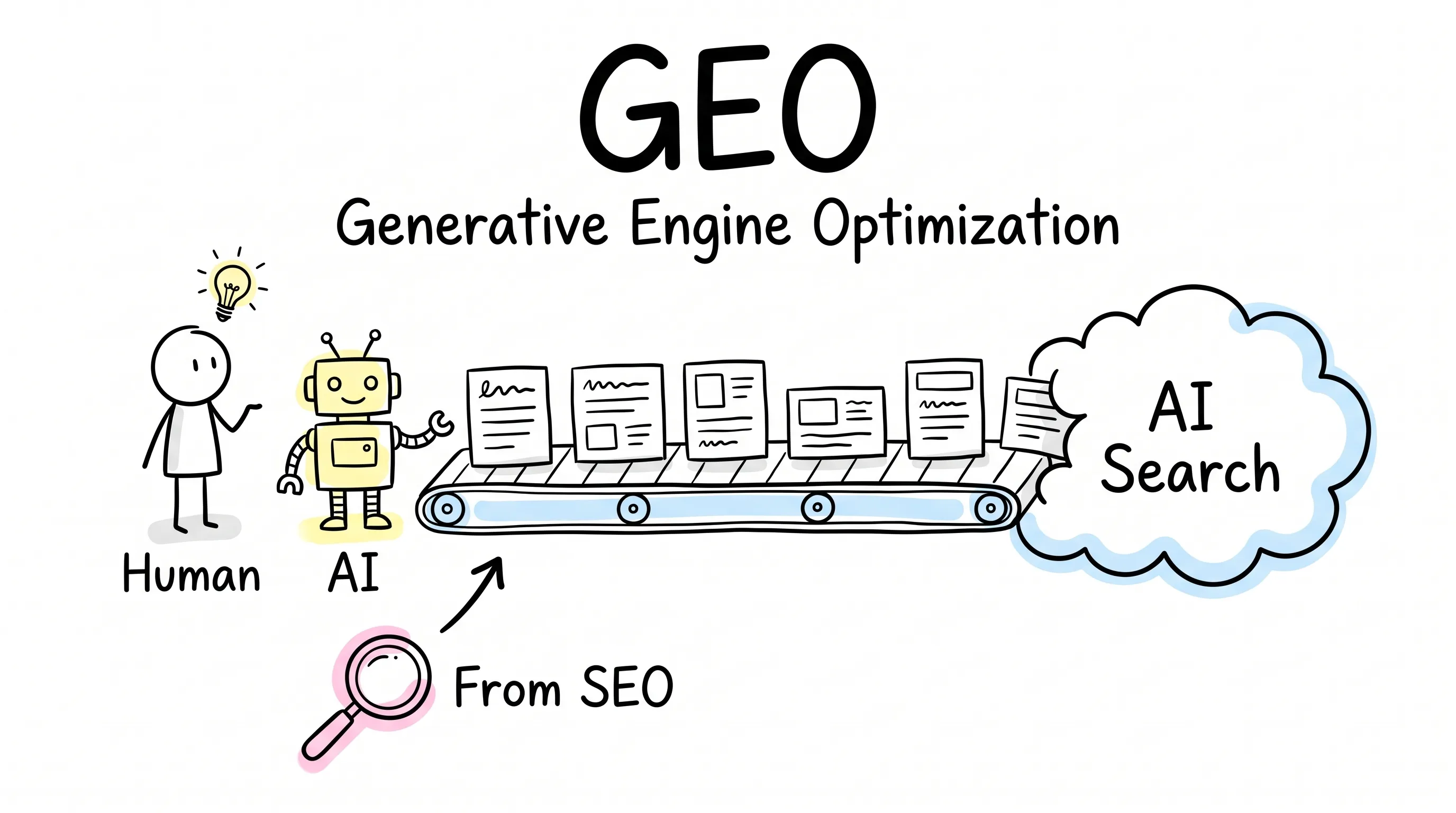
What Is GEO?
Put simply, GEO is this: use generative AI to generate and optimize content, so your content runs faster in search.
Traditional SEO is handcrafted. You research keywords, you write articles, you tweak titles, you swap backlinks. You polish every step of the process, one at a time.
GEO brings the machine onto the shop floor.
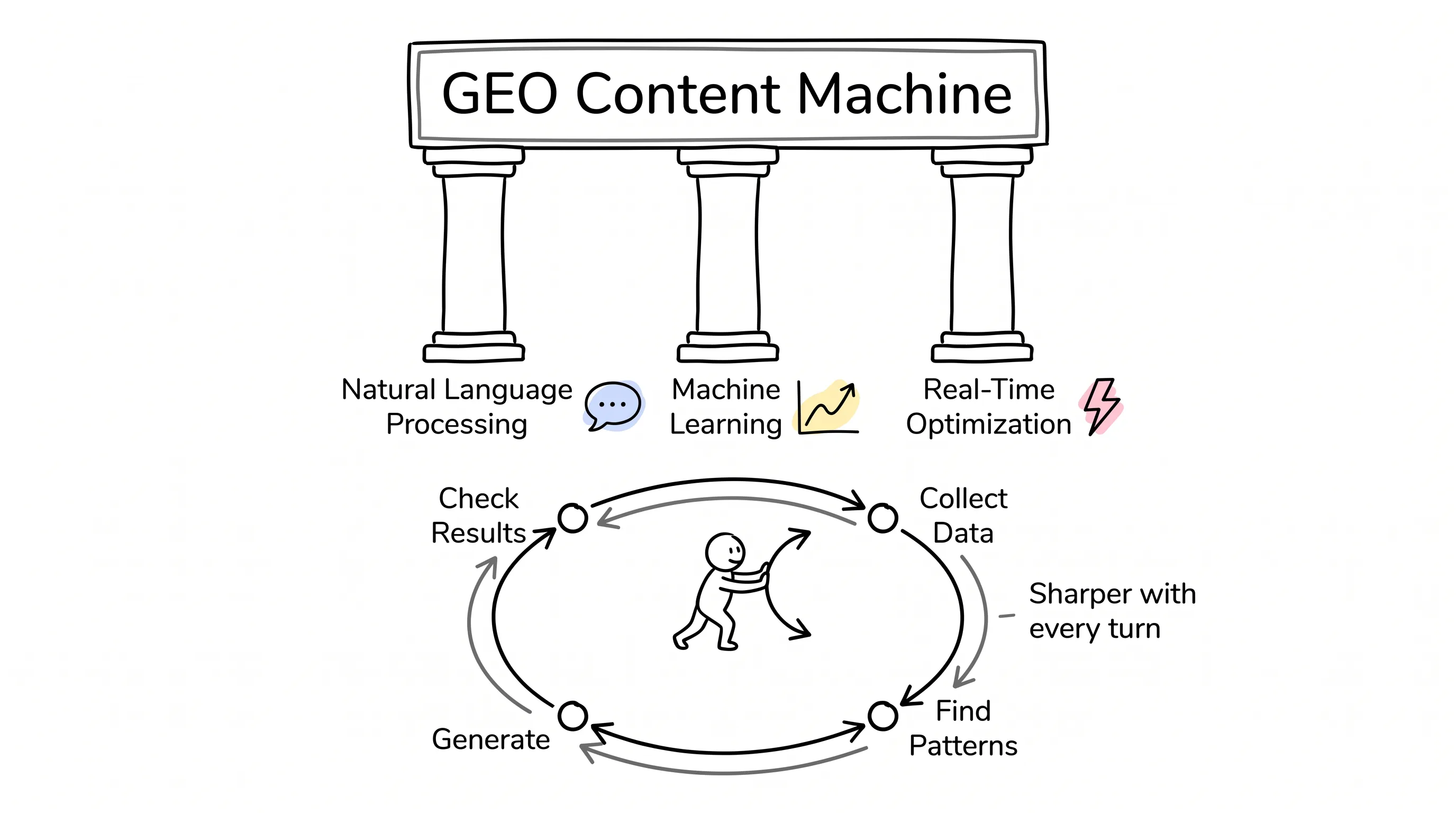
It stands on three pillars.
The first pillar is natural language processing. Machines that understand how people talk—and can talk back. That's the prerequisite for them to write content at all.
The second pillar is machine learning. After content goes out—did it perform well, do users love it—the data will tell the story. The machine takes that data and keeps tuning the next batch of content.
The third pillar is real-time optimization. Search trends shift, algorithms update, and content follows. No waiting. No dragging.
The three pillars together form a self-correcting content machine: collect data, find patterns, generate content, check results, adjust again. Round and round it goes, sharper with every turn.
But Don't Throw Out SEO Just Yet
I know what you're thinking right about now: are people doing SEO about to lose their jobs?
Quite the opposite.
GEO won't replace traditional SEO. It will only amplify the people who know how to use it.
Why do I say that?
For years now, search engines have rewarded one thing: Expertise, Authoritativeness, Trustworthiness. The industry calls it E-A-T. Whether what you write has real substance, whether you're a true insider, whether it holds up—search engines are watching all of it.
Machines can generate content in bulk, but they don't know which judgments are right in your industry, or which claims would mislead users. That judgment has to be fed into the machine by a human.
So the approach that actually works stands on two legs: humans provide the strategy, the judgment, the taste; machines provide the first drafts, the speed, the scale.
A craftsperson's brain. An assembly line's legs.
Speed Is the Other Edge
Traditional SEO has one defining trait: it's slow.
A week for keyword research, two weeks for content creation, another two for optimization. From kickoff to visible results, you're usually counting in months.
GEO? Real-time.
The moment a trend starts to surface, the machine catches it; the moment an algorithm changes, the content strategy pivots that same day. On the search track, speed itself is a competitive edge.
Think about it: the same hot topic. Others only follow up next month; your content is already ranking this week. What separates you is the playbook.
What This Means for Marketing
Zoom out, and GEO changes the way all of marketing operates.
Content can be made at scale by audience segment—a thousand users, a thousand versions. Ad campaigns can be tuned in real time—whichever copy performs, you pour more in on the spot. Trends can be anticipated ahead of time, instead of chased after the fact.
Let me run the numbers. Say your team can hand-write 5 solid pieces a week. Switch to machine drafts with humans doing the review and judgment, and you might push 50 pieces a day. That's 10 times the output. And the people you free up? They think strategy. They hunt topics. They wrestle with the questions machines can't wrap their heads around.
What you save isn't cost. It's time to think.
Of course, output alone doesn't settle the account. Conversion rate, engagement, ROI—in the end, the data has to speak. The tools changed; the standard didn't: content has to be genuinely useful to people. Sloppy work, no matter how fast you generate it, won't get you to value any faster.
Back to That Cup of Tea
When we finished, my friend asked me: so where do I start?
I said, start with the field where your judgment is sharpest. Pick the part of the business you understand better than any machine, let the machine do the prep work, and you run the kitchen. Get one small loop working end to end first, then scale it up.
Remember this:
Machines handle generation. Humans handle judgment. Cram both into one job, and you'll do neither well.
The search business is still running forward. Here's hoping you're running ahead of it—not chasing behind it.
Continue reading
Related articles

Cross-Border Business: Time to Upgrade Your AI Toolbox
A learn article explaining how AI tools help cross-border e-commerce sellers clear five hurdles: language, regulation, logistics, payments, and fraud. It outlines a five-compartment toolbox, a five-step adoption path, and metrics such as conversion rate and CLV, while cautioning against over-reliance on AI.

AI Is Taking Over the Dirty Work of Social Media Marketing, One Task at a Time
This learn article outlines four social media marketing tasks AI can handle — audience analytics, content drafting and design, ad targeting and creative testing, and spam moderation — and cautions that taste, judgment, and data security remain human responsibilities.

AI Is Already This Good — Why Is Your Social Media Marketing Still Pure Manpower?
An overview of 18 AI tools for social media marketing, organized into six categories covering audience research, content creation, scheduling, comment and DM handling, ad management, and visual production, plus notes on personalization, prediction, and emerging trends.