
What Is GEO? Stop Chasing Rankings. Start Chasing Citations.
An explainer on GEO (Generative Engine Optimization): how AI answers retrieve and cite content, why paragraph-level and topical coverage matter, and how citations build brand visibility in AI search.
A while back, a friend of mine who runs a cross-border e-commerce business invited me for tea. He sat down and his first sentence was: "Mr. Run, something bizarre is going on."
I asked, what happened?
He said, my site's keyword rankings have barely moved, indexing is normal, and we're still publishing content diligently — yet organic traffic has dropped by about a quarter. The team spent a month investigating and simply couldn't find anything wrong.
I asked him: have you asked AI?
He froze.
I opened ChatGPT and typed in how to choose the kind of product they mainly sell. The AI immediately served up a recommendation, mentioning a few brands by name along the way. His wasn't one of them. Not a single link.
I told him: this isn't a problem your team can diagnose. Your rankings didn't drop — what dropped is something else: when AI writes its answers, it doesn't play with you.
A user states a need, and AI serves the answer on the spot. Whoever gets mentioned in that answer gets seen. If you're not mentioned, you might as well not exist — even if you still rank on page one.
Later I dug into this properly and found it already has a name: GEO — Generative Engine Optimization. Once I understood how it worked, my reaction came down to two words: game changer.
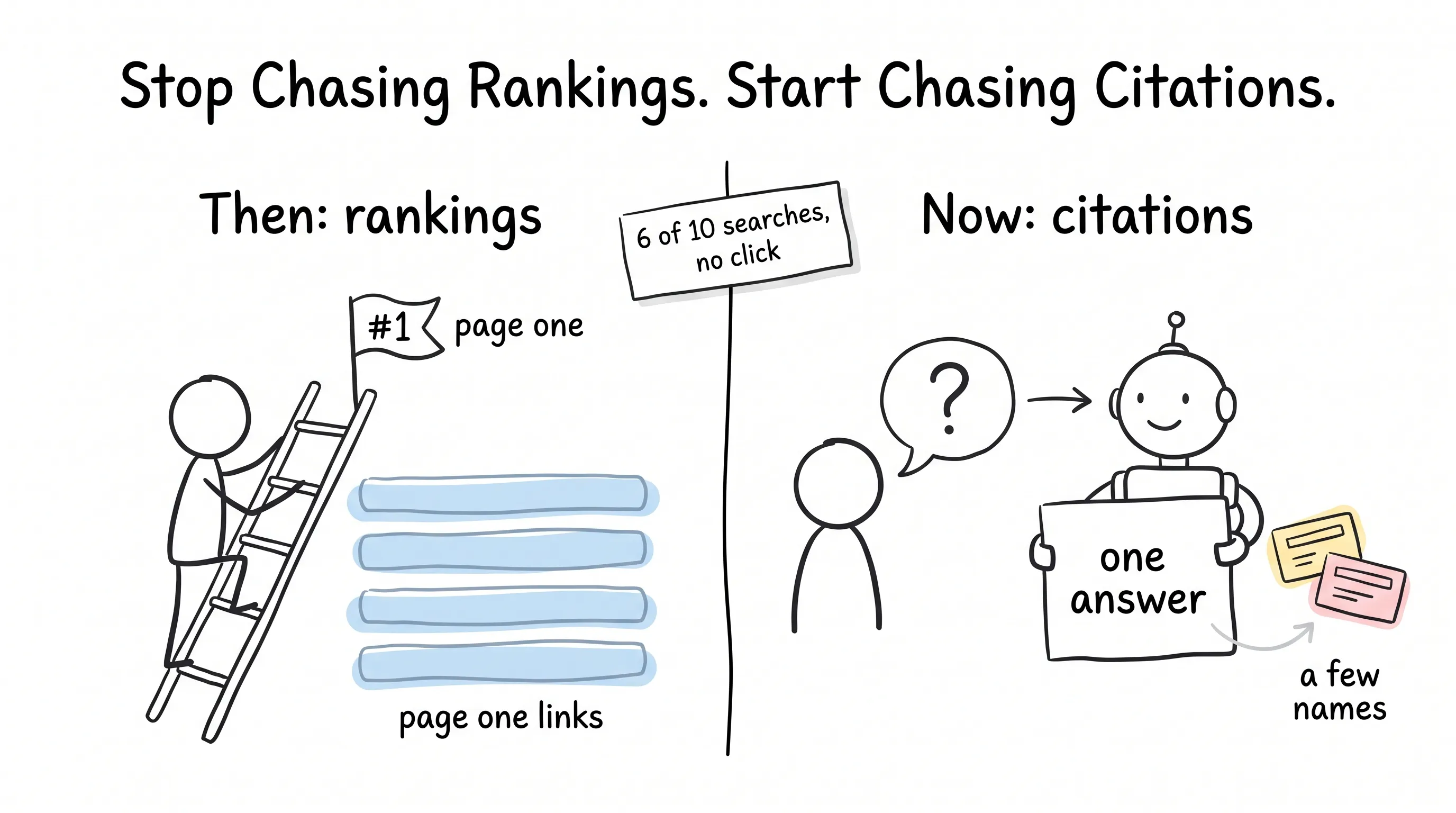
First, Some Numbers
I came across a set of data, and it's alarming.
On Google, six searches out of ten end with the user reading the AI summary (AI Overviews) and leaving without clicking a single link. An even sharper stat: nearly forty percent of people who use AI tools already go straight to ChatGPT and the like before buying, without even bothering to touch the search box.
What does that mean?
Your next customer is asking AI, not the search box. Whatever AI says you are, that's what you are.
So what do you do? Don't panic. To get picked, you first need to understand how AI does the picking.
How Does AI Do the Picking?
I went through several patents Google has made public, and they left me with a lot to think about.
One of them, patent number US11769017B1, describes how Google uses neural networks to retrieve web content, then lays that content underneath the AI-generated summary as its evidence base.
Notice this move: being the foundation underneath. AI's answers need evidence; where does the evidence come from? Fetched from the web. Fetched from whom? That's the key.
Search engines of the past graded "web pages": was keyword density enough, were there enough backlinks, could you squeeze into the top ten?
Now, Google's AI grades "paragraphs", even "entities" (distinct things a machine can identify — brands, products, concepts).
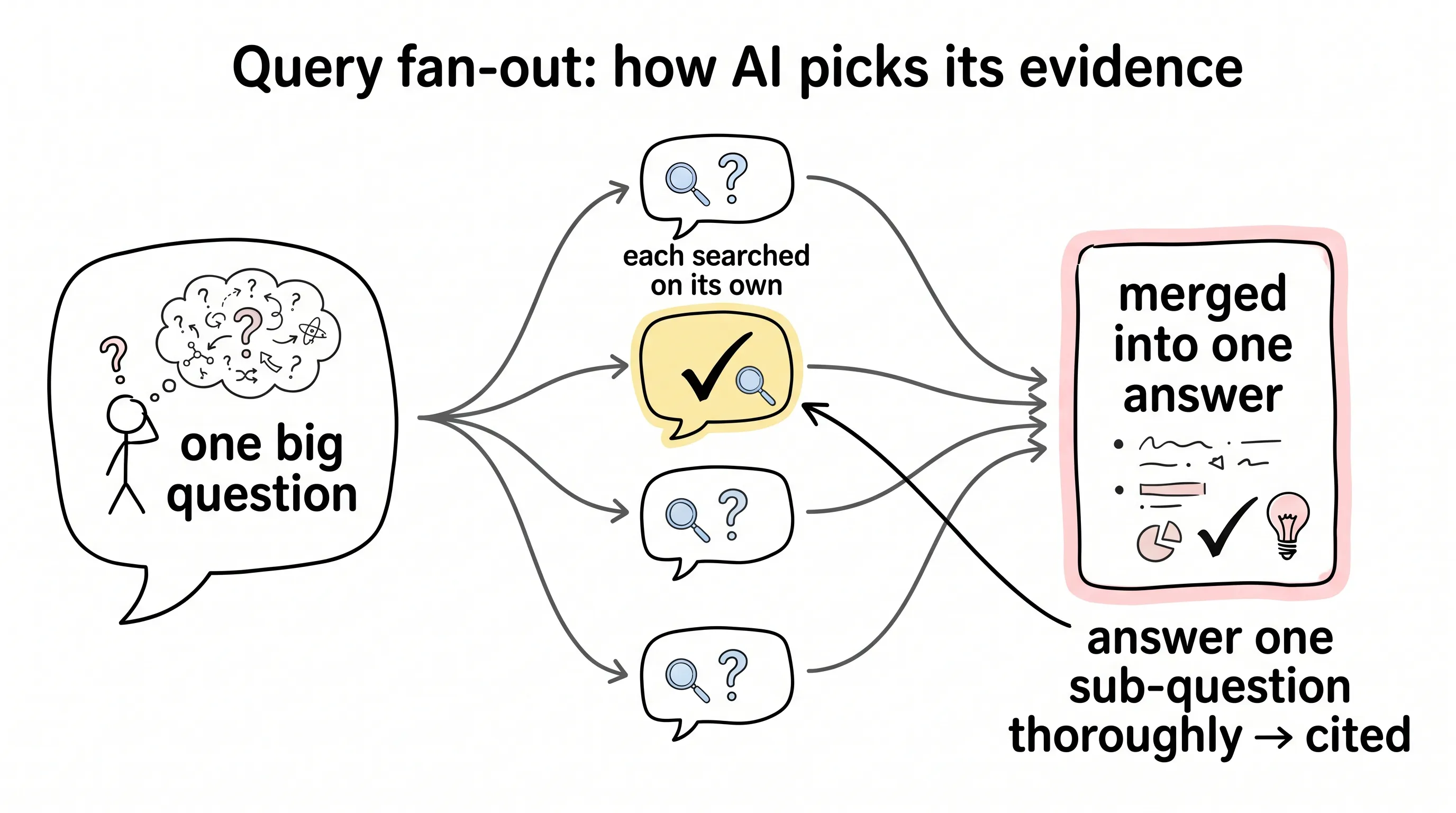
Another patent, WO2024064249A1, describes a particularly interesting mechanism called query fan-out.
What is query fan-out?
You ask AI a complex question, like "With a 500,000 RMB budget, should we buy a house first or a car first, considering interest rates and the kids' schooling." AI doesn't take your sentence and search it whole. It breaks the question into five or six small ones: where are interest rates headed? What is school-district policy? How much does keeping a car cost per year? Each small question gets its own independent round of searching, and in the end all the results are merged and written into a single paragraph.
Think about what this means.
It means your big, all-in-one article may not have claimed a single sub-question. But if one paragraph answers one small question especially thoroughly — say, clearly explaining "how the interest rate is calculated at this step" — you have a chance of getting picked in that round of retrieval.
Before, you competed on the total score; now you compete on individual subjects.
This leads to a practice called paragraph-level optimization.
What is paragraph-level optimization? Every paragraph of yours must be able to stand on its own. Pull it out on its own, hand it to someone who has never read the full text, and it can still serve directly as an answer.
Straightforward titles, clean language, use a table when possible instead of taking detours, use a list instead of stacking long sentences. One paragraph, one thing.
Google's way of judging "whether this paragraph is useful" is equally blunt: it computes similarity. Your content and the answer it intends to generate are placed in the same semantic space (a shared mathematical space where meaning can be measured) and compared; the closer you are, the more likely you get selected.
Flip this logic around and you have a ruler. Take your content and measure its similarity against AI-generated answers — how big the gap is becomes obvious at a glance. It's like holding the reference answer and working backwards to what yours should look like.
What Counts as Authority? Covering It All
One level up, this becomes a whole-site matter.
Before AI synthesizes an answer, it first has to judge: who deserves to be the expert on this topic. Its way of judging is not to listen to you say "we're professionals," but to look at how completely you explain the subject.
What would users ask — how many of those questions have you covered? Related concepts — did you mention them? Are structure and hierarchy clear? Pieced together, this is what authority looks like in AI's eyes.
So there's a fundamental drill: comb through your whole site's content by topic and see which part of your knowledge map is missing in AI's eyes. The missing part is exactly the part where you're invisible.
The Old Craft Is Still the Entry Ticket
Some people hear "AI search" and conclude traditional SEO is obsolete. Quite the opposite.
AI's answers need evidence, and evidence comes from the web. The precondition for being fetched is being findable: pages indexed normally, schema markup written clearly, a sitemap with no missing pages, internal links not tangled into a ball of yarn.
There's an even plainer fact: AI loves citing content that already ranks highly. Ranking is still the entry ticket.
And this logic isn't Google's alone. ChatGPT, Microsoft Copilot — same principle: retrieve first, then synthesize. If your content doesn't make it into the retrieval round, everything afterward has nothing to do with you.
Citations Are Built Up
One last thing, and it's the easiest to overlook.
Before writing an answer, AI first has to decide whom to trust. How? To a large extent, by how many times you get mentioned in authoritative sources. Organizations have studied specifically which factors decide whether a brand makes it into AI summaries, and one of the strongest predictors is citation frequency.
So the old craft of digital PR has a new assignment: on the authoritative sources AI loves to cite, get your brand mentioned again and again.
This isn't gaming the system; it's building credit. Build up enough, and when AI writes its answers, it will naturally think of you.
Back to That Friend
My friend later reworked things along these lines: on-site content reorganized around sub-questions, every paragraph rewritten so it stands on its own as an answer, structured data filled in, plus a round of exposure in industry media.
Three months later, he sent me a message: "Mr. Run, one of our products just got name-checked by ChatGPT."
The product hadn't changed, the price hadn't moved. They had simply finally learned to say things clearly in words AI can understand.
The endgame of search probably looks like this: one question, one answer. Behind the answer, a few names.
The era of chasing rankings was a contest over who ranked higher.
The era of chasing citations is a contest over who gets remembered.
May your brand always be in the answer.
Continue reading
Related articles

Cross-Border Business: Time to Upgrade Your AI Toolbox
A learn article explaining how AI tools help cross-border e-commerce sellers clear five hurdles: language, regulation, logistics, payments, and fraud. It outlines a five-compartment toolbox, a five-step adoption path, and metrics such as conversion rate and CLV, while cautioning against over-reliance on AI.

AI Is Taking Over the Dirty Work of Social Media Marketing, One Task at a Time
This learn article outlines four social media marketing tasks AI can handle — audience analytics, content drafting and design, ad targeting and creative testing, and spam moderation — and cautions that taste, judgment, and data security remain human responsibilities.

AI Is Already This Good — Why Is Your Social Media Marketing Still Pure Manpower?
An overview of 18 AI tools for social media marketing, organized into six categories covering audience research, content creation, scheduling, comment and DM handling, ad management, and visual production, plus notes on personalization, prediction, and emerging trends.