
What Is GEO? Search Is Moving House, and Your Back-Catalog Articles Need to Move Along With It
An explainer on GEO (Generative Engine Optimization): how AI answers are shifting traffic away from traditional search rankings, how GEO differs from SEO, and four steps to refresh back-catalog articles so AI engines can cite them.
A few days ago, I was lurking in a webmaster group when someone dropped a screenshot from their site's backend dashboard.
A ten-year-old site. Not a single article deleted, not one backlink lost — yet from some point in time, the organic traffic curve had started sliding downhill at a steady slant.
The group blew up. Some said the algorithm had updated again. Some said pivot to short video, fast. One put it even more bluntly: quit building sites — the times have changed.
I stared at that chart for a while, and it suddenly struck me: every one of these diagnoses might be prescribing the wrong medicine.
The illness isn't in the site. It's that the people with questions are now asking them somewhere else.
It used to be: a user had a question, and the first instinct was to open a search box and pick an answer from a row of links. Now? They just ask the AI. ChatGPT, Google's Gemini, Perplexity — you ask one question, and it hands you a ready-made answer. You don't even bother clicking a link.
The users haven't disappeared. The traffic simply moved — into AI's answers.
What Is GEO?
The industry has given this shift a name: GEO — Generative Engine Optimization.
So what is generative engine optimization?
Put plainly: it's a full set of practices for tidying up the content on your site until AI wants to read it, can understand it, and is willing to write it into its own answers.
You might say: isn't that just SEO?
Close. But one critical move is missing.
What SEO does is push your web pages into the front rows of search results, then wait for users to click through. What GEO does is get your content to appear directly inside the body of AI's answer. The user doesn't click a single link — and they're already "using" you.
Here's an analogy. Doing SEO used to mean opening a shop inside a mall, then fighting for the best storefront on the ground floor and waiting for foot traffic to stroll past the door. Today, plenty of customers don't browse anymore. They walk in, grab a sales associate, and ask: what should I buy? The associate answers on the spot — and whichever shop's goods get a mention in that answer, that shop gets the business.
That sales associate is the generative engine.
Who the associate recommends has nothing to do with storefront placement — only with whether your goods are good, and whether you've said it clearly.
GEO vs. SEO: Where Exactly Do They Differ?
A search-industry veteran with more than twenty years in the field once offered a phrase for all these new acronyms that I find spot-on: search everywhere optimization. If search is everywhere, you have to optimize everywhere.
People had floated that line for years; it never caught on. Why? Because for the past two or three decades, ninety percent of all searches ran through one company: Google. Serve Google well, and you had served "everywhere."
Not anymore. The places people ask have truly scattered — and the phrase has finally landed.
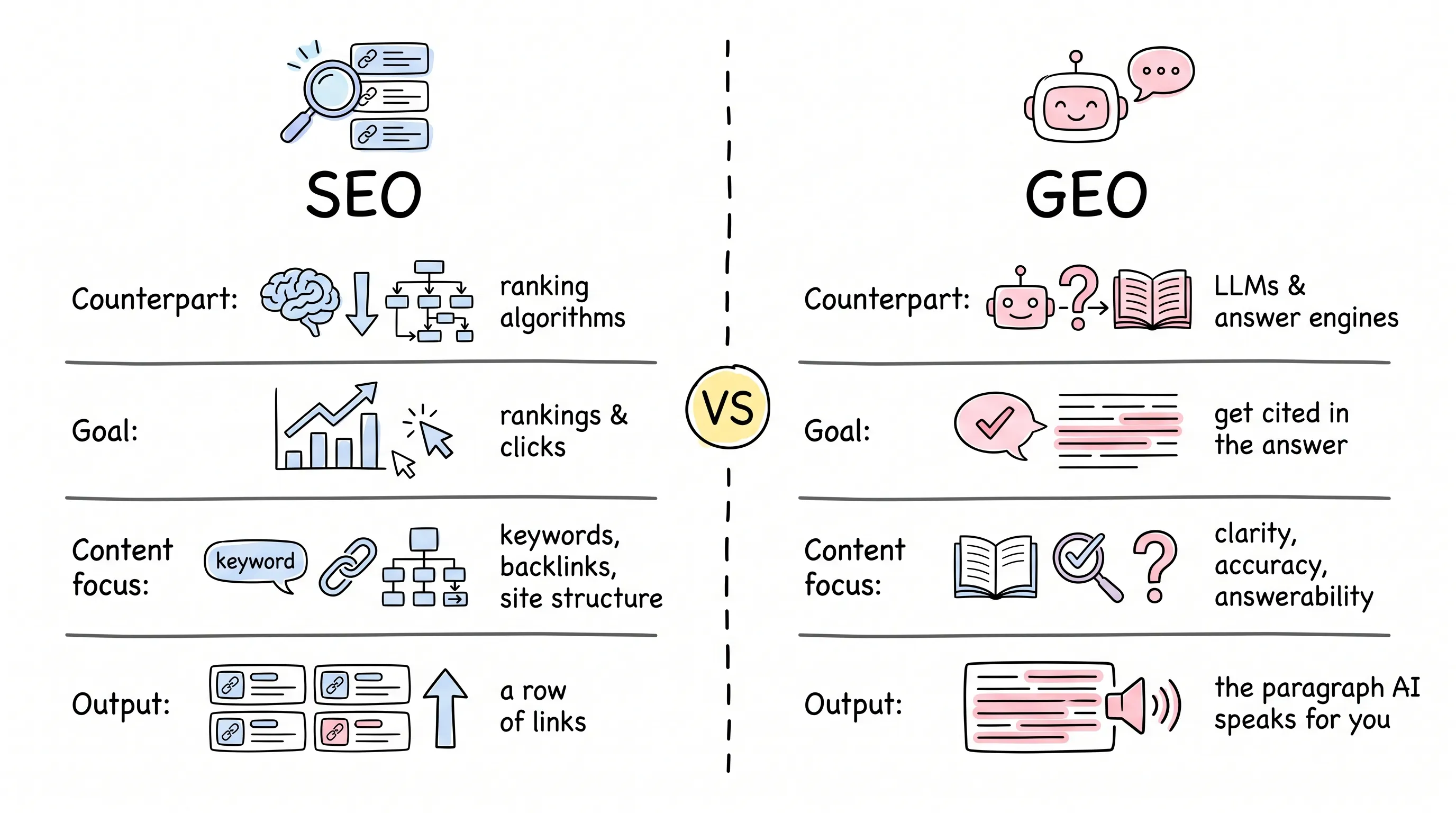
Where exactly do they differ? I'd sort it into four points:
- Different counterpart. SEO deals with ranking algorithms; GEO deals with large language models and answer engines.
- Different goal. SEO wants rankings and clicks; GEO wants to be cited — wants the AI to restate your words, and restate them well.
- Different content focus. SEO is about keywords, backlinks, site structure; GEO is about clarity, accuracy, and the ability to answer directly. AI picks content the way a teacher picks exam papers — the one with neat handwriting and complete workings gets chosen first.
- Different output. The result of SEO is a row of links; the result of GEO is the paragraph the AI speaks on your behalf.
But note this: GEO is not here to replace SEO. Search engines themselves are bolting on AI features — that's exactly how Google's AI Overview came about. These two crafts are only going to get more entangled.
Keep doing rankings — that's your foundation. Start banking AI citations now — that's your upside.
Why Older Articles Actually Have a Chance
Back to the guy in the group. What pained him most was the 400-plus articles his site had stacked up over ten years.
The old logic was brutal: squeeze into the front rows, or get no traffic. And so a whole batch of good content got buried at the bottom of the trunk.
Now, here's a number worth remembering. One study tallied where Google AI Overview pulls its citations from: 57% of citations come from pages outside the top ten organic results.
The first time I saw that number, I froze for a second.
Think about what that means.
It means that in the AI's eyes, a top-ten ranking is no longer the ticket in. It doesn't care where you once stood — only what the content itself is: is it clearly said, and does it answer cleanly?
That batch of old articles buried at the bottom of the trunk suddenly has a second shot at the shelf.
How to move them? My advice to him came in four steps:
- Answer first. An article about "what is X" should finish delivering the answer in its first paragraph, then unfold slowly.
- Say it plainly. Break long sentences into short ones, translate jargon into plain words on the spot, and give each paragraph one job only.
- Label your data. Years, numbers, sources — written out in plain sight. AI loves paragraphs it can lift and use as-is.
- One article answers one real question. Don't get greedy.
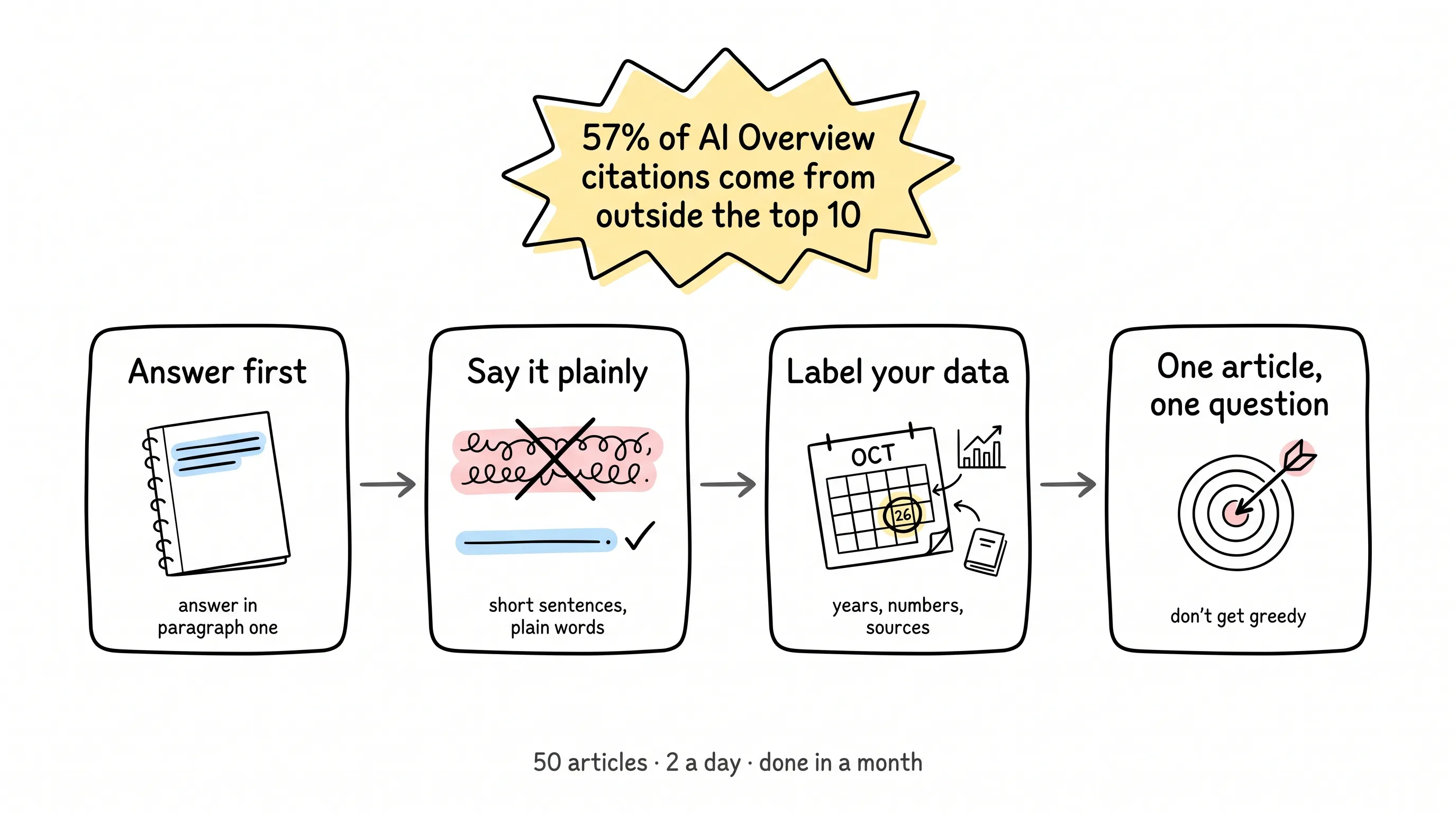
And let me do the math for you. 400 articles — don't dream of reworking them all in one go. Pick the fifty most valuable first and rework them through these four steps. Two a day, done in a month. However you run the numbers, it pays off.
GEO and AEO: Don't Spend Energy Telling Acronyms Apart
Lately you may have run into another term: AEO — Answer Engine Optimization. Going forward, expect new acronyms to keep popping up.
So which one is the real orthodoxy?
My take: don't agonize. It's like asking what the difference is between optimizing for Google and optimizing for Bing. Are there fine distinctions? Sure. But the substance is one and the same: making AI think your content is worth using.
Every move you make for AEO is groundwork for GEO — and the reverse holds too.
The acronyms will keep multiplying, but there's only one exam question: make your content clear, and make it accurate.
Finally, Back to That Group
Oh, right — the guy who posted the screenshot popped back up in the group later.
He said he'd picked fifty articles, reworked them through those four steps, and added a "one-sentence answer" at the top of each.
Last week, he sent over a second screenshot. This time it wasn't a traffic curve — it was a customer inquiry. The client said they'd seen their company in an AI's answer and tracked it down by name.
The group went quiet for a few seconds. Then someone replied: so the traffic that moved out — it can be won back.
Search is moving house. The old shelves will shake — but good goods always find buyers.
May all your old articles catch fire one more time — inside the new engines.
Continue reading
Related articles

Cross-Border Business: Time to Upgrade Your AI Toolbox
A learn article explaining how AI tools help cross-border e-commerce sellers clear five hurdles: language, regulation, logistics, payments, and fraud. It outlines a five-compartment toolbox, a five-step adoption path, and metrics such as conversion rate and CLV, while cautioning against over-reliance on AI.

AI Is Taking Over the Dirty Work of Social Media Marketing, One Task at a Time
This learn article outlines four social media marketing tasks AI can handle — audience analytics, content drafting and design, ad targeting and creative testing, and spam moderation — and cautions that taste, judgment, and data security remain human responsibilities.

AI Is Already This Good — Why Is Your Social Media Marketing Still Pure Manpower?
An overview of 18 AI tools for social media marketing, organized into six categories covering audience research, content creation, scheduling, comment and DM handling, ad management, and visual production, plus notes on personalization, prediction, and emerging trends.