
What Is GEO? It Started With My Broken Air Conditioner
An explainer on GEO (Generative Engine Optimization), using a personal AC-repair story to show how AI assistants choose which businesses to recommend. It covers trust signals, content tactics, third-party mentions, and simple ways to track brand visibility in AI answers.
Last month, my air conditioner broke.
It was 38 degrees outside, and the apartment felt like an oven. In the past, my move would have been automatic: open a search box, type "AC repair," then sift through a dozen results trying to tell which ones were ads and which ones actually fixed air conditioners.
This time I didn't. I opened an AI assistant and asked one question: given my situation, which repair company can I trust?
A few seconds later, it gave me a name, plus two reasons: good reviews, close by.
I took a look and booked it.
The AC got fixed. But the episode stuck in my head for a long time. Because I suddenly realized something: why did that company get recommended?
What did it do right? And here's the uncomfortable part — if it had done nothing right, I might never have known the company existed.
Today, I want to talk about this. It has a name: GEO.
What Is GEO?
GEO — Generative Engine Optimization.
What is a generative engine? ChatGPT, Gemini, Perplexity — the tools where you don't type in keywords, you just ask a question. Those are generative engines.
So what is GEO?
Put simply: it's making your business the answer that AI says out loud.
You might ask: isn't that just SEO?
It's not.
What is SEO? You fight for a position on the search results page. Out of ten blue links, you squeeze into the top three — ideally number one — and the clicks follow.
But now, users have stopped picking. Whichever company the AI says is reliable, that's the one they book.
In the search era, the contest is who gets found. In the AI era, the contest is who gets believed.
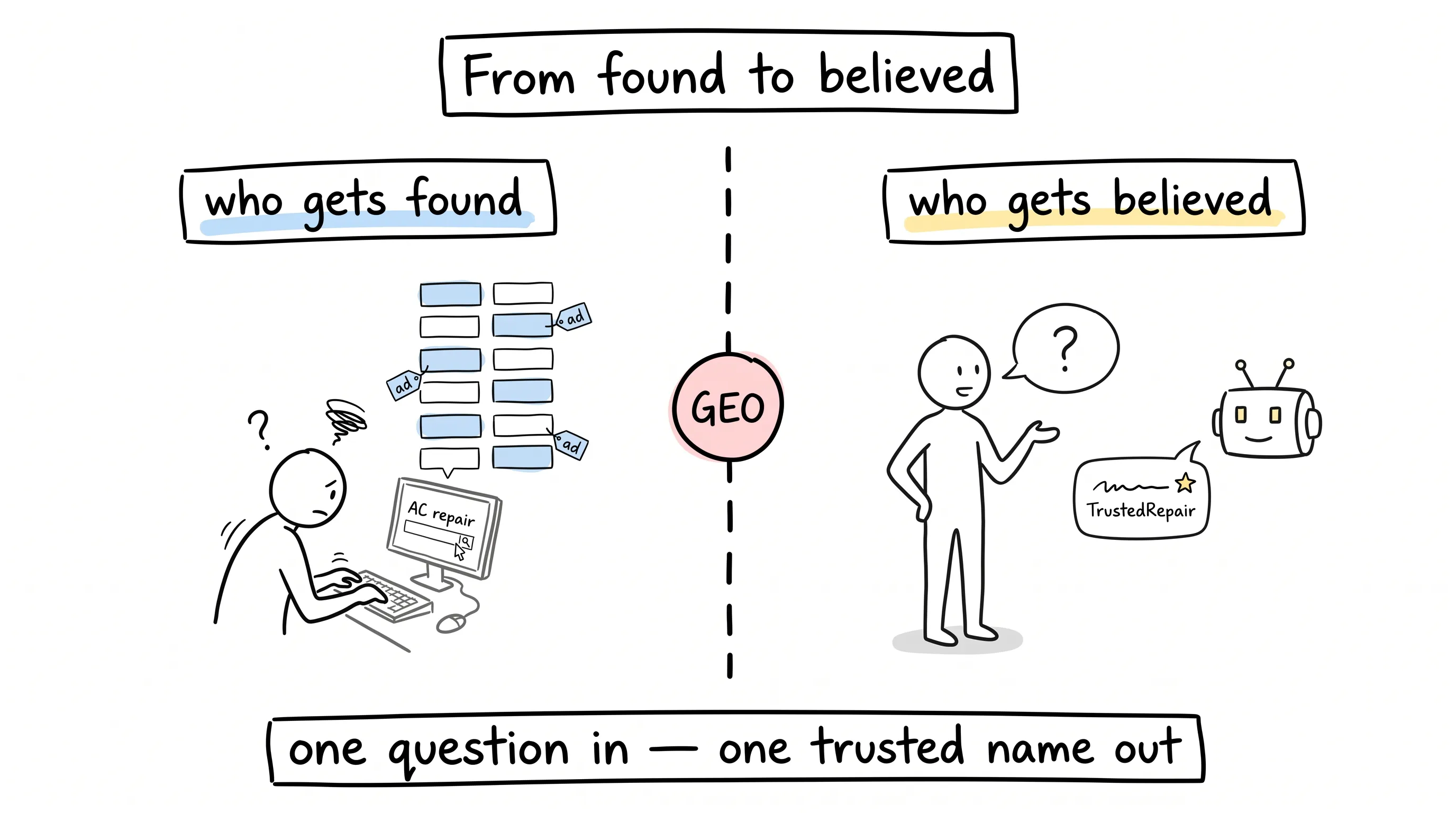
Does ranking still matter? Yes. But it's the foundation now, not the finish line. Google itself has said that optimizing for its AI features is, at its core, still SEO. So don't tear down what you've built — GEO is the second floor you build on top of SEO.
Why Does AI Recommend You?
That's the key question.
A lot of people assume the names AI spits out are random, or even pay-to-play. Plenty of people really believe this.
They're wrong.
Think of the AI as an extremely cautious headhunter. Ask him to recommend a repair company — would he dare answer off the top of his head? He wouldn't. He'd do his homework: who's at the top of this industry? Has anyone vouched for them? Does what they publish hold up?
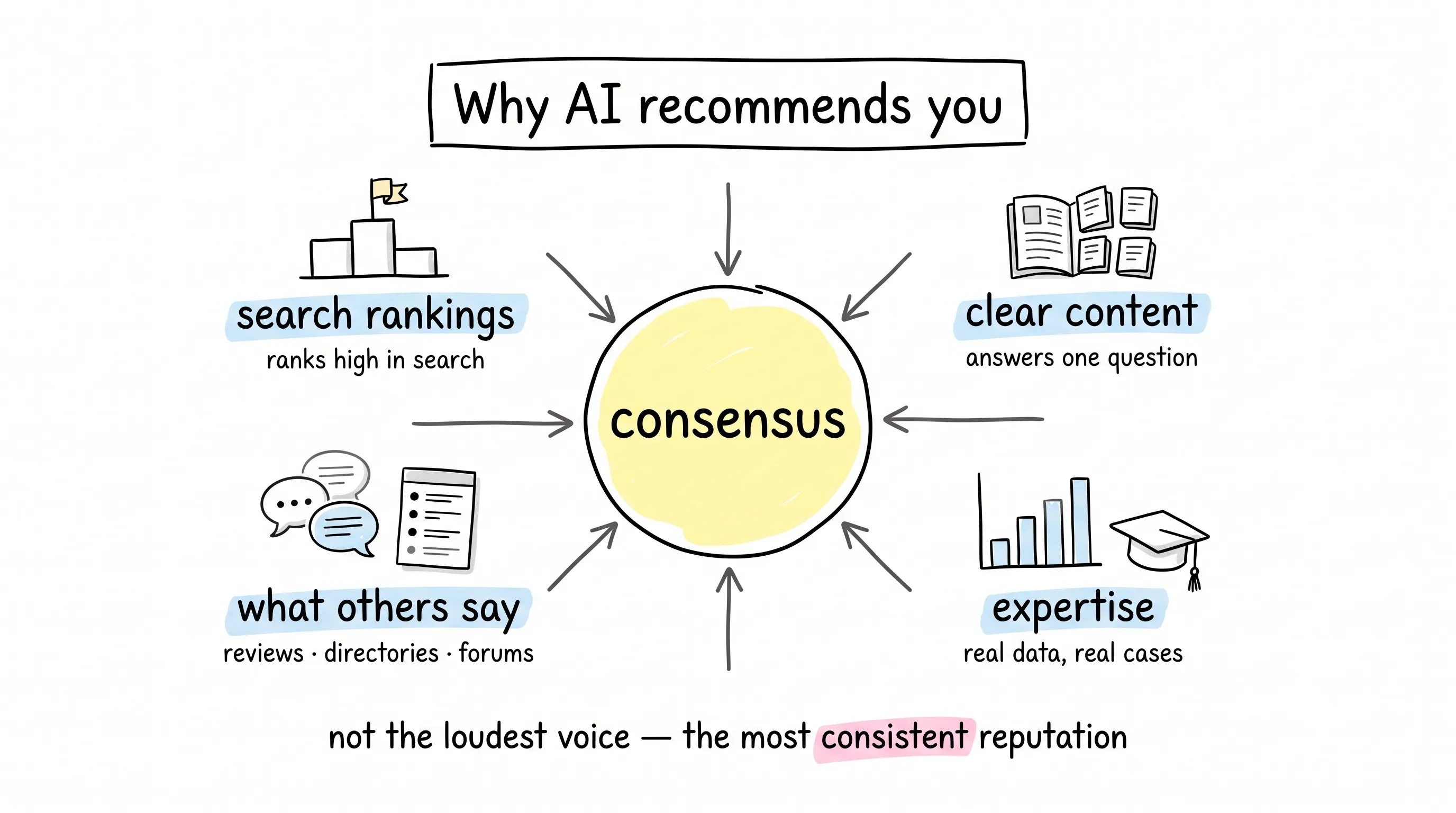
The AI does exactly the same thing. It weighs four things:
First, your existing search rankings. A large share of the content AI cites already ranks high in traditional search.
Second, how clear your content is. AI consumes content in chunks. If your page can thoroughly answer one question, the AI is confident enough to cite it directly.
Third, what others say about you. Industry directories, review sites, media coverage, forums like Reddit. These third-party mentions are how the AI judges whether "this company actually has customers."
Fourth, your expertise. Does your content contain real details, data, case studies? Slogan-heavy marketing copy gets skipped at a glance.
When all four line up, one word appears: consensus. Only when your name shows up repeatedly in places the AI trusts does it have enough confidence to say you out loud.
What AI recommends is never the loudest voice — it's the most consistent reputation.
How Do You Write So AI Will Cite You?
"Consensus" is still a bit abstract. Is there anything more concrete?
There is. Researchers at Princeton University ran an experiment: they designed nine different ways of writing content, then tested them against roughly ten thousand queries to see what kind of content AI prefers to cite.
The three tactics with the biggest lift: cite sources, add data, include quotes. With these, brands gained about 30% to 40% more visibility in AI answers than unoptimized content.
Thirty to forty percent. In the world of marketing, that's a number you don't think twice about.
In plain terms:
When you write, write less "we're the industry leader" and more "we tested 200 units; average lifespan, 8 years." Don't be afraid to commit to specifics. AI likes definite, verifiable details nobody else has said.
Make every section stand on its own. Because AI takes content away in chunks, and if every chunk can hold up on its own, your odds of being cited go up.
One more thing that's easy to miss: stay fresh. For the same question, an old guide with a date on it loses to one that was just updated. Content expires.
Any Shortcuts? Let's Talk About What Doesn't Work
Having covered what works, we should cover what doesn't — otherwise you'll spend your effort in the wrong place.
Lately there's been a flood of "AI optimization tricks" going around, like adding an llms.txt file to your website, or special machine markers.
Does it cost money? Yes. Is it a hassle? Yes.
Does it work?
Google says it plainly: its search doesn't use these things. Without llms.txt, you can still show up in its AI features.
So my advice: don't touch it. Spend the time on a clean site structure, fast loading, pages that open well on a phone. This unglamorous homework beats any secret trick.
There's a bigger blind spot, though: third-party mentions.
I said earlier that AI weighs heavily "what others say about you." But most companies only ever work on their own website, and never ask: am I in the industry directories? Are my reviews good enough on the review sites? Do those "top 10 local" lists everyone reads have my name on them?
AI has read enormous numbers of directories, reviews, and forums. If you don't appear there, you don't exist in the AI's world.
Back to My Air Conditioner
By now you can probably guess what that repair company did right.
Later I went and looked. What they'd done was so plain it was almost boring: the page states clearly which brands they repair, which areas they serve, and how the call-out fee works. Their name, address, and phone number are identical, word for word, across their website, maps, and every directory. The reviews are real reviews — with details, and replies.
No fancy moves. But every single item lands exactly on the signals AI uses to judge "trustworthy."
If you run a local business — repair, renovation, housekeeping, cleaning — this is actually good news. Because for local businesses, the trust signals are very concrete: who you are, where you are, what you fix, and how others rate you. Get those four things written clearly and kept consistent, and you've already beaten most of your competitors whose pages are a mess.
And you don't need to build a separate play for ChatGPT, Gemini, Claude, and Grok. Not at the start. What all of them reward is identical: clear structure, truthful content, solid third-party reputation. Lay the foundation first; fine-tune later.
How Do You Know If AI Recommends You?
Business owners often ask me: how do you measure this?
Traditional analytics tools can't see the whole picture — which is exactly most people's blind spot.
Watch three numbers. Your citation rate: how often AI cites your pages in its answers. Your mention rate: take a set of questions real customers would actually ask, ask the AI, and count how many times your brand appears. Your share of voice: for the same questions, is your name dropped more or less often than your competitors'?
The simplest starting move doesn't require any tools at all: take the 10 questions customers ask most often, put them to ChatGPT, to Gemini, to Perplexity, and see who gets named. Do it once a month, write it down, watch the trend.
This is the exam of the AI era. You write the questions, and you proctor it yourself.
How Long Until It Works?
Don't expect results in two weeks. Seriously: plan for 3 to 6 months of consistent effort before you see clear change.
Sounds slow?
But this thing has a wonderful property: compounding. A page you optimize today is still being cited six months from now. This month's effort doesn't reset to zero next month — it stacks, layer on layer. Just like SEO: slow at first, steep later.
Some worry: if AI just hands over the answer and users stop clicking links, doesn't my traffic disappear?
It will drop. But think about it: a customer who found you after being educated by an AI, versus one who wandered in by chance — which one wants to buy?
The former is a qualified prospect; the latter is just traffic. Before you've even spoken to him, he already knows who you are and what you do. What you save is the most expensive part: explaining.
Starting Today, Do One Thing
If this article leaves you with just one action, it's this:
Pick your few most profitable pages and rewrite them. Open with the questions customers ask in their own words, give the answer in the first line, then put the data, the evidence, and the case studies below, and spell out your services and service areas plainly. Then go to the industry directories and review sites and fill in your information, entry by entry.
That's it — two things. Done, and you're already ahead of the vast majority of your competitors.
Last month, my air conditioner broke, and AI gave me a name.
Next month, your neighbor's air conditioner breaks, and he asks the same question.
Will AI happen to say your name?
That depends on whether, starting today, you do those two things.
Here's to becoming the name AI keeps recommending.
Continue reading
Related articles

Cross-Border Business: Time to Upgrade Your AI Toolbox
A learn article explaining how AI tools help cross-border e-commerce sellers clear five hurdles: language, regulation, logistics, payments, and fraud. It outlines a five-compartment toolbox, a five-step adoption path, and metrics such as conversion rate and CLV, while cautioning against over-reliance on AI.

AI Is Taking Over the Dirty Work of Social Media Marketing, One Task at a Time
This learn article outlines four social media marketing tasks AI can handle — audience analytics, content drafting and design, ad targeting and creative testing, and spam moderation — and cautions that taste, judgment, and data security remain human responsibilities.

AI Is Already This Good — Why Is Your Social Media Marketing Still Pure Manpower?
An overview of 18 AI tools for social media marketing, organized into six categories covering audience research, content creation, scheduling, comment and DM handling, ad management, and visual production, plus notes on personalization, prediction, and emerging trends.