
What Is GEO, and Why Is It the Next Battleground for Search Marketing?
An explainer on GEO (Generative Engine Optimization): how AI-generated answers change search visibility, why citations now matter alongside rankings, and four principles for making content easier for AI to understand and trust.
A while back, I asked my assistant to find me a few vendors specializing in data compliance.
He never opened a browser. Never typed a keyword. Never scrolled to page two. What he opened was an AI chat window. Three minutes later, a shortlist — with reasons for each recommendation — landed on my desk.
I asked, where did this come from?
He said, the AI gave it to me.
Honestly, I froze for a second.
Then it hit me: search has quietly changed the game.
Today, I want to talk to you about this new game. It has a name: GEO.
What Is GEO?
GEO stands for Generative Engine Optimization.
Put simply: it used to be that you figured out how to get your web page to the top of the search results. Now, what you should be figuring out is how to get AI willing to mention you and cite you in its answers.
The old search engines handed you a pile of links, and you picked through them yourself.
Generative search today just hands you an answer — conclusion included. That's how ChatGPT works, and Google's AI Overviews too.
Think about what that means.
It means users may never click a link at all. One question, one answer, task done.
So here's the question: is your brand inside that answer?
If yes, the AI is saying it for you. If no, the deal never had anything to do with you, from start to finish.
It Used to Be About Fighting for Shelf Space. Now It's About Being in the Sales Pitch.
What's the real difference between these two games? Here's an analogy.
Search used to be a supermarket. Doing SEO meant getting your product onto the most visible shelf: picking the right keywords was like securing a good stall; stacking up backlinks was like stocking your stall with proof you're a legitimate supplier; building up domain authority was like claiming the brand end-cap display. Consumers pushed their carts over and helped themselves.
Now, search is a sales associate who really knows the trade. Consumers no longer browse the shelves themselves. They walk up and ask: I have this problem — what would you recommend?
And the associate answers on the spot.
However beautiful your shelf display, if the associate's pitch doesn't include you, you simply don't exist.
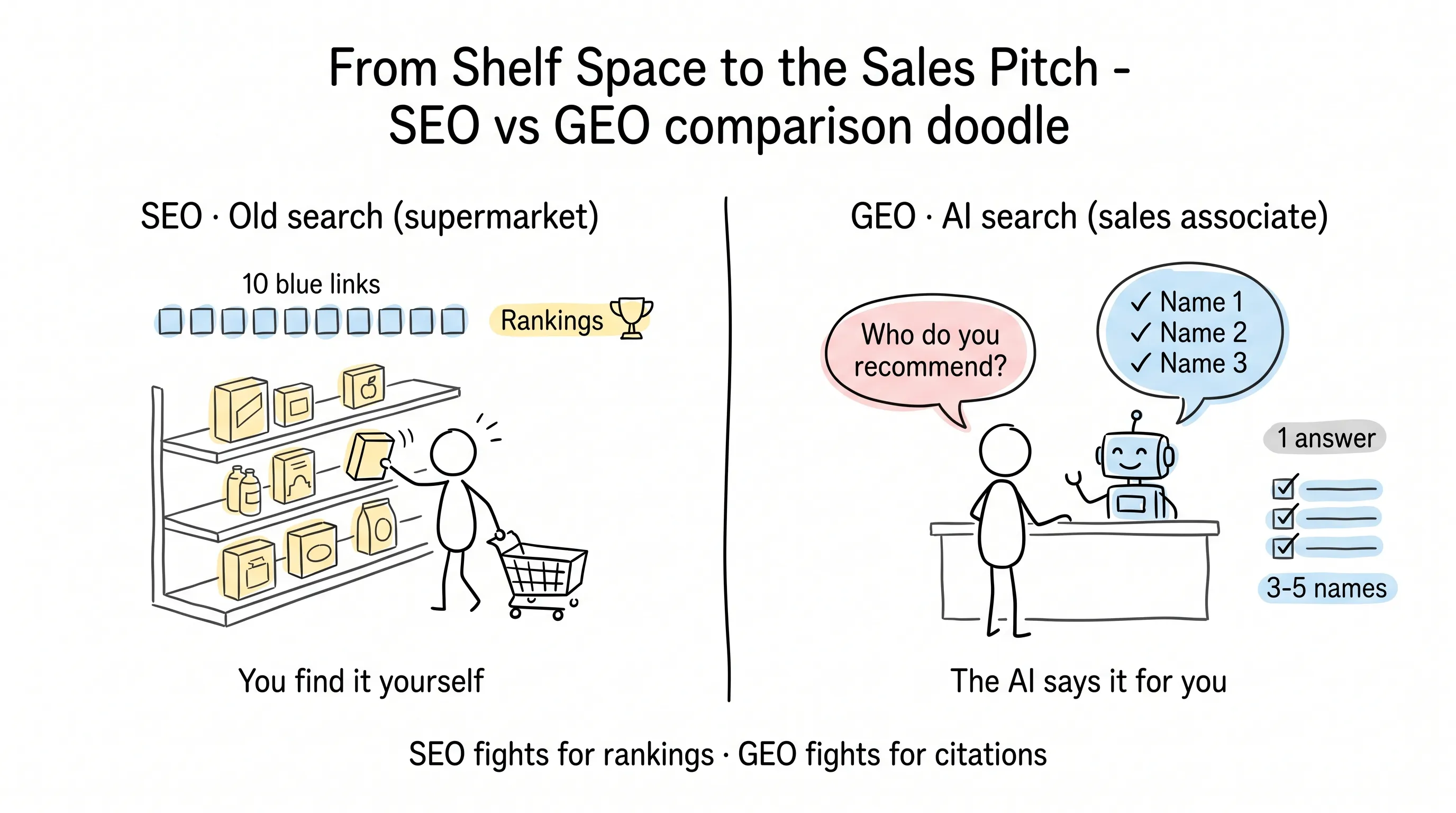
SEO fights for rankings. GEO fights for citations.
One gets the user to find you; the other gets the AI to speak for you. These are two entirely different ballgames.
Why You Need to Move Now
Some say AI search is just getting started — no rush.
I'd advise against that thinking.
Once user behavior changes, it rarely changes back. People who are in the habit of asking AI won't patiently dig through ten blue links again. And every question they ask is the beginning of a decision.
There was a time when the search results page had ten spots, and even ranking eighth meant you were seen.
Now, an AI's answer may only mention three to five names.
The traffic game has flipped: it used to be a "ranking game." Now it's a "list game."
If you're not on the list, it doesn't matter how pretty the positions behind it look — you're invisible.
So how do you get on the list?
GEO in Four Sentences
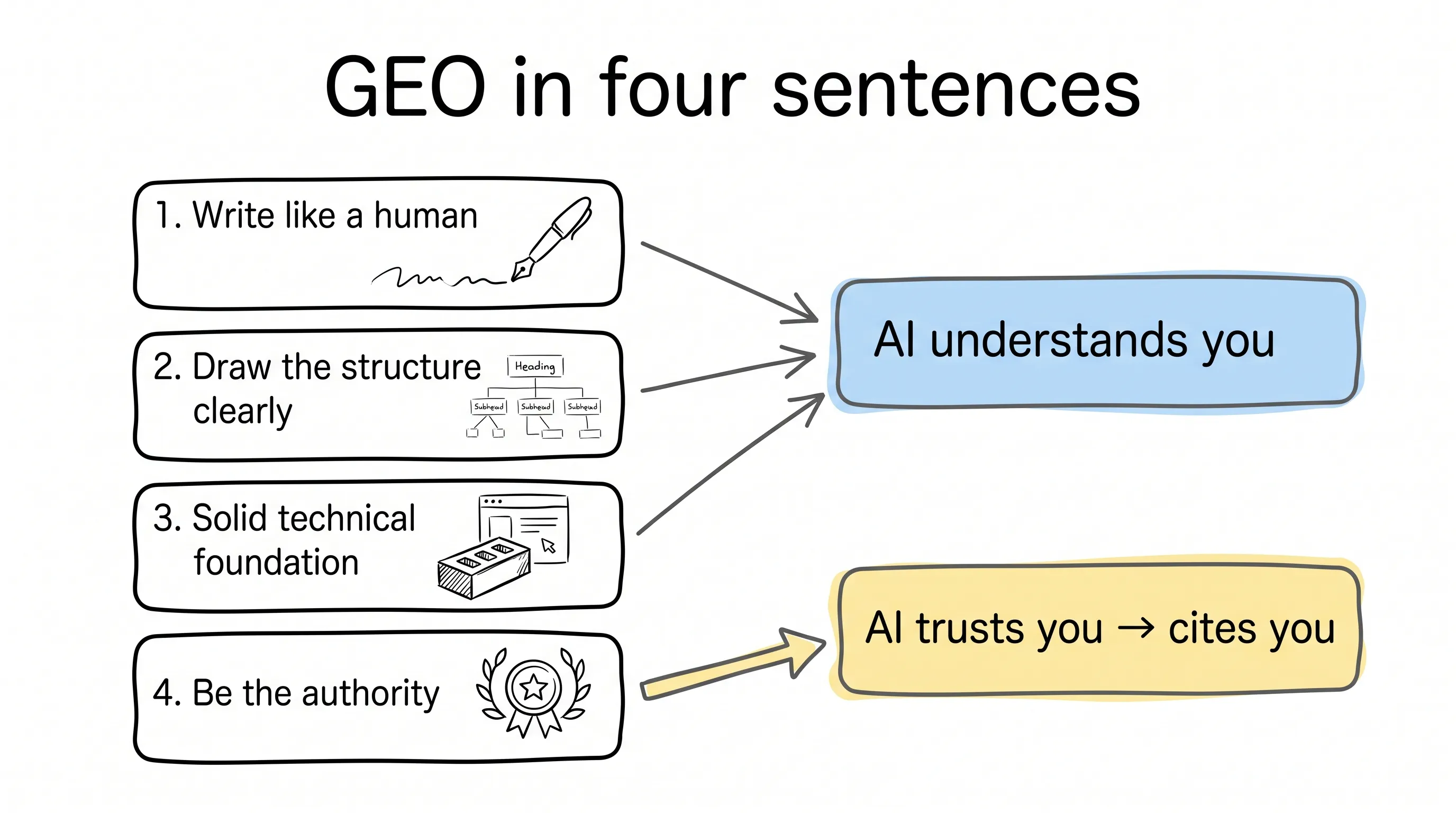
I've boiled GEO down to four principles.
First: write like a human.
What AI wants to cite is content it can lift straight as an answer. Write your article as if it were answering a real question: a conclusion, an explanation, the reasoning behind it. Fewer keyword piles, more actually explaining things clearly. The more you write like "a knowledgeable person explaining something," the more likely AI is to cite you.
Second: draw the structure clearly.
FAQs, subheadings, content summaries, structured data — these are the reading map you draw for AI. The less effort it takes AI to read you, the higher the odds you get written into the answer. For frequently asked questions, just organize them into question-and-answer pairs and put them right where AI can see them at a glance.
Third: get the technical foundation solid.
Your site should load fast, work well on mobile, and connect securely. These are the same old three from the SEO era — they look dated, but they haven't aged a day. AI crawlers reward them just the same. If the foundation is shaky, no matter how good your content is, the AI may never read it at all.
Fourth: establish your brand as an authority.
AI has one clear preference: it cites sources that are recognized authorities in their field. So whatever's said about you across channels needs to be consistent, and your content needs to hold up to scrutiny. One story today, another tomorrow — the AI won't dare cite you, and users won't dare trust you either.
The first three get AI to understand you. The last one gets AI to trust you enough to cite you.
First, Test Your AI Visibility
Where to start? Here's the simplest possible move.
Open an AI right now and ask it: I'm in the XX industry — for this problem, who do you recommend?
Then see if your name shows up in the answer.
A lot of people have never once tested their AI visibility. It's like running a business your whole life and never checking whether a maps app has your store pinned.
If you made the list — congratulations. Keep reinforcing.
If you didn't, don't panic. Those four principles above are the starting moves, and they don't cost a cent. Overseas, there are already service providers built around exactly this — Ntooitive, for instance, bundles GEO with traditional SEO. And if you'd rather do it yourself, start with writing like a human and organizing your FAQs.
Finally, Back to That List
Remember the list my assistant handed me at the start? Some of the companies on it may have spent serious money fighting for rankings. Others may have simply written content clear enough and credible enough that the AI named them on its own.
Consumers can't tell the difference. But for you, the front door of the business has moved.
The search of the future won't care where you rank. It will only care whether the AI is willing to say your name.
Here's hoping you make the list soon.
Continue reading
Related articles

Cross-Border Business: Time to Upgrade Your AI Toolbox
A learn article explaining how AI tools help cross-border e-commerce sellers clear five hurdles: language, regulation, logistics, payments, and fraud. It outlines a five-compartment toolbox, a five-step adoption path, and metrics such as conversion rate and CLV, while cautioning against over-reliance on AI.

AI Is Taking Over the Dirty Work of Social Media Marketing, One Task at a Time
This learn article outlines four social media marketing tasks AI can handle — audience analytics, content drafting and design, ad targeting and creative testing, and spam moderation — and cautions that taste, judgment, and data security remain human responsibilities.

AI Is Already This Good — Why Is Your Social Media Marketing Still Pure Manpower?
An overview of 18 AI tools for social media marketing, organized into six categories covering audience research, content creation, scheduling, comment and DM handling, ad management, and visual production, plus notes on personalization, prediction, and emerging trends.