
What Is GEO? A Plain-English Primer for Those of You Hearing It for the First Time
A plain-English primer on GEO (Generative Engine Optimization), explaining how AI answers select and cite sources, why SEO still matters alongside it, and what content, technical, and measurement practices support visibility in AI answers.
Let me ask you something first.
When was the last time you opened a search box and dutifully typed in a string of keywords?
Can't remember, right? These days, when a problem comes up, you most likely open an AI and just ask: Budget: 3,000 — recommend a few easy-to-clean coffee machines? This new policy — what does it actually mean for my company?
It doesn't toss you a row of blue links. It serves the answer up, ready to eat.
Lately, business owners and marketing friends keep coming to me with the same word: GEO. Some ask, do I have to learn yet another new thing? Others ask, after all these years of SEO, do I have to tear it all down and start over?
Don't panic. I'll do my best to explain this in plain English. One cup of tea is all the time you'll need.
Customers Went from "Searching" to "Asking"
Think about how big the shift behind this is.
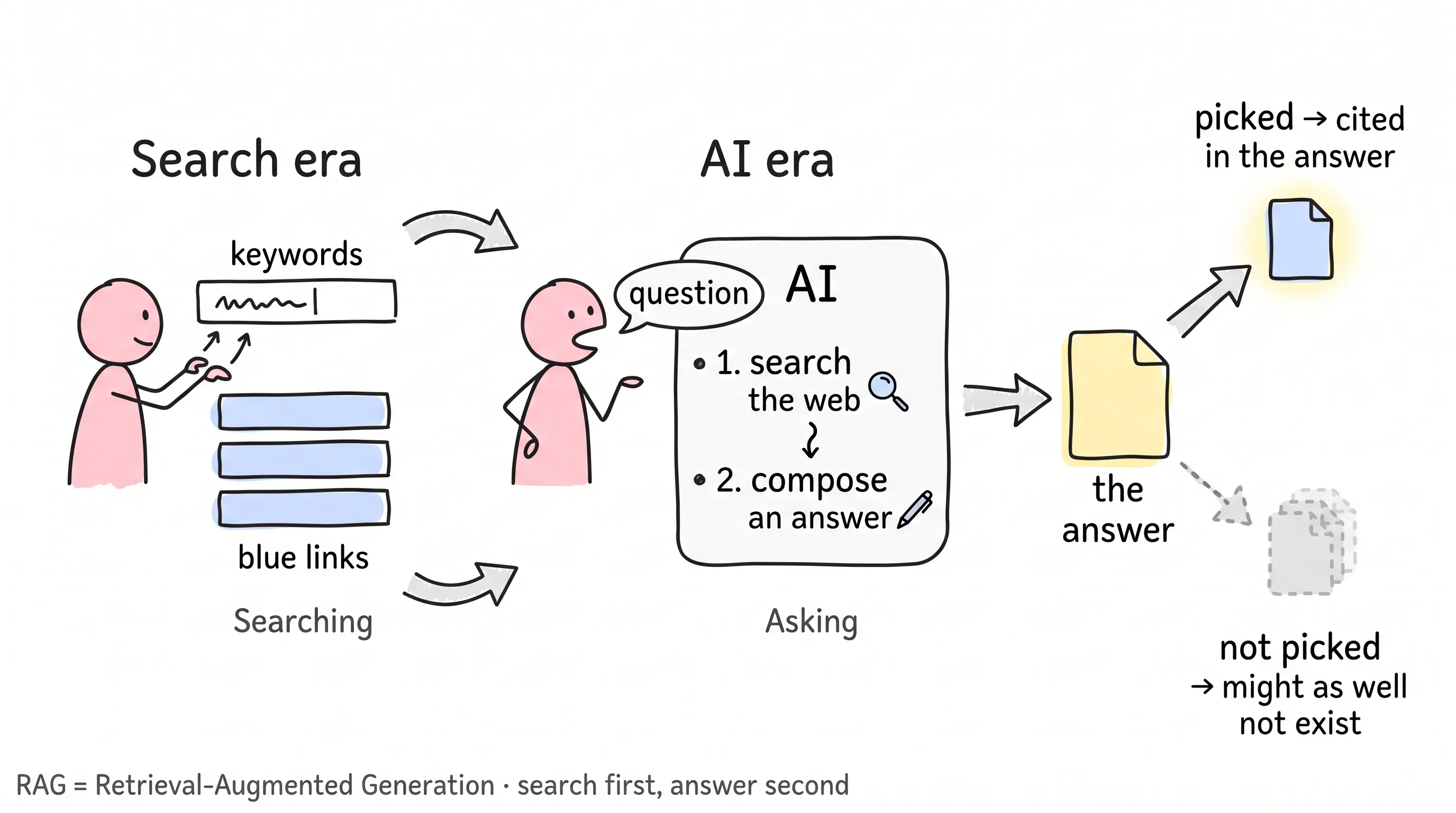
In the search era, users arrived with keywords, and your job was to fight for rankings: get your web pages to the front of Google's results page (and, by the way, Bing's). Rank high, get traffic.
In the AI era, users arrive with questions — and they talk the way they chat, often packing several questions into a single sentence. The AI runs the errands for them: first it searches the whole web for material, then organizes what it found into an answer, and serves it up.
That's right: search first, answer second. This mechanism has a name — RAG, Retrieval-Augmented Generation. No need to memorize the name; just remember the action.
So here's the question: when it goes looking for material, whose does it pick?
The piece that gets picked ends up in the answer. The ones that don't — however well written — might as well never have existed.
Getting AI to pick you and cite you when it researches is a discipline of its own, with its own playbook. That playbook is called GEO, Generative Engine Optimization. ChatGPT, Perplexity, Google's Gemini (along with the AI Overviews in search results), and Anthropic's Claude are the "examiners" it has to please.
The way customers find things has shifted from "search" to "ask." Your content has to be something AI can answer with.
Is SEO Dead?
Every time a new term pops up, someone shouts "X is dead." That battle cry has been going for twenty years.
My verdict is blunt: no.
Google search, to this day, still accounts for the lion's share of global web traffic, and most of your existing customers are still over there. But you're also watching, with your own eyes, a new gateway rerouting that traffic.
So don't pick one or the other — run on both tracks: keep fighting for your Google rankings; start placing your pieces for AI citations. These two don't just coexist — they complete each other. The more you get cited, the more you're mentioned across the web, and the deeper the trust you've banked on the search side.
SEO isn't dead. The exam has simply added a new subject.
What Makes AI Cite You? Five Things
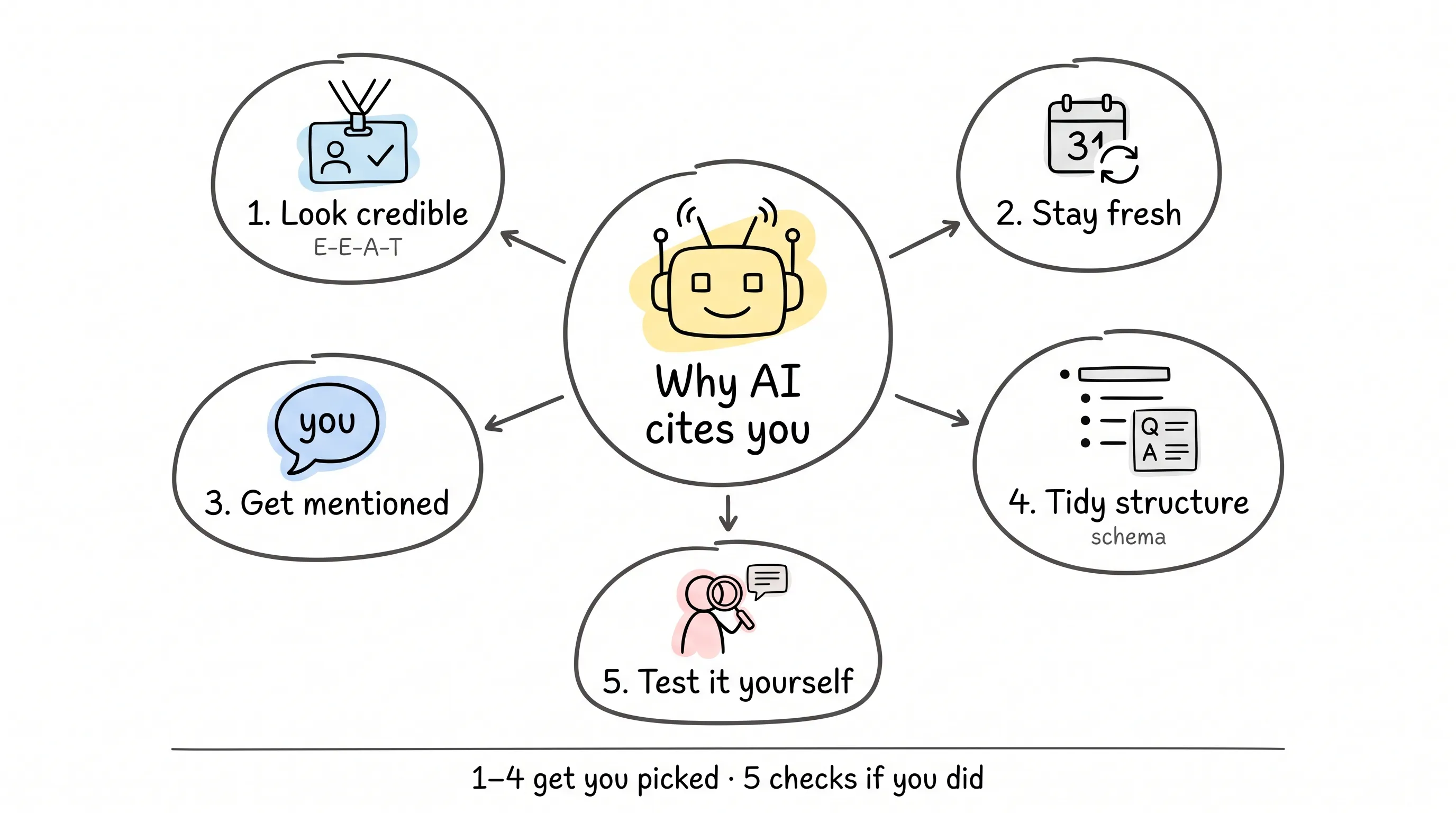
So what does AI look for when it picks its sources? I've broken it into five things, one at a time.
First, make yourself look credible. When AI judges whether a piece of content deserves trust, it thinks much like a person: Is there a real, named author? Does the author have credentials? Are sources cited when data is quoted? Behind this sits an old framework called E-E-A-T: Experience, Expertise, Authoritativeness, Trustworthiness. Google uses it to grade content, and its standard fits in one line: helpful, reliable, people-first. AI picking sources follows the same playbook. So don't skimp on author bios and credentials, and when you cite data, remember to link to reliable sources — machines favor information that can be checked.
Second, keep content fresh. Price changed but the page wasn't updated? Data still from a few years back? Swap them out, the sooner the better. When AI picks sources, it favors the new over the old. Also: for newly emerging topics, race ahead of your peers and write the definitive piece. The first person to explain a new question clearly gets cited again and again.
Third, get mentioned more across the web. Your link-building effort wasn't wasted — mentions from credible websites still carry real weight today. And even mentions without links count: when someone writes about you in black and white, your name gets tied to that topic, and AI can see it.
Fourth, arrange your content neatly. Headings in hierarchy, lists where lists belong, tables where tables belong — for FAQs, just write them in Q&A form. AI loves to lift this kind of tidy content; sometimes it takes whole passages as-is. One level deeper is schema markup: tag your content — this is a product, this is an event, this is an FAQ. Machines understand at a glance, and take it at a glance.
Fifth, run the tests yourself. List the questions your customers ask most often, then put them to the AI one by one: does your name show up in the answer? If not, look at who does get mentioned, and on what grounds — then go back and do your homework accordingly.
The first four get AI to pick you. The fifth tells you whether it picked you.
A Technical Checklist — Just Forward It to Your Tech Team
The five above are content work. The list below is engineering work; you don't need to do it yourself — hand it to your technical colleagues and let them build to the list.
Use JSON-LD for structured data, and make sure every content type has the fields it should have — products, events, articles, FAQs, each with its own tags. Keep your HTML headings in order, one level at a time, and write honest descriptions for your images. Put an llms.txt file in your site's root directory, organizing your key content into a format AI loves to read. Render pages server-side wherever you can, so content truly appears on the web page instead of hiding inside scripts. Go one step further and use an architecture that separates content from presentation — in the trade's jargon, a headless CMS: the same body of content gives humans a beautiful page, and keeps a tidy, well-formed set of structured data ready for machines. One body of content, serving two masters.
As for how AI actually fetches and uses these materials in real time — the retrieval machinery behind it runs deep, and deserves a piece of its own.
How Do You Measure Results? A Few Low-Tech Methods
A word of warning first: there is no precise dashboard for this yet. The tools are new, the tactics keep shifting, and the AI companies haven't published their "source-picking criteria."
And AI answers are unstable by nature. Ask the same question in the morning and again in the afternoon, and the answers may differ; rephrase it, they differ again; ask too many times from the same account, and it starts factoring in what you asked before. Ask three times in a row, and you might get three versions!
So don't expect numbers precise to the decimal point. Watch the trend; don't nitpick single data points.
Within that caveat, here are a few low-tech methods you can start using today.
The most direct is still manual testing — the fifth item above. Whether you were mentioned, whether it was a verbatim quote or a paraphrase, which part of the answer you appeared in: log it all in a spreadsheet, round by round, and compare.
If manual feels too slow, bring in tools. A batch of products doing AI-visibility tracking has already sprung up — some are new features added by established SEO tools, others are startups built for this gap.
If you have a technical team, write scripts. Schedule calls to each AI's API, ask automatically, record automatically. With enough volume, the trend holds up.
Don't drop mention monitoring either — an old craft from the SEO era. Set up Google Alerts, or whatever brand-monitoring tool you prefer, with your brand terms, and collect every mention of you across the web, linked or unlinked — all of it counts.
Last one: watch conversion rate. The most easily overlooked, and the most valuable. AI brings answers straight to users; for many questions, they never have to click into your site at all. If traffic drops, let it drop — look at the quality: whoever still clicks through at this point already intends to pay. Whether this crowd converts is the true report card of your content.
If No One Clicks Links Anymore, Should You Still Build a Website?
Yes. And it matters more than before.
In a zero-click world, the website's identity has changed.
From a storefront customers browse, to a raw-material depot AI pulls from.
Once that clicks, four things become impossible to skip.
Content must be findable by machines. AI answers need sources; if your content doesn't exist, it has nothing to cite. Structure has to be planned in from day one of building the site — don't patch it in afterwards.
Information must be watched by you. Price changed and the page wasn't updated, a discontinued product's page still hanging around — what AI cites is the wrong version. Only a site that stays fresh keeps your brand protected.
Count visitors by quality, not just by number. Fewer clicks is a fact. But think it through: before, of a hundred people who walked into the store, ninety-something would look and leave; now the AI has answered their questions most of the way, and whoever still clicks through is just one step away — all that's missing is you handing over a quote. Fewer people, but finer ones.
Deals need a landing point. Trial requests, downloads, price inquiries — there has to be somewhere to complete the action. Without a website, the last mile is broken.
Back to the Opening Question
So, do you have to learn something new again?
You do — but it's not as hard as you think. The craft you already own — how trust is built, how a brand gets mentioned, how content is organized — is worth exactly as much as before. The exam hall has simply moved from the search results page into the AI's answer.
However big the change, keep clear on what changed and what didn't. The channel changed; the exam questions changed. Content worth citing has never changed at all.
Here's to the day — soon — when an AI's answer holds the sentence that belongs to you.
Continue reading
Related articles

Cross-Border Business: Time to Upgrade Your AI Toolbox
A learn article explaining how AI tools help cross-border e-commerce sellers clear five hurdles: language, regulation, logistics, payments, and fraud. It outlines a five-compartment toolbox, a five-step adoption path, and metrics such as conversion rate and CLV, while cautioning against over-reliance on AI.

AI Is Taking Over the Dirty Work of Social Media Marketing, One Task at a Time
This learn article outlines four social media marketing tasks AI can handle — audience analytics, content drafting and design, ad targeting and creative testing, and spam moderation — and cautions that taste, judgment, and data security remain human responsibilities.

AI Is Already This Good — Why Is Your Social Media Marketing Still Pure Manpower?
An overview of 18 AI tools for social media marketing, organized into six categories covering audience research, content creation, scheduling, comment and DM handling, ad management, and visual production, plus notes on personalization, prediction, and emerging trends.