
What Is GEO? A New Craft for Content Creators in the Age of AI Search
An explainer article introducing GEO (Generative Engine Optimization), the shift from keyword search to asking AI, and five practical writing moves: question-based topics, AI-readable structure, answer-first writing, credibility signals, and technical foundations.
A while back, I caught up with an old friend who runs an enterprise-services company. His company's content wasn't half bad. They had been doing SEO diligently for years — keyword placement, link building, none of it neglected.
But then he told me something that made my heart skip a beat.
These days, he said, by the time customers come to you, they've stopped searching. They're asking AI. Asking ChatGPT, asking Perplexity, asking Gemini, asking Copilot. And once they've asked, they take the AI's answer and make a decision on the spot.
The search results page I'd been fighting so hard to optimize, he said, seemed to be losing its importance.
When I got back, I spent a few days digging into it. What I found: this isn't just one company's hunch. It's a migration already under way — the entry point of search is shifting from the "keyword box" to the "dialog box."
And so a new craft has emerged. It's called GEO (Generative Engine Optimization).
What Is GEO?
Let me start with an analogy.
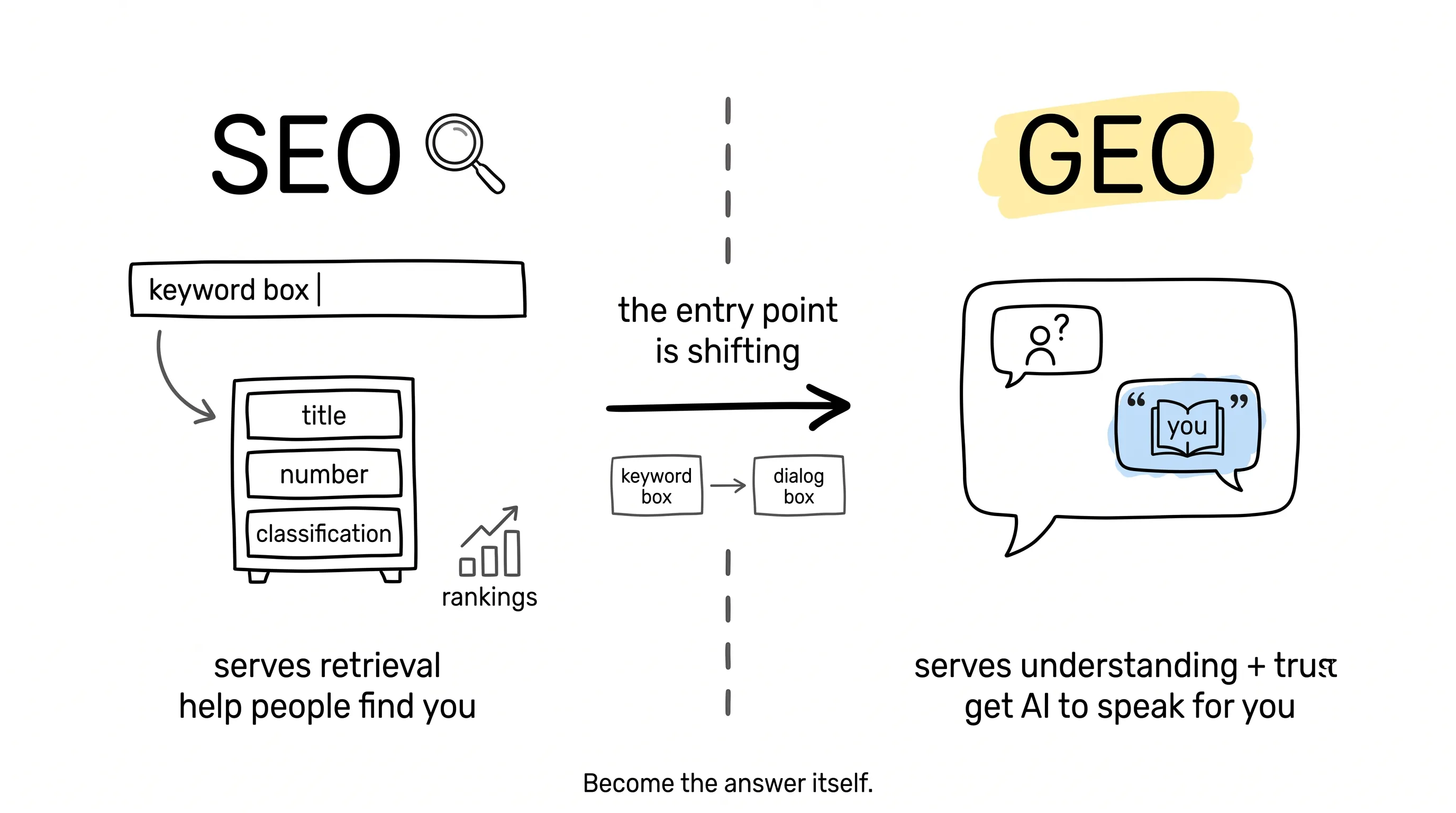
What is traditional SEO like? It's like handing the librarian an immaculately organized card catalog: title, number, classification code, every field labeled in the clearest detail, so he can find your book in seconds.
GEO, on the other hand, is a conversation with the librarian.
Which shelf the book sits on is just the opening line. What you really need to tell him: what this book is about, why it's the most trustworthy one on the shelf, and how it happens to answer exactly the question the reader is asking.
Simply put: SEO serves "retrieval." GEO serves "understanding" and "trust."
ChatGPT, Perplexity, Gemini, Copilot — these AIs spend every day reading web pages in bulk, summarizing, and answering. When they pick sources from the web, they only pick the ones that are easy to understand, trustworthy, and cleanly structured.
An article with GEO done properly will be written straight into the AI's answer.
When a user asks "What CRMs are right for a small company?", the AI's answer mentions you. When a user asks "What are the pros and cons of solar panels?", the material in the AI's comparison comes from you.
At this point, your goal has changed.
SEO used to be about helping people find you. GEO is about getting AI to speak for you.
Stop thinking about rankings. Become the answer itself.
How to Actually Do It: Five Moves
That's the theory. Now for the part you can actually put to work. Here are five moves — check your own content against each one.
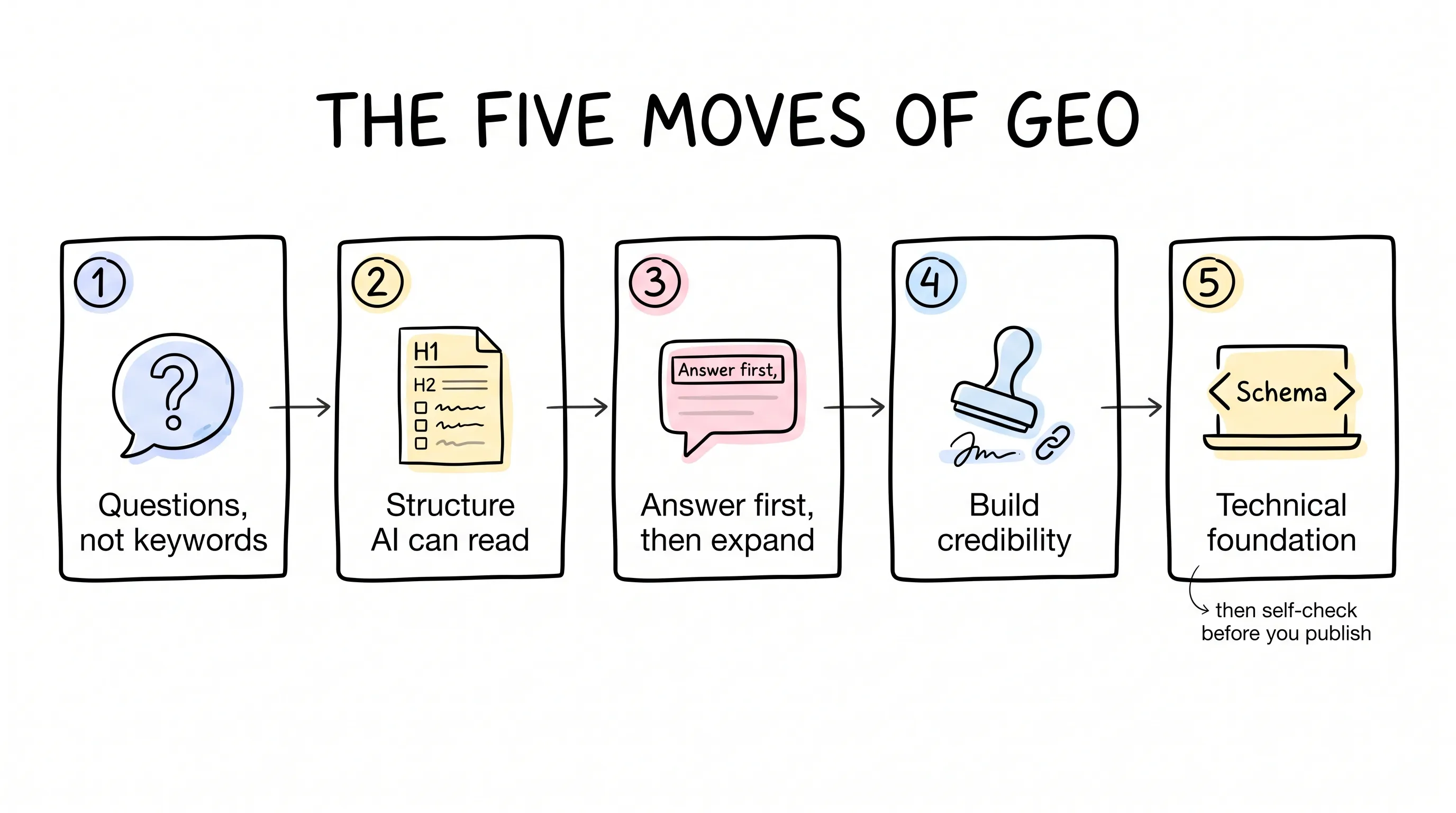
Move 1: Start from questions, not keywords
The old habit was to pack your headline with keywords. That playbook is losing its power.
Because in front of AI, users no longer type keywords. They type whole questions. Someone looking for a free tool won't type "GEO tool free" — they'll ask, "What free GEO tools can I use?"
So before you write, skip the keyword list. Make a list of questions instead. How would your users ask? What words would they use to ask the AI?
One more thing: behind the same question often stand several different people. Some are learning, some are comparing, and some are already reaching for their wallets. Your content should be able to catch all of them.
Move 2: Structure your content so AI can read it easily
Think about it: AI reads your article like a reader in a hurry — it scans the headline, then the subheadings, and then decides whether to read closely.
So keep the hierarchy clean. H1 for the topic, H2 and H3 to break down the questions, one level at a time — no mess.
Use lists, tables, and steps wherever they fit. For comparison pieces, one pros-and-cons table does more than three paragraphs of prose.
And here's something many people overlook: the FAQ is a gold mine for GEO. Every FAQ is just about the exact question a user will toss at the AI. Answer it well in your article, and you've already caught that conversation before it happens.
Move 3: Give the answer first, then expand
Write the way you'd answer a curious friend's question. Whatever they asked, your first sentence answers it.
If your subheading is "What's the difference between SEO and GEO?", the very first sentence underneath should state that difference outright. The old style — a long buildup, a big detour, a punchline saved for last — doesn't work anymore.
Because vague openings and marketing talk are noise to an AI. It skips them and goes straight for the parts with substance. The more solidly you write, the more accurately the AI picks it up.
Move 4: Build your credibility
When AI picks its sources, what it's really picking is trust.
How do you earn that trust? A few things — plain, but they work.
Date your updates, so the AI knows your content is fresh.
Cite verifiable sources. Outside research, data, reports — link to them when it makes sense. It shows you've done your homework.
Sign your work. Who wrote it, and why they're qualified to write about it — make that clear.
In a world where anyone can generate content, trust is the most valuable currency. It's hard to fool an AI by stuffing keywords. But through sheer substance, you can be the one it picks.
Move 5: Don't neglect the technical foundation
AI understands content like a human, but crawls your site like a machine. You have to serve both.
Add structured data (Schema) to your articles — Article, FAQPage, Author, that family of types. It's like handing the AI an instruction manual for your content.
Title tags, meta descriptions — the old fundamentals still need doing.
Your site needs to be fast, stable, and secure. If the foundation is shaky, nothing you write on top of it will matter.
Before You Publish, Run a Self-Check
Before you hit publish, I'd suggest running through these questions:
Is your title a question a real user would actually ask?
Do the first few sentences answer the core question directly?
Is the structure clean — clear hierarchy, short paragraphs, easy to skim?
Is there an FAQ? Is there an author, a source, an update date?
And finally, the most practical step of all: go to ChatGPT or Gemini and actually ask your target question. Look at what kind of content they're citing right now. Then come back and revise yours.
Most people never do this. Yet it may be the single most informative move of them all.
Finally, Back to My Friend
Toward the end of that conversation, I asked him: so what are you going to do about it?
He said: the content stays the content, the team stays the team — they just have to change how they write. They used to puzzle over how to get found. Now they have to puzzle over how to be understood by AI, trusted by AI, and worth quoting.
I couldn't agree more.
The rise of AI hasn't devalued good content. Quite the opposite — it's forcing all content to become more honest, more useful, more human. Here's the paradox: to please the AI, you have to take care of your readers first.
On the surface, GEO is writing for machines. In essence, it's making your content worth quoting.
Here's my wish for you: starting today, may you not just be found — may you be written, deliberately and respectfully, into the answer itself.
Continue reading
Related articles

Cross-Border Business: Time to Upgrade Your AI Toolbox
A learn article explaining how AI tools help cross-border e-commerce sellers clear five hurdles: language, regulation, logistics, payments, and fraud. It outlines a five-compartment toolbox, a five-step adoption path, and metrics such as conversion rate and CLV, while cautioning against over-reliance on AI.

AI Is Taking Over the Dirty Work of Social Media Marketing, One Task at a Time
This learn article outlines four social media marketing tasks AI can handle — audience analytics, content drafting and design, ad targeting and creative testing, and spam moderation — and cautions that taste, judgment, and data security remain human responsibilities.

AI Is Already This Good — Why Is Your Social Media Marketing Still Pure Manpower?
An overview of 18 AI tools for social media marketing, organized into six categories covering audience research, content creation, scheduling, comment and DM handling, ad management, and visual production, plus notes on personalization, prediction, and emerging trends.