
What Is Generative AI? It's Quietly Rebuilding Your Business from the Ground Up
An educational overview of generative AI in business: how it differs from earlier analytical AI, why companies are investing, use cases from customer service and marketing to coding, plus risks and trends such as agentic AI.
A while back, I stopped by the office of a friend who runs an e-commerce business.
The moment I walked in, he showed me the customer-service chat logs in his admin backend. Frontline support, he said, had been cut to half its original size. Bots now take the first pass on every inquiry; the ones where a customer's mood goes sour get handed to a human.
I asked, "Can customers tell the difference?"
He said they can't. And the bot knows how to read people, too: when a customer is anxious, it slows down and softens its tone; when a customer blows up, it catches the emotion first, then solves the problem.
Impressive.
My friend's company is not an isolated case. Over the past two years, generative AI has gone from "a new toy that can write and draw" to the very foundation of how many companies operate. Writing copy, writing code, creating images, screening résumés, forecasting demand — it's everywhere.
If your company isn't using it seriously yet, this is a question worth settling right now.
What Is Generative AI?
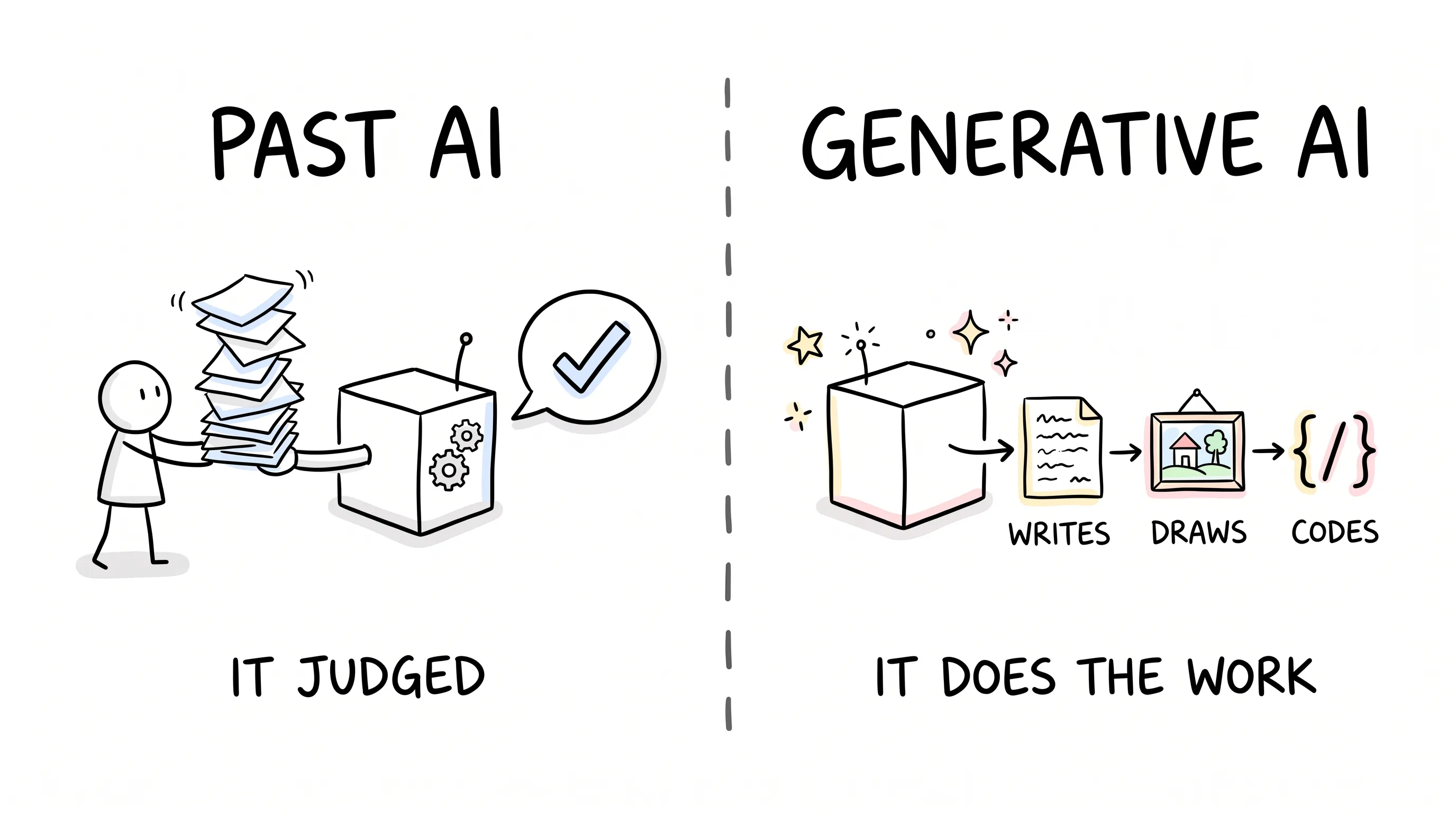
Let's take the concept apart first. AI of the past was more like an analyst: you feed it data, it hands you conclusions. Will this borrower default? Will this customer churn? Its job was only to look and calculate.
Generative AI is different. It "creates."
Feed it a pile of existing data, and it can write sales emails, draw original images, generate code that actually runs — even produce batches of data that don't exist but are statistically near-indistinguishable from the real thing, to fill the gaps in your samples.
In one sentence: AI of the past helped you make judgments; generative AI gets the work done.
That's why you see retail, healthcare, finance, entertainment — every one of them stuffing it into their own workflows. For what? Efficiency, customer experience, and new business models.
Why Is Everyone in Such a Hurry?
In May 2024, Forrester ran a survey of enterprise technology decision-makers: 67% of respondents said they would increase their generative AI budget over the coming year.
Six or seven companies out of every ten, adding money. This is no longer early experimentation. This is an arms race.
The way I read it, that added money is really three accounts in one.
One is a capacity account. Copy, images, videos — these used to be ground out by people, hour after hour. Now AI produces them in bulk, and people just pick and polish, freeing up their time for higher-value work.
One is a cost account. Hand the repetitive work to machines, and operating costs come down for real.
One is a personalization account. "A thousand faces for a thousand customers" used to be a slogan; now it's table stakes: tailor the service and the messaging to each individual customer, and loyalty builds up bit by bit.
There's another judgment in Forrester's research that I fully agree with: generative AI is every bit as consequential as any technology wave we have lived through. It has already moved AI from "icing on the cake" to the foundation of a company's competitive roadmap.
I didn't say that — their research team did. Impressive.
Where Can It Actually Be Used?
Let's go through them one by one.
Start with customer service. This is the fastest place to see results. Tools like ChatGPT and IBM Watson take the inquiries: fast to respond, accurate in their answers. Sentiment analysis watches the tone and adjusts the script in real time. When the customer is anxious, it slows down; when the customer is angry, it apologizes first.
Then marketing. Platforms like Jasper write blogs, social posts, and emails in bulk, in your brand's voice, so everything that goes out sounds like it came from a single brand. In design, AI produces assets and first drafts that light the team's creative spark.
Recruiting has been rebuilt, too. Tools like Eightfold.ai handle candidate matching: toss in the job requirements, and it fishes out the right people — hiring cycles visibly shrink. When new hires onboard, AI even lays out their learning paths, so training is no longer a stack of dry PPTs.
Data teams feel it even more directly. A pile of complicated tables, and AI boils them down into a few sentences of plain language — decision-makers read the conclusions straight away. Reports shrink from days to hours.
The interesting one is supply chain. What's the biggest headache in fast fashion? New products have no historical data, so demand can't be forecast. Generative AI can synthesize data to fill in where samples are thin — and forecast accuracy actually goes up. How much stock to line up for launches and promotions — now you have a solid number in mind. See — synthesizing data isn't faking it, it's filling the hole.
Coding is the biggest chunk of all. Programming assistants like GitHub Copilot help developers write code, hunt down bugs, and run tests, speeding up the entire software lifecycle. Even the driest technical documentation can get a first draft from AI.
And knowledge management. Run a company long enough, and the knowledge ends up locked inside your veterans' heads — when they leave, the knowledge leaves with them. Use AI to build a knowledge base, gather everything that's scattered into one place where anyone can look it up, and the team stops redoing work that's already been done.
What About Industry by Industry?
In retail, virtual fitting rooms let customers "try things on" at home, while AI helps write product descriptions, forecast demand, and set prices.
In manufacturing, generative design helps engineers compute structures that are light and sturdy at the same time — less material, faster prototyping.
In finance, fraud detection, portfolio management, intelligent customer service — everything hinges on the speed of real-time response.
In pharma, AI analyzes case records and generates candidate compounds, compressing the drug-development cycle; treatment plans can be tailored to each individual's health records.
In entertainment, virtual scenes, personalized recommendations, localized dubbing. Good AI dubbing preserves even the emotion, so characters don't turn into robots reading off a script.
Sound like all good news? Hold on.
There's Always a Flip Side
The first hurdle is ethics. AI can fabricate images, spin up rumors, carry bias. Before you launch, ask three questions: If something goes wrong, who is accountable? Who does the oversight? How does regulation keep up? If you can't answer, don't launch yet.
The second hurdle is infrastructure. Generative AI eats compute — whether to build your own data center, go all-in on the cloud, or go hybrid, you'd better run the numbers. AWS, Google Cloud, and Microsoft Azure all offer ready-made AI compute offerings; most companies don't need to reinvent the wheel.
The third hurdle is data. Garbage in, garbage out. If data governance isn't done well, what the model puts out will be wrong — and wrong with a perfectly straight face. In heavily regulated industries like finance and healthcare, data security is the absolute bottom line.
The fourth hurdle is people. This is the one most easily overlooked. In 2023, Forrester ran another survey: 36% of employees worried about being replaced by AI.
Managers can't pretend not to see this worry. My take is simple: define AI as a tool that augments your people, not one that swaps them out. Equip employees with new capabilities — data interpretation, project management, ethical judgment — and when they do brilliant work, that's when you get the real return.
The fifth hurdle is the ledger. Money spent has to show a return you can actually calculate. Don't roll it out company-wide on day one — pilot first, let the metrics come in, then decide whether to double down: how much did efficiency improve, how much did revenue grow, how many more customers stayed?
Security and compliance deserve their own mention. If AI-generated content resembles a third party's work, the copyright lawsuits arrive; if the training data carries bias, the model will amplify that bias.
One more survey: 29% of enterprise technology decision-makers said trust is the single biggest roadblock standing between generative AI and real-world adoption. Transparency, accuracy, ethics — get those three rock solid; only then does trust hold.
Where Do We Go from Here?
There's a distinction a lot of people can't quite make: agentic AI and generative AI — are they the same thing?
No.
Generative AI can "think"; agentic AI doesn't just think, it acts. It sets its own goals, breaks them into steps, makes decisions in real time, adjusts by itself when the environment shifts — barely any human supervision needed.
Put the two together, and here's where the imagination kicks in: many complex tasks inside an enterprise can one day be handed to a swarm of collaborating agents pushing work forward in real time. Whoever gets this workflow running smoothly first gets ahead first.
The second direction is knowledge graphs. Take all that tacit experience inside a company — the kind that's hard to put into words — and structure it so machines can read it, then let AI work on top of it. Finding information, running analysis, making decisions: all of it gets faster.
The third direction is personalized AI. For customers, finer-grained recommendations and interactions; for employees, assistants that understand how you work — the way you like to get things done is the way it works alongside you. Consumer-facing industries benefit first, and enterprises follow.
One Last Word
Back to my e-commerce friend from the beginning.
As I was leaving that day, I gave it to him straight: your lead right now is, at most, a year. Service bots, smart recommendations — every competitor is rolling those out. What actually opens up the gap is whether you dare to sink AI into the back of the house: recruiting, supply chain, data. Everyone can play the front of the house; the back of the house is where the moat is.
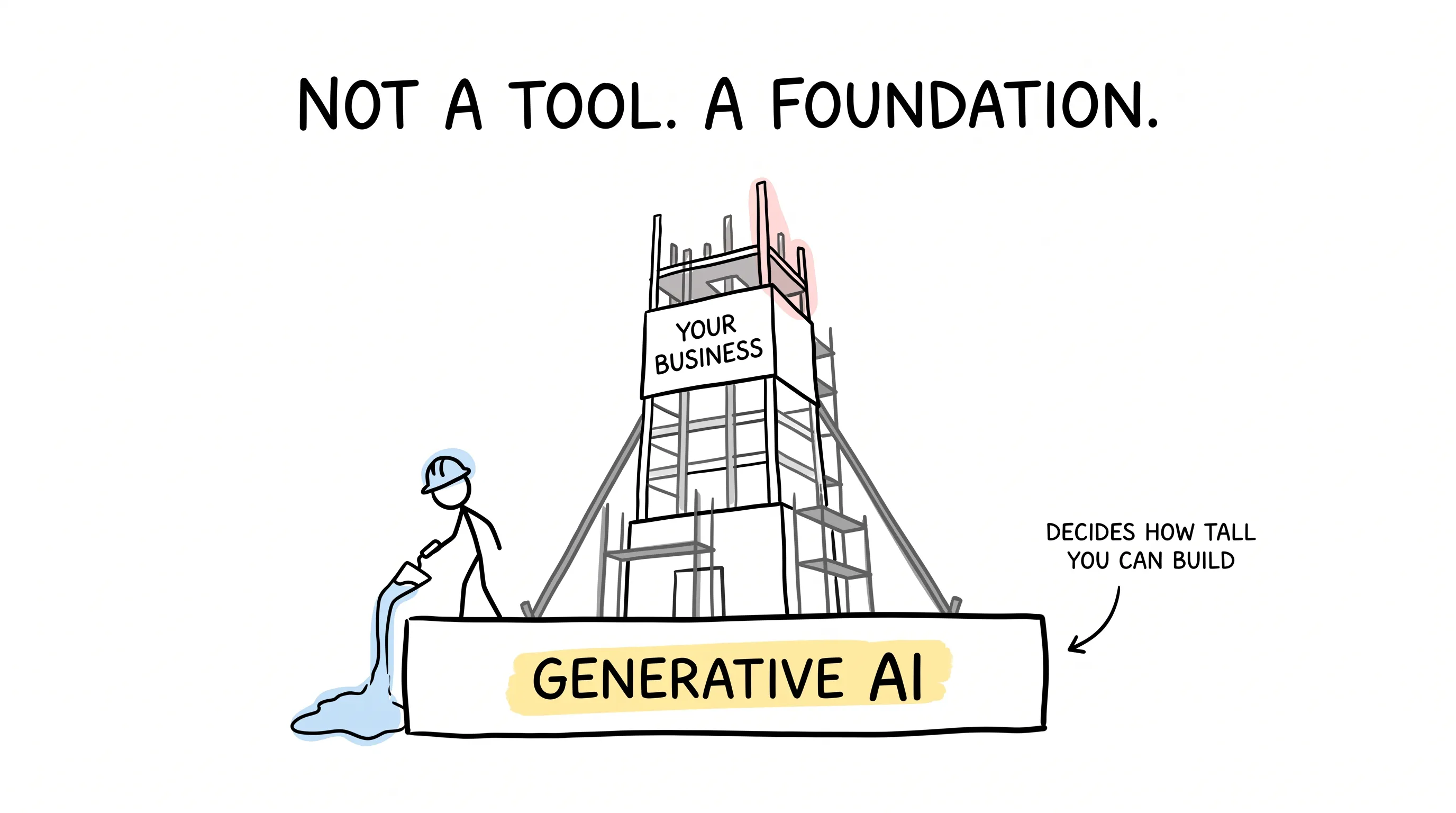
Generative AI is not one more tool.
It's a new slab of foundation.
Tools: whether you use them or not, life goes on as usual. Foundations: they decide how tall a building you can put up.
Here's to being the one who pours the foundation first.
Continue reading
Related articles

Cross-Border Business: Time to Upgrade Your AI Toolbox
A learn article explaining how AI tools help cross-border e-commerce sellers clear five hurdles: language, regulation, logistics, payments, and fraud. It outlines a five-compartment toolbox, a five-step adoption path, and metrics such as conversion rate and CLV, while cautioning against over-reliance on AI.

AI Is Taking Over the Dirty Work of Social Media Marketing, One Task at a Time
This learn article outlines four social media marketing tasks AI can handle — audience analytics, content drafting and design, ad targeting and creative testing, and spam moderation — and cautions that taste, judgment, and data security remain human responsibilities.

AI Is Already This Good — Why Is Your Social Media Marketing Still Pure Manpower?
An overview of 18 AI tools for social media marketing, organized into six categories covering audience research, content creation, scheduling, comment and DM handling, ad management, and visual production, plus notes on personalization, prediction, and emerging trends.