
What Is AI Marketing? Let Me Tell You 5 Stories
An explainer that introduces AI marketing through five brand stories, covering recommendation systems, personalized playlists, newsroom LLM use, AI-generated celebrity video ads, and customizable video invitations.
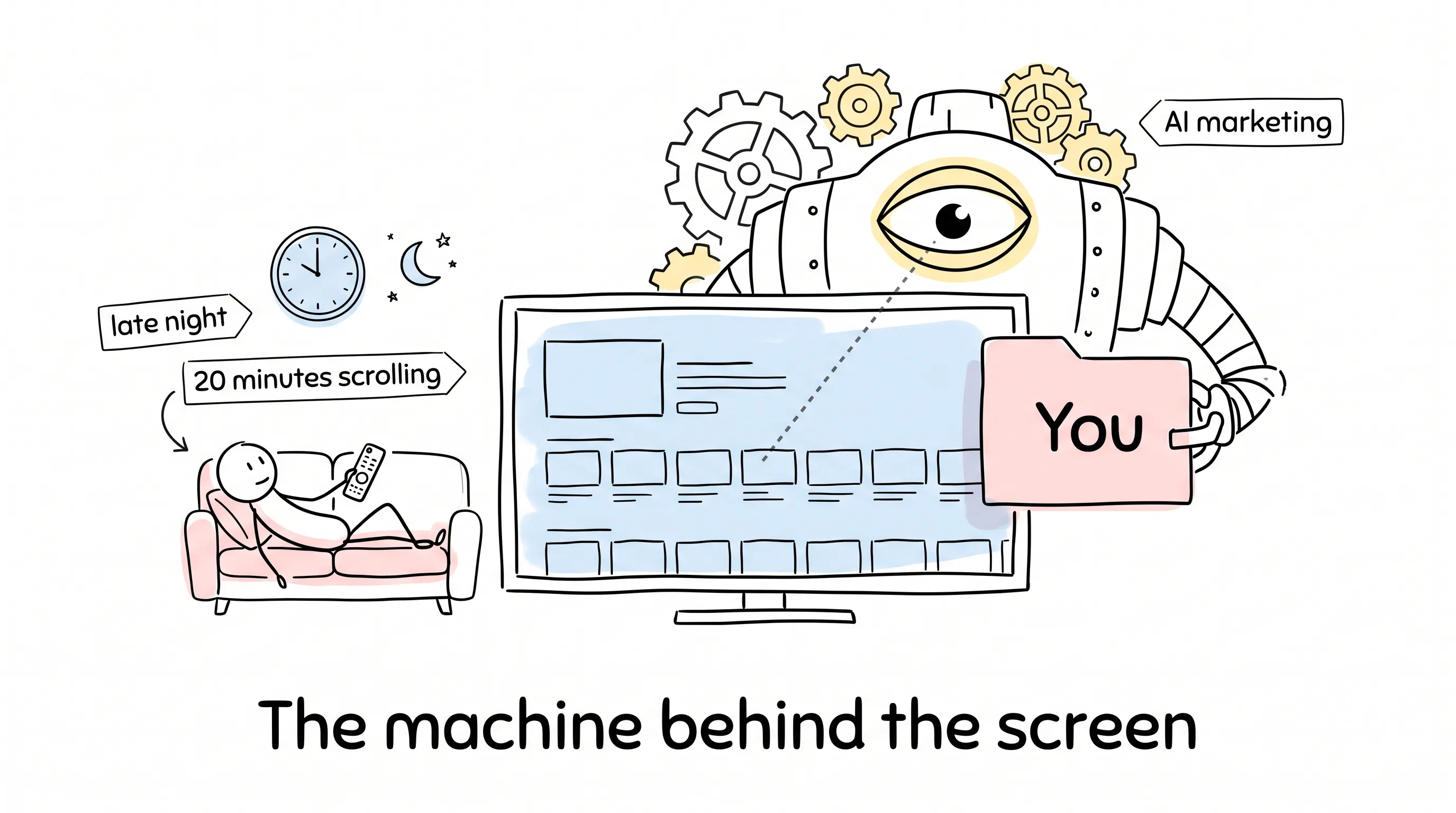
Late one night a few days ago, I finally got home from overtime, flopped onto the couch, and opened Netflix to put on a random movie.
I never watched a movie. I spent twenty minutes scrolling the home screen instead.
And not scrolling for something to watch — scrolling through what it was recommending to me. The sci-fi row was full of titles I'd never heard of that I wanted to click the moment I read the description. The documentary row looked almost like the twin of the one I'd finished the week before.
It baffled me: how did it know what I wanted to watch tonight?
Later it clicked. Behind that home screen is an entire machine, one that nearly every top company is pouring money into today. You've heard its name: AI marketing.
You might think it's a grand-sounding buzzword, something far removed from your life.
It isn't. McKinsey ran a survey on how companies use AI tools, and the function at the very top of the list was marketing and sales. See? This isn't some future thing. It's happening right now.
Let me tell you 5 stories. By the end, you'll get it.
First, the Basics: Four Things AI Marketing Can Do for You
Before the stories, let me walk through these four skills in plain language. Otherwise you'll watch the stories and see only the show, not the mechanics.
First: read your customers inside out.
Say a young woman is browsing athletic wear in your online store. She lingers over a pair of yoga leggings for a good while, doesn't buy, and leaves.
What's the traditional playbook? Two days later, mass-blast her a "new arrivals" email.
The AI approach has three steps. Step one: study her behavior — which section she lingered in longest, which items she viewed, where she hesitated. Step two: sort her into a specific segment — the woman who wants yoga leggings but is still comparison-shopping. Step three: build her a dedicated path. Emails pushing similar bestsellers with a discount; the moment she opens your site, a popup tells her the pair she looked at just dropped in price; the moment she scrolls social media, there are those leggings again, on someone else, styled in a workout scene.
You think she's shopping. She's actually being read, layer by layer.
Second: help customers find the thing they want.
Someone goes to a sporting-goods site to buy hiking boots, and the site quietly stocks its "Recommended for You" section with socks, trekking poles, and tent accessories.
That's no random arrangement. The AI adds two things together: what he searched for, and what he's been browsing lately. Cross the two, and the suggestions earn a knowing smile: this really is the gear for the next leg of my trip.
Third: stitch your scattered channels together.
Someone downloads your shopping app and never opens it again.
The AI digs through mountains of similar cases to learn how "installed but dormant" users get won back. For example: a push notification three days before the big sale, telling him what time the discounts go live; then an email follows up, delivering the promo code straight into his hands. One touch in the app, one in his inbox — two channels working in tandem, and suddenly your reach has real depth.
Fourth: speak the local language for you.
Everyone in business wants to go global. Localization used to mean hiring translators, briefing copywriters, redoing layouts — three months, minimum.
Now? Want into the French market? One click and your entire site speaks French. Spain? Click again. In one sentence: pick a country, and let it deliver your message straight to the hearts of the people there.
All right, four skills covered. Now for the live rounds.
Story One: Netflix, Turning "Recommended for You" Into a Money-Printing Machine
First, back to that night from the opening.
How big is Netflix's library? More than 3,600 movies and 1,800 series. Watch one a day and it would still take you more than a decade to get through.
Abundance is a blessing in the warehouse and a disaster on the home screen. The user opens the app, stares, closes it. Too many options, and suddenly you can't pick anything. This condition has a name: choice overload.
Netflix's cure is an algorithm called collaborative filtering.
What is collaborative filtering? It runs on two tracks.
Track one: find your people. The system watches every user, picks out a cluster whose viewing tastes overlap heavily with yours, sees what else they love, and pushes it to you. In plain words, it finds you a dinner buddy: when even your obscure quirks match, the restaurants he frequents almost certainly won't let you down.
Track two: find similar titles. You love A, so the system lines up B, C, and D — all with A's temperament — right in front of you.
Run both tracks at once, and those ten-second teaser trailers on your home page are cut inch by inch from your own viewing history.
Netflix has run the numbers itself: roughly three-quarters of the company's revenue is directly tied to this recommendation system, and the system is worth north of $1 billion a year. In early 2024, its subscriber count crossed the 260 million mark.
That's firepower.
And guess what — recommendations are only one of its trades. Content creation, personalized clips, image analysis — even data-center energy savings and customer service run on AI.
Story Two: Spotify, the DJ Who Knows Your Playlist Better Than You Do
The second story is the first one's twin.
Same disease: too many songs, too little time. Spotify's catalog holds more than 100 million tracks, for a user base of more than 600 million. How do you pull each person's few hundred songs out of a hundred million?
Its prescription isn't one pill but a whole regimen: Discover Weekly, Blend, Daylist, Made for You Mixes, plus the home feed.
Where's the cleverness? In the ratio of familiar to new. Old songs keep you feeling at home; new ones hand you a small delight. Never intrusive, never annoying. Like a DJ who gets you, camped permanently inside your earbuds.
Oh, and this isn't a last-minute scramble. Spotify has been building personalized playlists for more than a decade — it started back when "AI" wasn't even a buzzword yet.
Now, its big bet is called AI DJ.
What's AI DJ? A radio DJ transplanted wholesale into your phone. Tap the DJ button and an AI voice starts chatting with you: here's a new song, here's the story behind the artist — and, by the way, here's a playlist you've never heard.
Why build it? Because AI has an old blind spot: it can predict what you love listening to, but not when you'll want out of your comfort zone. A hundred plays of the same old song is comfortable — but one day, everyone craves a change. The AI DJ button exists for exactly that moment.
When you feel like taking a risk, press it, and it takes you on the adventure.
That is retention. When users feel the platform gets them, the hand that renews doesn't hesitate.
Story Three: The Washington Post, an Old Newspaper's AI Experiment
The third story changes the scene entirely: this time it's a newspaper with more than a century behind it.
Its anxiety is concrete: readers have migrated to new channels — conversational products, short video. Pretend you don't see it, and you're waiting to die.
Its response was blunt: take every big-name LLM on the market, drag each one out for a trial run. ChatGPT, Gemini, Meta's LLaMA, plus a whole pack of open-source models — walk them all.
Why not bet on a single one? The reason is plain: a newspaper can't tie its survival to the technical temperament of any single vendor.
One detail strikes me as especially smart: to keep the AI from making things up, they feed the models only passages from stories their own reporters have written.
So what does the AI actually do there? My summary: it plays the perfect intern. It helps reporters gather material and write summaries; it generates several versions of headlines and copy for editors to pick from; it reworks a long investigation into versions shaped for short-video and social platforms; it even chats with readers in the reporter's own voice, collecting the questions readers care about and handing them back to the reporter.
You see, when an old institution learns something new, the real danger isn't failing to learn — it's refusing to get in the game. This newspaper chose to get in.
Story Four: Cadbury, Cloning the King of Bollywood 130,000 Times
The fourth story takes place in 2021, and it's the wildest one in my book.
Cadbury makes chocolate. In India, Diwali is the make-or-break season for its "Celebration" gift boxes every year. Why? Indians traditionally give sweets during festivals — companies to clients, relatives to friends. That year, 45% of Celebration's sales were riding on the Diwali season alone.
The main force selling these boxes? Small street-corner shops. More than 85% of sales came from these little stores.
You and I both know how hard 2021 was for small shops. And when the shops struggle, the boxes pile up in warehouses.
How did Cadbury fight back? It brought in technology partners like Rephrase.AI and Delta X and did something previously unthinkable: it cloned Bollywood's biggest star, Shah Rukh Khan.
How many copies? 130,000.
In every single ad, Shah Rukh Khan looks into the camera and hawks the goods: this festival, buy your chocolate at the shop on your corner. A store owner typed in their shop's name and got a personalized ad all their own.
In the old days, booking a spokesperson of that caliber for a single shoot meant a budget of several million — big companies only. Now, 130,000 little shops got one each: as if every one of them had hired an A-lister to stand behind their counter.
The result? Customers came back to the small shops during Diwali, and sales came back with them. There was an unexpected bonus, too: a global brand stooping to champion street-corner stores — its image went up, not down.
Ashray Malhotra, co-founder of Rephrase.AI, once said: if everyone in the world could express themselves with high-quality video, it would be a breakthrough in communication.
Wow. It sounded like a vision statement at the time. Cadbury turned it straight into 130,000 ads.
Story Five: Virgin Voyages — Who Could Say No to Jennifer Lopez?
The fifth story is even bolder than the fourth.
Virgin Voyages runs luxury cruises. The cruise market is brutally competitive — what makes consumers remember you?
Together with the digital agency Flaunt Digital, it built something called "Jen AI": an AI persona made to look like Jennifer Lopez.
The ad opens like this: J.Lo lounges on a deck chair aboard the ship, chatting straight to camera. As you watch, something starts to feel off: this one... might not be human.
Right — it's AI.
Then comes the point of the whole thing. Whoever receives this video invitation can edit it themselves: swap in their own name, dates, and itinerary, then send the video to friends and family, inviting them aboard.
In other words, every passenger gets to have J.Lo record a personal invitation on their behalf. Imagine that kind of star power on call.
Founder Richard Branson said: we want to be the ultimate choice for every kind of celebratory travel. And honestly — who could say no to Jennifer?
The result: buzz through the roof, endless sharing and discussion — and some people genuinely started looking into tickets because of one customized invitation.
Finally, Back to That Night
Five stories, told.
Look back at that night from the opening: I spent twenty minutes scrolling Netflix's home screen. In those twenty minutes, the thing talking to me wasn't an editor or an operations team. It was a recommendation system that had been studying user behavior for years.
These five companies: Netflix and Spotify used it to cure choice overload, The Washington Post used it to feed the newsroom, Cadbury used it to rescue small shops, Virgin Voyages used it to manufacture buzz.
On the surface, five stories. Underneath, one single thing:
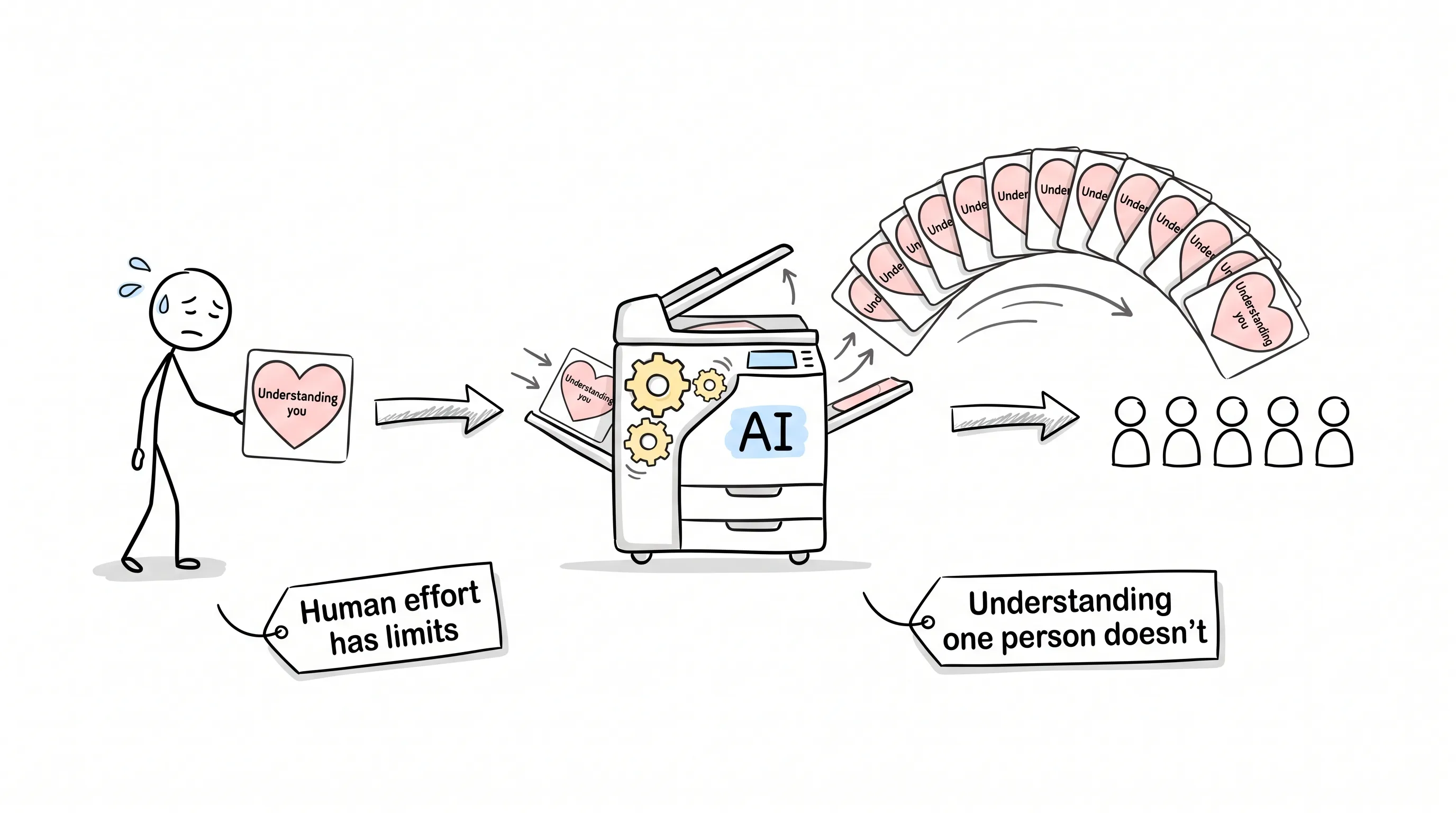
Human effort has limits. Understanding one person doesn't. Whoever can scale "understanding you" wins.
People ask me: it's 2026 — is there still time to get in?
Here's my take: look at these five — a streaming giant, a music platform, a century-old newspaper, a global candy brand, a luxury cruise line. Not a single small company among them. But AI marketing has never been about the size of your operation, only about how early you start. Begin with one small thing: figure out who your customers really are, then let the machine help you push "understanding them" one inch deeper.
Here's to you becoming the one who knows your customers best.
Continue reading
Related articles

Cross-Border Business: Time to Upgrade Your AI Toolbox
A learn article explaining how AI tools help cross-border e-commerce sellers clear five hurdles: language, regulation, logistics, payments, and fraud. It outlines a five-compartment toolbox, a five-step adoption path, and metrics such as conversion rate and CLV, while cautioning against over-reliance on AI.

AI Is Taking Over the Dirty Work of Social Media Marketing, One Task at a Time
This learn article outlines four social media marketing tasks AI can handle — audience analytics, content drafting and design, ad targeting and creative testing, and spam moderation — and cautions that taste, judgment, and data security remain human responsibilities.

AI Is Already This Good — Why Is Your Social Media Marketing Still Pure Manpower?
An overview of 18 AI tools for social media marketing, organized into six categories covering audience research, content creation, scheduling, comment and DM handling, ad management, and visual production, plus notes on personalization, prediction, and emerging trends.