
What Is a GEO Agency? Here Are 10 You Should Get to Know in 2026
A guided tour of GEO (Generative Engine Optimization): what it is, how it differs from SEO, AEO, and LLMO, plus a September 2026 roundup of 10 GEO agencies with pricing, case results, and picks for startups, enterprises, and B2B SaaS.
A few nights ago, I had dinner with a friend who runs a B2B software company.
His company isn't big, but its website has always ranked well on Google, with steady traffic. Two years ago, that was his go-to brag over dinner and drinks.
That night, he was deflated.
I asked what happened. He'd lost a big deal. During the post-mortem, the client said one thing that cut him to the bone: "We were doing vendor research. We asked a few AI assistants — and you weren't on a single list they gave us."
The rankings were still there. The traffic was still there. The deal was gone.
That dinner hit me hard. On the way home, one thought kept circling: the user's decision entry point has moved from the search box to the chat box. And behind that shift, a new industry has grown up. Today I want to walk you through that industry — and, as of September 2026, the 10 agencies out there doing this work.
It's called GEO — Generative Engine Optimization.
First, Let's Be Clear About What GEO Actually Is
GEO: Generative Engine Optimization.
What's a generative engine? Think ChatGPT, Gemini, Perplexity — the AI assistants — plus AI Overviews, the thing sitting at the top of Google's search results. You ask one question, it hands you a full answer.
Think about it: how is this different from before?
Marketing used to run on one logic: open your shop at the busiest intersection. Search engines were a giant marketplace — users came strolling in with keywords, and your job, via SEO, was to make your sign brighter and your storefront sit up front, so they'd spot you at a glance and walk in.
And now? Users don't browse anymore. They stand at the intersection and ask: "Which one should I pick?" The AI rattles off three names — and throws in the reasons for free.
If you're not on that list, it's not because you rank poorly. It's that you never showed up in the conversation at all.
Before, you fought for position. Now, you fight for the recommendation.
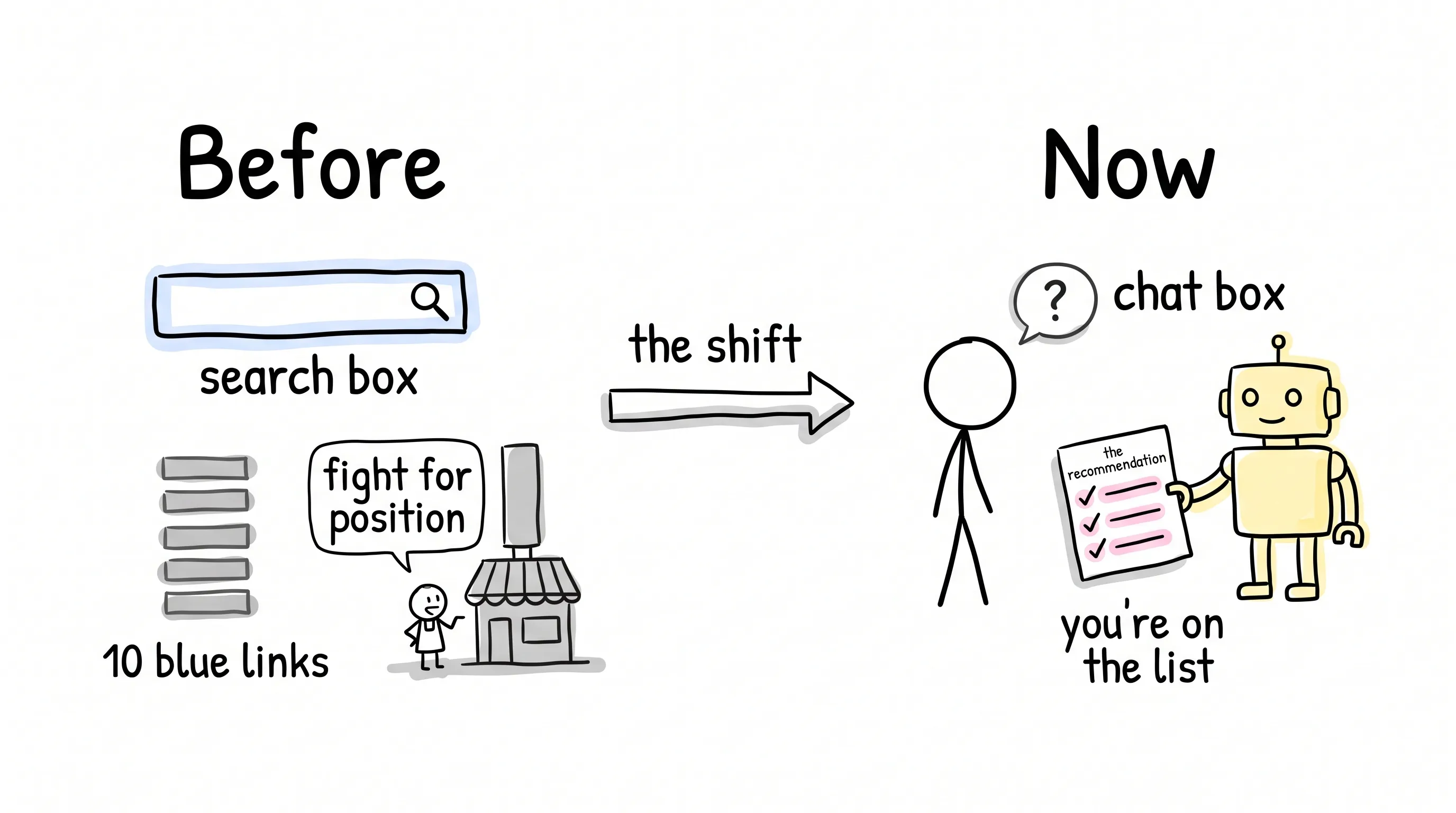
That's exactly what GEO does: getting AI to choose you, cite you, and recommend you in its answers. How? Content architecture, entity and brand positioning, digital PR, third-party authority signals, technical structures AI can actually crawl — plus GEO-specific measurement — all bundled into one strategy.
GEO, AEO, LLMO — Don't Mix Them Up
New buzzwords have been flying around for years now, and a lot of people use these terms interchangeably.
Don't. These are three different things. Let me untangle them.
AEO — Answer Engine Optimization. It fights to make you "the standard answer to this question." Featured snippets, voice-assistant responses, FAQs — that's its turf.
LLMO — Large Language Model Optimization. It governs how AI reads you: whether your content structure is clear and your semantics clean, whether models can digest you smoothly.
GEO governs what AI says about you.
One makes AI understand you. One makes you the answer. One makes AI recommend you.
AEO fights for "the answer is you." GEO fights for "you're on the list."
For most brands, it's the third one that's make-or-break.
But This Industry Has Murky Waters
GEO is too new. How new? Plenty of agencies have slapped a new cover on a three-year-old SEO playbook and called it GEO.
So how do you tell them apart?
Look at strategic depth. That was my strongest takeaway after going through all ten.
A good agency can answer one question clearly: why would AI cite you? Its answer is a complete playbook — content architecture, entity positioning, third-party validation — with every step pointing at "make AI trust you," plus measurement tied to AI results.
A bad one can't. Ask why, and all you get is more content, more backlinks, more technical specs.
When you're choosing, check five things:
- Specialization. Can they clearly separate GEO from SEO, AEO, LLMO, and PR? If they can't, it's probably a re-skin.
- Service coverage. AI visibility audits, content architecture, entity positioning, digital PR, comparison and category content, technical crawlability, GEO-specific reporting — if they can't tick these boxes, put a question mark next to them.
- Proof. Any hard evidence of AI citations? Can they explain how they pulled it off? A track record with no method behind it — don't trust it.
- Reputation. Dig through client reviews; focus on whether they discuss methodology and working style, and whether there are case studies from complex projects.
- Pricing. Legit quotes look like monthly retainers, phased engagements, or performance-based fees. Pure hourly headcount sales? You do the math.
Flip it around — five signals, and you run: SEO rebranded under a new name; only one trick — tech, content, or PR — piled on; no success stories to show; prices absurdly low; and never a word about measurement from start to finish.
Okay, groundwork done. On to the list.
September 2026: 10 Agencies Worth Knowing
This next stretch runs a bit long. Treat it like a trade-show walkthrough — I'll be your guide. For each one: who they are, where they're strong, who they fit, what getting started costs — with real case numbers woven in.
1. Minuttia: The All-Rounder That Changes Shape
This one takes the top spot, and its edge comes down to a single word: adaptive.
Minuttia is a content marketing agency that thrives in any climate, from Google to generative engines. It has its own in-house AI visibility tracking tool: strategy adjusts with the data, and it reshapes itself every time search engines shift.
Its services form an entire ecosystem: Google and AI search strategy, human content creation, AI content creation, digital PR, plus agent analytics reporting.
Who's it for? B2B SaaS and enterprises already in motion: $10M+ ARR, a solid marketing budget, and ambitions to rule long-term. One strong sample from its client roster: time-tracking tool Toggl, which passed $30 million in revenue back in 2024. Minuttia took its top-performing content to 7 million impressions, 27,000 clicks, and 200+ conversions.
Entry point: $4,000. Honestly, by the standards of this industry, that's cheap.
2. Chilli Fruit: Boutique and Focused, Stacking "Trust Points"
This one's interesting.
Chilli Fruit takes the boutique route — no chase for size and breadth; its play bends to each client's specific needs. Its strengths are digital PR and relationship-based link building. It firms up a brand's overall footprint, stacking trust signals inch by inch, rather than scattering a few mentions here and there.
And trust signals are exactly what LLMs weigh most when they pick sides.
A fit for mid-sized websites, SaaS in it for the long haul, B2B, and knowledge-based service providers. Case in point: social media listening tool Brand24 — it built the brand's topical authority and traffic up together. Those two happen to be the foundation of LLM visibility.
Pricing is opaque. No public rates anywhere — just one data point: sponsored placements start at $5,000.
3. Intero Digital: The Full-Stack Heavy Hitter
The biggest player on this list.
Intero Digital is a full-stack digital marketing company — paid media, social, web development, brand creative, all of it. Its GEO play is a trademarked exclusive called Intero GRO, Generative Response Optimization, which bundles modern SEO, digital PR, custom content, and cross-platform engagement into one coordinated push, aimed squarely at winning influence inside LLMs.
Behind it all, proprietary tools have its back. Take InteroBot, a bot that simulates a search engine crawler to hunt down your optimization blind spots. The thinking behind that tool? Genuinely impressive.
A fit for mid-to-large brands chasing full-funnel growth. Case in point: industrial equipment distributor Global Industrial — 1,200 appearances in AI Overviews, 24% organic growth.
You can start at $1,000. But don't celebrate yet: most projects land between $10,000 and $50,000, and content marketing engagements can climb to $200,000.
4. Respona: Technically Not an Agency, but You Should Look
First, a misconception to fix.
Respona itself is a digital PR and backlink platform — it finds opportunities, manages outreach, and accumulates brand mentions at scale. It doesn't count as a GEO agency. But its new done-for-you service lands right on GEO's vital spot: brand authority signals.
Here's how it works. Enter your domain, pick a publisher quality tier — the higher the tier, the better your odds of LLM citations. Next, set content guidelines: spell out how you want the brand to show up (not guaranteed — publishers have their own rules). Finally, set approval gates and timelines. Submit, pay, and a placement report lands in your inbox every month.
Fully managed — but the steering wheel stays in your hands.
A fit for overstretched marketing teams, early-stage startups, B2B companies with complex content, and even fellow agencies. Case in point: BI platform ClicData — in two years, traffic up 350%, 300+ top rankings, and 1,500+ new referring domains.
Pricing follows the tier, and bigger orders unlock steeper discounts. If what you need is LLM trust signals, the math usually beats hiring a traditional PR firm.
5. Seeders: A 13-Year Veteran with GEO Grown on SEO
Seeders has done SEO for 13 years and plays across borders, with clients in 50+ international markets.
Its GEO isn't a standalone product line; it grows out of the SEO foundation. I find that approach remarkably honest: AI visibility doesn't fall from the sky — it grows out of search authority. It's the ones forcing a "pure GEO" pitch you should watch out for.
A fit for companies going global and brands that need multi-market coordination; white-label partnerships welcome too. Case in point: language learning platform Preply — the Italy arm alone landed 1,000+ PR placements in local media.
Entry at $1,000; average SEO and GEO projects come in under $10,000. The most wallet-friendly tier on the whole list.
6. Webspero: The One-Stop Shop That Does It All
Webspero's signature is GEO plus NLQ — natural language query optimization — then bridging GEO with traditional SEO for coverage across multiple engines.
Its service menu is scarily wide: AI development, next-gen SEO, process automation, paid ads, content writing, web and mobile development. If you'd rather not juggle five or six vendors and want it all under one roof, Webspero will keep you very comfortable.
A fit for SMBs, B2B SaaS, local and global companies, and brands that need a site built. Case in point: skincare brand Hey6e — impressions up 85%, clicks up 50%.
Entry at $1,000. Marketing strategy projects run $10,000–$50,000; GEO can be done for under $10,000.
7. Omnius: Granularity Down to 22 Checkpoints
The most engineer-brained player of the ten.
Omnius specializes in AI search marketing for B2B SaaS and fintech. It has published a 22-point GEO strategy checklist — I counted — running from AI crawler optimization, llms.txt (a file sites publish to guide AI crawlers), and citation engineering, to zero-click queries, multimodal content, and per-platform competitive analysis. That granularity? Honestly, wow.
Beyond GEO, it also delivers B2B SEO, content marketing, programmatic SEO, and development-plus-conversion optimization.
A fit for SaaS and fintech companies that have found product-market fit and have growth budget to spend. Case in point: asset-backed lending company Myos — six months in, signups up 228%.
Entry at $5,000. One-off projects are sometimes billed hourly, at $50 an hour.
8. eSEOspace: Design and Search, Handled Together
eSEOspace is a growth agency that leads with web design and development. Its philosophy: search and design are two sides of the same coin when it comes to visibility. If the site can't stand, forget about being cited.
It even runs its own academy courses on SEO, GEO, and AEO.
Let me flag the weakness up front: limited deep GEO R&D and experimentation. If that's your core need, skip straight past it to the next one.
A fit for small and mid-sized businesses that need a new or rebuilt site and want SEO plus GEO plus AEO in one package. Case in point: TheraPro360, practice management software for physical therapists — AI visibility built up through an overhaul of site architecture and structured schema.
Entry at $1,000. GEO is billed hourly at $500–$3,000 per month. But note the trap in this model: run out of hours in a month, and you either pay more or wait for the next month.
9. Onely: Technical, Pricey, and Picky About Clients
Onely is an international player focused on advanced technical SEO and GEO. The approach is holistic: a hardcore technical foundation, deep data iteration, AI-oriented optimization. It spends freely on experiments and R&D, and keeps pace with how fast AI search changes.
Compare it with the last entry and you'll see: this is the "deep R&D" kind. Large sites, aged sites, structurally complex sites — that's its home turf. AI-facing site migrations, emergency rescues of plunging organic traffic, information architecture — all signature specialties.
A fit for large complex sites, B2B SaaS with long sales cycles, and companies that value deep research. Case in point: e-commerce retailer Thermodyne — beyond the Canadian division, visibility built up across the European, US, and UK divisions too.
Fair warning up front. Entry at $10,000 — not cheap. And it only takes clients planning a long-term partnership; if you're in for a one-and-done, look elsewhere.
10. LSEO: The One That Shows You the Whole Textbook
Closing out the list, LSEO is a full-service player — everything from SEO and GEO to paid media and web design.
Its LLM optimization service covers three things: LLM-oriented content optimization, schema and structured data, and FAQ and snippet optimization. All standard moves — no flashy tricks.
So why does it make this list?
Its GEO knowledge base. From GEO's first principles to platform-specific playbooks for every LLM, all laid out in public. Its methodology follows the platforms too — different AI platforms, different moves. That kind of transparency is rare among agencies.
A fit for companies wanting integrated digital marketing; it takes on big, mid-size, and small alike, in any industry. Case in point: home security brand Ring — rankings up 100%, with several fiercely competitive keywords going straight to the top.
Entry at $10,000. Exact GEO pricing isn't public — you'll have to ask.
Three Scenarios, Straight Answers
After all ten, you might be more overwhelmed than when you started. Don't panic. For the three most common scenarios, I'll just give you the answer.
Just starting out, budget tight? Look at these four: Minuttia, Chilli Fruit, Respona, Omnius. Startups need results that are fast and measurable, progress on both fronts — SEO and AI discovery — and someone in their corner. Chilli Fruit stacks authority signals fast, Respona lets you order per engagement without an annual contract, Omnius understands technical startups best, and Minuttia shows real GEO results even on a small budget.
Enterprise? Look at these five: Minuttia, Intero Digital, Onely, Seeders, LSEO. Enterprises want different things: long-term roadmaps, cross-team coordination, compliance, low risk. Minuttia has the most complete framework, Intero coordinates across the full stack, Onely has the hardest-core tech, Seeders covers multi-country operations, and LSEO's audits and benchmark reports are rock solid.
B2B SaaS? Look at these five: Minuttia, Omnius, Onely, LSEO, Intero Digital. SaaS purchase decisions are complex, and the comparisons, alternatives, and categories inside AI answers are today's shelf space. Minuttia excels at category narrative and comparison content, Omnius goes deep on technical architecture and feature-level structuring, Onely untangles the tech on large sites, LSEO brings complete audits and competitive benchmarks, and Intero suits mid-to-late-stage SaaS embedding GEO into a bigger growth machine.
One last reminder. Prices and reviews on a list like this all have expiry dates. Before you sign, go talk to them yourself. Make them answer one question clearly: why would AI cite your brand? Clear answer — give it ten more minutes. Muddled answer — stand up and walk.
Finally, Back to That Dinner
At the end of that dinner, my friend asked me: if I start catching up now, is it too late?
I told him the window is still open — just genuinely narrower than two years ago. Once AI's recommendation list hardens into "the default option" in users' minds, squeezing in as a latecomer gets ten times harder.
AI has become the new middleman. Brands aren't found anymore — they're recommended.
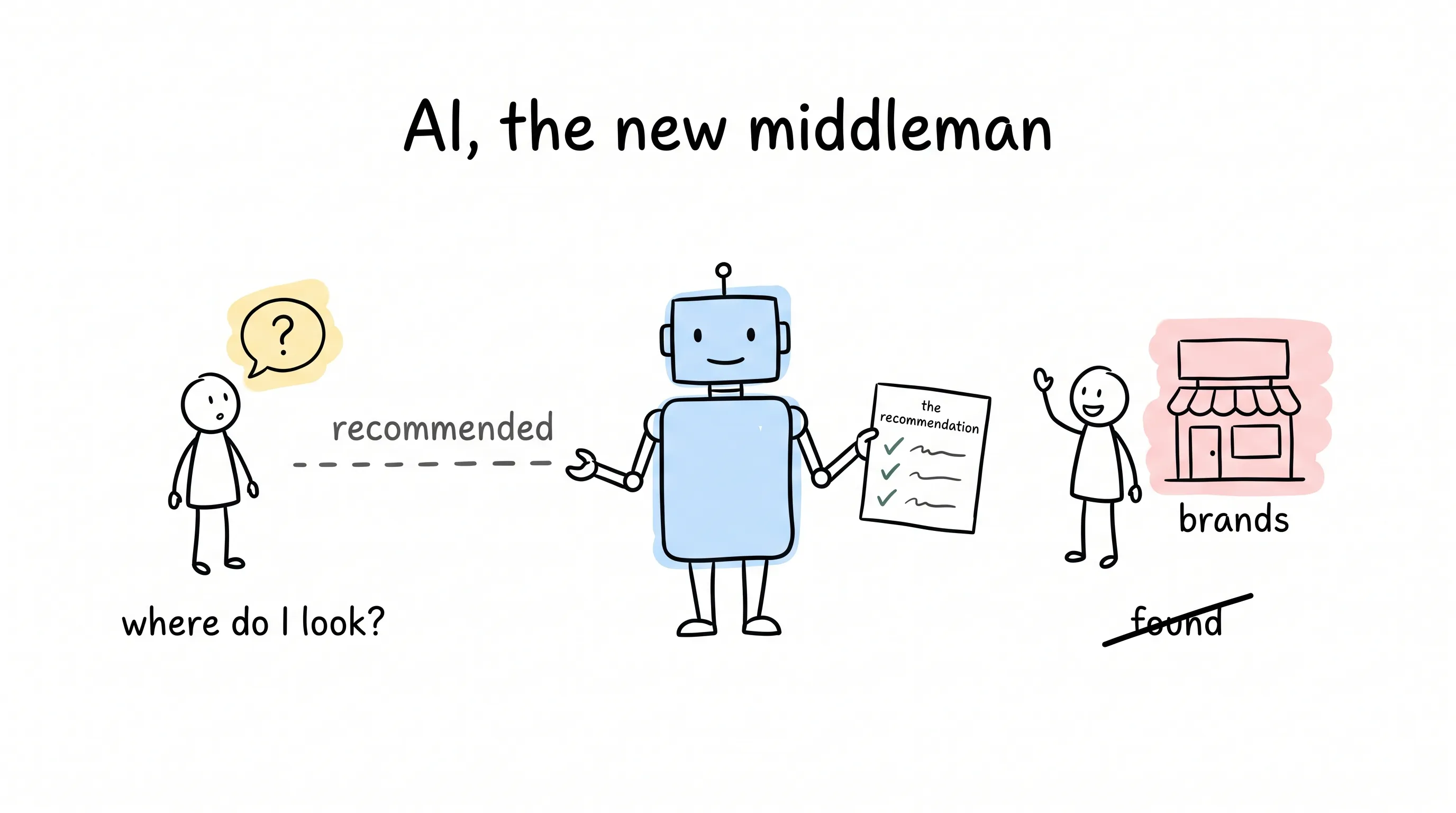
Whether you make that recommendation list — starting today, that's a job someone has to own.
Here's to always being on the first line of AI's recommendation.
Continue reading
Related articles

Cross-Border Business: Time to Upgrade Your AI Toolbox
A learn article explaining how AI tools help cross-border e-commerce sellers clear five hurdles: language, regulation, logistics, payments, and fraud. It outlines a five-compartment toolbox, a five-step adoption path, and metrics such as conversion rate and CLV, while cautioning against over-reliance on AI.

AI Is Taking Over the Dirty Work of Social Media Marketing, One Task at a Time
This learn article outlines four social media marketing tasks AI can handle — audience analytics, content drafting and design, ad targeting and creative testing, and spam moderation — and cautions that taste, judgment, and data security remain human responsibilities.

AI Is Already This Good — Why Is Your Social Media Marketing Still Pure Manpower?
An overview of 18 AI tools for social media marketing, organized into six categories covering audience research, content creation, scheduling, comment and DM handling, ad management, and visual production, plus notes on personalization, prediction, and emerging trends.