
What Has AI Actually Saved Cross-Border Sellers? Let's Run Three Accounts
A learn-format piece breaks down what AI saves cross-border e-commerce sellers into three areas: labor via automation, cheaper multilingual video content, and higher conversion through localized listings and automated ad delivery, illustrated with seller anecdotes.
A few days ago, a friend of mine who runs a cross-border e-commerce business was venting to me. He said there's a saying going around the industry lately: with AI, the question is no longer whether you use it — it's who masters it first, and who gets the edge first.
When he said it, he sounded half defiant, half anxious.
I asked him: so, have you used it?
He gave a sheepish chuckle: I have. But somehow it never feels like it's going where it counts.
I thought about it, then told him a few stories I'd come across recently. When I finished, he said: so it turns out the problem isn't that I don't know how to use AI — it's that I never even stopped to think about what I should be letting AI save for me.
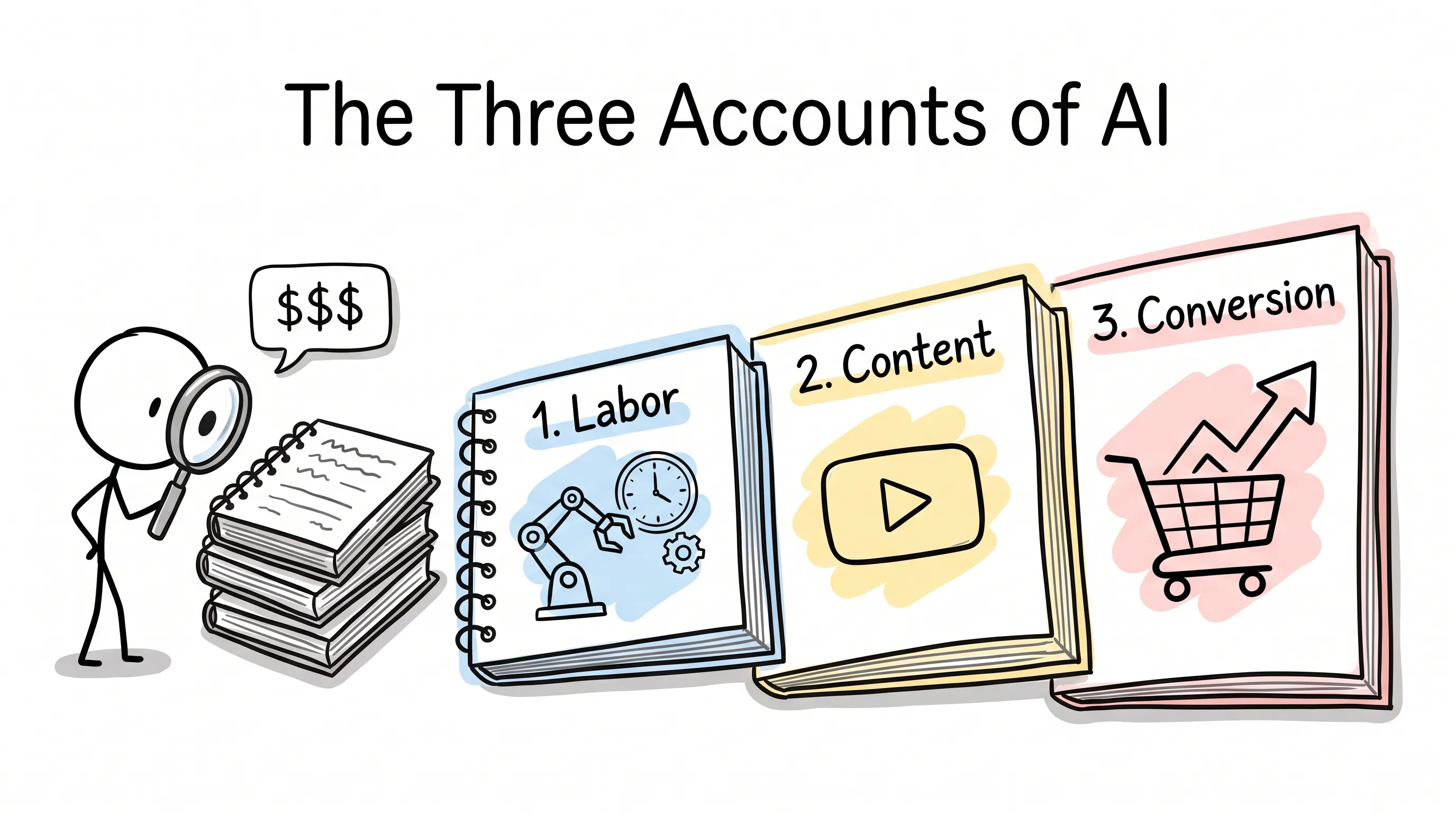
Today, I'll tell those stories to you too. By the end, you'll see that AI in cross-border e-commerce, once you break it apart, comes down to three accounts.
First, a Story
In Quanzhou, there's a slipper seller named Liu Shiqi.
When he first started out, he began work at three in the afternoon and kept watching his screen until nine the next morning. Why? His customers were in Europe and in the United States — their middle of the night was exactly our daytime. The moment an inquiry came in, if you didn't pick it up, the order was gone.
Impressive. But it was burning yourself out for money.
Later he changed his approach and handed product selection over to AI. He let AI analyze big brands' new releases, historical bestseller numbers, layered on top of trend signals. He kept just one job for himself: making the final call.
And the result? He came up with a pair of "ugly slippers," sold overseas at 145 US dollars a pair. That's over a thousand RMB, with a 92% gross margin.
One pair of slippers. 92% gross margin.
What's scarier is the efficiency. He used to grind out a new product in a month and a half; now he can turn out several hundred in a day. His daily work now: open the AI-generated spreadsheet, give it a scan, and send the designs he likes to the factory.
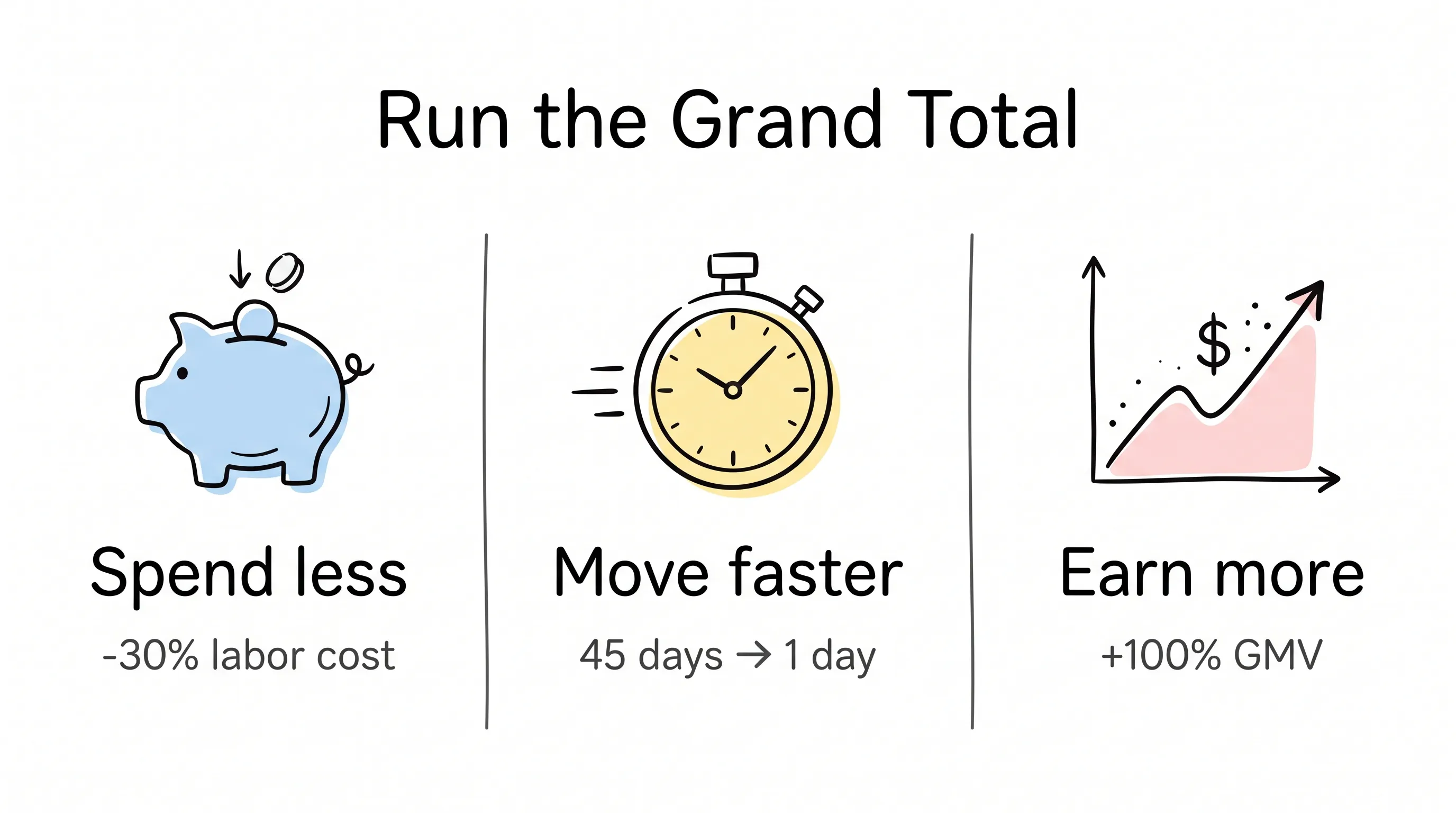
From 45 days, down to 1 day.
Tell me — how much is the time saved in between worth?
The First Account: Labor
What's the labor account?
It's the repetitive work that requires no creativity. It used to take headcount. Now it can take AI.
One example. Jihong, a listed company doing cross-border social e-commerce, built its own platform called Giikin AI+ and embedded AI into every stage — product selection, ad buying, customer service, fulfillment. Overall operating efficiency rose by more than 60%, and labor costs dropped by roughly 30%.
Sixty percent — what does that mean?
Think about it: work that used to take 10 people now takes 7 people plus AI — and it's not just getting done, it's getting done better.
Now for a tougher one. The underwear brand ubras runs its Amazon store with just 2 people, producing the output of a traditional 10-person team.
2 people doing the work of 10. The 8 salaries saved — is that not pure profit?
You might say: someone real has to handle customer service, right? When customers come asking in the middle of the night, you can't just not reply?
Turns out you don't need a human standing by. That's exactly what AI customer service is for. It doesn't sleep, so "off duty" isn't a thing. You go to bed; it stays on shift.
The Second Account: Content
Cross-border selling has another stubborn pain point: shooting video is brutally expensive.
In the US, a 1-minute brand video starts at tens of thousands of dollars. You think that's the end of it? If you're selling in 10 countries, you need 10 language versions, 10 sets of cultural adaptations. Cost times 10.
Good grief.
And now? AI-generated video costs about a tenth of the original. Where one clip used to cost tens of thousands, a few hundred dollars now buys you dozens of clips. Whatever angle a given country responds to, that's the clip you run there.
Same budget. Before, enough for a single shot. Now, enough to cover an entire wall.
The Third Account: Conversion
The first two accounts are about saving costs. But the real life-or-death line in cross-border e-commerce is conversion rate.
If conversion doesn't climb, your ad spend is money poured down the drain.
Start with ad delivery. TikTok launched an automated campaign tool called GMV Max. You just set your GMV (gross merchandise value) target and daily budget, and the system runs the whole loop itself — building creatives, delivering ads, tuning. The official line: before, you drove the car yourself; now you sit in the back seat. In early tests, more than half of advertisers saw GMV grow by over 100%.
Same ad spend, double the goods sold. Is the difference not also money you saved?
Now, localization. The core logic of how AI lifts conversion, bluntly stated, is one sentence: make customers in every country feel you're a local brand.
Here's a true story. In a mountain village in Guangxi, there's a rattan-weaving artisan named Huang Lianjiang, an inheritor of intangible cultural heritage (an officially recognized bearer of a traditional craft). She doesn't speak foreign languages, and back in the day, the only way to get her products to market was hauling them out of the village by ox cart.
Then she started using the AI business assistant on Alibaba.com (Alibaba's international B2B marketplace). The AI told her: European customers care deeply about eco-friendliness and will pay more for sustainable products. She took it in, made eco-friendliness the lead for the European market, and developed products like bread storage and home storage pieces. The AI also rewrote her product titles and translated them into several European languages.
After the change, the precision of her store's inquiries rose by 30%.
The same product, in the US market, got a different pitch from the AI: lead with natural texture and the handmade feel.
Think about that move for a second: rattan baskets woven by the same pair of hands are "eco-friendly" in Europe and "handmade" in America.
The right message, told to the right people. Conversion rate is built up exactly like that, little by little.
Running the Grand Total
Once you've run all three accounts, you'll notice that what AI does is actually remarkably plain:
Where money is spent, make it spend less. Where time is burned, make it move faster. Where revenue is made, make it earn more.
And don't panic thinking all of this is exclusive to big companies. Quite the opposite — the barrier to entry for these tools is dropping at a pace you can see with the naked eye. AI that only big corporations could afford is now within reach of individual sellers.
Finally, back to that friend from the beginning.
That day, when the stories were done, I left him with one line. I'll leave it with you too:
AI won't eliminate sellers. But sellers who use AI are eliminating sellers who don't.
That's no scare tactic. When that slipper seller in Quanzhou was pushing hundreds of new designs a day, his competitors were probably still asking in group chats: any good product-selection software you'd recommend?
Here's hoping you get those three accounts sorted — soon.
Continue reading
Related articles

Cross-Border Business: Time to Upgrade Your AI Toolbox
A learn article explaining how AI tools help cross-border e-commerce sellers clear five hurdles: language, regulation, logistics, payments, and fraud. It outlines a five-compartment toolbox, a five-step adoption path, and metrics such as conversion rate and CLV, while cautioning against over-reliance on AI.

AI Is Taking Over the Dirty Work of Social Media Marketing, One Task at a Time
This learn article outlines four social media marketing tasks AI can handle — audience analytics, content drafting and design, ad targeting and creative testing, and spam moderation — and cautions that taste, judgment, and data security remain human responsibilities.

AI Is Already This Good — Why Is Your Social Media Marketing Still Pure Manpower?
An overview of 18 AI tools for social media marketing, organized into six categories covering audience research, content creation, scheduling, comment and DM handling, ad management, and visual production, plus notes on personalization, prediction, and emerging trends.