
What Does Marketing with AI Actually Mean? Let Me Tell You 3 Stories First
An explainer on using generative AI in marketing, contrasting traditional analytics that report the past with AI that drafts copy, emails, and audience segments. It walks through brand case stories, argues first-party data is the foundation, and outlines a three-step maturity path plus human-in-the-loop safeguards.
A while back, I had dinner with an old friend who has spent more than a decade in marketing.
Over dinner, he vented: his budget had just been cut by 20%, and his boss was still asking whether he could double the output.
I said he could.
He froze. "Have you been drinking?"
I hadn't. But I threw a question back at him: this "marketing with AI" you keep talking about — which half of what AI can actually do are you using?
He didn't have an answer.
No surprise there. Practically every marketing team talks about AI these days, but most treat it as an intern who just writes faster. The companies actually capturing the gains treat it as something entirely different.
What is generative AI, anyway?
You might say, I know this one — I use ChatGPT every day.
Hold on. That's not what I mean.
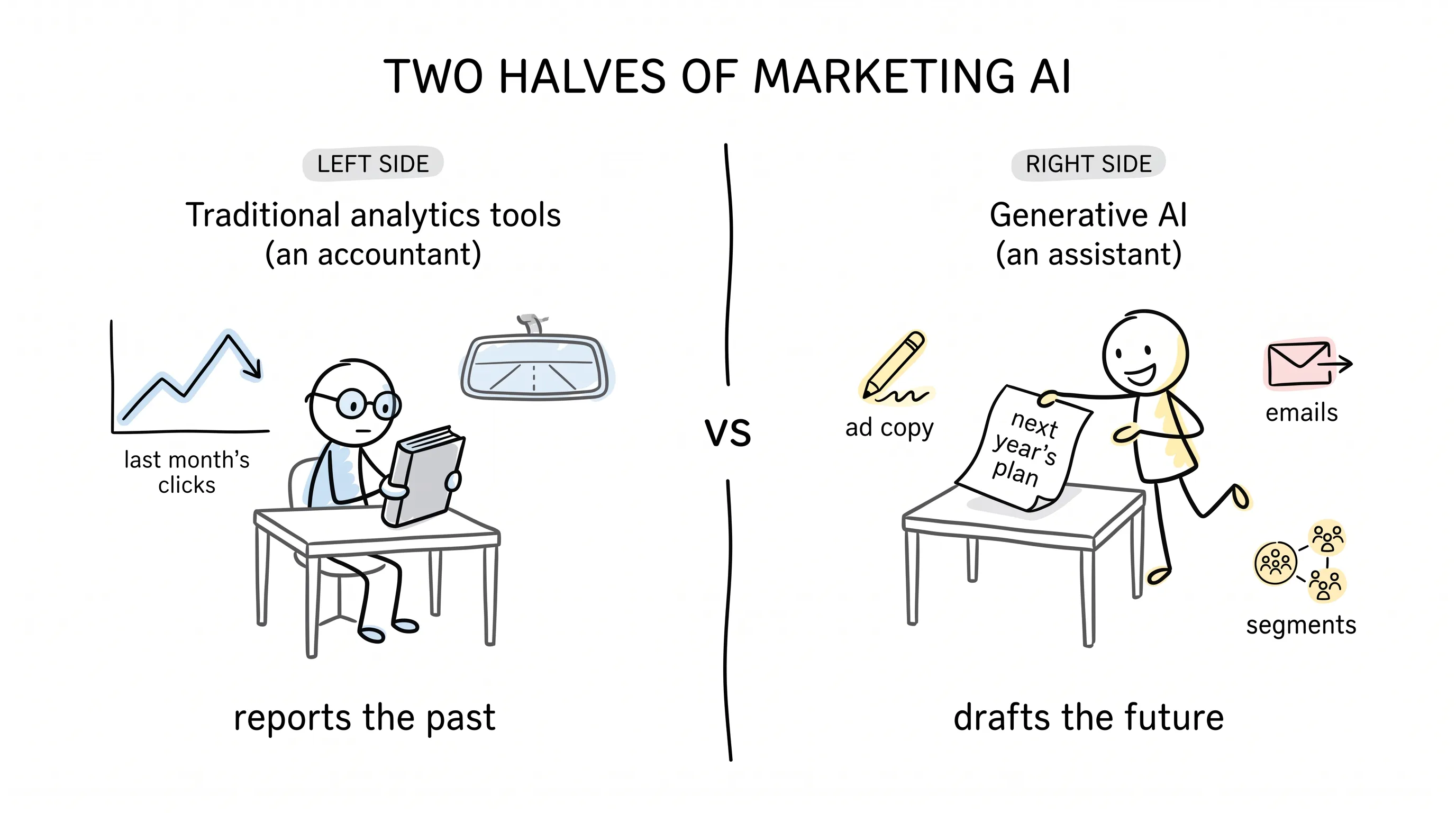
The marketing tools we've always used — reports, dashboards, whatever the flavor — essentially do only one thing: tell you how many times last month's ads got clicked and which channels swallowed your money. Smart, sure. But they only report the past.
Generative AI is different. It doesn't just watch — it does. Ad copy, email subject lines, audience segments, product recommendations, image assets, strategy summaries: all of it can be produced directly. Work that used to take weeks now takes hours. Test, tweak, and test again.
Here's an analogy.
Traditional tools are like an accountant: they help you make sense of last year's books.
Generative AI is like an assistant: it drops the first draft of next year's plan straight onto your desk.
That's the difference.
So how common is this already? A survey by the American Marketing Association found that 71% of marketers use generative AI every week. Every week.
Why the surge? Think about how marketers have been living these past few years: budgets cut again and again, with the boss repeating ROI like a daily mantra. Worse, AI search is rewriting how consumers discover products, and the old playbook is losing its punch.
If you don't find leverage, what else can you do?
But simply "using it" gets you nowhere. Let me tell you 3 stories, and you'll see exactly where the gap lies.
Story 1: Pandora's 65 Million Emails
Yes, that Pandora — the jewelry brand.
They send 65 million personalized emails a year. Sixty-five million — every single one different. Each one is tuned individually to your purchase history, your browsing habits, and where you are in the customer journey.
The result: open rates up 50% compared with one-size-fits-all sends.
Fifty percent. What does that mean? The same email list, not one extra dollar of media spend — just turning "ten thousand people receiving the same letter" into "ten thousand people receiving ten thousand versions."
No human team can do this. Hire all the copywriters you want — you'll never keep up.
Story 2: Skechers Won Its Churned Customers Back
Skechers ran into the problem every brand dreads: churned customers.
They buy once, then vanish. The win-back emails of the past went out and sank without a trace.
So they changed the approach. First they scored customers by lifetime value and activity level to pick out "the people most worth winning back," then rewrote the messaging for each group from scratch.
Result: click-through rate up 324%, cost per click down 68%.
Same people, same budget. A different logic, and the results more than tripled.
That's remarkable.
Story 3: HP Compressed Five Hours into One
HP pulled all of its first-party data into one place and let marketing teams build audience segments themselves.
Before: building a single audience took five hours, minimum.
Now: one to two hours, done. And 400 million records process in seconds.
Staggering. No amount of overtime gets you that.
There are plenty more stories like these. HSBC uses machine learning in its PayMe app (HSBC's mobile payment app in Hong Kong) to read the intent behind every transaction and push personalized suggestions on the spot — engagement jumped 4.5x. Walk into a Burberry store, and before you say a word, the in-store associate's terminal already knows you looked at three trench coats on the brand's website last week; they know exactly what to recommend. After Acxiom unified its clients' data in one place, the time-to-launch for actionable insights shortened by about 30%. And Publicis Groupe consolidated data analytics onto a single platform, cutting its data teams' operating costs by 22% while lifting efficiency by 30%.
Notice anything?
The common thread in these stories has nothing to do with how beautifully the copy reads.
It's the data.
Pandora's emails, Skechers' scoring, HP's segmentation — behind them all is the same move: feeding clean, structured first-party data to the model.
The smoother the ground, the faster the car goes.
This also explains something else: why do so many people use ChatGPT for two years and their marketing stays exactly the same?
Because you're using a general-purpose brain. Off-the-shelf tools like ChatGPT, Claude, and Perplexity are quick to pick up and easy to start with — brainstorming, first drafts, summarizing research, all with instant results. But they were raised on the common knowledge of the entire internet. They don't know how your brand talks. They don't know who your customers are. They certainly don't know which campaign flopped last quarter.
Whatever it gives you, your competitors can get too. And in marketing, it's precisely differentiation that carries the value.
To make it speak in your voice, you have to feed it your own assets: brand voice guidelines, historical campaign data, customer insights, product catalogs. Cross that line, and AI stops being a communal typewriter and becomes your marketing engine.
By the way, at that stage the marketing machine runs on two engines at once: a predictive model, handling who to reach and when; a generative model, handling what to say and how to present it. Lose either one, and the machine won't run smoothly.
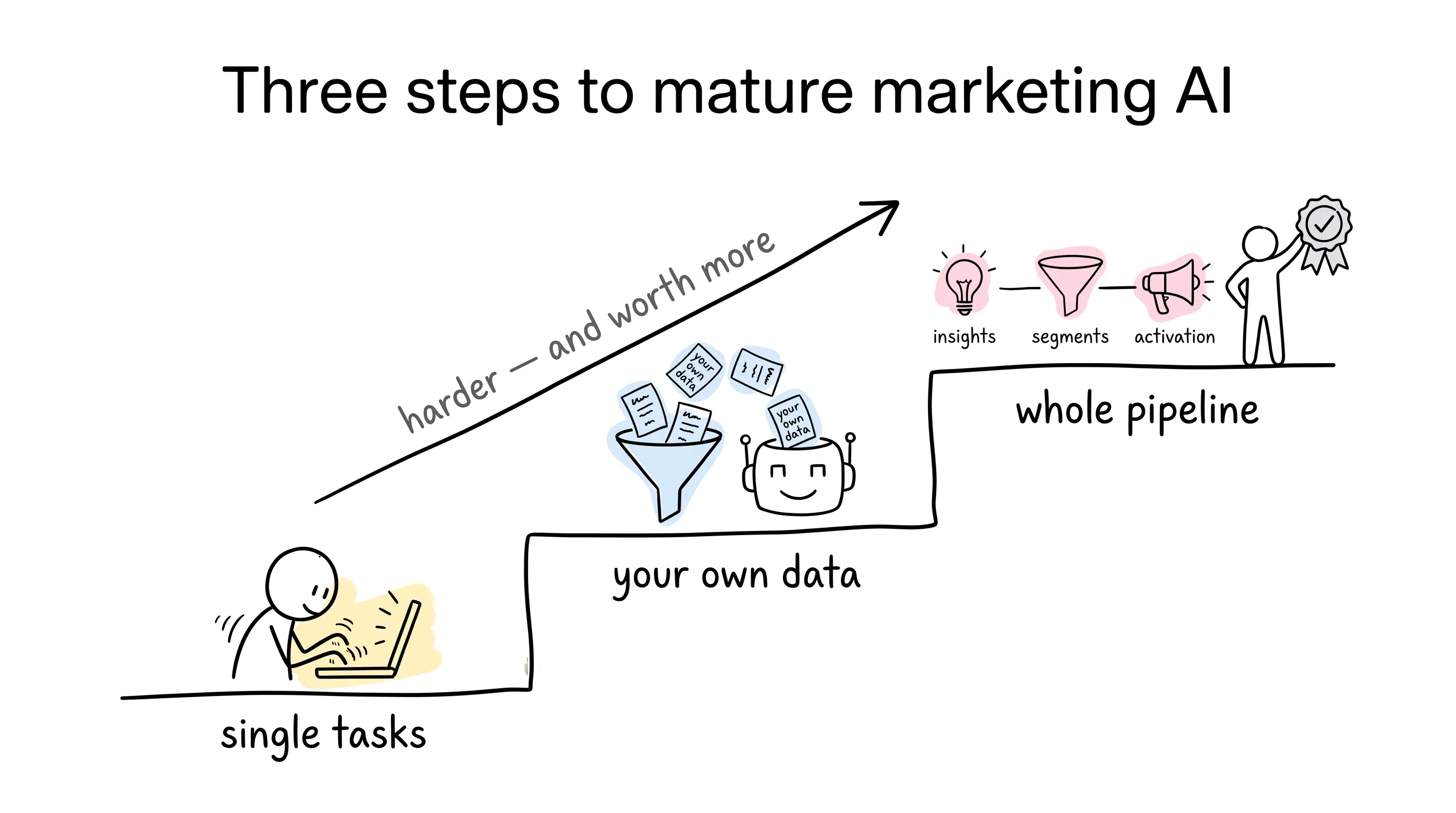
Mature companies tend to climb three steps.
Step one: use off-the-shelf tools to speed up single tasks — copy, assets, the basics.
Step two: train the model on your own data so it understands your business, and output starts lining up with business goals.
Step three: embed AI into the entire marketing pipeline. Insights, segmentation, activation, post-mortems — AI is involved at every step, with humans in charge of judgment and final calls.
Each step is harder than the last — and worth more.
But Don't Rush In Just Yet
Time for a bucket of cold water.
Generative AI has a flaw: it makes things up with a perfectly straight face.
Ask it to write product copy, and it might invent a feature that doesn't exist. Ask it to summarize customer feedback, and it might quietly leave out half the voices. Bias in its training data can also shut entire groups of people out without anyone noticing.
Then there's the privacy line. Marketing data is packed with personal information, and regulatory red lines like GDPR and CCPA cannot be crossed — not once. Cross them, and the fine is the small part; losing trust is the part that kills.
Worse still is brand drift. Have AI write a hundred pieces in one go, and you may get a hundred different voices.
So what do you do?
Four words: human in the loop.
AI produces the first draft, humans give the final sign-off. Every piece of outward-facing content needs someone accountable for it. Data needs access controls, output needs quality spot checks, and models need regular reviews — did they say anything wrong, has the tone wandered off?
And before you start, think it through. What do you actually want: higher conversion, shorter production cycles, lower acquisition costs, or faster post-campaign reviews? If the goal never makes it onto paper, no matter how strong the tool, it's just wasted ammunition.
The rollout sequence is unglamorous but simple.
First, do the math. Set targets, record baselines — otherwise you can't even say whether things improved.
Next, clean house. Get your first-party data scrubbed and straightened out. This step is the most boring — and the most critical.
Then pick your tools. Run a small pilot with real marketing data; don't rip out your existing systems right out of the gate.
Then take small steps. Start with low-risk work like email subject lines and ad copy drafts, and get a feel for it first.
Finally, keep a close watch. Watch accuracy, watch brand consistency, and check whether the model has been led astray by new data.
Don't skip any of these steps.
Finally, Back to That Dinner
The first thing my friend did when he got back? You'd never guess.
Buy tools? No.
He spent two weeks cleaning the customer data scattered across seven systems, from start to finish.
Three months later he told me that this one thing alone brought segmentation time down from five hours to one. For the first time, the team felt that AI had actually come to help.
So you see — Pandora's 65 million emails, HP's 400 million records — it all comes down to the same truth: data is the foundation; AI is the leverage.
AI won't make judgment calls for you. It just takes what you get right and amplifies it tenfold.
Anyone can buy the tools. The foundation, you have to pour yourself.
Here's to building your foundation on data — not on slogans.
Continue reading
Related articles

Cross-Border Business: Time to Upgrade Your AI Toolbox
A learn article explaining how AI tools help cross-border e-commerce sellers clear five hurdles: language, regulation, logistics, payments, and fraud. It outlines a five-compartment toolbox, a five-step adoption path, and metrics such as conversion rate and CLV, while cautioning against over-reliance on AI.

AI Is Taking Over the Dirty Work of Social Media Marketing, One Task at a Time
This learn article outlines four social media marketing tasks AI can handle — audience analytics, content drafting and design, ad targeting and creative testing, and spam moderation — and cautions that taste, judgment, and data security remain human responsibilities.

AI Is Already This Good — Why Is Your Social Media Marketing Still Pure Manpower?
An overview of 18 AI tools for social media marketing, organized into six categories covering audience research, content creation, scheduling, comment and DM handling, ad management, and visual production, plus notes on personalization, prediction, and emerging trends.