
What Does It Mean to Get AI Right? Let Me Tell You 10 Stories
A learn article compiling ten public cases of companies applying generative AI across the customer journey, from service assistants and content generation to employee support and dynamic out-of-home ads.
A while back, I had my team do one thing: compile a list of public cases from the past two or three years of companies using generative AI in customer experience.
The colleague in charge of compiling it complained to me: most of the cases look exactly alike.
Meeting notes. Chatbots on the service line. A couple of marketing blurbs while they're at it.
That's not a competitive gap — that's table stakes.
But the list had 10 stories that were a bit different.
These 10 companies worked AI into specific steps of the customer journey — and made the numbers work.
What does it mean to get AI right? Let me tell you.
1. Put AI in Front of the Customer
Delta: A Butler Who Speaks First
Delta put a "butler-style" AI assistant inside its own app.
What does butler-style mean? It doesn't wait for you to ask — it speaks first. Real-time flight updates, personalized itinerary suggestions, even exclusive deals — all pushed to you proactively.
The result? Routine questions like "What time is my flight?" or "How do I change my booking?" basically stopped reaching human agents.
Contact volume came down, wait times got shorter, and human agents finally freed up their hands to deal with the genuinely messy stuff.
And Delta isn't planning to stop. Next, it wants to connect more experiences on Amazon Bedrock, and it's toying with using AI for dynamic pricing.
Hopper: Making AI Speak Out Loud
In 2024, online travel platform Hopper took on something harder: making AI go from typing to talking.
It built a dedicated voice agent, trained on real customer conversations, focused on polishing high-frequency issues like refunds, cancellations, and rebookings. At launch it also came with explicit guardrails — what the AI is allowed to say, and what must go to a human — written down in black and white.
Today, AI catches 10% to 15% of repeat questions first. Humans step in only at planned points.
Even more remarkable, Hopper publicly shared its own missteps: focus first on your top five needs, and stop obsessing over metrics like "deflection rate" and "containment rate."
Good grief. Candor like that is vanishingly rare.
Klarna: Among the First to Pounce
Klarna moved even earlier. When ChatGPT first appeared, it was one of the first companies to pounce — and the first in Europe to launch its own ChatGPT plugin.
Two years on, a single AI assistant was catching more than two-thirds of its customer service conversations.
Two-thirds. Let that number sink in.
Later Klarna announced it would rebuild its entire tech stack with generative AI, swapping out every legacy system nobody used.
But once the big announcement was out, it quietly walked some of it back.
Because tearing down a tech stack is a lot harder than shouting slogans about one.
2. Let AI Get Things Done for the Customer
Booking.com: A Personal Tour Guide, Online 24/7
After the pandemic, what did travel platforms lack most? Trust. Users had been burned by cancellations and rebookings.
Booking.com's answer was to send AI straight to where customers make decisions.
One tool, called Smart Filter, uses generative AI to sweep the site's entire inventory. You say what you want, and it hands you a custom list based on your preferences.
Another one, Property Q&A: any question about a listing, just ask — instant answer.
It's like giving every user a personal tour guide who's online 24/7.
Intuit: Turning Tax Filing into "Done for You"
Intuit — the company behind TurboTax, the one that helps Americans file their taxes.
Together with Google Cloud, it packaged a visual recognition platform, Gemini models, and Doc AI into its own GenOS.
Tax filing went from "you fill it in yourself, box by box" to "we'll handle it for you": the system reads the documents itself, fills in the forms itself.
Faster, and a lot harder to get wrong.
3. Let AI Into the Content Workshop
Puma: No More Photo Shoots for a Shoe
How else do you photograph a shoe?
Puma's answer: don't shoot. Generate.
It uses Google's Imagen 2, running on Vertex AI. The same shoe, placed on a Berlin street corner today, on a tropical beach tomorrow — whichever scene matches the product's vibe, that's where it goes.
The images feel closer to real-life use, they look more appealing to users, and click-through rates and conversion rates both went up.
And by the way, all that endless studio shooting and retouching? Saved too.
Amarra: A Dress Seller with Big-Company Reflexes
Amarra sells prom dresses and wedding gowns — about the last company you'd associate with high tech.
Yet every product description is written by AI. One every few seconds. Detailed. SEO-friendly. And crucially, they actually convert.
Copy for thousands of dresses, no longer a matter of throwing bodies at it.
In the back end, AI also manages inventory and logistics: excess inventory cut by 40%.
It even reads trends out of customer search and returns data to decide what to stock and which styles to push next.
A small-to-midsize company, running with the feel of a major retailer.
Coca-Cola: Let the Users Play
Coca-Cola was among the first brands to "let users do it themselves."
The "Create Real Magic" campaign: open up brand assets, pair them with tools like DALL-E, and invite fans to create their own works.
The result: thousands upon thousands poured in. AI-generated designs of every kind, everywhere you looked.
The community grew, social media lit up, and Coca-Cola picked up an entire library of marketing assets along the way.
And it hasn't stopped since. It has made AI video ads too — some stunning, some flops.
Normal. You can't experiment without a few crashes.
4. Let AI Advise the Employees
JPMorgan: Three Advisors Crammed into One Chat Box
When markets get choppy, what's the sentence clients dread hearing most?
"Let me check on that and get back to you."
JPMorgan gave its wealth advisors a Coach AI. Research lookups, drafting recommendations, preparing meetings — Coach goes first on all of it.
It's like a market analyst, an assistant, and a strategist, all crammed into a single chat box.
From 2023 to 2024, sharper client interactions drove gross sales up 20%. AI in fraud prevention and decision-making saved another $1.5 billion.
But the biggest return is hiding in the experience itself. Advisors walk in better prepared. Conversations carry more substance.
Clients can feel it.
5. Finally, the One That Went Most Viral
PODS: The Smartest Billboard in the World
PODS, a moving and storage company.
It put billboards on trucks. And the billboards change with the neighborhood: wherever the truck drives, the message changes with it.
How?
First, train a Gemini model on Vertex AI, feeding it project plans, brand guidelines, and video scripts, all in one go.
Then have Gemini write copy tailored to each neighborhood, hooked up to real-time data from Google Cloud. Time, weather, traffic — all factored in.
Creative agency Tombras gave it a name: the smartest billboard in the world.
Within a week, online visits rose 60%, and quote requests rose 33%.
Good grief. One billboard — a thousand people, a thousand faces.
And That's All 10 Stories
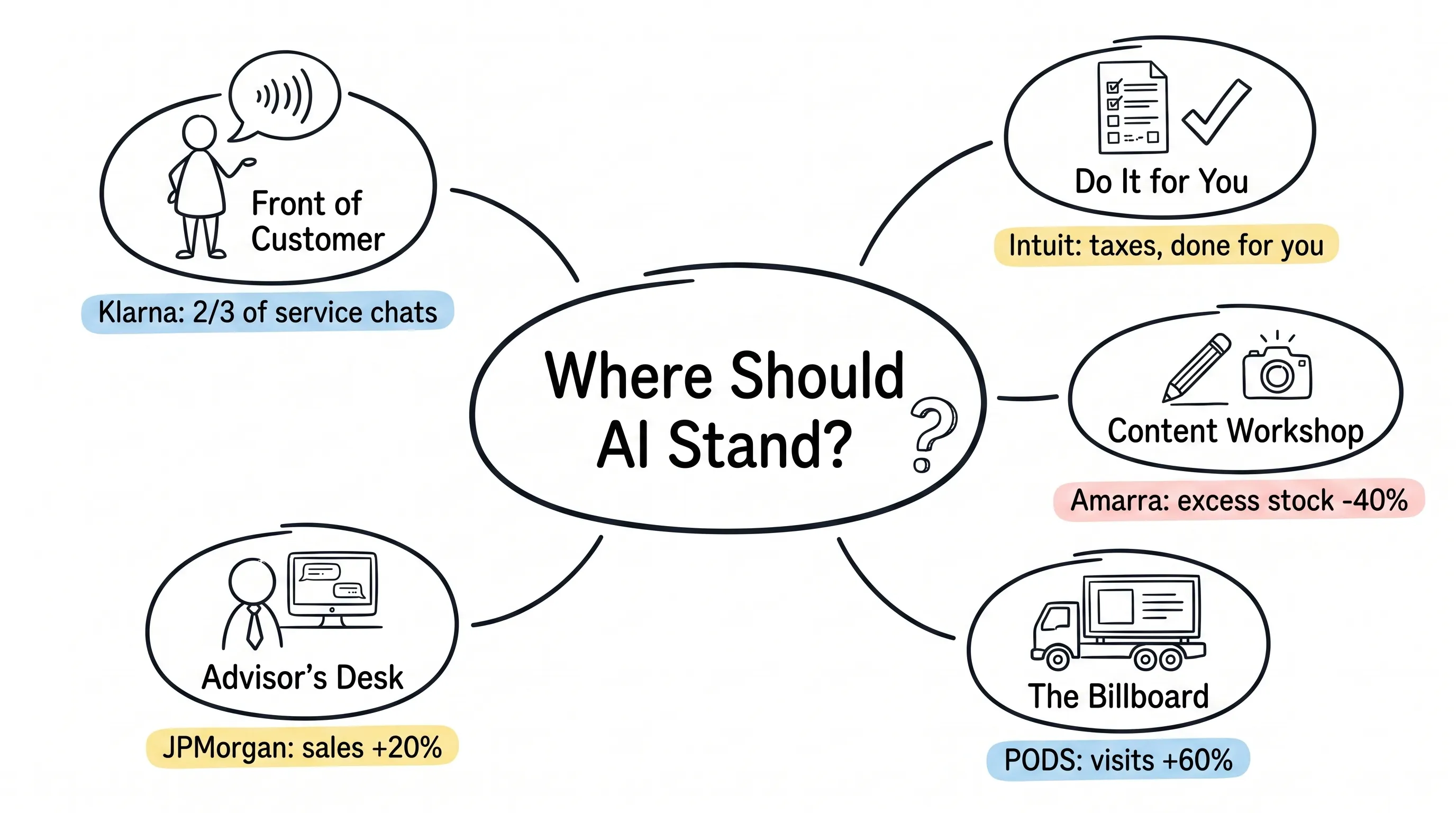
Have you noticed? Not one of these 10 companies was asking "should we use AI?"
They were all asking something else: where in my customer journey should AI stand?
Standing in front of problems, sitting in on decisions, working the content floor, perched on employees' desks — or simply becoming a billboard.
And now it's the AI agents' turn to take the stage. From "you ask, I answer" to "you say it, it gets done."
Marketing, sales, onboarding, service, retention — every touchpoint deserves to be redesigned.
That list of cases is still pinned to the whiteboard in our office. Every time someone argues about whether AI is worth the investment, I point them to these 10 companies.
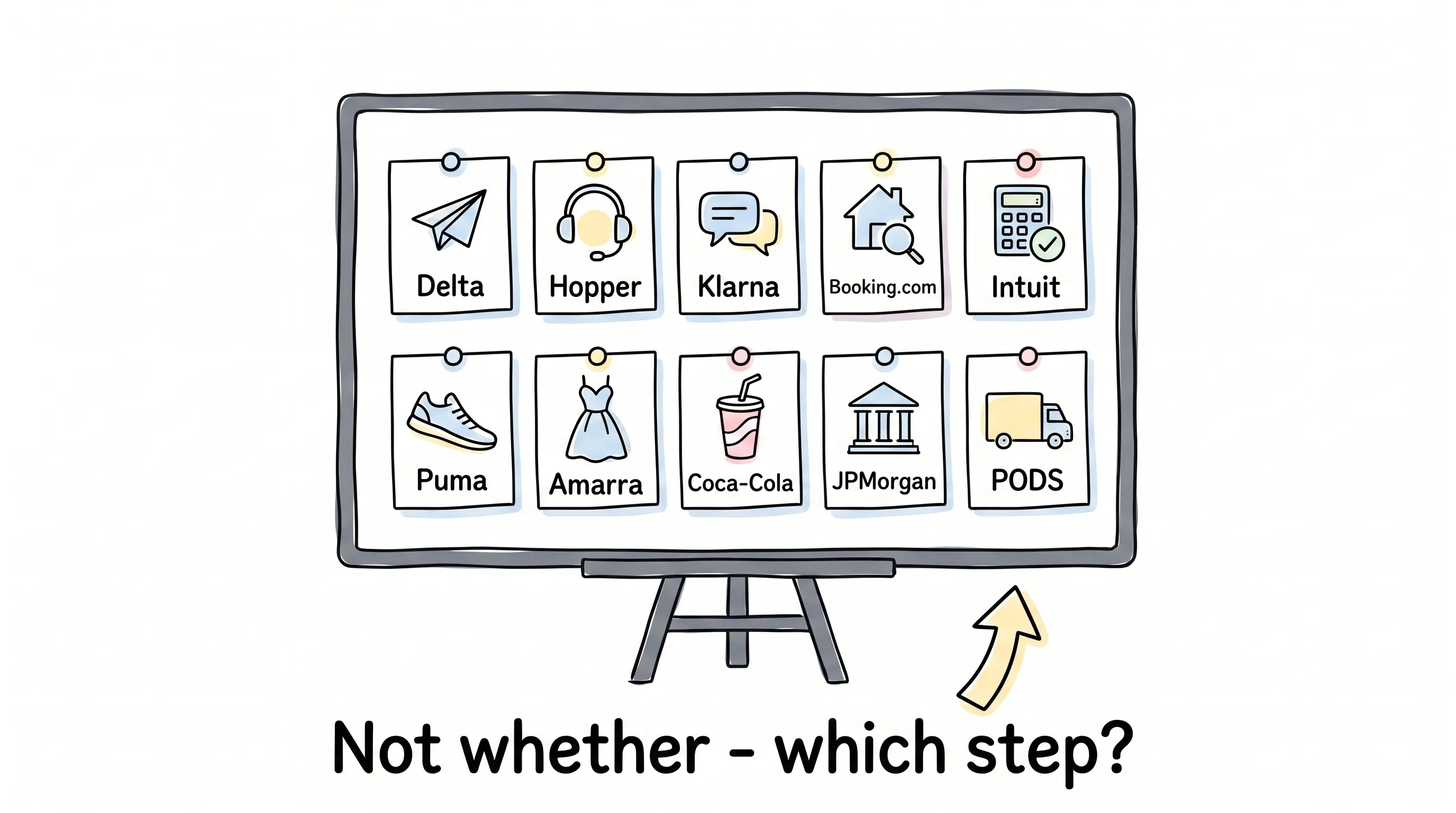
In this world there is no question of "whether to use AI" — only the question of "which step to put it in."
Here's to finding yours — soon.
Continue reading
Related articles

Cross-Border Business: Time to Upgrade Your AI Toolbox
A learn article explaining how AI tools help cross-border e-commerce sellers clear five hurdles: language, regulation, logistics, payments, and fraud. It outlines a five-compartment toolbox, a five-step adoption path, and metrics such as conversion rate and CLV, while cautioning against over-reliance on AI.

AI Is Taking Over the Dirty Work of Social Media Marketing, One Task at a Time
This learn article outlines four social media marketing tasks AI can handle — audience analytics, content drafting and design, ad targeting and creative testing, and spam moderation — and cautions that taste, judgment, and data security remain human responsibilities.

AI Is Already This Good — Why Is Your Social Media Marketing Still Pure Manpower?
An overview of 18 AI tools for social media marketing, organized into six categories covering audience research, content creation, scheduling, comment and DM handling, ad management, and visual production, plus notes on personalization, prediction, and emerging trends.