
What Does AI-Native Actually Mean? Strip Out the AI and See What's Left
A learn article explaining how to tell AI-native products from AI-washed ones, using a 'remove the AI' test and criteria on data, improvement, error handling, and pricing. It also profiles AI tools for sales, marketing, and operations and offers four questions for evaluating AI vendors.
A while back, a founder friend of mine who runs a B2B SaaS company grabbed a coffee with me. He had just closed his Series A, and the first thing out of his mouth was a sigh: his team had spent serious money bolting AI onto their product, only to discover on customer visits that every legacy player they benchmark against had already done the same.
"So we have AI too — why aren't customers buying it?"
I asked him one question: strip the AI out of your product. What's left?
He froze.
Which brings me to what I want to talk about today. Some numbers to set the scene: 64% of organizations are now genuinely using AI in their business, and among large companies that figure is 76%. Sit with that for a second — what does it mean? It means that by the time a startup pitches "we have AI" as its selling point, your customers and your competitors have long had AI too.
AI is no longer a bargaining chip. It's the price of admission.
What does AI-native actually mean?
What does AI-native actually mean?
Simple — one test: remove the AI. If the product still basically runs, AI is just a feature. If the product disappears outright, that is AI-native.
Think about how big the gap is between those two.
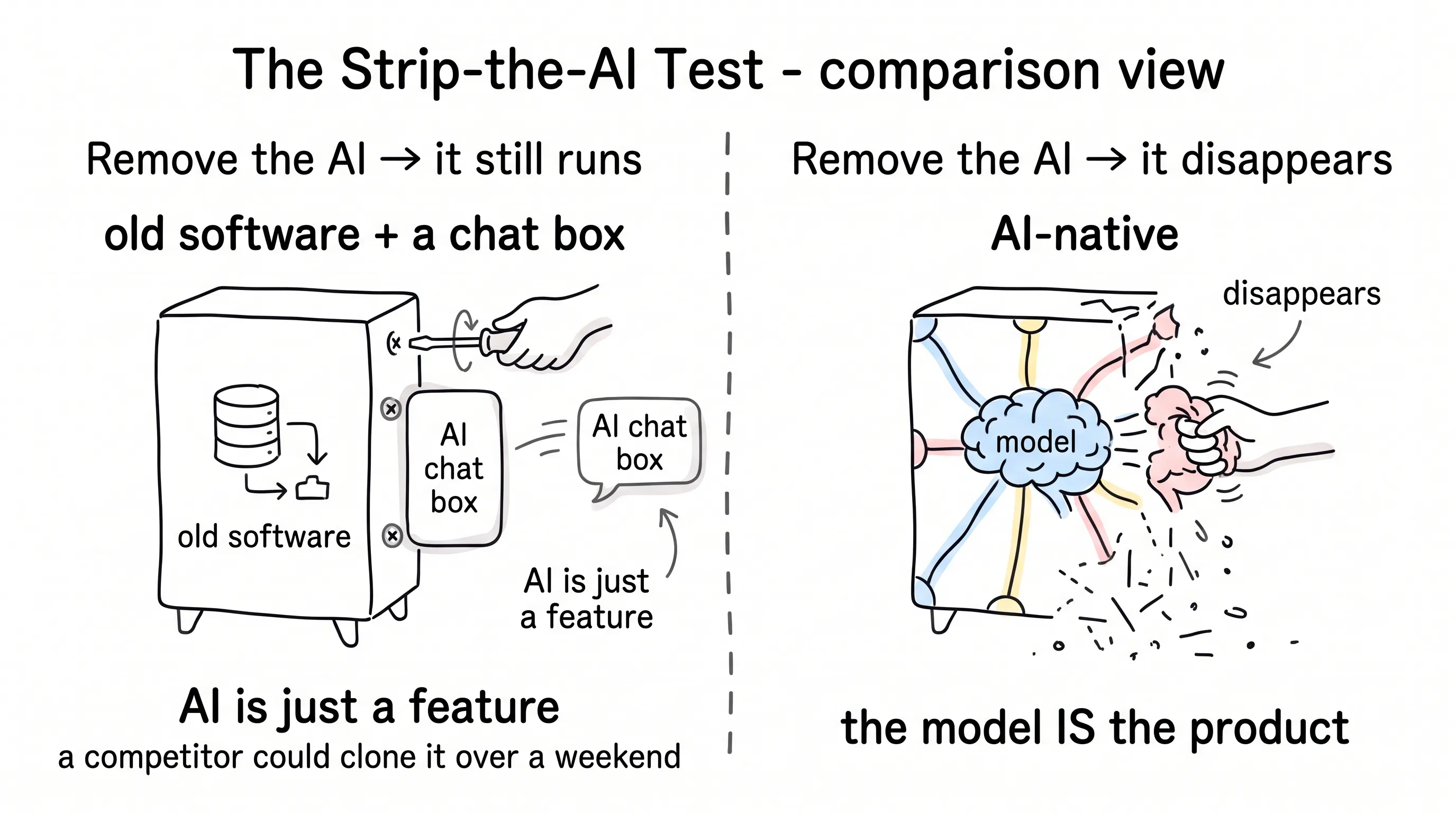
Products that survive without AI are, to put it plainly, "old software plus a chat box." Same database, same workflow — just with a chat box bolted on. Anything a competitor could clone over a weekend belongs in this category.
AI-native companies, on the other hand, have a model that is the product. The yardstick runs roughly like this:
- Where does the intelligence live? For the AI-native, the model is the product; for the AI-washed, a chat box is welded onto the old system.
- Where does the data come from? The former feeds on proprietary, domain-specific data it accumulates itself, getting smarter with every use; the latter runs on whatever the general-purpose model already had, and accumulates nothing.
- When does it get better? The former gets more accurate the more customers use it; the latter ships a new version because the vendor changed a prompt.
- What happens when it errs? The former has logs and human review as a backstop; the latter has one line: "the AI did it."
- How is it priced? The former charges by usage or by outcomes; the latter charges per seat, at the same price as the old tool it replaces.
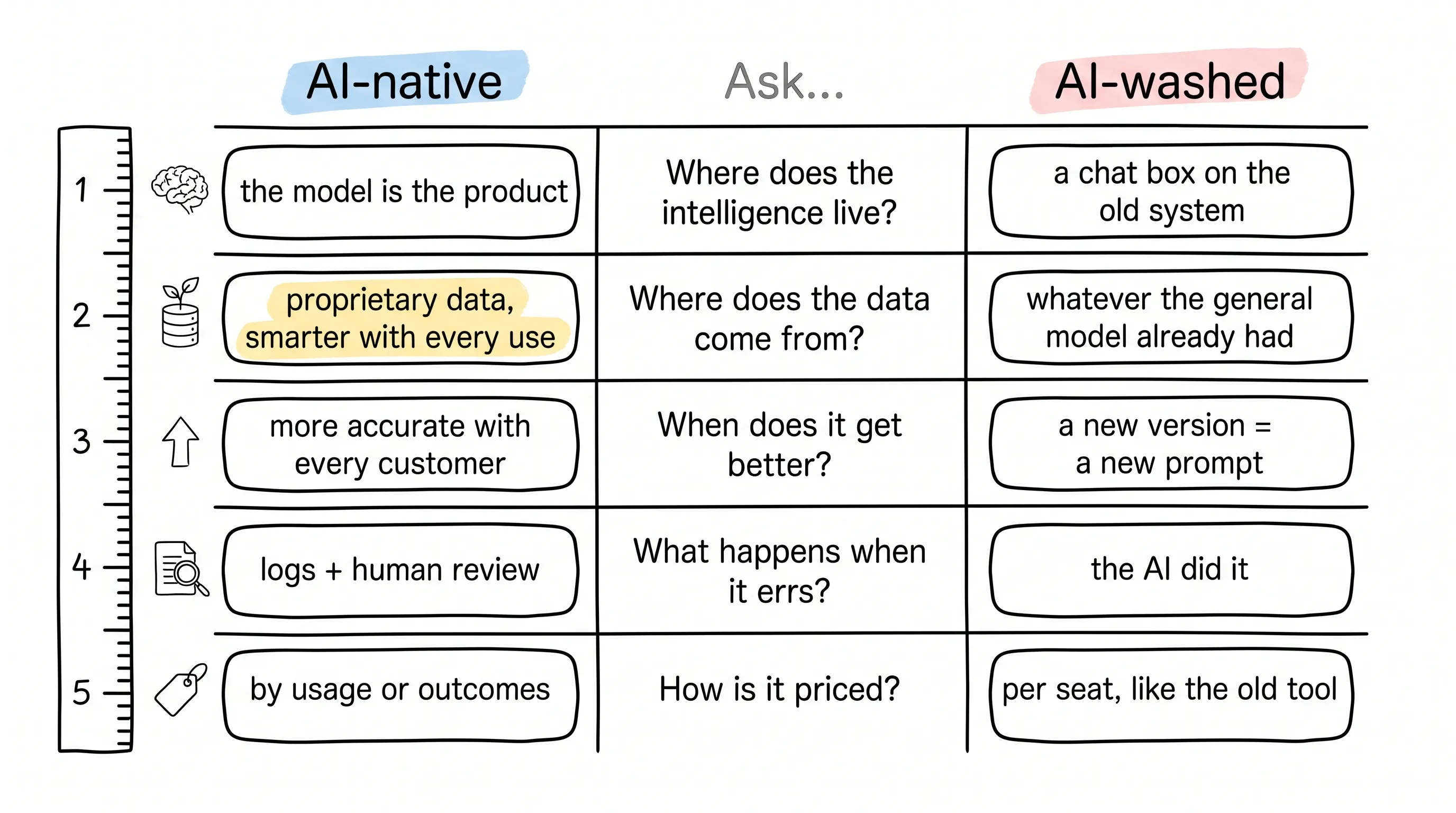
If a vendor lands on the "washed" side for four of the six, you can safely conclude: it's a beautiful fundraising deck, not a product.
The sales battle: no more guessing — do the math
Start with sales.
What did traditional sales teams run on? Intuition, and Excel. Who's a serious buyer? Whatever the rep senses. How many deals close next quarter? Whatever gets guessed.
Not anymore. Let me tell you about a few companies actually doing the work.
6sense's job is figuring out which companies are in a buying cycle before those buyers ever come knocking. Reps stop hunting needles in the haystack; they just work the list by priority.
Clari owns the revenue line. It stitches together data from email, CRM records, and call logs, and hands the sales leader a real-time picture of pipeline health. The rep forgot to update the record? No problem — the risk gets flagged on its own.
Qualified takes a different path. It sits on your website, watching for high-value visitors, and the moment a target account shows up, it hands that person straight to the right rep. Website traffic that used to glance and leave can now turn directly into pipeline opportunities.
How do the results stack up?
Salespeople who use AI tools are 3.7 times more likely to hit their quota than those who don't. 64% of sellers say AI saves them one to five hours a week. And what do they do with the time? Sell. Companies that use AI for lead scoring convert 20% to 30% better than the traditional approach. In NVIDIA's 2026 survey, 53% of organizations listed "employee productivity gains" as one of AI's biggest impacts.
Strong.
The marketing battle: ten thousand homepages, a thousand hellos
Now, marketing.
What did marketing used to look like? One big river, sprinkled on everyone. Same ad, same website, same mass email.
Today's AI marketing tools have flipped that playbook.
Jasper helps marketing teams produce on-brand content at scale — blog posts, ad copy — work that used to take weeks now takes hours.
Mutiny's play is even sharper: the personalized homepage. Customers from different industries and company sizes open your website and see different front pages. The CFO sees messaging written for a CFO; the CTO sees messaging written for a CTO. Two executives at the same company land on different pages.
Writer is built for enterprises and solves one specific problem: "AI writing that doesn't sound like us." It first learns your company's voice, terminology, and style rules, then applies them automatically to every piece of content. The compliance line gets watched too.
What is this playbook worth? Let's run the numbers.
One European cybersecurity company cut customer acquisition cost by 17% within two quarters after putting AI in charge of its marketing. Win rate? From winning one deal in nine to winning four in nine.
Read that again. That isn't an improvement — that's a different business.
And an even wilder number: precision targeting outperforms broad blasting in click-through rate by up to 72%. Because the words you're saying are exactly the words they want to hear.
The operations battle: the slow knife draws first blood
Sales and marketing get all the spotlight. But honestly, the money AI earns backstage is every bit as real as what's made out front.
Blue Yonder does supply chain. It uses machine learning to forecast demand and optimize inventory — and, most crucially, to flag the risk before a stockout happens.
AKASA digs into one narrow spot, healthcare finance, using generative AI to run the claims pipeline and specifically cut down on denied claims. For healthcare organizations, that loss runs to the tune of millions of dollars a year.
Airwallex handles expenses: reads receipts automatically, sorts them, routes them through the process. Finance teams finally lift their heads out of the spreadsheet.
Here's a concrete scenario.
A mid-sized manufacturer feeds supplier data, shipping schedules, and order history into an AI platform. The system spots a pattern: key suppliers in Southeast Asia, judging by weather data and freight-capacity signals, show early signs of delay.
Operations gets the alert three weeks ahead. They adjust orders and line up backup suppliers, and the production line never stops for a second.
Now think about it: could Excel or a traditional ERP do this? No. By the time a human notices, the factory has already stopped.
The value of AI in operations isn't speed. It's a head start.
How to choose? Four questions
So back to my friend from the beginning: the market is full of companies shouting AI — how do you pick?
My method is to ask four questions. It works whether you're a buyer or an investor.
First: does it solve a real problem? Fix your eyes on the specific, expensive, painful one. If a task could be done with a few if-else rules and the vendor insists on wrapping it as AI, steer clear.
Second: is the data its own? This is the checkpoint most people miss. An AI product's ceiling depends almost entirely on data quality. Proprietary, domain-specific data that compounds is the moat. Ask directly: where does your training data come from? How do you clean it? Do you get smarter as you add customers?
Third: does it plug into your systems? However clever the AI, if it can't connect to your CRM and your data warehouse, it lives only in the demo. Whether it integrates natively is often the dividing line between "changes the workflow" and "installed and never used."
Fourth: can it show real numbers? Have it find a customer who looks like you and look at the specific metrics: how much conversion improved, how many hours saved, how much cost came down. A vague "significant efficiency improvement" never counts. Stanford HAI's 2026 AI Index report flags the same trend: industries adopt AI for measurable output, not vision.
Ask these four questions and real versus fake basically sorts itself out.
The four hurdles nobody else can see
A fair word while we're here: companies in this space aren't having an easy time either. They're wrestling with four brutal problems, and how they chew through them is exactly the sieve that sorts the good from the rest.
Cold start. AI needs data to work, and young companies have none by definition. To get customers you need a good product first; to build a good product you need data first. There are ways through: co-build with a few lighthouse customers, or buy third-party data to feed the model early. Companies that clear this hurdle a day earlier run steadier from then on.
Compliance. Europe has GDPR; California has CCPA — hard constraints, both. Legal, compliance teams, and data governance all cost real money. Flip the angle, though: companies that got their privacy infrastructure solid early are worth more to enterprise customers, not less.
Talent. NVIDIA's 2026 report puts it bluntly: the supply of AI talent is falling short of demand across the board, and big companies keep pushing salaries up. Small companies compete for talent on the founder's reputation, a sense of mission, and options they can put on the table.
The black box. Enterprise customers want more than the AI's verdict — they need to be able to explain that verdict to their own boss. When AI marks a lead as low priority or bounces a claim, there has to be a reason behind it. That's why explainable AI keeps gaining attention: research from CB Insights shows accuracy, reliability, and transparency are exactly where enterprises are least satisfied in deployment. Companies that design for explainability from day one have earned every sale they make.
Last — back to that coffee
Back to the friend from the beginning.
My advice to him was three sentences. Stop selling "we have AI" and aim at the specific, expensive, painful problem. Meet any vendor: ask first where the data comes from, then look at real numbers from similar customers, and finally confirm it can plug into your existing systems. Sit through fewer fundraising decks, book more product demos — seeing is believing.
He heard me out and said: it's that simple?
Yes. Just that simple. The pity is that amid all the noise of buzzwords, most people manage to skip exactly these simple questions.
AI isn't coming to B2B. It's already here, and it's moving fast. The companies around you that use it won't wait — it's winning for them, faster.
Here's to you — always one step ahead of your rival.
Continue reading
Related articles

It's 2026: Stop "Buying" AI Tools for Your Marketing Team — Start "Hiring" AI Agents
This learn article explains how AI agents differ from standalone AI tools in marketing, outlines three agent categories — build-your-own platforms, CRM-native agents, and vertical tools — and covers use cases across SEO, social media, advertising, and reporting, plus criteria for choosing one.

Did the Money You Spent on AI Marketing Ever Come Back?
A guide to measuring AI marketing ROI across three layers: ad reports, sales pipeline, and the financial ledger. Covers metrics such as ROAS and CPA, eight dashboard metrics, industry benchmarks, and common measurement mistakes.

How to Pick a Creative Automation Platform: First, Figure Out What These Eleven Actually Do
A learn article sorts eleven creative automation platforms — including Bannerflow, Celtra, Smartly.io, and Storyteq — into four functional groups and proposes five evaluation questions covering publishing reach, automation depth, ease of adoption, team fit, and verifiable evidence.