
What AI Says About You Is Now a Business
An explainer on GEO (Generative Engine Optimization) and why brands now compete to be mentioned in AI answers instead of search rankings, with an overview of GEO monitoring platforms and market activity.
A few days ago, I had dinner with a friend who runs a consumer brand.
He told me something strange. His brand ranks number one on Google. Solidly number one. Yet over the past six months, orders coming from search have been visibly sliding.
I asked: competitors stealing your ranking?
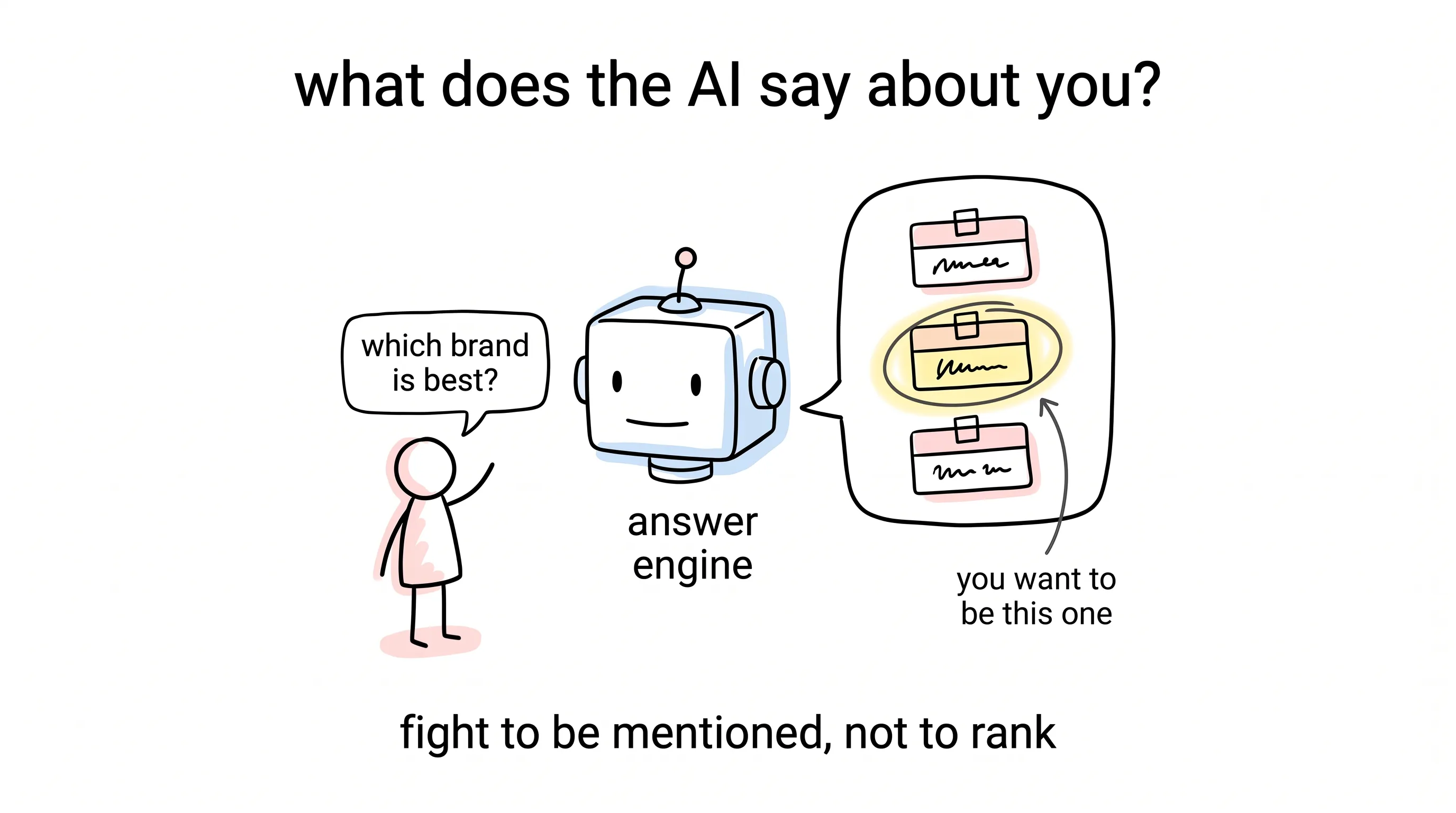
He said no. It took him a long while of digging to figure it out: customers don't "search" anymore — they "ask." They ask ChatGPT. They ask Perplexity. They ask, "Which brand is best in this category?" The AI plays fortune-teller and rattles off a list of names.
His wasn't on it.
Think about what that means. In the search-engine era, if you ranked first, you were the first thing customers saw. Now customers ask for the answer outright, and whatever the AI gives them, they believe.
Whether you show up at all comes down to a single sentence from the AI.
That's far scarier than losing your ranking.
What Is GEO?
After that dinner, I did some homework and picked up a new term: GEO.
What's GEO? Generative Engine Optimization.
Put simply, SEO is about pleasing the search engine so your web pages rank near the top of the results. GEO is about pleasing the AI, so that when it assembles an answer, it's willing to mention you and cite you.
One fights for ranking; the other fights to be mentioned.
But flattery alone isn't enough. First you need to know: what is the AI actually saying about you right now?
And so a new category has popped up: GEO monitoring platforms.
What's a GEO monitoring platform? Think of it as watching the ears and mouths of those answer engines on your behalf. ChatGPT, Perplexity, Google AI Overviews, Claude, Gemini — it counts, one by one: how many times you get mentioned in their answers, how many times you get cited, how big your share of voice is, and whether the words are kind or cruel.
What do they actually do? Let me pick the few that left the deepest impression.
Prompt-level tracking, for one. Which user questions make the AI surface your brand — recorded, question by question.
Competitor benchmarking, for another. Pose the same question to the AI and tally how many times it names you versus your rivals — one list, instant verdict.
Automated alerts, too. If your AI visibility suddenly drops, the alarm goes off right away — no waiting until the day you finally dig through the numbers and notice.
And my favorite of all: doing the math. Tying AI search performance to hard-dollar metrics like traffic and revenue. Marketing's greatest fear is never being able to prove what the spend returned — now there's a ledger to reconcile against.
Who's using this? Marketing teams, SEO veterans, brand managers — exactly the people who used to watch their Google rankings most obsessively.
Who's in This Business?
Where to begin? Let me start with a number that surprised me.
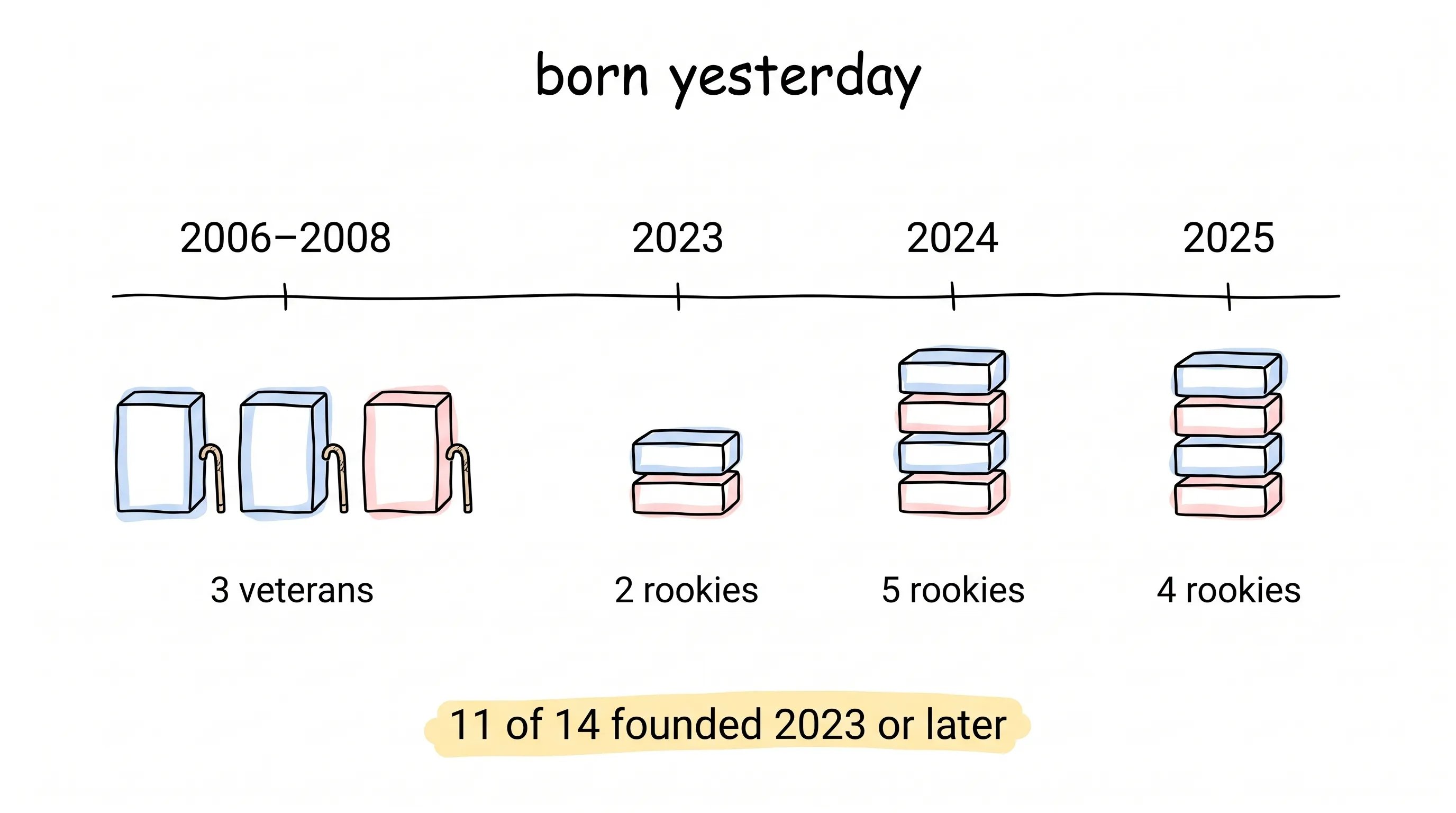
In its enterprise technology landscape, CB Insights created a dedicated category for this space and listed over a dozen companies. Fourteen of them have founding years listed, and 11 were born in 2023 or later.
Eleven. This market, counting everything generously, is barely two or three years old.
Start with three veterans.
Conductor, born in 2006, started life as LinkExperts and now does enterprise-grade answer engine optimization, with customers across retail, healthcare, and finance. Similarweb, born in 2007, started life as SimilarGroup, built on digital data intelligence, and grew from market research all the way into competitive analysis. Semrush, born in 2008, out of Boston, began as an SEO toolset and grew into an all-in-one suite spanning search, AI visibility, content, paid media, and social.
All three have been on this street for nearly 20 years. They've weathered more than a few storms.
Now the rookies.
In 2023, two moved first: Otterly.AI out of the small Austrian town of Persenbeug, and Scrunch out of Salt Lake City. In 2024, crack — five more arrived in one go: Profound, Bluefish, and Evertune in New York, BrandLight in Tel Aviv, and Omnia in Madrid. In 2025, four more showed up: Searchable in London, AthenaHQ in San Francisco, Peec AI in Berlin, and The Prompting Company in San Francisco. The last name on the list is GenFlux out of Delaware, also watching how ChatGPT and Perplexity rank and recommend brands.
Oh, and New York alone is packed with five of them.
Each rookie has its own playbook. Searchable tracks visibility inside ChatGPT, Claude, and Perplexity, serving e-commerce, B2B software companies, and local businesses. Peec AI specializes in competitor benchmarking for AI search. The Prompting Company is the most interesting of the bunch — its craft is almost "handmade": converting your web pages into clean, tidy markdown so the AI can read them properly and cite them accurately.
See? The moment demand poked its head up, everyone arrived with a shovel.
The Big Players Have Moved In
But every coin has a flip side.
For all the buzz, some have already exited early — by getting acquired.
In April 2026, Adobe bought Semrush, in a deal valuing it at $1.9 billion. A veteran born in 2008.
In June 2026, Sitecore bought Scrunch, valuing it at $225 million. A rookie born in 2023.
One old hand, one young rookie — snapped up back to back.
What does that tell you? The giants read the situation clearly: the battleground for brand visibility is moving from the search box into the chat window. This capability will become standard issue in every marketing suite. Build it from scratch? There's no time. Just buy.
For you as a brand builder, that's actually a signal: this is now big enough to earn a line in the annual budget.
Back to My Friend
Whatever happened to the friend from that dinner?
He now does one thing: every week, he picks the ten questions customers are most likely to ask an AI, asks them one by one, and records how many times his brand gets mentioned, where it ranks, and whether the answer has anything nice to say about him.
A low-tech method — manual GEO monitoring.
I told him this was the most primitive version. He said: get it running first, buy the tools later.
Well said. We used to fight for rankings; now we fight to be mentioned.
Here's hoping your brand is always the answer the AI gives.
Continue reading
Related articles

Cross-Border Business: Time to Upgrade Your AI Toolbox
A learn article explaining how AI tools help cross-border e-commerce sellers clear five hurdles: language, regulation, logistics, payments, and fraud. It outlines a five-compartment toolbox, a five-step adoption path, and metrics such as conversion rate and CLV, while cautioning against over-reliance on AI.

AI Is Taking Over the Dirty Work of Social Media Marketing, One Task at a Time
This learn article outlines four social media marketing tasks AI can handle — audience analytics, content drafting and design, ad targeting and creative testing, and spam moderation — and cautions that taste, judgment, and data security remain human responsibilities.

AI Is Already This Good — Why Is Your Social Media Marketing Still Pure Manpower?
An overview of 18 AI tools for social media marketing, organized into six categories covering audience research, content creation, scheduling, comment and DM handling, ad management, and visual production, plus notes on personalization, prediction, and emerging trends.