
We Built an "AI Reporter" to Interview Our Own Experts
A content team built an AI agent in ChatGPT to interview in-house experts, gathering context, asking one question at a time, and delivering fact-checked briefings that cut the effort experts spend contributing viewpoints.
Last Monday morning, we held our editorial meeting.
Five pieces of content a week — locked in. Three of them have to be carried by genuine viewpoints from our internal experts. Without their first-hand judgment, those three pieces are just repackaged material from around the web.
Then the meeting stalled on item four: who's going to book them?
The CEO was traveling. The tech lead had three meetings back to back that afternoon. Our head of content thought about it and said, let's make it next week.
Next week. There is always a next week.
When Everyone Runs a Printing Press, Paper Stops Being Worth Anything
Think about how easy it is to publish a piece of content today.
AI can spit out a perfectly respectable draft in minutes. Output stopped being the problem a long time ago.
When production becomes infinitely cheap, what's scarce changes.
Swapped for what?
It shifts to the things only a living person can give: a genuine quote, a pit someone actually fell into, a judgment with edges, a lesson paid for with real money in a real experiment. Machines can't make these up. When they try to fake it, readers recognize that "seen it everywhere" flavor at a glance.
That's why our team has always stuck to one rule when we create content: experts first.
The seeds must come from real people; AI just helps write it all up and ship it.
What counts as a seed? We've always had raw material on hand:
We record a podcast episode every week, full of ready-made viewpoints; we run our own courses and have racked up plenty of methods; every year we do original research where all the data is first-hand; and we hold internal Q&A sessions specifically to dig out what's scattered inside each person's head.
The first three, we just keep doing. It's the fourth one where we got stuck.
Stuck on what? Time, and people.
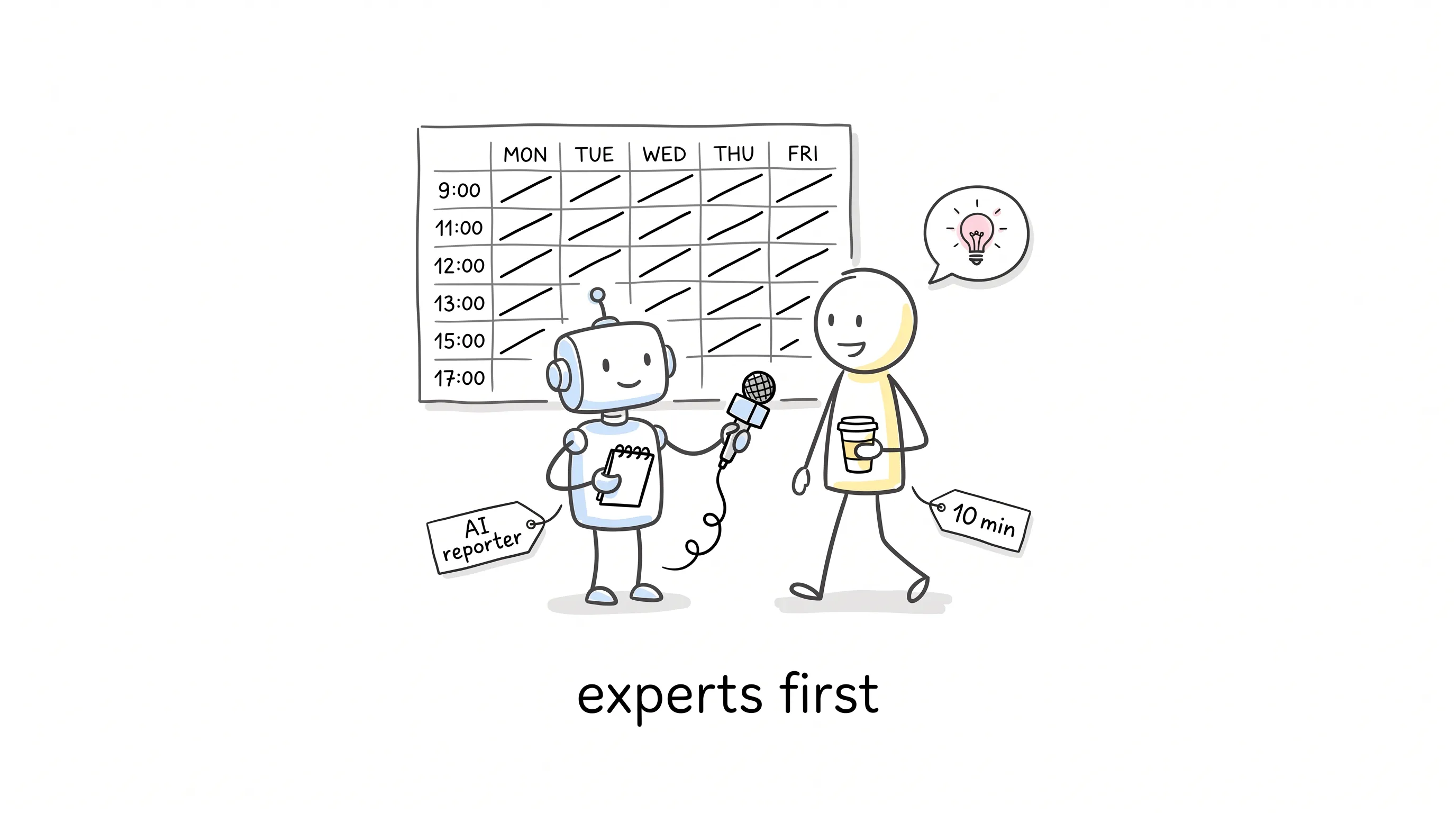
The person you most want to interview is the one you can never book. It's not that they won't cooperate — they genuinely have no time. Even a half-hour, chat-style interview can't fit anywhere on the calendar.
So Let the AI Do the Interviewing
After getting stuck too many times, we changed our thinking: since the expert can't carve out a block of time, could we send a tireless "someone" to go find him?
That's how this experiment came about: an AI Agent that can conduct interviews — a minimum viable version built inside ChatGPT.
How does it work? Say this week's three pieces all need the same expert's viewpoint. No meetings, no back-and-forth emails. The Agent takes over and runs three steps.
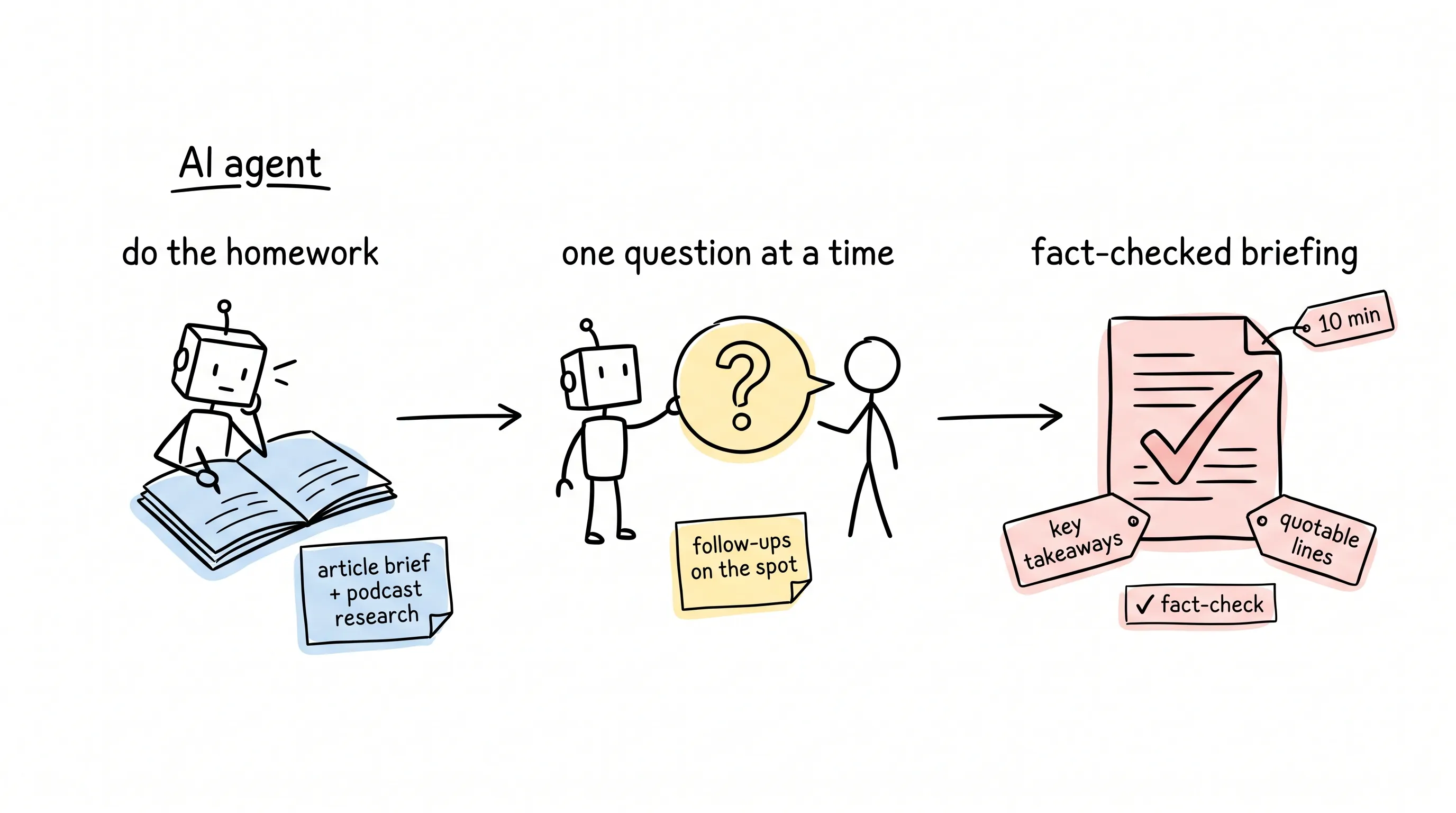
Step one: do the homework.
Before the interview even starts, it figures out what the article is about and who it's for, then goes through what this expert has said recently on our podcast. Several lines of research run at once. By the time it starts asking questions, it already has real context — it doesn't show up with an empty head asking random ones.
Step two: ask one question at a time.
This is where it's most like a reporter. You answer, and based on your answer it decides on the spot what to follow up with next. It doesn't read off an outline. The goal is to pull out, bit by bit, the specific, detailed things only this expert could say. Boilerplate? It doesn't take it.
Step three: deliver a briefing you can use as-is.
When the interview ends, it outputs something structured: key takeaways, quotable lines, the full conversation transcript, relevant background. And one thing many people wouldn't expect: it fact-checks what the expert said, while it's at it.
Why? Because experts misremember too. Build the fact-checking straight into the process, and the editors downstream skip a step.
What It Actually Solves Is Something Else
You might say: isn't this just a content generation tool?
Quite the opposite. It doesn't generate a single word for you. It does exactly one thing: it pushes the cost of contributing a viewpoint down to the level where an expert can do it in passing.
Run the numbers. An interview used to take two days of calendar wrangling, a half-hour interview, then another half day to organize — the expert paid a bit over an hour all told. Now? He answers in 10 minutes while out on a walk. None of the substance lost, almost none of the time spent.
Of course, this is still a half-finished product.
Every interview still needs someone to kick it off manually: telling the Agent which articles are due this week and who to go find. The next stage of automation is in the works: down the road, as soon as someone tags an article "needs expert interview" in the project management system, the Agent will come knocking on its own and arrange the interview itself.
As for the results — whether these briefings actually make the content noticeably better — we're still testing, still measuring.
But the direction? We're already certain.
Once AI has raised speed and scale, the effort a content team saves should go where machines can't reach: original insight can only come from real people and real things.
Back to That Editorial Meeting
Same five pieces of content, three needing expert viewpoints. The flow now: the Agent does its homework, sends the questions over one by one, the expert answers them during a stroll, and a fact-checked briefing lands in the system on its own.
That afternoon of saying "let's make it next week" — it's gone for good.
Here's to never again flipping through an expert's calendar, back and forth, just to squeeze in one interview.
Continue reading
Related articles

Cross-Border Business: Time to Upgrade Your AI Toolbox
A learn article explaining how AI tools help cross-border e-commerce sellers clear five hurdles: language, regulation, logistics, payments, and fraud. It outlines a five-compartment toolbox, a five-step adoption path, and metrics such as conversion rate and CLV, while cautioning against over-reliance on AI.

AI Is Taking Over the Dirty Work of Social Media Marketing, One Task at a Time
This learn article outlines four social media marketing tasks AI can handle — audience analytics, content drafting and design, ad targeting and creative testing, and spam moderation — and cautions that taste, judgment, and data security remain human responsibilities.

AI Is Already This Good — Why Is Your Social Media Marketing Still Pure Manpower?
An overview of 18 AI tools for social media marketing, organized into six categories covering audience research, content creation, scheduling, comment and DM handling, ad management, and visual production, plus notes on personalization, prediction, and emerging trends.