
Want YouTube to Find Your Customers for Free? Start by Forgetting "Customers"
A learn article explaining how businesses can use YouTube's recommendation algorithm for organic customer acquisition: serve viewers rather than customers, research audience concerns through comments, build trust with helpful videos, and iterate using retention analytics.
A few days ago I had dinner with a friend who runs an e-commerce business. The sigh arrived before he did. Paid traffic keeps getting more expensive, and his customer acquisition cost climbs month after month. Don't spend — no business. Spend — and you're basically working for the platform.
I told him about a guy who sells used office furniture. He was in exactly that same spot once. But his business has since grown while spending almost nothing on advertising.
He went from one warehouse to two, with cumulative sales topping $20 million.
How did he do it?
He bet his business on YouTube. And note what kind of bet: not the pay-for-traffic kind, but the kind where the platform itself delivers customers to your door.
I've since taken this playbook apart piece by piece, and the more I studied it, the more interesting it got: most companies aren't failing to do YouTube — they're doing it backwards from day one.
First, Understand What the Algorithm Is Actually For
To understand why he succeeded, you first have to understand how the YouTube machine thinks.
2013 was a watershed. Before that, YouTube's recommendation logic was plain: whoever had the most views got pushed. After 2013, it was fitted with an AI brain.
That brain does exactly one thing: find the people who want to watch this kind of content right now, and do everything it can to keep them on the platform.
Notice the wording there: "people," not "money."
What does "keep them on the platform" mean? The more absorbed viewers are and the longer they stay, the happier the algorithm gets. So as long as you supply good content, it will happily push your videos, for free, to people who are very likely to enjoy them. You save on distribution costs, it earns watch time, and viewers get what they wanted to see. All three sides come out ahead.
So how do most companies use it?
They treat YouTube as a video warehouse: shoot the promo, upload it, done. The slightly more conscientious ones often make an even subtler mistake: making content for "customers." With their heads full of who will pay, their videos are all product, selling points, and promotions.
But the algorithm serves "viewers" — people who don't know you yet but are interested in this type of content right now.
You're watching customers; the algorithm is watching viewers. You two aren't even looking in the same direction.
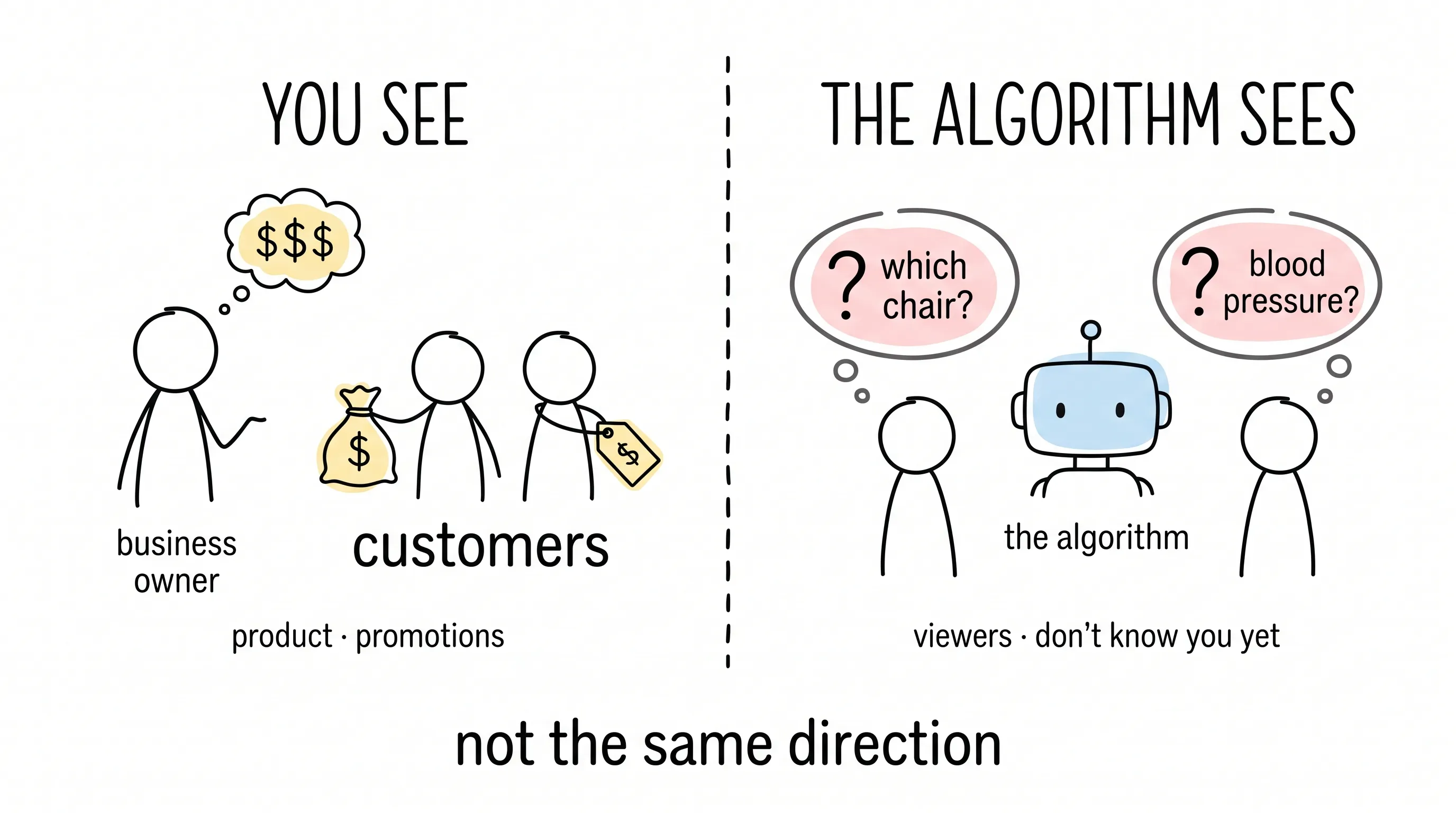
That furniture guy figured out exactly this layer. There was no warehouse in his shots — only the audience's anxieties: reviews, comparisons, and guides on which pitfalls to avoid when buying used office furniture. He even built an S-tier-to-F-tier ranking of gaming chairs for young gamers, because that crowd genuinely searches for "a cheap gaming chair that's actually comfortable."
The result? 75% to 80% of his views come from YouTube's recommendations. His videos also show up in search results on both YouTube and Google — exposure on two fronts. Later he added the usual follow-ups like email marketing, and sales climbed past $20 million. His own May mega-sale livestream outperformed Black Friday.
And the ad spend? Zero.
Who Is Your Audience? Don't Ask Who They Are — Ask What Worries Them
So how do you find your audience?
Most people's first instinct is to check demographics: age, gender, city. That's useful, but it only answers "how to present." A video made for Gen Z will naturally move at a different pace than one made for viewers in their sixties.
What actually decides whether they click, watch, and believe is the psychographic picture: their values, and which wall in life they're currently stuck against. The psychologist Abraham Maslow's hierarchy of needs makes a handy lens here: what a person is missing at this moment determines why they'd tap open a video.
There was an immunologist who wanted YouTube to bring patients to her clinic. A few of her videos caught a modest spark, and one was closing in on a million views.
The strategist who took over didn't pull the analytics right away — one question came first: who exactly is watching?
One look: the audience was mostly ages 45 to 65.
What does 45 to 65 mean? It means many of these people have just started receiving their body's alarm signals: blood pressure creeping up, energy draining away — and among friends their own age, some may already be gone.
Once the picture sharpened, the playbook wrote itself. Her first hit, "Ten Foods That Naturally Lower Blood Pressure," pulled 1.7 million views. Right after came "The Five Most Common Mistakes When Measuring Blood Pressure" — 865,000 views in under two weeks.
Why did the second one blow up too? Because everyone who watched the first was standing bewildered in front of a blood-pressure monitor the next day. The algorithm recognized the two videos as two of a kind and pushed the second to people who had watched the first.
That's how videos warm an audience up one by one: first they know you, then they like you, finally they trust you. And once trust runs deep enough, the nutritional supplements she sells and the online consultations she offers practically sell themselves. Not a single sales pitch in the whole journey.
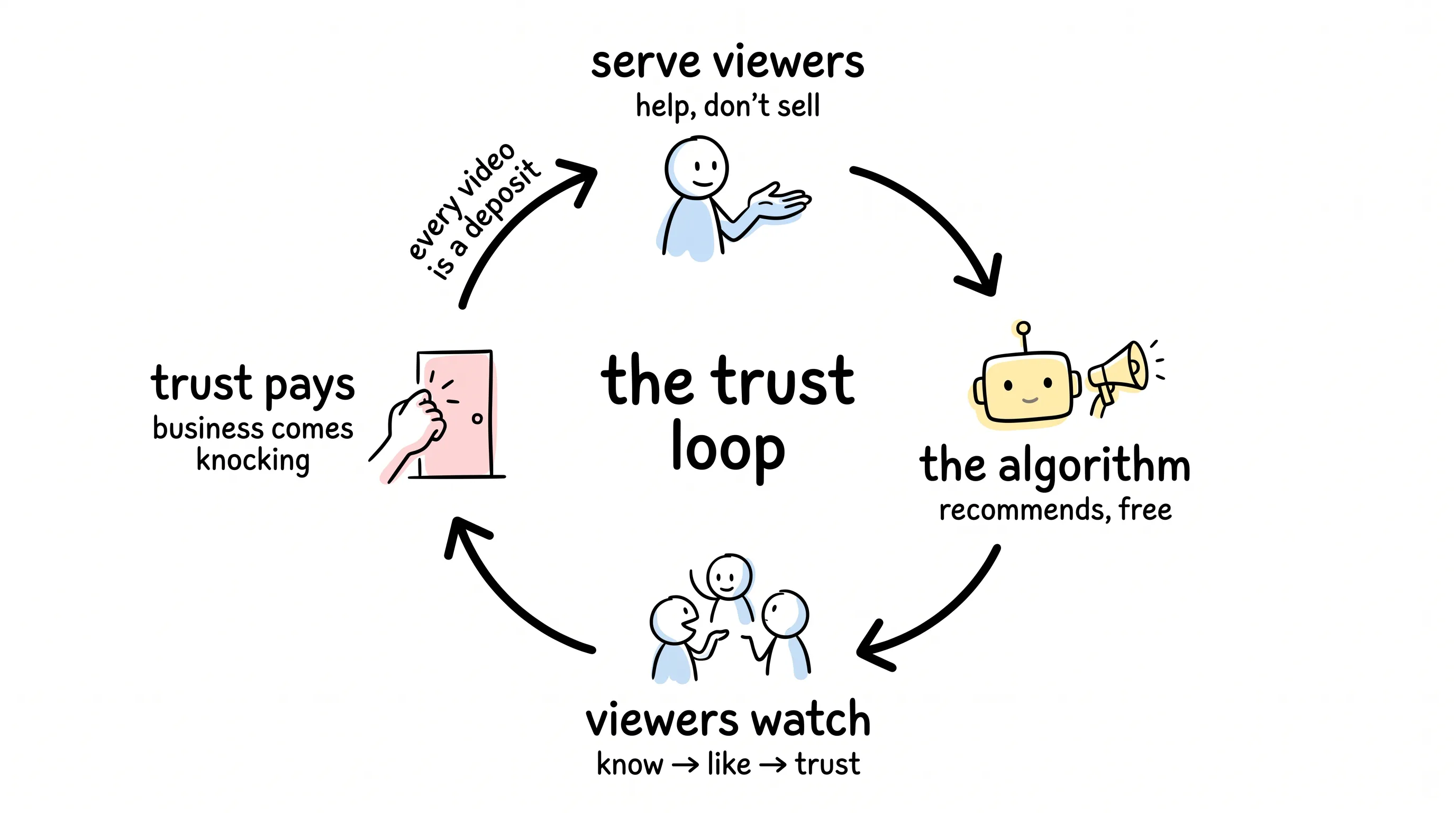
Videos are a savings account for trust. Every deposit now makes a withdrawal possible later.
How do you find out what your audience worries about? Here's a scrappy trick: hunt for outlier videos.
What's an outlier video? A tiny channel with barely any subscribers where one video's views suddenly shoot skyward. What does that tell you? The topic has hit an itch shared by a huge crowd of people.
How do you find them? Search the content territory you plan to cover, save the small-channel-big-views videos into a spreadsheet, then dive headfirst into the comments. Comments are a goldmine: viewers will tell you what the video helped them with — and where it stopped short.
Where the explanation stops short, your opportunity begins.
While you're at it, click into a few commenters' profiles — are young people talking, or middle-aged people reflecting? That helps you verify whether your picture of the audience is accurate. These days it's even easier: toss a batch of video links to Claude, ChatGPT, or Gemini and have it summarize: what do these comments have in common? Which questions never get answered?
Oh, and one counterintuitive reminder: don't try to please everyone with a single video. There is always a core audience most sensitive to your content. The more precisely you see who truly values your content, the more precisely the algorithm can find people like them.
The more specific you are, the better the algorithm works for you.
What Earns the Click — and What Keeps Them Watching
Picture in hand, next hurdle: why should anyone click on yours?
One word: curiosity.
Your title and thumbnail have to carve an opening in the viewer's mind — an opening that can only be filled by clicking in. "Ten Foods That Naturally Lower Blood Pressure": a person with elevated blood pressure sees it and their heart skips a beat — of these ten, how many am I actually eating?
Not clicking hurts. That's a good title.
But winning the click is only half the battle. For a long video, the decision window is just 5 to 10 seconds. On phones it's harsher, and for shorts it's counted in milliseconds. So in the first few seconds, you must immediately make good on the thumbnail's promise: you've come to the right place — the good stuff is coming right up.
There's one trap I have to pull out and address on its own: people who have run paid campaigns love to drag the ad-copy playbook into their videos. Open by establishing the persona, then toss out the selling points, then push the conversion. In paid advertising that's textbook; in organic traffic it's suicide. Viewers came for content — they smell a sales pitch, and they're gone in three seconds.
Switch from "selling" to "helping." When viewers can walk away with the full value of this video alone — clicking nothing and still leaving satisfied — only then does everything that follows become possible.
Trust Is Something You Save Up
Many people making videos fixate on the view count of a single video.
Wrong. YouTube's real value isn't in one video — it's in whether a person, after finishing one video, is willing to watch the second, the third. Three videos in, strangers start turning into fans.
There's a compounding effect here too: give real substance in the first few minutes and viewers have more patience to watch to the end; the longer they watch, the more the algorithm recommends; recommendations bring more new viewers, and the trust loop rolls around again. When viewers think a video is good, they'll pass it along to the four or five people around them who happen to need it. That's distribution from outside the algorithm — handed to you free.
The strategist once gave an example, and after hearing it I had exactly two syllables: unreal.
There's a show called Dry Creek Wrangler School, with 1.6 million subscribers. The host is an old cowboy in his sixties. And the content? Sitting by a campfire, talking about how to live and how to treat people. No editing, no polish, and a thick, authentic cowboy drawl.
How did it get popular? During the pandemic years, his in-person wrangler school couldn't open, so with time on his hands he just chatted at the camera.
He had one habit: he watched the comments. He noticed many viewers saying their lives were a mess they couldn't straighten out. So he made content along that thread. His most popular video, titled, roughly, "When You Feel Like Your Life Is a Complete Mess," drew 8.5 million views. The next two: one on loneliness, one on what it really means to be a decent man. Some videos racked up 18,000 comments.
Why would so many people listen to an old cowboy talk about life? Because on the other side of the screen were a bunch of lost young people who wanted one straight-from-the-heart truth that nobody else was giving them. Whether the footage was rough didn't matter at all.
The result: his week-long in-person cowboy camps sell out every session, with the waitlist stretching three and a half years out. Not one customer was pitched into coming — they all watched, then showed up on their own.
When trust is banked deep enough, you don't need to sell at all. You only need to show up.
The opposite trap deserves a mention too: don't lock value behind a landing page. Every video slams the brakes right at the key moment — "the rest is on my page" — and viewers feel toyed with. An occasional call to action is fine; hold something back every single time and trust leaks right out.
There Has to Be a Real Person on Camera
One more thing decides whether a channel grows or stalls: whether the person in front of the camera is real.
Many people sit down in front of a camera and automatically switch into marketing mode: crisp diction, standard-issue smile, lines you can hear being recited. Viewers can smell the fakeness right through the screen.
What to do? The answer is almost comically simple: treat the camera as the friend sitting across the dinner table — one who is genuinely interested in the topic and doesn't need to be persuaded by you at all. However you chat with a friend, that's how you record.
One speaker published videos for 17 years and had only 10,000 subscribers, with views wobbling between 25 and 7,000. Yet this person, standing on stage delivering a keynote, was at a level that could carry the energy of an entire room. Where was the problem? The moment he saw the camera, he froze.
Later someone thought up a homespun fix: set up a video call, project the students' faces onto a screen behind him, and let him speak to living, breathing people.
The first video: 1.5 million views.
Insane. Seventeen years to earn 10,000 subscribers; one video, 1.5 million. The gap between a person and the camera has never been about technique — it's the felt sense of a live human on the other side. Later he no longer needed the students on the screen, but that on-camera presence was trained into him by that very screen.
An even sharper contrast: business blogger Pat Flynn charged into the world of Pokémon collecting and started a channel called Deep Pocket Monsters. He didn't pose as an expert; he came in simply as a collector with genuine curiosity. It took a full year to find his groove; once found, real curiosity, a talent for storytelling, and a sense of humor all switched on at once — and even hour-plus long videos held an exceptionally high completion rate. A single event he hosted drew 9,500 people.
By his own account: all that business-channel experience had to be torn down and rebuilt here. Different audience, different voice.
The stronger AI gets, the more this is worth. A machine can spit out ten thousand videos a day, and the production cost of content is collapsing. But "I came here for you — the person"? Machines can't give you that.
The smarter the algorithm gets, the scarcer real humans become.
Content's "Rails" Are Hidden in the Structure
Now some technical craft: what structure does a video use to hook people from the first frame to the last?
Before you shoot anything, look at what your audience is already watching. List the videos running well in your niche and find the commonalities: how do they open? What do they lean on to keep people?
One detail many people never think of: editing style is itself a signal of the audience's age. Fast cuts and dense pacing skew young; slow, steady delivery and solid substance skew middle-aged and up.
Then comes the single most important word: mechanism.
What's a mechanism? The hidden rail inside a video that makes viewers willingly watch to the end.
The easiest mechanism to pick up is the listicle. "The five most common mistakes," "the ten foods you should eat most." The viewer psychology: I've already heard three — number four might be even better. That's what keeps you to the end. But the listicle has a fatal flaw: the rhythm must be even. If item one runs 10 minutes and item two runs 2, viewers turn around and walk.
A more advanced mechanism is storytelling. A handy three-thread structure: Thread A — what this video is about, which must match the title; Thread B — why the viewer should care about this; Thread C — an undercurrent strung from start to finish that keeps viewers in the right frame of mind to see it through with you.
Further variants: the timed challenge — accomplish something within a time limit; the collection challenge — complete a full card set. Different skeletons, same psychological hook.
One more thing when designing the mechanism: check what device viewers watch on. The back-end data will tell you: people watching on TV are lying on a couch, don't swipe away easily, and often watch in pairs — so go ahead and make a full hour of long-form content. People watching on phones are on the subway, on their lunch break — shorter, tighter.
Shorts have a clear job too: searchlight. One brilliant short sparks curiosity, and viewers trace the links you've left to come watch the full-length video.
Shorts are where people meet you. Long videos are where people remember you.
Hitting Publish Is Where It Starts
The last hurdle — and the one most people get lazy about: the review loop.
A simple cycle: plan, execute, analyze, adjust. YouTube hands you the finest-grained analytics of just about any content platform — ignoring them is a waste.
How do you read it? Start with the retention curve.
Most viewers bolting in the first 10 seconds? Two possibilities: your title and thumbnail lured in the wrong people; or your opening failed to make good on the thumbnail's promise.
Viewers running off at minute three? You delivered value too slowly, or you're missing a teaser hook — you have to let them know there's something bigger coming.
Then change one variable and publish again. First-10-seconds drop-off down from 50% to 30%? The change worked — keep it. Where's the next drop-off point? Go treat that one next.
Every video is an experiment. Hitting publish isn't the end — it's collecting the sample.
Nobody who has truly made it on YouTube got there by guessing right the first time. They just did one small thing right:
Treat every single video as data.
Finally, Back to That Dinner
That day I walked my friend through this whole logic, and he asked me: so what's the core, exactly?
I said the core is one sentence. YouTube is a free distribution machine, but it only helps one kind of person: those who serve viewers with genuine sincerity.
Give strangers real value, and the algorithm will deliver you onto the screens of ten million strangers. When trust has been saved up enough, the business comes knocking on its own.
That used-office-furniture guy started with a remarkably plain question: what is the person buying furniture worried about at this very moment?
Here's hoping you find the people already worrying about it — sooner rather than later.
Leave the rest to the algorithm.
Continue reading
Related articles

Cross-Border Business: Time to Upgrade Your AI Toolbox
A learn article explaining how AI tools help cross-border e-commerce sellers clear five hurdles: language, regulation, logistics, payments, and fraud. It outlines a five-compartment toolbox, a five-step adoption path, and metrics such as conversion rate and CLV, while cautioning against over-reliance on AI.

AI Is Taking Over the Dirty Work of Social Media Marketing, One Task at a Time
This learn article outlines four social media marketing tasks AI can handle — audience analytics, content drafting and design, ad targeting and creative testing, and spam moderation — and cautions that taste, judgment, and data security remain human responsibilities.

AI Is Already This Good — Why Is Your Social Media Marketing Still Pure Manpower?
An overview of 18 AI tools for social media marketing, organized into six categories covering audience research, content creation, scheduling, comment and DM handling, ad management, and visual production, plus notes on personalization, prediction, and emerging trends.