
Want to scale your search campaigns but afraid of losing money? Google Ads' latest update is the cure for exactly that
An overview of Google Ads' AI Max updates for search campaigns, covering multi-campaign A/B experiments with ROI targets, retained brand and location controls, and Performance Planner budget modeling before changes.
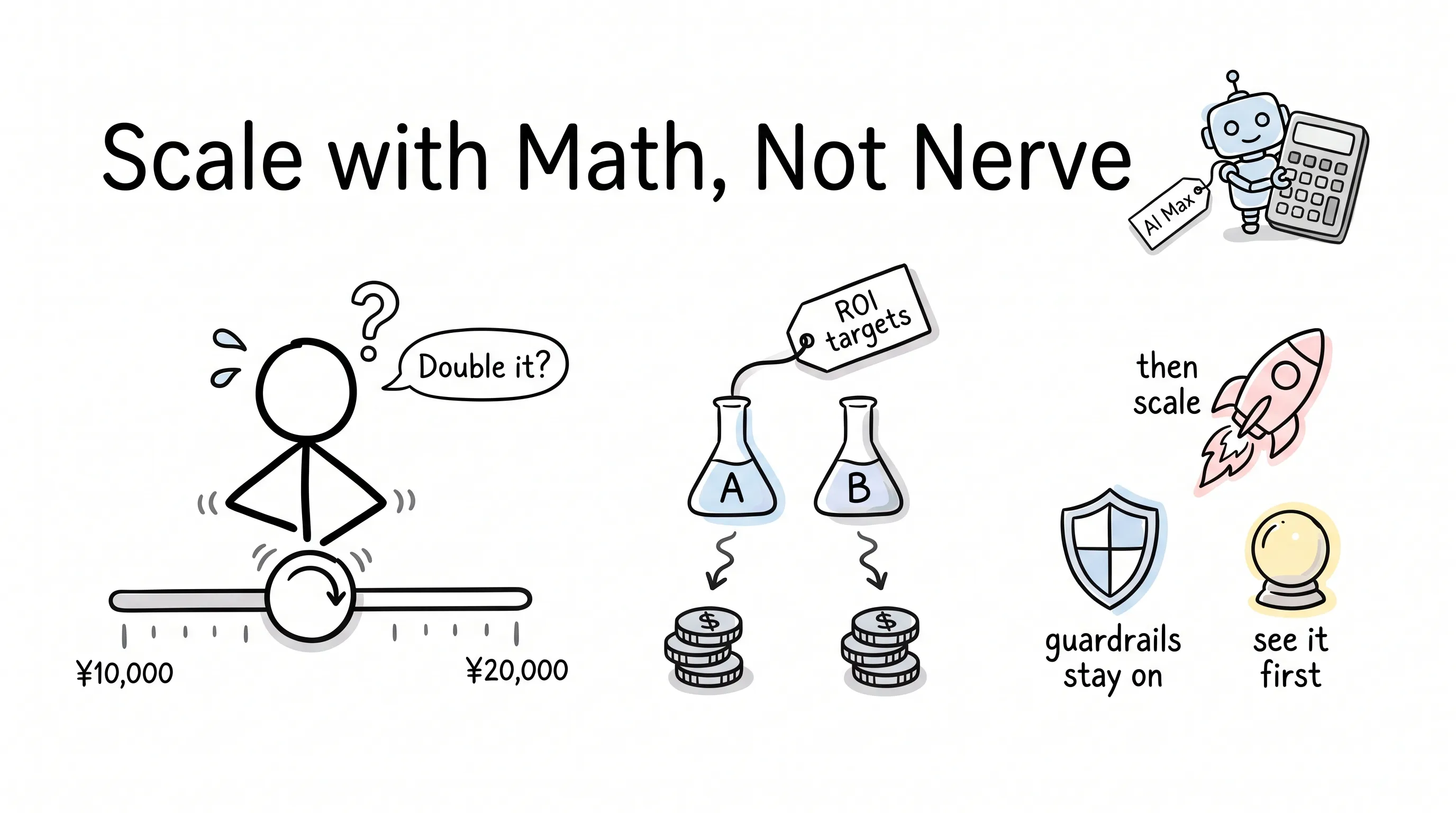
A few days ago, an old friend who has been running paid campaigns for the better part of a decade took me out to dinner. Halfway through the meal, he pulled out his phone, showed me his ad account, and said:
"I'm not afraid to spend the budget. But doubling it? That's where I freeze."
Sounds contradictory, but it's the quiet worry shared by a lot of media buyers. Paid media is, by nature, spending money to buy growth — yet the thing performance marketers fear most is exactly that: scaling the budget up.
Why?
Think about it: say you spend ¥10,000 a day today and come out ¥2,000 ahead. Scale that to ¥20,000, and if efficiency takes a hit, that extra ¥10,000 might not just fail to make money — it could put you in the red.
That's what makes scaling so hard: you don't find out the result until after the money's spent.
Whether you dare to scale has never been a question of nerve. It's a question of math.
On August 20, Google Ads shipped a set of updates, all of them on AI Max — Google's AI capability set for search campaigns. What is AI Max? In short, it's the AI layer inside Google Ads search, one that could already run one-click experiments. My read after going through all of it: nothing flashy here, but every change cuts straight at the fear of scaling.
One: Do the math before you scale
What's an A/B test? You run two versions side by side and let the data tell you which one works.
This update takes it a step further: within a single A/B test, you can compare multiple search campaigns at once, under different budgets and different ROI targets. It rolls out gradually starting in September.
Zero in on those two words: ROI targets.
Before, you tested which campaign performed better. Now you're testing what profit actually looks like once you raise the budget and raise the bar. The first looks at traffic; the second looks at what's actually left in your pocket.
Do the math in the experiment first. Then decide whether to put real money on the line.
Two: Let AI take the wheel — worry-free
A lot of veteran media buyers have a knot in their stomach about handing things to AI: the brand-keyword controls and location controls I've fine-tuned for years — will an overexcited AI sweep them all away?
The concern is completely fair. When brand keywords drift, it's the brand that takes the hit; when location targeting drifts, it's your channels.
This update lets you keep those controls on and run AI Max experiments as usual. The guardrails stay up; the tests keep running.
Put simply: you can hold on to your own rules while finding out how much AI can actually do for you.
Three: Look first, change second
What's Performance Planner? A long-standing planning tool inside Google Ads.
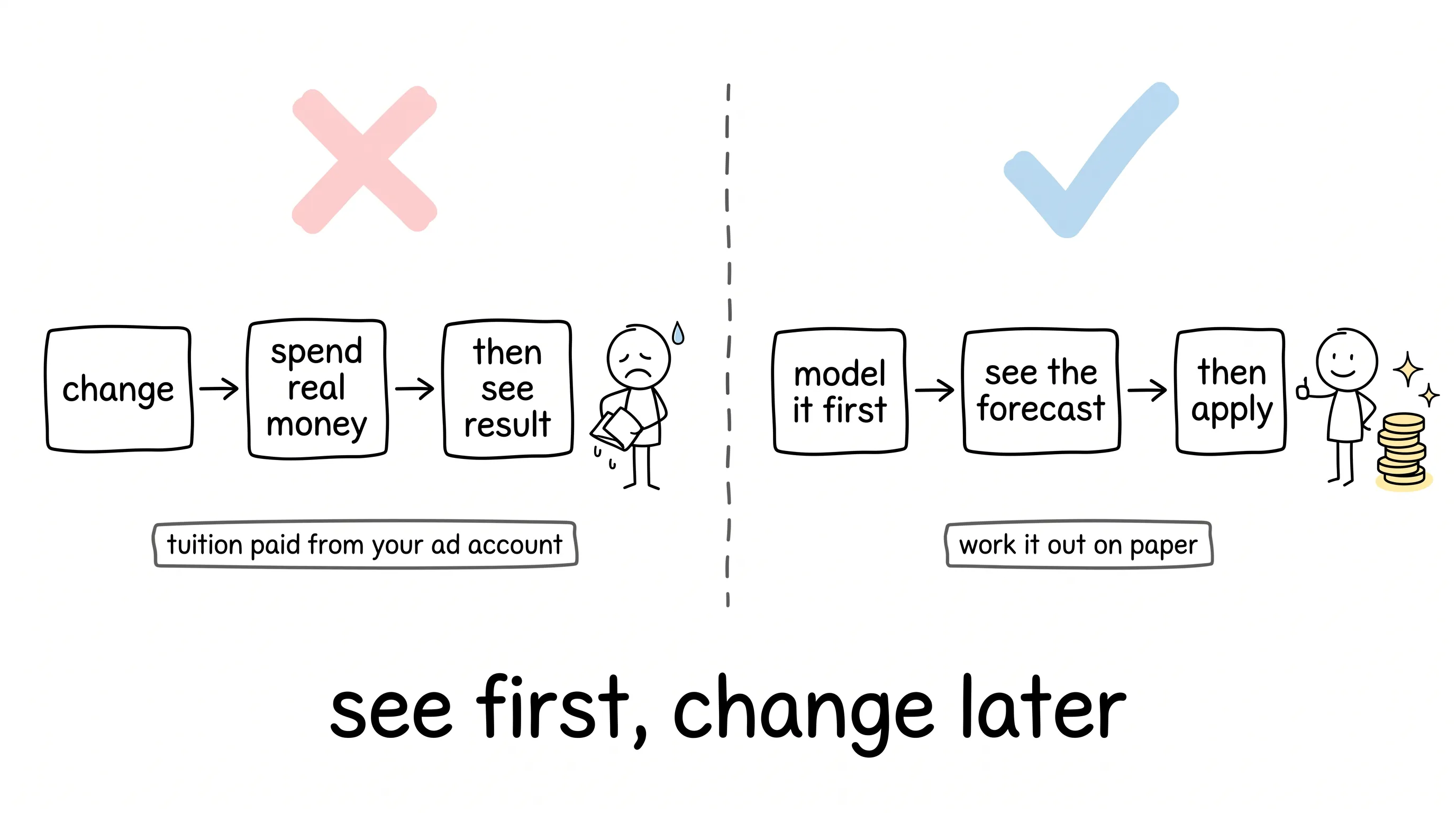
Now it has a new trick: before you adjust bids or budgets, you can have it model how those changes might affect your existing campaigns. If you like what you see, apply them in one click.
From "change first, see later" to "see first, change later."
Don't underestimate that order of operations. In paid media, the cost of trial and error never shows up in the tool — it shows up in your account. If you can work it out on paper, don't pay tuition with your budget.
Back to that dinner
Here's what I told him, word for word, as the dinner wrapped up: when these features roll out in September, don't rush to scale — go run the numbers in an experiment first. Oh, and Google is putting on an online event this year called Rethink 2026, about how to use Google AI to scale. Worth saving yourself a seat.
He nodded and said he'd get right on it once he was back.
The tools keep getting better — that's a fact. But what no tool can replace is your judgment about your own business. All they do is make it cheaper to test that judgment.
May every scale-up you make be the calm kind — the kind that comes after you've done the math.
Continue reading
Related articles

Cross-Border Business: Time to Upgrade Your AI Toolbox
A learn article explaining how AI tools help cross-border e-commerce sellers clear five hurdles: language, regulation, logistics, payments, and fraud. It outlines a five-compartment toolbox, a five-step adoption path, and metrics such as conversion rate and CLV, while cautioning against over-reliance on AI.

AI Is Taking Over the Dirty Work of Social Media Marketing, One Task at a Time
This learn article outlines four social media marketing tasks AI can handle — audience analytics, content drafting and design, ad targeting and creative testing, and spam moderation — and cautions that taste, judgment, and data security remain human responsibilities.

AI Is Already This Good — Why Is Your Social Media Marketing Still Pure Manpower?
An overview of 18 AI tools for social media marketing, organized into six categories covering audience research, content creation, scheduling, comment and DM handling, ad management, and visual production, plus notes on personalization, prediction, and emerging trends.